Tuesday, April 23, 2013

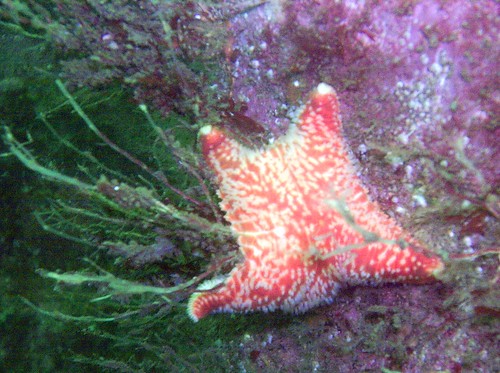
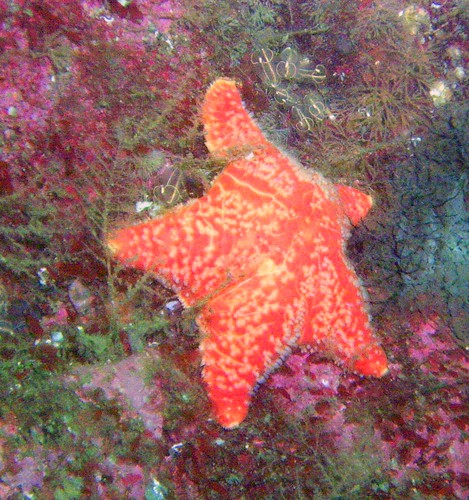
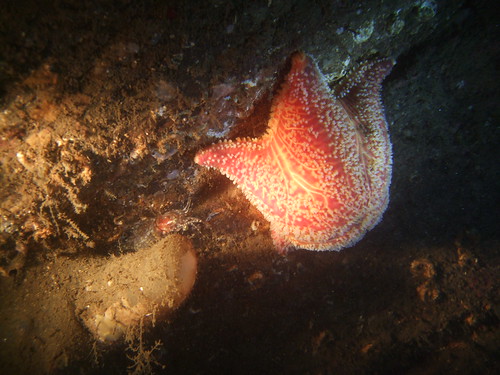
How many starfish species are there?? Where do they Live? How long have they been around? Five Points about Sea Star Diversity!

Images here from the Encyclopedia of Life
This week, something about the many different KINDS of asteroids (aka sea star or starfish!) that are found throughout the world. Data for this, is from a paper I wrote with Dan Blake last year for PLOS One. You can download it for free here based on info at the World Asteroidea Database.

I can't tell you how many times I've read something about starfish in pop culture or even in pop sci-and the writer assumes that starfish are the SAME all over the world! As if there was only one type.

This gets to be annoying..so let me just make sure everyone knows: There's a LOT OF DIFFERENT KINDS OF STARFISH. And they live in different places all around the world.

Similarly, I've talked about my field work in Antarctica and in the middle of my story, someone stops me to ask "Wait, there are starfish IN ANTARCTICA??"

So here are five things about the diversity of sea stars that will razzle your dazzle and make you a favorite at echinoderm-themed invertebrate zoology parties (esp. those where people are ignorant of starfish)!

1. How Many Starfish Species Are there?
At the moment? There's about 1900 species of accepted (living) starfish in the database. That runs a bit lower than the larger numbers quoted elsewhere (such as here),  but I assure you, that I am doing everything I can to kick that 1900 up a notch every chance I get!

Here's a post where I keep track of many of my new species!

More importantly, that's 1900 species in 36 FAMILIES. That means there's 36 different distinct groupings found all throughout the world in different habitats at different depths in different settings. So, its not just 1900 different kinds spread out all over the place- its 1900 species divided up into 36 distinct body types adapted to living in many different ecological niches!! (note that 1900 is a rounded figure due to questionable status for some names)

For those who need to know: the full list is in the PLOS paper listed above. So feel free to click and go!

Of the many weird kinds, there's Tremaster, as I discussed here awhile back.. 
There's the deep-sea brisingids! Crazy lookin' things that live in the deeps! Here

This Antarctic monster! Labidiaster annulatus!            The Slime Stars! Yay Mucus!

Predatory Sun Stars!     And just for good measure- here's a neat assortment from Hawaii! 

2. Where Do Starfish Live? 
All echinoderms, including sea stars, live in the ocean-on the sea bottoms (although their larvae swim in the water column). They are among the few groups of animals which live exclusively in marine habitats.

Starfish live in all the oceans! Atlantic! Pacific! Indian! Arctic! Southern!

And in answer to the question "Do starfish live in Antarctica?" and "Under the Ice?"  Yes!

The video below is from the famous "brinicle" video released awhile back showing starfish (Odontaster validus, probably) getting around some hardcore Antarctic ice! (narrated by 30 Rock celebrity Alex Baldwin!)

And many starfish also live in the deep-sea (below 200m).

Of the 36 living families of sea stars, nineteen of them occur exclusively in the deep-sea (436 species)! Four families are mostly deep sea but with some shallow-water members (1191 species) and several families include large numbers of deep-sea members. Only 8 families live ONLY in tropical habitats (218 species).
 It turns out that MOST starfish live in cold-water (or temperate) settings, such as the deep-sea or in the polar or near polar regions!

So among those deep-sea starfish species, which ones live most deeply?  As it turns out several starfish groups occur in the deep abyss below 5000 meters!

One of the most commonly encountered deep-sea asteroid groups at that depth is the Porcellanasteridae.
Image from the EOL page
They usually live buried in mud, devouring massive amounts of sediment, presumably absorbing digesting various goodies present in it.  This feeding mode is similar to the more shallow-water mud stars, which I profiled here.

Another group known to occur down to 6000 meters? Brisingids (go here to learn more) in the family Freyellidae...

Easily half a dozen families of asteroids are represented at the 5000+ meter depth range! Its unclear how many go deeper than 6000 however...

3. Which Group of Sea Stars is Most Diverse? (i.e., Which one has the most species?)
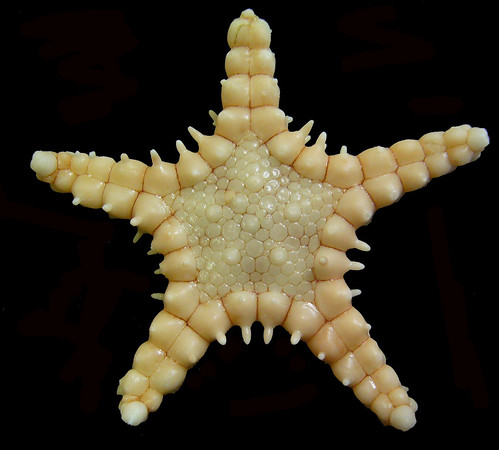
What's weird about this question is that the group with the MOST number of species is probably the group you are least familiar with...  Enter:  The Goniasteridae! 

Ding!Ding! This group rings in at a whopping 256 species in 65 genera! Deep sea! Tropical! Antarctic! Shallow! Goniasterids are everywhere (but mostly in cold-water places, in the deep sea)! 

But usually, in out of the way places, so they don't really turn up in places where people encounter them. So not many folks think of them you ask  "what does a starfish look like?"

Goniasterids vary in size and shape as you can see.. but some get REALLY large! Such as this monstrous Mariaster giganteus from Japan !!   (held by my colleague Yoichi Kogure!)

Goniasterids are diverse-and there remain MANY different species yet to be discovered....They are ecologically important in deep-sea AND shallow waters.

I'll probably do a full post on this group at some point-but in the mean time here's a bunch so far!
Tosia-the biscuit star: hidden species and brooding behavior! here!

New genera and species of deep-sea corallivores! here!  and some video!


4. How Many Undescribed Starfish Remain to be found? 
P1010709.JPG
Image by Island_girl
Its hard to make estimates about stuff that doesn't exist yet!  How many more species are out there to be discovered?  What is my best estimate???

Sea stars/starfish are big, obvious creatures. One would think that we have found most of them...but you'd be wrong!

One subject group: The Goniasteride has 256 species in 65 genera. Out of the total # of genera and species:  14% (approx n=9) of genera  and 12% (approx n=31) of species were discovered ONLY recently (since 2001).

I have further unpublished data on many MORE new goniasterids! Which suggests that the total number of newly discovered genera could go up to 37% and the number of new species could go up to 32%!!

These are rough estimates from one group. Most people might expect that new species would be found in inaccessible and poorly studied places such as the deep-sea or perhaps in distant tropical lands such as New Caledonia.  But another possible source may already be right in front of us....

Cryptic species are those which are distinguished by genetics or reproductive differences, some other source of evidence OTHER than external morphological characteristics to demonstrate they are separate species. Molecular genetics shows great potential as a tool to discover diversity where cryptic species are concerned...

Again, the case of Tosia-the biscuit star: hidden species and brooding behavior! here! is a great example.


5.  How Long Have We Observed Starfish in the Fossil Record? 
Hudsonaster USNM 40882, early asteroid from the Ordovician.  Copyright Dan Blake. Image via www.tol.org/Asteroideahttp://tolweb.org/Asteroidea
Starfish are old. And their history will doubtlessly fill another post on the Echinoblog some day. A general account of the fossil history of the Asteroidea can be found here.  But the short version is this..

Some very early ancient forms (i.e., predecessors to modern day "proper" asteroids) are observed in the Paleozoic (540 to 250 million years ago!).

But we really don't start to see modern asteroids until the Mesozoic, that is early Triassic....where the record is poorly preserved...
Left to right: Trichasteropsis weissmanni (specs. MHI 843/1, SMNS 3173/5 and Noriaster barberoi (MPUM 8420) on far right. Images copyright Dan Blake, Images via www.tol.org/Asteroidea
But basically, from then on, ALL modern asteroids continue on to the Recent. In other words, starfish which are alive today are part of the same lineage which has been around since the Triassic (250 to 200 million years ago). A distinct, separate lineage from those in the very, much older Paleozoic. 

But just to give everyone a "landmark" to gauge what I'm talking about:  YES. Starfish are OLDER than dinosaurs. 

Some starfish deposits from the Cretaceous are very well preserved and so, when T. rex was running around, starfish were there, doing their thing.  Thanks to some excellent fossil preservation, we know that some of them looked like this...

Metopaster parkinsoni
Fr. Discovering Fossils UK
Also M. parkinsoni, I believe...
Calliderma schulzei
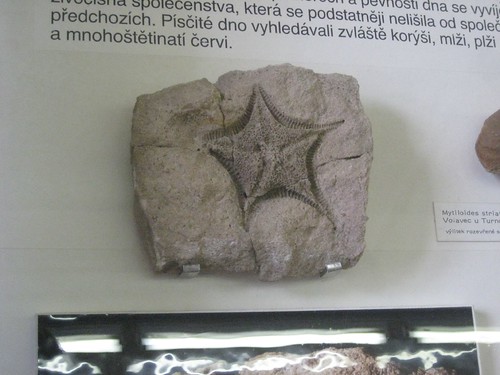
Calliderma Schulzei
Image by Claire H
But, fossil goniasterids were highly diverse and the number of fossil species is very high. The actual number of fossil "species" is difficult to compare with living species owing to differences in what geologists called "species" versus what biologists observed in living animals. Uh.. trust me, its complex and I'll get into it another day.

But yes. Starfish have been around for quite a long time. Longer than humans (and primates). Longer than dinosaurs. 

To sum up this week?
  1. There are about 1900 species of starfish and that number is climbing.
  2. They live everywhere in the ocean! Especially in cold-water habitats like the deep-sea!
  3. The family Goniasteridae is the MOST diverse (i.e. most number of species)
  4. MANY more species of asteroids remain to be discovered!
  5. The fossil record shows that starfish have been around for a LONG time, since before big reptiles roamed the Earth!

Friday, April 19, 2013

More mysteries with Porania pulvillus! Yay for Crowd Sourcing!

Thanks to this weeks' blog, a new mystery photograph from Diver/photographer George B, who sent me an image of this strange swelling on Porania pulvillus. Image was taken from the west coast of Scotland at 20 m depth.

Is it feeding and have a distended disk (as other starfish do here)? Does it have a parasite? Some kind of tumor?  Not sure it has ever been reported before!!!

This is a neat highlight, that even though you have a species which has been recognized since 1776 and lives in the North Atlantic where many divers and scientists are active, many of these species remain poorly known.

It also highlights the value of crowd sourcing. Images on Flickr and YouTube add so many more eyes and observations...

Thanks again!

Tuesday, April 16, 2013

Natural History Meets Data Mining! A case study in Porania pulvillus

porania pulvillus-01
Image by Geir Friestad via Flickr. Norway I think.
I've always been a big fan of how the vast body of available images and crowd-sourced information can be beneficial to scientists but also interesting and engaging to the citizen scientist!  From tracking down videos and images of rarely seen benthic ctenophores (here) to helping to locate invasive brittle stars! (here)

As I've said in the past-images and videos collected by everyone..from amateur divers on Flickr to pics aggregated on websites such as the Encyclopedia of Life contain MASSIVE amounts of potential observations (and thus data)!! 

But of course, the images have to be recognized first.  How often do discoveries like this happen?  Sometimes new species are found on Flickr (such as this new lacewing species)

I've blogged about how crowd sourcing and citizen science has discovered new and unpublished (or at least very poorly known) commensal behavior in sea stars, fishes and their commensals (here!) and today another discovery!  

But not in the exotic Indo-Pacific but in the cold to temperate water familiar North Atlantic!! 

Our subject is a starfish called Porania pulvillus (aka the "red cushion star"-one of many), one of many summary accounts of this species can be found here.  It is an uncommon but recognized species in the North Atlantic from both the North American and European sides...  Porania is a member of the Poraniidae which is an unusual group occuring mostly in deep-sea and cold-water habitats, occurring from roughly 10 to 300 (often deeper in some places) meter depths . Surprisingly little is known about them...

The story starts with a picture...
Yesterday, I received an inquiry from my colleague at EOL- Dr. Jen Hammock who forwarded me a link to the picture below from the SERPENT Media Archive!  SERPENT is a coalition of industry and academic organizations that work to share images of the deep-sea with the public..(here) to see more.

 She asked me "What's going on here?" "Is this feeding on sea pens a thing?"
from this EOL page via SERPENT Media Archive
Indeed it was a "thing!"

But let's take a quick step back and get started with all the players! 

What we know...
First: the species..... Porania pulvillus! A nicer pic is here: 

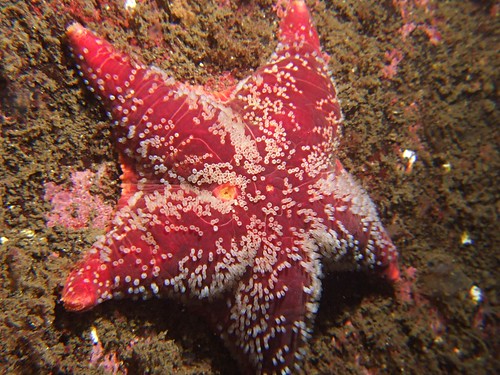
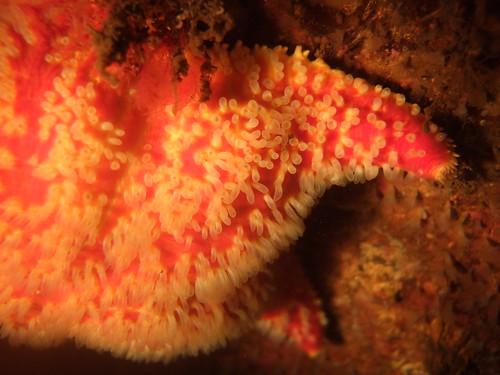
Note that the white "dots" above and the finger-like yellow bits below are the papulae- aka the gills! This is how the animal "breathes".. Image by Mark Craig
Close-up of a Cushion Starfish
In 1915, zoologist James F. Gemmill described what he observed to be filter feeding using the numerous tiny cillia covering the body of this species.

Dr. Gemmill was quite an authority..being an  M.A., M.D. D.Sc, F. Z.S."!!! And is pretty well known historically for a number of significant contributions.  He dropped little red carmine particles (basically a  red dye made up of a fine powder) on P. pulvillus and watched them move over the surface..

A quick reminder about basic biology of this (and all starfish). The epidermis COVERS the body! The epidermis is in turn covered by tiny hair-like structures called cilia, which are usually in constant motion.

These little particles were moved over the body and apparently headed towards the mouth. Here's his diagram showing the little arrows apparently indicating how water was flowing to the mouth.
Fig. 2 from Gemmill 1915
And this description as a "filter feeder" has stuck. Even a relatively recent paper (here) from 2005 describes them as "suspension feeders." But are they truly???  Is that all there is to the story?  Could they be predators? Opportunists? 

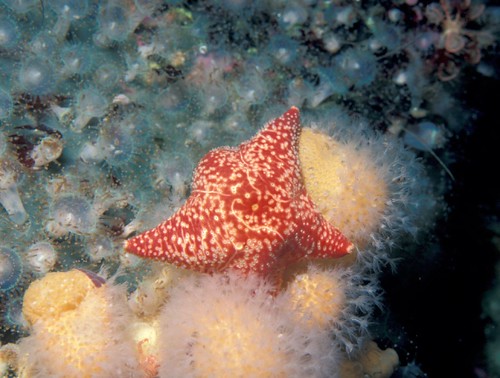
A paper in 1973 (here), one of the first SCUBA accounts documented that they fed on "soft corals" such as this Alcyonium digitatum-the so-called "Dead Man's Fingers"
Porania on Alcyonium digitatum
Image by Christine Howson via Flickr
The paper reports that this species feeds on brachiopods and even tunicates!  Here's a nice one showing feeding on tunicates...
Oban-201205-InishIs-Starfish-CushionStar2-FeedingOnAlcyoniumDigitatum-PoraniaPulvillus
Image by Tony J. Gilbert

Perhaps P. pulvillus is sort of an opportunistic predator in addition to the "suspension feeding" with mucous threads?

Is this Porania pulvillus getting ready for a big banquet? Or is this the echinoderm version of those "1 dog, 1 pig, and a cat" pet adventure stories?
5.Kuddstjostjarna
Image by www.ilreporter.com
But getting back to the picture...
It turns out that what we are seeing here is probably something unreported! NEW!!  A previously undocumented feeding interaction!!
From this EOL page via SERPENT
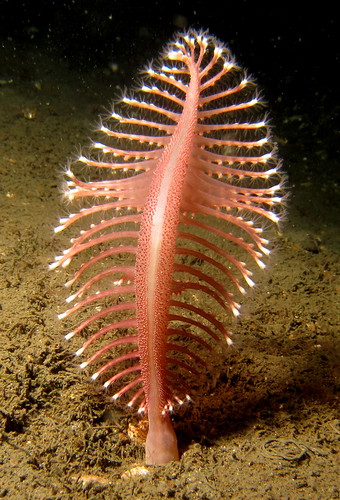
So, that Porania pulvillus was FEEDING (that's what it appears to be doing) on this sea pen (called Pennatula phosphorea). Image was from 124 meter depth in the North Sea, west of Shetland.


Here's a nicer pic of the sea pen...
pennatula phosphorea
Image by Jarle Strømodden via Flickr

Again-this was a NEW discovery! What does it mean for this animal's ecology? Does it mainly feed on yummy cnidarians?  Is the species more opportunistic than thought?  More predatory than previously thought??

And of course.. there's the impact on the bottom fauna.... I've written about goniasterids that feed on deep-sea coral (here) and here's a video about them from MBARI a few years back...

These types of interactions are important owing to our interest in deep-sea corals and their role in biodiversity and conservation of deep-sea ecosystems..

But after looking at the pic above from the SERPENT pool on EOL, I discovered several more...

Some further interesting feeding observations of Porania pulvillus, such as this one of it hunched over this rock and possibly feeding on the polychaete worm Pomatocerus sp. (which makes up the tubes). And of course, there could be hydroids or other encrusting goodies on there as well...
EOL page link here SERPENT Media
Here were a couple that showed P. pulvillus CLEARLY hunched on and probably feeding on something-but it was unclear exactly what it was.  Dead sea pen maybe??
From this EOL page working w/ SERPENT Media
From the EOL page here SERPENT Media
And here we have P. pulvillus feeding on another mysterious gooey blob...
From EOL page by SERPENT media
The one below was labelled as "Porania pulvillus" but at least most of these look like the goniasterid Ceramaster granularis, another species with a large disk and triangular arms...These look like they're hunched over the sponges.  Looks very much like feeding...

But either way with whichever species, here's ANOTHER great example of a behavior that hasn't been published on as yet.. 
From the EOL page SERPENT Media archive

Bear in mind-if these things had been thought of as primarily suspension feeders for years and years-and it turns out they're big time predators???  That would represent a big shift in understanding the ecosystem/food web in this area. Sometimes it can all be in the details..

So.. really ALL kinds of neat legitimately important observations from this pretty vast pool of data fr. SERPENT/EOL!

And there's MORE??

With my appetite teased I spread out a little more and went looking on Flickr!

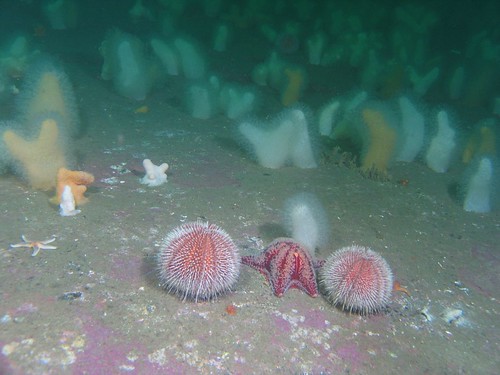
Feeding on some green stuff! Algae? Hydroids? Image by Gordon.Milligan
Red cushion star
Or maybe gettin' ready to go after those tunicates in the upper right hand corner?
Red cushion star

Feeding?  Or getting ready to spawn? 
Red cushion starfish and shrimp
Image by Mark Craig via Flickr
So, I've spoken about how poorly known the "spawning on tippy toes" posture is... Here was the link to that post

What does this say? 
What I see when I look at these pictures is inspiration.  ANY of these observations- the feeding or the spawning posture might be the beginning of someone's research project...or be relevant to one. 

It seems strange to think -but this blog has more on the "natural history" of this species than has been published since that last account in 1973!  Many of these pictures have been floating around the internet for YEARS. Funny to think of "natural history" and "data mining" as terms that go together here, but here they are indeed a strange marriage....

Thanks to Jen Hammock, EOL, the SERPENT Media Project and all the photographers cited!

Tuesday, April 9, 2013

Starfish or Sea Star? Asteroid? 5th Anniversary Post!!

thanks to Paul G. for the photo!
Greetings! Today for the FIFTH ANNIVERSARY (began April 9th, 2008) of the Echinoblog a special topic!  One so controversial and so earth shattering that it will pit Friend vs. friend! Sibling vs. sibling! Spouse vs. spouse! Mentor vs. student! 

A topic that has found bitter and vicious debate at museums, aquariums, marine biology and even paleontology programs around the world!


Undoubtedly upon this post reaching public circulation, many of my colleagues will probably stop returning my email and spit upon me as I walk by them (although some of them do that anyway!)


I speak of course, of the dreaded "Starfish or Sea star (seastar)??" controversy!

Which common name should we use for these frequently encountered and familiar marine animals??? 

But where to start?  Let's define some terms, so this discussion doesn't get completely out of hand.

Let us make no mistake-when we talk of this debate that we speak of members of the ASTEROIDEA. 

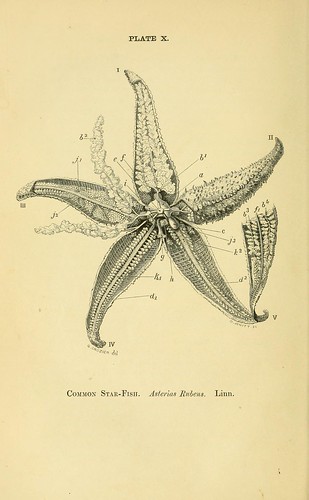
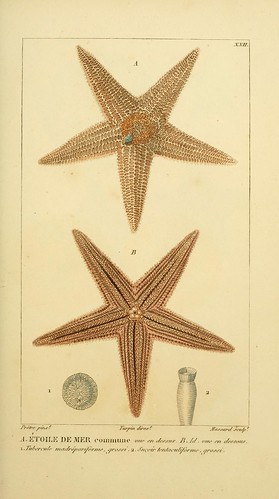
  1. Starfish/Sea Star is a term that VERY SPECIFICALLY refers to the ASTEROIDEA-one of five living classes within the phylum Echinodermata (the others include sea urchins, sea cucumbers, crinoids, and ophiuroids). 
  2. It is incorrect to refer to OPHIUROIDS as "sea stars" or "starfish", per se.  Ophiuroids are an altogether DIFFERENT class of animals from asteroids. Go HERE to see some characters that tell them apart.  Common names of ophiuroids include: brittle stars, serpent stars, basket stars. I find it acceptable that certain echinoderms are referred to as "XXXX  stars" under certain circumstances. A separate class of echinoderm-the Crinoidea (lacking a stalk), for example are often called "Feather stars." I'm cool with that. The specific terms "sea stars" and "starfish" should only be applied to ASTEROIDS.
  3. Note that this is one of the few groups in which the common name DOES correspond to a 'real' classification. Terms such as "crab", "coral", or "jellyfish" actually do NOT refer to a single natural classification of animal-but rather several similar looking kinds of often distantly related animals. This video about "jellyfish" explains the issue nicely:
There is also one more caveat-that we restrict this discussion treats only MODERN animals. In the Paleozoic there are fossil animals that blur the line between asteroids and ophiuroids. This gets trickier and is a discussion left for another day... 

Here we go.. Asteroid vs. Starfish vs. Sea Star!!!
There are THREE, Latin-based, English terms- as outlined below: "asteroid" (from the scientific name Asteroidea), "starfish", and "sea star." This discussion comes up over and over..and seldom seems to find resolution...  Here then are a list and discussion of these terms and the back-and-forth over the terms..

Note that the terms "starfish" and "sea star" do not reflect different morphologies within the Asteroidea the way that say, common names for ophiuroids do (e.g., Basket stars = the name for Gorgonocephalidae). So there really has been quite a commotion over these two terms as they find standardized use...

These reflect various arguments I have heard/collected over the years. While I have my conclusions at the bottom...please feel free to take these different perspectives to your classrooms, aquarium education courses, and grad school discussion groups to discuss at your pleasure!  Yell at me in the comments if you wish! 
1. The term "asteroid" (from class Asteroidea)
We Should Use the Term Asteroid Because:
The latin name from the group, ASTEROIDEA was officially put to paper by the noted French zoologist Henri Marie Ducrotay de Blainville in 1830 from the Greek aster and eidos referring to "star (as in the sky)" and "form or likeness."  Nouns are derived from the scientific name.. so "asteroids" is technically the proper term for animals that we would refer to as "sea stars" or "starfish".

The Main Argument against: No, we can't use the term "asteroid" because it might be confused with a giant space rock hurtling through space! OH NOES!
From Nat Geo article about asteroid collision
2. The term "Starfyshe"(starfish)?
n415_w1150
Arguments FOR using the term starfish!
1. The word starfish is widely used and "I" like it. So why change what ain't broke?
          Google recovers 13, 200,000 hits relating to "starfish"including use in religion, politics, obscene rock lyrics, hitting the bed and splaying out on the surface, charity organizations, nuclear bombs, and yes, sometimes it even refers to animals!

2. So what if the word is a misnomer?  
Plenty of words in the English language are inaccurate. Greenland is icy and Iceland is green! Sea horses aren't horses! Why can't we just put up with one more? That's life! C'est la vie! 

3. Starfish is the oldest known western term.  (thanks to John Lawrence, at USF for the info)  According to the Oxford English Dictionary (OED) this dates back to 1538 referring to "Stella, a   sterre, also a sterrefyshe."(from Elvot, dic.) This usage corresponds to the first definitiion given for "fish" in the OED: "In popular language, any animal living exclusively in the water"

These days of course, our terminology has been much revised based on tons of evidence showing classifications among animals and we acknowledge that "fishe" had a much different meaning 475 years ago, but the term has stuck with us and its not likely to be going away anytime soon. 

I'll bet that scientists and students are probably not as big a majority user of the term "starfish" as they believe themselves to be. The term is widely used throughout the many aforementioned outside disciplines and probably won't find much change even if scientists begin to radically suppress the term...


Arguments against the term starfish!
Starfish are NOT fish!  The term is inaccurate since any MODERN definition of "fish" refers to proper vertebrates and NOT invertebrates! Inaccurate terms are SO confusing! People and students who have not had basic biology will not know that asteroids are NOT fish! Oh Noes!

3. The term "Sea Star (or Seastar)"? (yes there's even a controversy over whether "sea star" is one or two words!)
n52_w1150

Arguments for using the term sea star (or seastar)!
1. The term is more accurate. Asteroids aren't true fish so why call them that ?? (other than historical tradition, which is dumb!).

2. ALL the other western countries use "sea star" why don't we? We should do that too! Its consistent!  Get with the program! Don't you want to be doing what all the cool countries are doing?  (e.g., German=seesterne, Spanish=estrella de mar, French=étoile de mer and I believe even the Chinese word means "ocean star")

Arguments against the term Sea Star
1.  The term Sea Star gets less use than Starfish. "Seastar" (one word gets 2,660,000 hits) but note that "sea star" (two words gets 475,000,000 hits-but many of these may be random combinations of "sea" and "star"). Its dumb that we use such a wishy washy word that other countries use!

2.  Sea Stars are not stars.  Asteroids may not be "fish" but nor are they big burning balls of space gas! I once used the "sea stars are not stars" thing jokingly-but it turns out, the reference to stellar bodies has a real basis!

The FIRST definition for "sea star" in the OE dictionary (and indeed Websters as well) (date uncertain) is of a "star which guides mariners at sea", the Star of the Sea, with only the SECOND definition referring to proper asteroids.
Blue Star.
Blue Star. by negombo83 on Flickr
Earliest usage in reference to the animal I have record of:
1569... A kind of fishe called Stella or Sea starre, bycause it hath the figure of a painted starre (fr. Fenton-Secret Wond. Nature)
Curiously a subsequent definition reads
1594..The fishes called Sea-starres, that burne one another by excessive heat. (fr.Nashe, Unfort. Trav.) 
3.  Asteroids are not always star-shaped!  Sometimes they are pentagonal...almost to the point of being round..
 Other times flat and almost paper-like..
And still others can be almost ball-shaped

Dispelling a Myth about "sea star" as political correctness
In the 90s (or thereabouts) there was a huge revolution in educational programs across museums and aquariums throughout the US, and inevitably beyond. Many of the various common names ended up getting names that people felt were more accurate. So jellyfish were called sea jellies. Hagfish were called sea hags and so on.

At about the same time was the big "political correctness" revolution from the late 80s, early 90s which was intended at diffusing offense and infusing more respectful terminology among public and political dialog-with extensive changes to almost all terminology.
Here is a full workup of that scene at Wikipedia.

Naturally, it was widely assumed that common names in science had befallen the same fate. But as indicated above.. the term "sea star" has been around since the 1700s.  And across different languages. And since, ultimately, asteroids DON'T really care WHAT you call them, it does seem unecessary to apply political correctness to echinoderms.

Are European terms the only one we should consider?

At a certain point in this discussion it becomes readily apparent that the "common name" argument for asteroids emphasizes the western/English terms. Do terms for starfish in other languages offer more attractive options?  Let's look at a few!

*hitode (ヒトデ). This word means "palm" in Japanese. Here is a post I wrote about Japanese starfish names!  Records of the term hitode date back to 1712!
*tapak sulaiman.In Malay, this word literally translates to "Solomon's Footprint"! Snazzy, eh?
*불가사리  In Korean, the word for starfish refers to "Immortality"!!!

(my thanks to Yoichi Kogure, Marcus, Tai-Lin and Taekjun for their helpful insights!)
These are all awesome. and hmm.. Solomon's Footprint is a pretty cool name for an asteroid!

Ultimately, though these terms seem to work out best in their homelands where the cultural context makes the terms more useful (and perhaps less confusing in English). Although I dunno... I'm still kinda  fond of Solomon's footprint..


What was the oldest name again? 
1538: sterrefyshe
1569: sea starre
1712: hitode
Yup. Its "starfish" and not technically "sea star"..so if you're a big taxonomic synonymy fan but not a big fan of "starfish"..uh.. sorry... 

Within the international rules that dictate proper scientific names for animal species, it is generally accepted that the OLDEST term has seniority over the others. But these rules generally only apply to the proper Latin species names and not the "common" or popular names. So, they don't necessarily apply. But as far as established 'legal' criteria goes this is one of the few which exists, so it should be considered.  "Starfish" is the senior name..

Finish it up! I ain't got all day!
These are things that are not negotiable

1. Asteroids are starfish/sea stars. NOT ophiuroids (aka brittle stars). I often see a wide variety of individuals in the popular arena apply the terms mistakenly. That is improper use and thus, is disapproved of. Hrrumph!! Double Hrrmumph! PLEASE STOP IT! 


2.  The term "asteroid" is technically correct. As indicated above, this is a NOUN based on the actual scientific name of the animal?  HERE YOU GO. But of course, we could still confuse a big space rock with a giant interstellar starfish. 

I prefer to use "asteroid" as a scientist of course, but barring that?  

WHY NOT USE ALL THE TERMS?  
Many languages have different words for the same thing. I accept that there are different words with the same meaning.  I trust context to decide usage.  I tend to use "sea star" around students and/or an audience that might not be familiar with asteroidsI use "starfish" around people who know better.. and I use "asteroid" among my colleagues..but obviously there is interchange.

But yes, please know that a "starfish" is NOT a fish before you begin using it. :-)


Over the years, the whole argument has started to sound kind of silly...


person 1: We can't use "asteroid" because we could confuse it with a space rock! Oh NOES!
person 2: Okay. Let's use starfish instead.
person 1: We CAN'T use starfish because people would confuse it with a FISH! 
We MUST use sea star.
person 2: Sea star! Pfah! weak. Why be conformist? Plus they are not burning balls of hydrogen! Bark! Bark! We shall use starfish!!! Its traditional! And sounds better! 
person 1:  NO! SEA STAR! IT LESS CONFUSING!
person 2: STARFISH! 
person 1: SEA STAR! 
person 2: STARFISH! 
person 3: SEASTAR!  BUT WITH NO SPACE BETWEEN THE WORDS! 
BARK! BARK! 
Me: Asteroid?
everyone: Oh NOES! TOO CONFUSING WITH Space Rock!
*sigh*

HAPPY 5th ANNIVERSARY from the Echinoblog! 

Tuesday, April 2, 2013

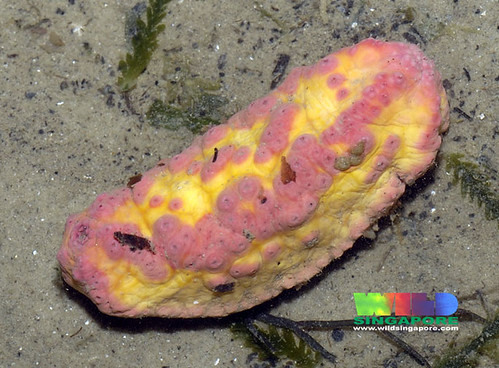
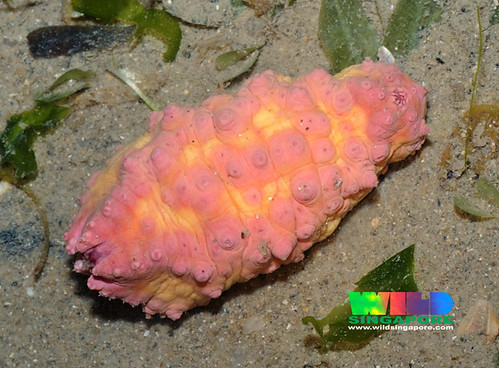
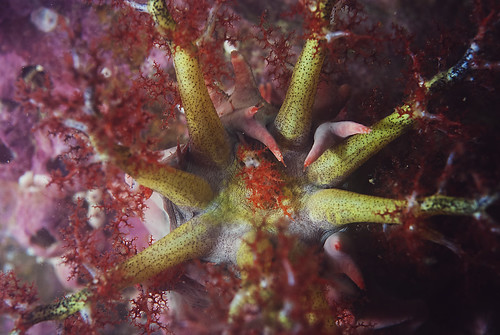
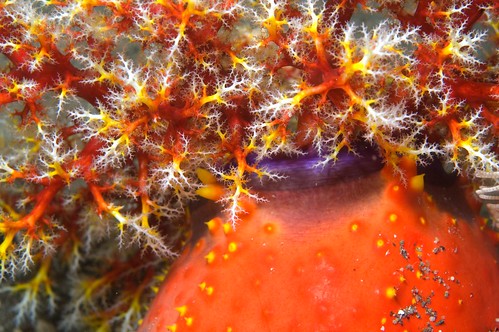
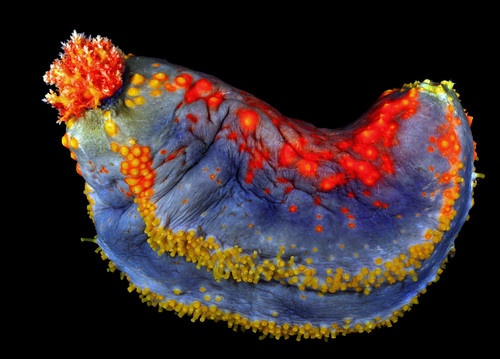
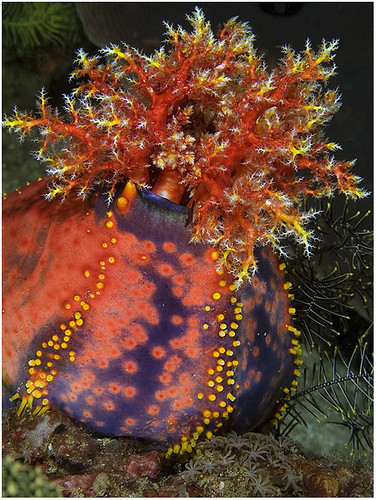
Happy Spring! Here's some bright pink and orange sea cucumbers (sea apples)! WOO!

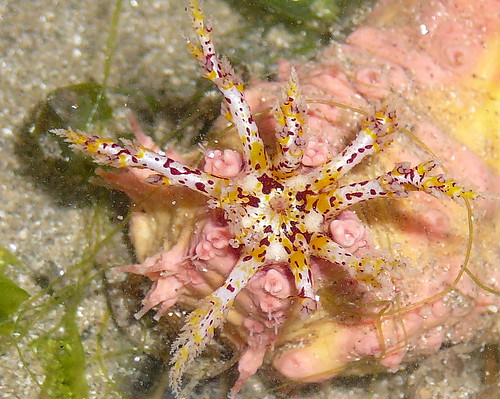
Tentacles of the warty pink sea cucumber (Colochirus quadrangularis)
Fantastic image by Arthur Anker-Colochirus quadrangularis 
Today, we welcome spring with these awesome brightly colored sea cucumbers from the tropical Indo-Pacific!

My thanks again to Arthur Anker, WildSingapore and other photographers who have put their images up to enjoy!

Warty pink sea cucumber (Colochirus quadrangularis)
Fantastic image by Arthur Anker-Colochirus quadrangularis

Pink-orange sea cucumber (Cercodemas anceps)
Cercodemas anceps by Arthur Anker
Another Cercodemas from Wildsingapore!
Pink warty sea cucumber (Cercodemas anceps)


Pink warty sea cucumber (Cercodemas anceps)

A nice one of Cercodemas with the feeding arms extended
Pink warty sea cucumber (Cercodemas anceps)

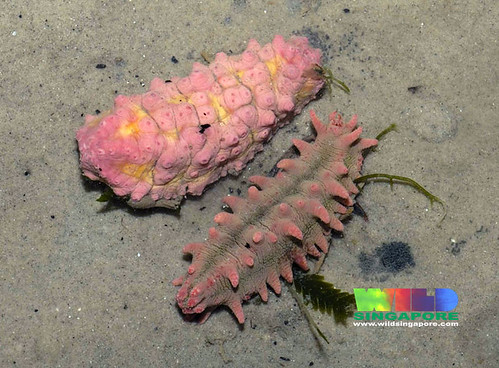
And here's BOTH Cercodemaas AND Colochirus! 
20061108 d6668

Sea apple - the most colourful sea cucumber in the world


Pseudocolochirus olivaceus. Images below by Arthur Anker, Singapore Marine Biodiversity Survey.

Another nice Pseudocolochirus shot by Jeff Mullins (underwater komodo)
Sea Apple - Cannibal Rock - Komodo

The feeding end of Pseudocolochirus. Image by Arne Kuilman
Power feeder (Pseudocolochirus violaceus)

A nice close up of the tentacles in a sea apple. Image by Pat M. Williams
Sea Apple


and finally, here's  a video of one in its habitat (this one from Hong Kong)