Echinodermata! Starfish! Sea Urchins! Sea Cucumbers! Stone Lillies! Feather Stars! Blastozoans! Sea Daisies!
Marine invertebrates found throughout the world's oceans with a rich and ancient fossil legacy. Their biology and evolution includes a wide range of crazy and wonderful things. Let me share those things with YOU!
UPDATE! (sorry-late from June 2011) More Giant Pink Star, Pisaster brevispinus pics from BRITISH COLUMBIA! thanks again to Neil McDaniel! Photos by Geoff Grognet
Here with Doug S. for scale....
(From April 2011)
About a week ago Mr. Jim V. of Elma, Washington sent me this pic of a MASSIVE specimen of Pisaster brevispinus-the Giant Pink Sea Star which he collected in a crab net with his sons Josiah and Dylan. (dated April 11, 2011)
(images courtesy of Mr. Volz and from King5.com)
According to Mr. V. : "We estimated 40 " from tip to tip. Approx 15 pounds".
So definitely sizeable but until we get exact measurements-its not clear to me if this was larger than the one from BC below, still pretty cool. Based on its feeding biology, it must have some VERY crazy long tube feet!!
From Neil McDaniel! This gigantic specimen of Pisaster brevispinus measured a freakkin 3.2 feet across in diameter!! (99 cm) From Inner Vancouver Harbor in British Columbia.
It is conceivably one of the largest individuals of this species recorded. Do you have a bigger specimen?? Take a pic and I'll feature it on the Echinoblog!! (but please don't harm the animal!)
The beast was returned to the wild after being photographed...
A slightly different kind of post today. One that is a little more in the category "citizen science" than my usual stuff.
So, about a week ago, I received an email report from Neil McDaniel, a marine photographer and cinematographer. (His website with stunning pix is here) regarding an unusual occurrence.
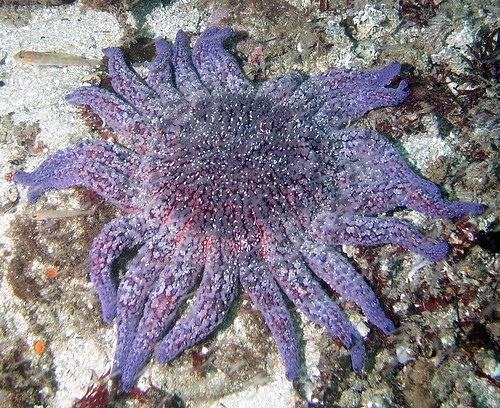
Pycnopodia helianthoides, the large sized and immediately recognizable "sunflower star" present on the west coast of North America, from Alaska to Southern California was being observed in MASSIVE numbers in British Columbia. In Mr. McDaniels' own words:
....Hordes, and I mean hordes of Pycnopodia can be found in the shallow subtidal in Howe Sound, a coastal fjord near Vancouver. During one dive where I covered all of 100 metres horizontally I found densities like this in a band perhaps 3 metres across starting at about 2 m below datum and extending downward to about 5 m below datum. It’s not an exaggeration to say there were several thousand just in this area. Not all of Howe Sound is like this but many areas are. So what’s happening here?
Normally, when one encounters Pycnopodia, its found by itself or rarely in the company of one or two other individuals and they're usually competing for food.. This video gives you a general idea of what Pycnopodia is typically like...
But pictures from Howe Sound in BC shows this:
(Image courtesy N. McDaniel)
(Image courtesy N. McDaniel)
(Image courtesy N. McDaniel)
(Image courtesy N. McDaniel)
and then, I put it together with a Vancouver Aquarium video on YouTube from August 2009. Note the ABUNDANCE of sunflower stars! Based on what I know of, that's unusual....
The Vancouver Aquarium account reads
Research diver Donna Gibbs was able to record on videotape a remarkable event that occurred at the time of an extreme low tide along the shoreline of West Vancouver, just east of Whytecliff Park. As Donna prepared to start a dive with Jeff Marliave at Kettle Point, the crew exchanged comments about the strong shoreline current, as well as the apparent red tide condition. The sea surface was also at a record 23 degrees Celsius. Donna and Jeff went down on a planned drift dive toward the west, counting rockfish at an artificial reef and along natural shoreline reef areas that have been monitored for this entire decade. The water clarity was excellent at depths below the red tide, and the dive plan proceeded normally until an area was reached where vast numbers of the giant sunflower sea star were covering the rock surfaces. At this point, a down-welling component of the shoreline current was evident and the sea stars were rapidly moving down the slope of the rock. The sea stars were traveling so quickly that they were running over each other, creating slow-motion landslides of sea stars tumbling down the slope.
So, what's going on???
I've asked around my network of scientist and diver colleagues in more southern regions..i.e., California and none of them has seen more than a couple of individuals of Pycnopodia together at one time.
I've even consulted with my colleagues who work in the deep-sea around California.. They see the deep-sea cousin of Pycnopodia, Rathbunaster...and although it can occur in high numbers, its generally different than what's being seen with Pycnopodia... Here's a couple of examples:
Are there possible explanations? Sure. For example....
1. Populations are high because juvenile survivorship is high. This is basically what happened with the crown of thorns (Acanthaster planci) in Australia.
Some environmental factor is different leading to a high survivorship of juveniles leading to a huge abundance of adults. In the case of Pycnopodia, this has not been documented. Could it be Food? Water temperature? Nutrients? Hard to say.
2. Could they be spawning? A lot of invertebrate species gather in large aggregations in order to facilitate spawning. The males produce their sperm and the females are handily nearby to facilitate fertilization between sexes.
That said, most observations of Pycnopodia have never documented more than a few specimens at a time at most... and none of the pictured/recorded individuals seem to be producing reproductive material...
(pic courtesy of Allison Gong, UCSC)
Speaking of which, one of my colleagues Dr. Allison Gong has helped produce an account of the subsequent development of Pycnopodia. You can see that here... So where does that leave us??
This huge, dense clustering of Pycnopodia is something that I, and many of my colleagues have never seen before. And when the combined experience of close to a dozen scientists haven't seen something on the west coast of North America??? Something weird is going on..
What could be causing it? What could be causing these mysterious swarms of giant, sunflower starfish? Are they just well-fed starfish? Climate change? Food? Social gathering? How does this affect the ecology of the area? How often do these high populations persist?
Could they be preparing an invasion? :-) (disclaimer: the great starfish invasion may not be real...)
(please note that this photo was performed by a professional-please don't try this at home!)
Unlike my other posts-this is NOT a report on a paper...I thought I would throw this out there as a general announcement to divers, scientists and interested folk!
Has anyone out there seen these massive, dense aggregations of sunflower stars? Do you have additional video? Pictures?
Contact me through my profile and let me know! (THANKS again to Neil McDonald for allowing use of his pictures!)
But people always seem a little surprised when they see something like a starfish in motion! Most times, starfish move slowly if at all and so if people see one being the lamborginhi of echinoderms, it generally provokes some curiosity...
Why should we care?? Doesn't this all seem like kind of an...odd thing to know? Indeed. But rate of movement is actually an important bit of information in understanding feeding biology, ecology, and food webs. How fast do the predators go compared to their prey? How far could an adult travel on its own and disperse its gametes in a discrete amount of time? So, yeah. Its worthwhile...
It should be noted that most of the rates outlined below are based on a clip motivated by predators. So, its not necessarily clear what their "average cruising speed" would be..
Some general trends..
Sea Star movement rates vary from 0.3 mm/s (milimeters per second) in the "sun star" Crossaster papposus to a breathtaking 50 mm/s!!!
Most of the observed species (which are intertidal-shallow species like Patiria miniata or Leptasterias) seem to run on the slow to moderate side, about 0.3 to 1.3/2.0 mm/s and are medium-sized but relatively few of the smallest or largest species were included.
Diversity isn't well sampled and we really only know the movement rates of VERY few species (17 out of 1900 species!).
Its thought that larger size does have some relationship to speed and some of the fastest species listed are also among the largest..
Here's a breakdown of speeds in starfish in milimeters per second!
Honorable Mentions:
I should just say that while these seem reasonable-it seems like there are faster species out there. These just seem to be well-known and as more information becomes available there's likely to be starfishes that put these guys to shame... Astropectenaranaceus and others.Speed: 2.5 (error+/-0.8) Astropecten is the "proper" sand star. They occur on unconsolidated sand/sediments where they sit and wait, buried until prey comes along. They occur in shallow-water, tropical to temperate water habitats all over the world.
There are many species..many of which are deceptively fast...Here is a nice video of A. aranaceus which is found primarily in European waters..
But here is Astropecten polyacanthus from the tropical Indo-Pacific. Look at that thing go!
Asterias forbesi and Asterias rubens (Asteriidae). Speed: 2.0 mm/s and 3.3 mm/s
These two species are the most commonly encountered in the North Atlantic-so on the east coast of the United States and in Europe. These are the classically known "starfish prey on a bivalve" type of starfish that you see in the intertidal.
Here's video from Massachusetts showing Asterias moving around at a decent but relatively slow clip..
Oreaster reticulatus (Oreasteridae). Speed: 3.3 mm/s
This species is the well-known "cushion star" found in the tropical Atlantic-Gulf of Mexico, Bahamas, etc. Its primarily an opportunistic omnivore feeding on algae and other organics present on the bottoms.
This was honestly kind of a surprise. On the spectrum of starfish that are known for speed-this one isn't one of them. But the original account observed them in undisturbed, natural settings, so perhaps there is some bias on my part...
TOP FIVE FASTEST KNOWN Starfish!
Of the known movement rates listed in Montgomery and Palmer's paper these were the 5 highest with embellishment from what I've seen etc. Bear in mind this is 5 of the best known species, out of nearly 1900 different species-so..there's possibly (probably) faster or at least, comparably fast taxa out there.... 5. Protoreaster nodosus (Oreasteridae). Speed: 4.6 mm/s (deviation +/- 1.2)
This is the well-known "Chocolate Chip Starfish" that occurs in the tropical Indo-Pacific. This species is often encountered in the aquarium and tropical tourist trade. It is related to the "Cushion star" O. reticulatus above..and similarly, feeds on microalgae and lives on loose, sandy bottoms.
The video doesn't show them at their quickest but its something..
4. Acanthaster planci (Acanthasteridae).Speed: 8.3 mm/s (deviation +/-2.5)
This is the infamous Crown of Thorns Starfish which occurs throughout the tropical Indo-Pacific from Hawaii and Baja California all the way to the east coast of Africa in the Indian Ocean. Its a large, fast, coral eating predator..
Archaster is parallel/convergent with Astropecten (below) but live in a similar habitat buried or semi-buried in loose sediment/gravel...There's a nice account of biology here by my friends at Wild Singapore..
2. Pycnopodia helianthoides (Asteriidae). Speed: 20.4 mm/s Pycnopodia is found only on the west coast of the United States from Alaska to southern California. Its a big animal-up to about 2-3 feet in diameter.
Its a big animal and boasts 15,000 tube feet on its 20-30 arms. Its a feared and voracious predator on mollusks, sea urchins and other invertebrates, which can actually smell it coming and will move out of the way when they do...
It has THE reputation for being the fastest starfish known.. but as we shall see, this is not the case...
here's some footage of this formidable species in motion!
1. Luidia ciliaris and friends (Luidiidae). Speed: 50 mm/s !! Luidia is a genus of "sand star" that lives in tropical to temperate, usually shallow sandy habitats all over the world. They are predators that feed on mollusks, sea urchins and other invertebrates.
L. ciliaris occurs in the North Atlantic around Europe-the UK and so thereabouts..
So, not what you thought! Pycnopodia has gotten the reputation as the "fastest starfish" in the world.
But NOT so! It would seem that Luidia spp. overall seem to be among the fastest of sea stars with a rate of movement just short of twice as fast as Pycnopodia!
Diver and photographer Neil McDaniel (who has contributed to the Echinoblog before) has graciously tested movement rates and found that under duress Luidia foliolata is about 25% faster than Pycnopodia. Luidia foliolata travels at a rate of about 46 mm/sec vs. about 35 mm/sec in Pycnopodia.
Perhaps something to do with living primarily on sandy sediments??
But why talk when I can show you...
Here's Luidia maculata from Lembeh (Indonesia). Note however, that this one has some commensal crabs that seem to be in on the action..
Even the 5-armed species are pretty light on their tube feet... Luidia clathrata from Isle of Palms, South Carolina..
With a map showing all occurrences, some are uncertain... (all accessible from the page above) and I dont' think this has recorded the Pycnopodia die-offs (probably because its not definitively clear yet if it is...)
The number of taxa seems to be broadening but is most acutely observed in Pycnopodia. But other accounts in BC waters have been seen in Mediaster, Dermasterias, and Solaster.
Why Should We care?
With all the media picking up the story and carrying it around to multiple outlets, at some point someone will get beyond the "weird news" twist that has been put on the articles and ask "So What?" Here are 5 reasons I think understanding why this die-off MUST be studied. 1. An Endemic Starfish Fauna.
Basically, one of the important facts was that all of the asteriid starfishes in this area, including Pycnopodia (the sunflower starfish), Pisaster (the ochre star), Evasterias, Leptasterias, etc. on the Pacific coast of North America are ENDEMIC TO THE COAST.
That means, you could see a starfish which resembles Pycnopodia in Australia or Mexico and it will have LESS relationship to Pycnopodia than Pycnopodia has to Pisaster!
Bottom line: You won't find these starfish species anywhere else in the world. These animals are an important part of the marine ecology of the Pacific coast of North America.
2. Aesthetic & Cultural History
Image by sjonnie van der kist
“What do they find to study?” Hazel continued. “They’re just starfish. There’s millions of ’em around. I could get you a million of ’em.”
“They’re complicated and interesting animals,” Doc said a little defensively.
3. We don't know what causes it. At the moment, there are a bunch of ideas. Bacteria. Virus. Some
kind of microbe? But as we see in Coral bleaching diseases, microbes are present.
They might be the cause OR they might be the RESULT of some shift in their surroundings? such as temperature or overall water quality. Sea stars DO have a natural microbial fauna(here) What if that fauna/flora goes bad because of changes in some greater part of their environment?
If this isn't a communicable disease per se but is instead more of a series of symptoms related to poor or changing environmental factors, which activates/corrupts/modifies that fauna, THAT could be a concern which leads us to our next point...
5. Widespread Ecological Impact. Here's the million dollar issue.. What happens if diseases change abundance or remove these species from their habitats? WHAT HAPPENS? What COULD happen?
Image by Phil Williamson
Image by Daniel Johnson
The thing is, that BOTH of these species occupy important ecological positions. As mentioned earlier, Pisaster is a keystone species. The presence or absence of a keystone species in an ecosystem can dramatically change the interactions of that ecosystem.
For example, Ochre stars (Pisaster ochraceus) removed from the intertidal would likely result in a significant overgrowth of mussels and other invertebrates which ochre stars typically feed upon. Mussels might come to dominate an ecosystem and prevent other animals from inhabiting that area. There could be a cascade of other consequences of course...
Similarly, Pycnopodia is a dominant predator of MANY other invertebrates species, sea urchins, abalone, snails, clams, etc.
But MORE than that there could be an unpredictable cascade resulting from fluctuating populations of any of these taxa. An increase in sea urchins, resulting from an absent predatory starfish, for example might result in additional sea urchin "barrens" (as I've described here).
What is perhaps most concerning is how MANY starfish species seem to be affected. Many of their ecological roles are poorly understood but are likely to be important. The effect on the ecosystem is likely to be significant.
Thanks to many discussions at Science Online Oceans this past weekend for discussions that inspired this post!
Research! People often speak of the rigors, hardships and even agony of their research. The long days in the field to the writing and so forth.. But what a lot of folks don't often spotlight is how damn satisfying it is (at least for me) to see something you've been doing for several YEARS come to fruition in a paper!
This was part of a project that began years ago in 2011 or so, as I discovered several of the specimens described below in the collections at the Muséum National d'Histoire Naturelle during one of my visits to study their starfish from far and distant lands!
Part of this work involved not only Hippasteria phrygiana, but testing whether or not the OTHER species of Hippasteria were the same! And what about other potentially new species?? Were those new??
My colleagues, especially Dave Foltz analyzed tissues sampled from samples of multiple Hippasteria species taken from all around the world. From the Atlantic to the North Pacific to New Zealand (South Pacific) to Kerguelen Island in the southern Indian Ocean!
We sampled for genes and compared them using analysis software to get this tree, which showed us which were the mostly strongly supported species..
We ended up with 7 species, 3 of them were new to science! Of the other 4, H. phrygiana we kinda changed (see below) and here.Hippasteria californica had some weird dynamics (see below, Hippasteria heathi was a "good" species but we found out that it had cousins which were found WAY beyond where it was found and the final species Hippasteria lepidonotus turned out to have been "oversplit" into the genus Cryptopeltaster. That is, it turns out to be a redundant name which was likely created because of the deceptive amount of differing morphology in that species (and thus thought to be more different than it actually was).
The species was Hippasteria muscipula after the pedicellariae's resemblance to the Venus fly trap (Dionaea muscipula)!
One other cool thing we found? The specimen from New Caledonia had its stomach wrapped around a deep-sea "coral" called Metallogorgia, which is kind of an odd looking gorgonian that looks like a living wire hanger! Possibly feeding on it?? Interesting.
This species was distantly related to Hippasteria heathi, which occurs primarily in the Aleutians..
This species was named for its "collector" the now defunct Remotely Operated Vehicle Tiburon which served science and MBARI well between 1996 and 2008!
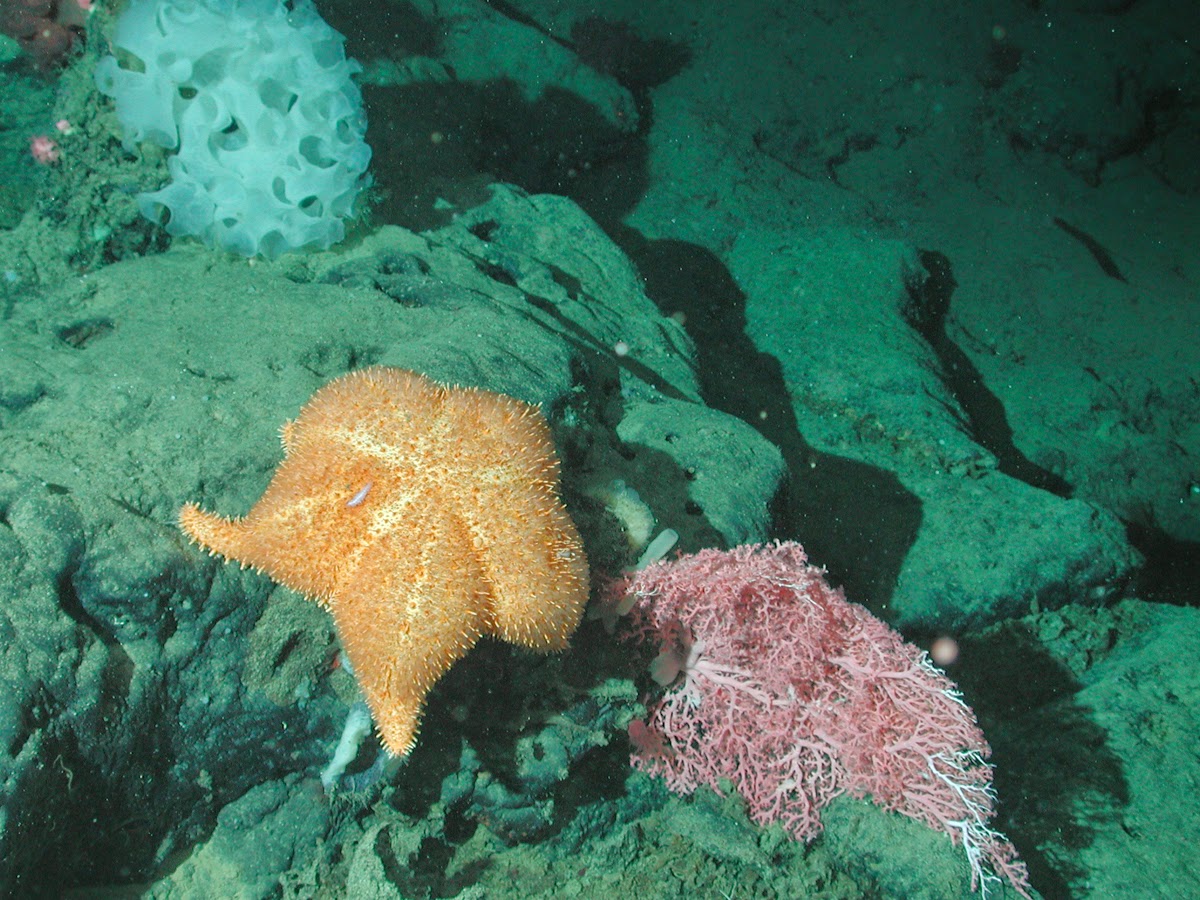
Hippasteria tiburoni, despite its size was observed feeding on deep-sea bamboo coral!! Ain't it an awesome little critter??
3. Hippasteria mcknighti
The third new species we described was found among specimens sent to us from the New Zealand Institute of Water and Atmospheric Research. It resembles the North Pacific Hippasteria heathi but the genetic and morphological data support it as being distinct..
The rest of the paper addresses multiple taxonomic changes (i.e. names of species). Among the most significant of these was the big discovery of how wide-ranging a species, Hippasteria phrygiana turned out to be!! This was a species found in THREE OCEANS!
The problem with this discovery was that historically, folks would often describe a new species if it was not previously known from that part of the world and sometimes there are widely occurring animals which do form regional subspecies. It depends.
But in this case, thanks to our genetic data, we could tell that a great many described species, which were likely separated as distinct species based on minor differences are in fact, just minor variation of one wide-ranging species!
In this case nearly a dozen species, were found to be "redundant" or were applied to Hippasteria phrygiana throughout different parts of the world.
We also looked at the other species of Hippasteria, H. californica which occurs in deeper water habitats than H. spinosa...
What we had found, up this point had been pretty consistent with what had been known until we found two individuals of this species which were revealed by genetics to have been Hippasteria californica BUT in SHALLOW WATER habitats in British Columbia AND which looked like H. spinosa!


 (images courtesy of Mr. Volz and from King5.com)