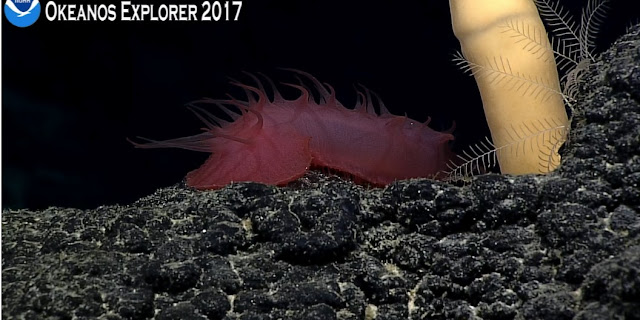
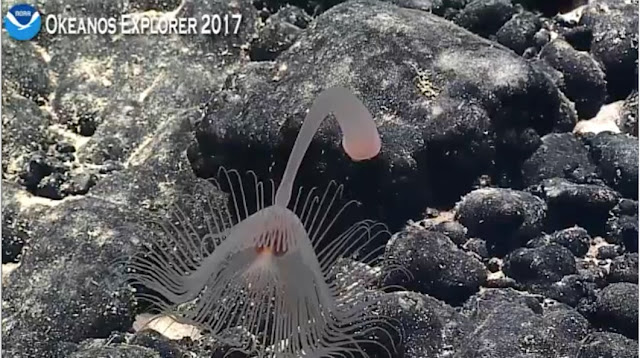
Echinodermata! Starfish! Sea Urchins! Sea Cucumbers! Stone Lillies! Feather Stars! Blastozoans! Sea Daisies!
Marine invertebrates found throughout the world's oceans with a rich and ancient fossil legacy. Their biology and evolution includes a wide range of crazy and wonderful things. Let me share those things with YOU!
Over the last 10 days or so since Okeanos Explorer has resumed its ROV-telepresence based exploration of the Phoenix Islands and adjacent areas in the tropical Pacific they've seen some REMARKABLE animals of all kinds, from corals to siphonophores, crabs to ribbon worms, etc... but particularly ECHINODERMS!
Before I get into the cool pix.. remember NOAA OPERATES Okeanos Explorer!! NOAA has been threatened with severe budget cuts. CONTACT YOUR CONGRESSIONAL REP AND TELL THEM THAT NOAA IS AN ESSENTIAL Agency!
Basically, almost all sea cucumbers and indeed most echinoderms are benthic..that is they live entirely on the sea floor and never get into the water column the way fish or jellyfish do.. Yes. Some sea cucumbers can swim but ultimately they return to the bottom.
Pelagothuria is unique because it LIVES SWIMMING in the water column! Similar to the way a jellyfish does. As a result of its strange lifestyle, it has MANY bizarre adaptations and looks unlike most other sea cucumbers much less other echinoderms!
Its not a commonly encountered animal..and we live in a wonderous time that we can see several minutes of HD video of this seldom seen animal swimming by...
Pelagothuria is contrasted with this other swimming sea cucumber which, after landing on the bottom, poops and then takes off! (from that unnamed seamount off Winslow Reef)
2. The strange irregular urchin Phrissocystis! From Polo Seamount, about 2100 m we saw one of the most seldom seen spatangoid urchins known! These are highly evolutionarily derived sea urchins which live by digging through and swallowing sediment looking for food.
Although they are bristling with spines, they are actually quite delicate. One collected many years ago apparently collapsed as soon as it was brought out of the water in the submersible collection box!
3. A stunning new phyrocrinid stalked crinoid! From an unamed seamount in the Phoenix Island chain, this bold and striking stalked crinoid was observed..and ultimately collected after it was identified as a new species by crinoid scientist Chuck Messing (based on a paper by Tunniclife et al.)
It was quite large with an unusual texture to the stalk and the cup...
4. The "jumping" brittle star Ophioplinthaca!
Brittle stars, distant cousins of sea stars, are EVERYWHERE in the ocean. And especially in the deep-sea you can see them inhabiting numerous cracks, crevices and living on corals!
Some are VERY spiny.. such as this species, what I think is called Ophioplinthaca. We've been seeing these ever since the first leg of the Samoa Expedition. They seem to occur on corals with the tissue removed.. possibly by the ophiuroid itself..
Another curiosity is that these seem to "jump" off their perches as soon as the ROV approaches. Whether this is due to light, vibration, the bow wave of the D2 or disturbance in the "ophiuroid force" (NOTE: Ophiuroid force does not exist) is unclear...
There is nominally ONE species present in almost every ocean in the world.. they've been found in the Atlantic, around New Caledonia, near Hawaii and in the Antarctic. Not sure if they've been found in the Indian Ocean.
Interestingly, these were found in astonishing abundance on one of the seamount dives
5a. The Deep-Sea Slime Star HYMENASTER
From Titov Seamount was this glorious, glorious deep-sea SLIME STAR, in the genus Hymenaster.
So, here is a nice highlight of various wonderful invertebrates observed by NOAA's deep-sea research vessel, the Okeanos Explorer which for all of 2016 and 2017 will be studying the massive marine reserves of American territory in the tropical Pacific!
DON'T FORGET OKEANOS LIVE FEED RESUMES MARCH 7!
That wraps up #Okeanos American Samoa expedition! Never fear, next expedition to explore Pacific MPAs starts March 7. We'll be back soon! pic.twitter.com/nTlBkF0NRG
— NOAA Ocean Explorer (@oceanexplorer) March 1, 2017
But obviously, not everyone can watch EVERY day during the entire dive. So I present some cool highlights (but invertebrates) from the last leg of the research dive.
My thanks to Santiago Herrera and Matthew Jackson the biology & geology science leads for this last epxpedition!!
Also a reminder based on recent news about significant budget cuts to NOAA Remember that NOAA operates the Okeanos Explorer program!! The oceans represent a HUGE unknown quantity and yet, we have no exploration arm to explore the amazing deeps of the Earth. Deep-sea News has made a GREAT argument about why we need an "Ocean NASA"! And right now, the closest thing NOAA gives us the closest thing to that!
So, if you enjoy these and other images as well as the livestream RESEARCH and DISCOVERY please contact your congressional representative and LET THEM KNOW: DO NOT DEFUND NOAA.
SPONGES!! Some of the most commonly encountered animals on these Okeanos dives are sponges. Sponges are relatively simple animals that are basically big masses of cells but some of them use specific kinds of materials to create skeletons. Some use calcium carbonate, some use a fiber called spongin..and one group which is seen commonly in the deep-sea: glass or silicon dioxide.
Here's a large one with a thick stalk and a large opening on the "head"
This is a cool one: this is a cladorhizid sponge. Many cladorhizid sponges are predatory and I think this one is as well..
those spines emerging off the edge makes it a deadly deep-sea umbrella!
Here's another one from a different angel from Rose Atoll, about 2525 meters!
This is a glass sponge in the Euplectellidae, which is often identifiable by the unusual "cap" on the top of the sponge.. These are known for having 2 commensal male and female mated shrimps which do not escape from the internal cavity..
I missed the name/identification on this one..but I like to point out that those brown "roots" are actually GLASS. Glass sponges often seem to be growing "living" fiber optic cable and have been studied for their optical properties!
WEIRD CNIDARIANS!! Cnidarians are of course-those animals with stinging cells and radial symmetry. Jellyfish, sea anemones, hydras, hydroids and so on.They account for a huge diversity in deep-sea habitats! This "cosmic jellyfish" has been making the rounds. Its been identified as Benthocodon hyalinus by my colleague Allen Collins at NMFS. It was observed on Utu Seamount at about 3006 meters!!
Its not unusual for us to see a giant hydroid on these dives.. This one identified tentatively as Corymopha
One of the most noteworthy of the cnidarians observed was this Dandelion or benthic siphonophore. Siphonophores are colonial animals which are mostly found swimming though the ocean in long chains which in some instances can be meters long! Familiar species include the painful Portuguese Man o War.
BUT the species in this group live attached to the bottom, apparently with a huge array of feeding tentacles extended.. there's a blog about these waiting to be written! hopefully soon...
Dandelion siphonophore, seen at 2500m depth in Rose Atoll. #Okeanos back at Rose Atoll today, but starting at 700m. ROV on bottom in ~3hrs! pic.twitter.com/CXB4wnl4SQ
Probably the BIG, weird star of this leg was this BIZARRE blobby tree shaped thing! Turns out its a bizarre sea anemone in the family Aliciidae! Its tentacles had been withdrawn...
Unsurprisingly, some of the most exciting observations on this last cruise were MOLLUSKS! We don't normally see a lot of snails or clams on these cruises..but we made up for it on this dive!
Neopilina, MONOPLACOPHORAN!
Few animals that I know of have what might be considered "holy grail" status. THIS is one of them..
In this case, the mysterious mollusk known as Neopilina! This mysterious mollusk has previously been collected from abyssal and ultrabyssal depths between 4000 and 6000 meters. From both the Atlantic and the Pacific.
These are rarely collected and in the past were perceived as being VERY important to evolutionary or other ecological studies. Basically these animals were regarded as ancient AND ancestral mollusks-the "Ur mollusk" if you will. They inspired a LOT of questions about what they were related to and how other mollusks were related to one another..
But I think this might be the FIRST time an in situ (in place and ALIVE) observation has been made! I admit that this tiny brown limpet thing does not have the same... presence as say some giant octopus or squid, but once you know all the history behind it.. well, I say this with no irony-seeing it alive in its habitat was HISTORIC!!
ROV scoop flipped one of these critters over & iIndividual gills (arrows) mean MONOPLACOPHORAN!
~3800m, Utu Seamount, Samoa #okeanospic.twitter.com/xKALOOeCtR
Octopus! So, of course we are always fond of cephalopods when they turn up! This white translucent octopus species was observed at least twice on the dive at relatively "shallow" depths between 380 and 400 m. This first shot was from Tau seamount. Note that the webs of skin between the arms were translucent!
This one was seen at Rose Atoll at about 393 m and it was investigating a series of little holes and caves.. presumably looking for food..
ECHINODERMS!! So, where MY group is concerned I'm always a little biased and have more imagery than of other groups (not as many corals for example). And because I work on starfishes-there's enough pics that I will get to those in another post! but for now, here's some striking "spiny-skinned" friends that I saw... This funny beast which I think was in the Deimatidae? Note that as with many deep-sea sea cucumbers, the body wall was translucent and we can see the sediment eaten by the animal THROUGH the body wall!
A sea urchin the family Pedinidae I think? Lovely greenish coloration!
A reddish.. echinothuriid urchin? Aka a "pancake" or "tam o shanter" urchin. I've written about these before here. We saw a few different species of these kinds of urchins. But they are difficult to ID from pictures..
MIXED TAXON CRAB + COMBINATION!!
There were at least two interesting cases where we saw crustaceans "team up" with another animal that one does not normally associate.....
1. Decorator crab + cidaroid urchin! This was an odd one. The ROV was observing this cidaroid urchin..and as it changed angles.. it noticed this majiid type "decorator" crab hanging on with its rear legs. We've seen other crabs hanging onto fire urchins in tropical shallow-water habitats as protection-but not seen something like this. Unclear if it is incidental or something that happens regularly...
2. Zoanthid "anemone" PLUS hermit crab! A relationship that has been seen before but no less weird whenever we see it. Basically a sea anemone-like animal called a zoanthid rides and replaces the shell that this hermit crab would normally be wearing..
The crab benefits from the protection and the zoanthid gets driven around by the crab for dispersion, food, etc.. Interesting commensalism!
Ophiuroids on Jelly in Mozambique. Photo by Andrea Marshall, Daily Mail, http://www.dailymail.co.uk/~/article-3990782/index.html#i-570251ad33a88841
And a HAPPY NEW 2017 to everyone! Yes. Obviously everyone has noticed the Echinoblog has gone to an "irregular" publication schedule. This is one of those "be careful what you wish for" issues- a lot of museum travel = a lot of new discoveries and thus papers and more work! And so, like a lot of artisan comic books.. I'll be publishing when good topics and/or when the inspiration strikes me.
Their work presents NEW data on the relationship between the "jellyfish hitchiking" brittle star Ophiocnemis marmorata (on the moon jelly Aurelia aurita)! The species occurs widely throughout the Indo-Pacific from Japan to India. I previously wrote about this phenomena back in 2009! here.
1. How many different types of Jellyfish species does Ophiocnemis marmorata occur ON??
The paper reports at least five or six, including at least 3 species of Rhopilema, Cephea cephea (the cauliflower jellyfish), Netrostoma and Aurelia aurita. But other internet records and social media show further hosts.. such as this hydrozoan, Aequorea from Thailand..
From Chaloklum Diving in Singapore, http://www.chaloklum-diving.com/marine-life-koh-phangan/corals-more-cnidaria/true-jellyfish-scythozoa/scythozoa-other-jellyfish/
2. Where/How many are present on a jellyfish host?
Based on their sample of 92 Aurelia aurita, the authors, found that 79% of them (n=73) hosted brittle stars! quite a large number. Most of them were present under the bell or on the "oral arms" (the lobes hanging down from the bell)
Image by Thomas Peschak, https://www.thomaspeschak.com/
The authors observed that brittle stars ranged widely in size (1.0 to 6.0 mm) but MOST had a disk diameter of greater than 3.0 mm. Medusae with MORE brittle stars were LARGER than those medusae without brittle stars.
The largest number of brittle stars recorded (n=14) occurred on a medusae with 155.0 mm bell diameter.
Its also worth noting that the brittle stars stay on the medusae ONLY within their home range. Many of these jellies, such as Aurelia (i.e. moon jellies) actually go beyond tropical settings and they really aren't seen on jellies in cold to temperate waters..
3. So, what are the brittle stars EATING??
The authors used a novel new method which basically breaks down the organic components of specific isotopes (Carbon and Nitrogen) and looks for how much of those isotopes is present in the subjects versus that which is provided by the environment.
Long story short: The data indcates that most of the food sources in Ophiocnemis seems to come from PLANKTONIC SOURCES! (i.e. the mesozooplankton) and NOT from the medusae itself and there were not any observations of Ophiocnemis filter feeding (i.e. arms up in the water).
And so the authors suggest that they are what's called KLEPTOPARASITES (a great word-really!). In other words, they take food directly away from the jellyfish out of the mouth or the oral arms, stealing or scavenging food from the jellyfish which are known as big pelagic predators.. What would be called "indirect food sources"...
There are several reports of other brittle stars that practice "kleptoparasitc" behavior.. i.e. moving down into the feeding arms or near the mouth and stealing food directly from the host. Some of it might not be a big deal to the host.. scraps and etc.. but meaningful to the ophiuroids..
Image by Ron Yeo at Tidechaser, http://tidechaser.blogspot.com/2012/03/brittle-stars-ophiuroidea-of-singapore.html
4. Growth and Settlement..aka Living on a Changing Jellyfish World
Although its not entirely clear HOW these brittle stars get up onto the jellies, one reasonable hypothesis is that they settle there as swimming larvae. Many of the brittle stars observed were tiny (smallest =1.0 mm disk).
Larger medusae seemed to carry a higher "brittle star load" than smaller ones. Its not clear exactly how/WHY certain species are chosen. Whether it is simply the physical dynamic of having a larger medusae that facilitates more larvae to settle or if perhaps there are other cues??
It also turns out, based on further obsevations by others, that this species DOES occur on the sea bottom on its own. So, its possible that as they get larger.. the brittle stars fall/jump/ or otherwise "settle" away from their floating substrate.
Or perhaps the jellies themselves die, as we see here on this unfortunate jelly in Singapore!
Image by Ron Yeo at Tidechaser http://tidechaser.blogspot.com/2012/03/brittle-stars-ophiuroidea-of-singapore.html
5. Why go to all the hassle??
Well, one must ask, WHAT does a brittle star get OUT of basically jumping onto a jellyfish as a freshly settled larvae and living on it until it gets too big and falls off??
Obviously, they are getting FOOD. So that's one thing. And to a certain extent they are being PROTECTED..because what better thing to live on that a giant stinging gelatinous mass that eats fish!
but perhaps the most important benefit is DISPERSAL.. that is the species is carried wide and far..
It was suggested that some medusae could carry these brittle stars up to 1000 kilometers from their point of colonization!
The apparent range of possible hosts adds further questions about the life mode and just HOW many different types of Ophiocnemis are present? And how do the different jellies affect how the brittle stars diversify and spread?