So, between travel, being sick, yesterday's massive Inauguration Day festivities and playing catchup, this week has been crazy!
So here are some neat starfish time lapse videos to keep you informed and entertained!
The awesome video of the tropical shallow-water "chocolate chip star" Protoreaster nodosus, foraging for organic particles and other food on the sea bottom.
Stars of the Sea from Karin Brussaard on Vimeo.
The foraging behavior of the predatory Chilean/Patagonian cold/temperate water Cosmasterias lurida (Stichasteridae)
Some classic videos from the Shape of Life series showing behavioral complexity. Read this article frorm awhile back to see what's going on...
Echinoderms: Sea Star Time-lapse: Eating Dead Fish from Shape of Life on Vimeo.
Echinoderms: Sea Star Time-lapse: Don Wobber's Film from Shape of Life on Vimeo.
Here's a nice HD time lapse of a tiny aquarium asterinid starfish. Note stomach extended and the places where the algae is absent from the glass.
A day in the life of a starfish from Rate My Funeral on Vimeo.
An unusual video that shows what happens when you drop a bunch of Patiriella (bat stars) and let them run free! Starfish show up at about 1:19 (its mostly set up prior to that)
Here's a nice little vid showing Archaster typicus (different from Astropecten-you can tell between the two by going here to see the differences) in an aquarium burying itself into gravel
By comparison here is a species of Astropecten from Singapore doing its thing!
The giant Pacific sunflower star (Pycnopodia helianthoides) is fast enough that you can see it moving without time-lapse. What happens when you speed it up a bit?
Hopefully next will be all caught up and I'll be back to posting more!
Showing posts with label Archaster. Show all posts
Showing posts with label Archaster. Show all posts
Tuesday, January 22, 2013


Tuesday, April 26, 2011
Telling Apart Sand Stars: Archaster vs. Astropecten! Two Common Trade Species
 So today, I thought I would finally indulge those of you who are in constant puzzlement over how to tell the difference between two of the more common "sand stars" found throughout the Indo-Pacific!
This is a surprisingly common question and its not just my colleagues who repeatedly ask me this -I frequently see these two species mistaken for one another in tropical aquarium and "shell collector" magazines, websites and so on..
Hopefully, the names of these two species can be consistently applied. And that's generally good for everyone in the long run...
Know Your Sand Stars! Convergence between Astropecten and Archaster?
So, first, we are talking about TWO different species from two different families in two entirely separate orders.
Astropecten in the Astropectinidae, Order Paxillosida (I will refer to the species Astropecten polyacanthus for simplicity's sake).
Astropecten is distributed worldwide and occurs primarily in the shallow-water tropics-but also to a certain extent in temperate to cold water (occasionally in deeper depths)
Here is a nice video example of Astropecten (prob. A. polyacanthus) very efficiently burying/unburying itself...
I should add the caveat that there's just over 100 species of Astropecten throughout the world and a fair number of them are present in the tropical Indo-Pacific.. So, there may be SOME variation if you are looking at different species of Astropecten wherever you may be reading this..
Archaster in the Archasteridae, Order Valvatida. Found in shallow water throughout the tropical Indo-Pacific . Archaster also makes a point of burying itself into sediment... (yeah-there's no single video that is as good as the one above..so these will have to do!)
In spite of belonging to two completely different and distant groups of starfish, BOTH live in sandy bottoms with loose, unconsolidated sediment and possess the ability to dig and hide under that sand or sediment.
As a consequence these taxa display a number of superficial similarities that are adaptations for each respective species to live buried in a sandy, muddy or otherwise unconsolidated bottom environment.
In vertebrates, you would see this same kind of relationship-called convergent evolution between dolphins (which are mammals) and fish (which are not). Several consistent morphological features, which appear similar, but that arise in very separate evolutionary groups as adaptations to a particular way of life.
In the case between dolphins and fish-the fins and smooth lemon drop shape are adaptations to life swimming through the water.
In the case of these starfish-the location of the spines and the certain similarities in body shape are independent adaptations to digging through sediment.
Hence..the word "sand star" could apply to both. (And that's why I dislike common names...)
These two species are frequently mistaken for one another. and Archaster is apparently quite common and abundant.. So usually, people mistake Astropecten for Archaster

So, How Do We Tell Them Apart?
1. The Radial Plate series (aka the carinal plates)
So-if there's one immediate and obvious character to use-its the distinctive central row of plates on each arm.
 Indicated below in blue
 This is versus Astropecten which basically has NO distinctive radial line or series of plates... Its just a big jumble...
 2. Suckered vs. Pointed Tube Feet
Another immediately obvious difference between the two..
Archaster has actual suckered tube feet.... As seen here on this video..
This is as opposed to Astropecten which have pointed or knobby ends on their tube feet..
 3. Body Shape and Spines on the Outline of the Body.
Archaster only has big flat spines on the lower side of its body that flank the oral surface.. If there are spines on the upper surface, they are small and tiny..
 Plus..the body itself is shaped rather distinctively. with the rather long-tapering arms
 There is more of a prominent angle formed between the surface and the side of the body. Also, the top surface is more flattened...
 In contast, Astropecten can have broader more triangular arms. This can vary by species-but if you find an Astropecten in the tropical shallow waters of the Indo-Pacific, it will look very similar to this...
 Arm is more triangular. And many species of Astropecten will have a very prominent perimeter of spines around the body's edge.
There is more of a curved angle formed by the top and the lateral side. And you'll often find the top surface to be more swollen and curved. Not as flat as you would find in Archaster...
 4. The Spines are Different.
Note that these spines are round and sharp rather than flat and blunt.
 You can especially see the difference in the abundance and the type of spines on the bottom (oral) surface...
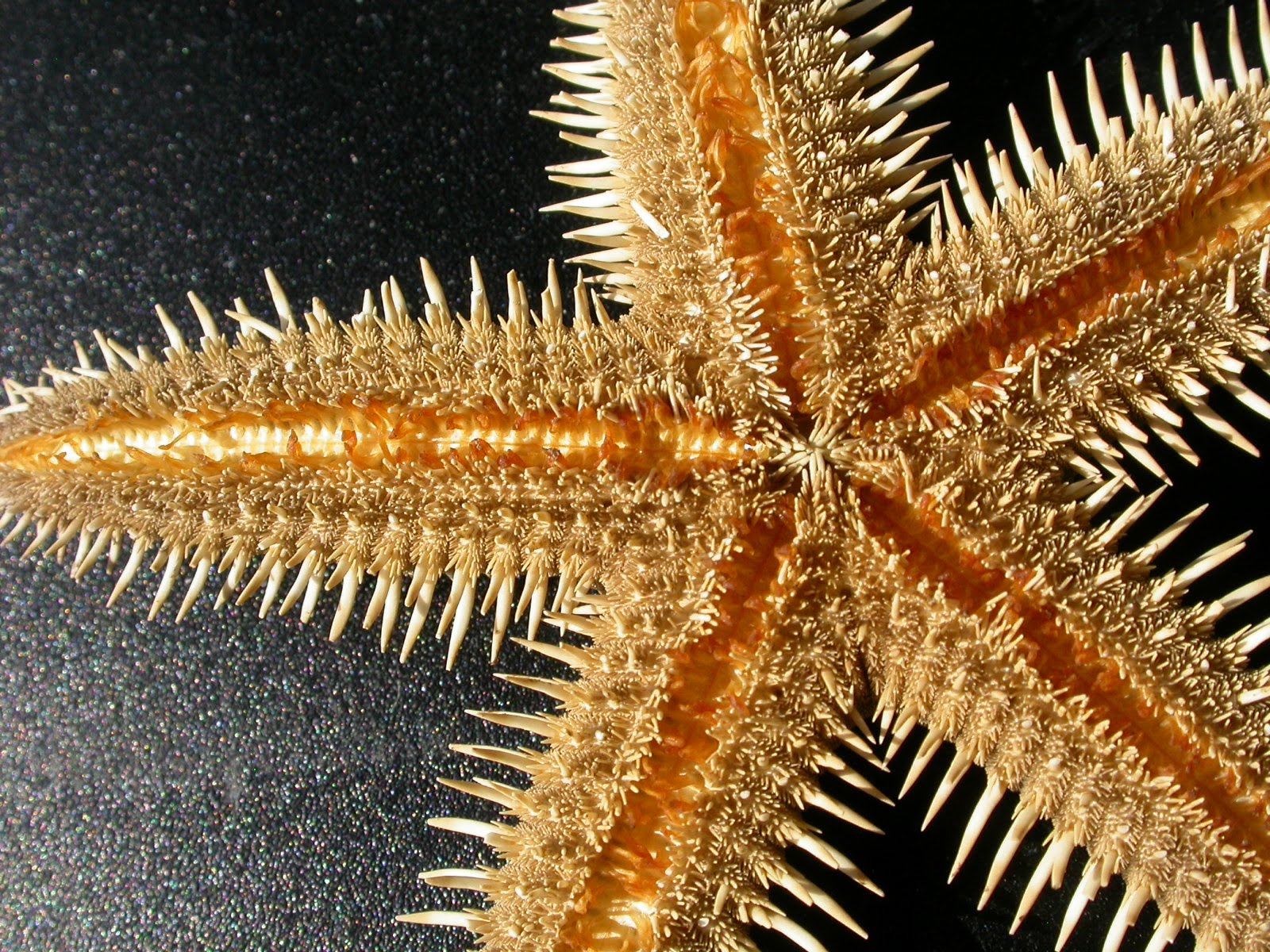 In Archaster, the spines are flattened and blunt!!
 To the seasoned expert, there are actually MORE differences than this. But these were the characteristics that I thought were the easiest to tell apart for those who are simply observing the exterior.
It turns out Archaster is probably one of the more heavily fished starfish species. Not only for aquariums, but one also sees this species on sale for arts & crafts and shell-collector websites and ebay.. but Astropecten turns up as well.. This pic gives you an idea of where this species ends up...
What might the impact be of overfishing these species? The first step is knowing which one is which...
Monday, May 18, 2009
Because DSN Sex Week is Awesome! Echinoderm Sex Videos!!
In honor of Deep-Sea News' Sex Week theme...Its time for Echinoderm Sex Videos!!!
Please play..."shake, shake, shake" your booty to the following....
Fromia elegans emitting gametes!
Archaster engaged in Pseudocopulation!!
Sea Cucumber in provacative reproductive posture (at 0:14 into the video)
Shake, shake, shake...shake your booty! (Play this for inspiration)
Please play..."shake, shake, shake" your booty to the following....
Fromia elegans emitting gametes!
Archaster engaged in Pseudocopulation!!
Sea Cucumber in provacative reproductive posture (at 0:14 into the video)
Shake, shake, shake...shake your booty! (Play this for inspiration)
Saturday, February 7, 2009
The Sex Life of Archaster! Pseudocopulation in Sand Stars!
Since this week leads up to Valentine's Day, I thought this would make a great time to talk about something that's been much on my mind.....
Yes! That's right! Pseudocopulation!!!
Wikipedia defines as:
Well..as it turns, out a bunch of echinoderms..particularly starfish and brittle stars do all the time!
But today, let's look at one of the best known of those asteroids which engage in this farce of faux fornication!
Archaster typicus!
 (pics from the Excellent blog: the Tidechaser!)
A classic study by Run et al. (1988) in Marine Biology based on one species, A. typicus from a Taiwanese population revealed many SEXY starfish dynamics!
1. The pairing behavior occurs during a separate season from spawning season. Pairing occurs in early May, peaks in May-June and decreases in July, ending in August.
Gonads are REALLY swollen during this period! (just before spawning!).
Pairing leads to fertilization...the whole pairing/fertilization process takes about 2 minutes.
2. The actual SPAWNING occurs about two months after the pairing!
 3. Density and movement of populations in Archaster both increase during "pairing season".
Males show a higher tendency for movement under these circumstances.
4. Archaster shows immediate sex recognition when individuals are side by side. Probably
owing to chemotactic recognition.
5. During the PAIRING: When a male FINDS a female..there is a behavior pattern that looks like this (aka the Archaster Kama Sutra!!):
6. The female is ALWAYS on the bottom! Males are always on top!
Oddly enough, the "male on top" urge is SO strong that male on male pairings, including male-on-male-on female "piles" of Archaster are encountered!
 (pics from the Excellent blog: the Tidechaser!)
One of the interesting points is the measure of something called the Gonad Index, which is a measure of the ratio of the weight of the gonad to the body shows that the male GI is LOWER for males then for females!
(pics from the Excellent blog: the Tidechaser!)
One of the interesting points is the measure of something called the Gonad Index, which is a measure of the ratio of the weight of the gonad to the body shows that the male GI is LOWER for males then for females!
There is thus the suggestion that a great deal of energy is used by the male relative to the female.. Possible uses of that energy?
Go here for MORE Pseudocopulation! Ophiuroids! Asteroids!
Yes! That's right! Pseudocopulation!!!
Wikipedia defines as:
Pseudocopulation describes behaviors similar to copulation that serve a reproductive function for one or both participants but do not involve actual sexual union between the individuals.I mean, who doesn't think about pseudocopulating every so often??
Well..as it turns, out a bunch of echinoderms..particularly starfish and brittle stars do all the time!
But today, let's look at one of the best known of those asteroids which engage in this farce of faux fornication!
Archaster typicus!
Archaster is the single member of the Archasteridae, a group of starfish that live in the tropical Indo-Pacific, occurring from the east coast of Africa to New Caledonia, Australia, and the tropical regions of Asia, including Japan in shallow-water environments.
 (pics from the Excellent blog: the Tidechaser!)
Archaster is a frequently encountered species, which closely resembles the other sand-star Astropecten. But both live in sandy, unconsolidated sediments..and are often called "sand stars" or "sand-sifting stars."
(pics from the Excellent blog: the Tidechaser!)
Archaster is a frequently encountered species, which closely resembles the other sand-star Astropecten. But both live in sandy, unconsolidated sediments..and are often called "sand stars" or "sand-sifting stars."
One of the more remarkable behavior aspects about these animals is that they are often found in pairs.
The Sex Life of Archaster typicus!
Since, their earliest discovery in 19th Century, this has been a point of interest in this species. Its since been documented as a case of pseudocopulation. Behavior that optimizes fertiliziation of the species.

 (pics from the Excellent blog: the Tidechaser!)
One of the more remarkable behavior aspects about these animals is that they are often found in pairs.
 (pics from the Excellent blog: the Tidechaser!)
A classic study by Run et al. (1988) in Marine Biology based on one species, A. typicus from a Taiwanese population revealed many SEXY starfish dynamics!
1. The pairing behavior occurs during a separate season from spawning season. Pairing occurs in early May, peaks in May-June and decreases in July, ending in August.
Gonads are REALLY swollen during this period! (just before spawning!).
Pairing leads to fertilization...the whole pairing/fertilization process takes about 2 minutes.
2. The actual SPAWNING occurs about two months after the pairing!
 3. Density and movement of populations in Archaster both increase during "pairing season".
Males show a higher tendency for movement under these circumstances.
4. Archaster shows immediate sex recognition when individuals are side by side. Probably
owing to chemotactic recognition.
5. During the PAIRING: When a male FINDS a female..there is a behavior pattern that looks like this (aka the Archaster Kama Sutra!!):
6. The female is ALWAYS on the bottom! Males are always on top!


Oddly enough, the "male on top" urge is SO strong that male on male pairings, including male-on-male-on female "piles" of Archaster are encountered!
 (pics from the Excellent blog: the Tidechaser!)
There is thus the suggestion that a great deal of energy is used by the male relative to the female.. Possible uses of that energy?
- The movement and "mounting and pairing" behavior itself is more energetically expensive
- The females on the bottom can eat and store energy from the food. Males on top are isolated from their bottom food sources and can only feed on whatever happens to be on the aboral surface of the female.
- While females are covered (i.e., protected) by males, being on top, males are exposed to air, sun, and the low tide (i.e., dessication) which is more stressful.
Go here for MORE Pseudocopulation! Ophiuroids! Asteroids!
Monday, August 11, 2008
Tropical Starfish Conservation: A partial guide to other fished species
 Last week I looked at Protoreaster nodosus, one of the more frequently encountered dried tropical starfish species and I thought I would partly continue that theme and continue looking at other species that I've encountered which are probably fished a LOT of in the dry shell trade.
There are some regional species that one sees on sale, but that don't seem to make it far beyond their home range (although they still make it to online sales).
In nearly all cases below, biology about reproduction is absent or poorly understood. Archaster is a predator of small sand invertebrates and the rest are all essentially microalgal or biofilm feeders similar to Protoreaster.
I'm omitting cold-water species like Pisaster or Asterias, which are also heavily "fished" because there's so much known about these species relative to their tropical counterparts.
Most of the following taxa are species I've seen over and over again in shell shops or for sale online. Some of these species are also seen a lot in the pet trade, which is another issue.
The most frequently encountered species I've encountered include: Protoreaster and Archaster, followed by Linckia with the others occurring less frequently.
Archaster (probably Archaster typicus, Fam. Archasteridae)
Apparently one of the most commonly encountered shallow-water tropical species. Known professionally as the "faux Astropecten" because of its convergent appearance with astropectinid sand stars.
 Archaster occurs with some abundance on sandy bottoms throughout the Indo-Pacific.
Archaster gets collected by the THOUSANDS. and in different size classes. Large to small sized individuals get collected and sold. The lot below was 100+ specimens at a size range of about 2-5 cm diameter. This begs any numer of questions about this species' carrying capacity.
 Linckia spp. (Fam. Ophidiasteridae)
The most commonly encountered tropical Pacific species is Linckia laevigata, but other species of Linckia exist throughout the tropics in the Pacific and the Atlantic which are used in shells and artsy things. Linckia columbiae from the Mexico/Baja area and Linckia guildingi from the tropical Atlantic/Pacific.
 Members of this species occur with some abundance in the shell-trade. Mostly those species that aren't asexual. The fissiparous ones are presumably not as visually appealing.
 Oreaster reticulatus (Family Oreasteridae)
This species occurs in the tropical Atlantic and has been heavily fished, leading to localized extinction in some parts. Unlike its Indo-Pacific counterparts, quite a bit of this species biology has been studied by Rob Scheibling and Anna Metaxas.
 This species is heavily fished, dried and sold. I haven't see this species as frequently on sale as Protoreaster and relative to Protoreaster, the populations are apparently larger (see Scheibling & Metaxas 2008).
 That being said, they have been rendered locally extinct in different parts of the tropical Atlantic.

 Pentaster obtusatus (Fam. Oreasteridae)
Not as frequently seen in the shell-trade, but where Protoreaster is found for sale, this species is usually present. They co-occur and are often collected together.
Its not known how abundant this species is and whether it has anywhere near the capacity to withstand the fishing pressure.


Pentaceraster spp. (Family Oreasteridae)
There are several species in this genus and biology isn't well known for most species in Pentaceraster. I haven't seen too many of these. They don't seem to be nearly as abundant or as frequently available as Archaster, Protoreaster, or Linckia.


Subscribe to:
Posts (Atom)