Showing posts with label Circeaster. Show all posts

Wednesday, September 16, 2015

Goniasterid Starfish LOVE to eat Octocorals!

Okeanos Explorer has begun Leg 4 into the Northern Hawaiian Islands and their last stream on Sunday was chock full of amazing vistas full of deep-sea (about 400-500 m) sea pens and corals! 
Probably one of the most exciting parts of these cruises is that I'm able to actually watch my favorite starfish species, some of which I described, in ACTION! Feeding on what turns out is their favorite food: octocorals!!


Sea pens are big fleshy octocoral colonies that look sort of like an aquatic "quill" or pen. Here's one called Ptilosarcus, which occurs in shallow water from about SCUBA depth. 
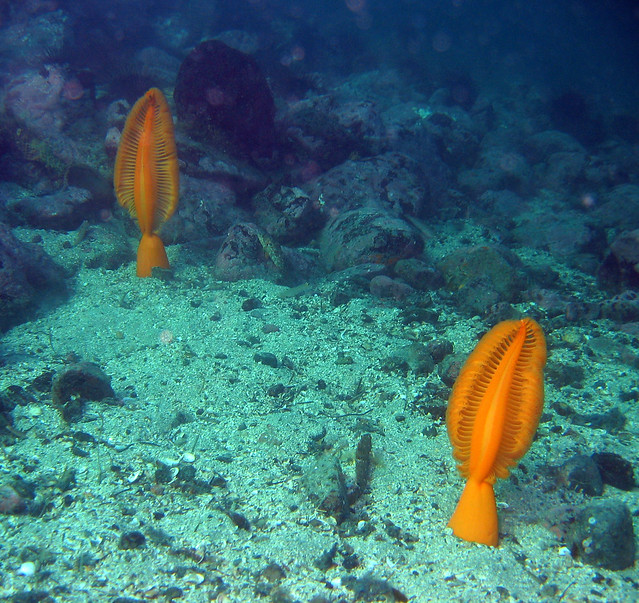
Sea Pens
Octocorals are specific type of cnidarian, which have eight arms on each polyp. They have a whole diversity of body forms and can be more colonial, such as this gorgonian or more like a big fleshy stick like the sea pens seen above..

The majority of the sea stars that we have observed feeding on octocorals are in the family Goniasteridae. As a generality, they look like this.
                                    
A big peripheral ring of plates frames their body. They can be anything from completely pentagonal to more star shaped. Many are covered by spines whereas others are not..

Among the best known of shallow-water goniasterid octocoral predators is the so called "spiny star" aka Hippasteria phrygiana (aka Hippasteria spinosa, etc.), which used to be known by MANY species before being recognized as one wide-spread species which occurs in three oceans! (here). 
Spiny Red Star snacking on a Sea Pen

This species occurs at SCUBA depth (and deeper) and many, involved studies have documented how these animals are important parts of ecosystems due to their predation on sea pens.

Thus, it makes a lot of sense that several of the deeper water species of Hippasteria, such as this Hippasteria imperials seen by the Okeanos Explorer should be a fairly active predator on deep-sea sea pens! 

Disks are swollen with water...
Here is just a gorgeous shot showing a seemingly endless vista of sea pens with these two large, Hippasteria imperialis roaming around like they own the place! 

BUT, Hippasteria imperialis isn't the only goniasterid starfish which feeds on octocorals. Many of its relatives, both close and far are also pretty active predators on deep-sea octocorals..

This big guy is Hippasteria muscipula! A species I just described last year! (here) It would seem to occur over a pretty wide depth range..from several hundreds to several THOUSANDS of meters!

They seem to be primarily predators on bamboo "corals" which are octocorals in the family Isididae.
and there was THIS stunning image showing H. muscipula but with 3 polynoid worms crawling around on its body surface. This is unusual, since polynoid worms usually crawl on the oral surface in the tube foot grooves..

Another closely related Hippasteria-like sea star which we've seen in the Hawaii region is the genus Evoplosoma.  


This shot is just awesome. We can see its stomach and tube feet hard at work clearing off the meat from the bamboo coral's stalk..

BUT that's not all! We've encountered multiple goniasterid species apparently feeding on coral! 

1. Astroceramus eldredgei

2. Calliaster pedicellaris
This species was described by Walter K. Fisher in 1906 and VERY rarely seen since then. 
3. Circeaster pullus
Here's another species I described back in 2006 and named in honor of Dr. Craig Young at the Oregon Institute of Marine Biology. It was observed perched on this coral skeleton where it was presumably feeding..

Have not seen any of these on the Okeanos dives as yet though.

4. Circeaster arandae
This one was a surprise because it very much looks like a species I described in 2006 from Madagascar!!  But it lives in deep, DEEP water (>1000 m) which is consistent with my earlier account. But weird to find it so far off..


How many more octocoral predators will we see??

Tuesday, February 3, 2015

Okeanos Explorer,Evoplosoma and the North Atlantic Starfish Coral Predators!!

This week, a bit of a break from my work in Japan to blog about my NEW paper!! Its a little something I've published in Marine Biodiversity Records focusing primarily on the deep-sea coral devouring starfish Evoplosoma and some of its relatives in the family Goniasteridae!  

The paper is noteworthy because it uses actual images and data from the Okeanos Explorer research and outreach cruises operated by NOAA.  I've made a point to mention how I've data mined the OE photo archives for some great deep-sea biology (here).   And many of the images below are no exception. 

I've certainly been present as an eyewitness to feeding by Evoplosoma on Okeanos Explorer dives in the last two years, such as the one above from the September mission....

but there were several that occurred well before I became more deeply involved. It often takes a taxonomist (or any scientist) who has become SO familiar with the subject animals that you can recognize when something is new and something is old and rare.. sometimes from plates and figures that are over 100 years old!
via Twitter! https://twitter.com/search?q=evoplosoma&src=typd
Ya see how the stalk with starfish is barren?  and the "healthy" branch to the right still has tissue and polyps (i.e feeding structures) on it??  We're seeing feeding by the sea star which digests that tissue off the white center stalk.. 


These types of observations have only recently been more frequent in the last few years..

So, everyone "sees" these observations on the expeditions. But what most folks don't realize is that this is SCIENCE IN ACTION. Observations and data being recorded while they are watching the live stream!

This blog post and the paper are the FORMAL RESULT of these pictures and video!!! The science entered into the formal record.

Lets see what we've got!! 

1. Some deep-sea seastars will feed on deep-sea "corals" for at least a YEAR! or more!
So, one cool thing I came upon during my providing "scientist on shore" input for the Okeanos Explorer live streamed expeditions was an anecdote by Dr. Scott France, who mentioned seeing a piece of "bubblegum coral" (not a true coral, but an octocoral called Paragorgia) on Manning Seamount in the North Atlantic, which had been knocked over at some point and was being fed upon by some sea stars, which at the time were unidentified..

This account and this picture were taken in 2004...
ONE YEAR LATER! the Okeanos Explorer again was on Manning Seamount and had returned to the same spot and BEHOLD the sea stars were STILL there feeding on the bubblegum coral...

The colony was still "alive" but being slowly fed upon by the sea stars!! Almost 15 MONTHS later! The feeding rate was incredibly slow compared to those measured in shallow water coral predators such as the Crown of Thorns (Acanthaster planci).
Lots of thoughts and comments have probably jumped into my head and probably yours as well. "Are you sure those are the same four (three) sea stars?"   "Couldn't they have moved on and come back?"
"Did they REALLY stay there, eating a coral for a year?"

Apparently yes. 

This feeding events gives us a rare look into how important nutrients and FOOD are to animals in the deep-sea... and the the time scale involved...

2. A new species of Evoplosoma, a coral devouring sea-star is named after its discoverer, Dr. Les Watling (University of Hawaii & University of Maine) !! 

During an expedition to Bear Seamount in the North Atlantic in 2004, Dr. Les Watling spied this sea star, apparently feeding on the deep-sea corals he works on.
                              
Not being an expert on sea stars, he tentatively identified it, and put the specimen into storage following its collection.  LOTS of different animals feed or live in or around deep-sea corals and sometimes there's just not enough time to work up every single, new piece of data...or new specimen that comes up...
                              
That's where I come in!  A few years later, I'm working on this group and examine the specimen he collected now over a decade ago! and voila it turns out to be a new species! 

                              
And..thus behold the new species Evoplosoma watlingi! Named for its discoverer!! 

3. Evoplosoma feeds on coral in a very particular way... what are all those spines and pedicellariae for anyway?
Everyone seems confident in assuming that sea stars feed in the same way.. that is, hump over the shell of a clam and extrude stomach into the crack and feed away, right??

Well, in coral-feeding sea stars we see a fine bit of acrobatic action involved!!!  And thanks to the high definition videos of Okeanos Explorer, we can see them in VERY fine detail!
Basically, what's interesting about this and OTHER pics of these animals is how such a big, bulky animal seems able to effortlessly CLIMB up into the branches of these deep-sea coral colonies in apparent defiance of gravity!

Well, bear in mind, this is all underwater and these sea stars are mostly water inside those calcium carbonate skeletons...

Other surprisingly common features on these animals? Spines... and little claw-like structures known as pedicellariae.  Are these used to help feed and climb???


The Lessons of Okeanos Explorer
  1. Specimens are still necessary for the "nitty-gritty" biology. New species, etc. 
  2. You CAN observe behavior and with a lot of sophisticated high-def video, you can even identify some of the critters you are watching! 
  3. There's a LOT of video nobody has been watching with a TON of good stuff in it!! 
  4. You can make a paper out of it! 
Thanks to 
The crews & team members of the Okeanos Explorer and at NOAA for the support and help!
Kate Neill, from the National Institute of Water & Atmosphere (NIWA) in Wellington, New Zealand! Marc Eléaume from the Museum national d'Historie naturelle in Paris, France and Scott France at the University of Louisiana!

As many of you know, I am a big fan of the Okeanos Explorer Program and have summarized highlights from many of their dives!   Here are some of them again!

What if the Okeanos Explorer went back to Indonesia? (here)
Xenophyophoreans! Giant deep-sea amoebas! (kind of) (here)
The rarely seen swimming sea cucumber Pelagothuria! (here)
Dumbo Octopus Love! (here)
Sea spiders aka Pycnogonid LOVE! (here)

and here's more Evoplosoma love from the Pacific via the Monterey Bay Aquarium Research Institute from work I did back in 2010!!