Showing posts with label Leptasterias. Show all posts

Tuesday, June 25, 2013

Starfish with Babies! Brooding Behavior & Pseudocopulation Revealed!

Today: BROODING Juveniles!  Wait, What?  No, NOT like this
Twilight
Seriously! This is one of the top images that comes up in a Google search for "brooding"
I meant Brooding juveniles like THIS!
Diplasterias brandti
from the Smithsonian NMNH USARP
In other words, these are "baby" starfish that are cared for by the mother until they are ready to head off ont their own. Parental investment resulting in a succesful offspring. 

Sometimes starfish (and indeed most echinoderms) can appear kind of alien. No head. Mouth on the bottom. 5 part radial symmetry. Strange adaptations. All kind of weird sometimes.

So, I suppose its appropriate that the WEIRDEST of ALL echinoderm (and starfish) behavior is that starfish have this almost mammal-like (or at least, vertebrate like) behavior!!   Some starfish species will actually brood and carry little starfish just like the cutest little furry thing you can think of!

Now, most starfish have a fairly straightforward reproductive cycle.

Eggs and sperm are ejected from the males and females-they fertilize and go on to form larvae which swim in the water developing through different stages, eventually eventually settling down onto the bottoms and growing up to become proper "adult" starfish.

But many starfish species stray from that typical cycle, and somewhere between the time the sperm fertilize the eggs and the settled "babies" are established the whole life cycle CHANGES to give you this:

Yes. Tiny baby or small juvenile starfish which are held by the mother around the mouth! (this varies as we'll see). Why do some starfish do this?  And not the more 'typical' behavior?

Scientists have known about brooding behavior in several species of starfish since the 19th Century but only recently has there been the extensive observation and insight to finally piece together the complete story!

The Story of Leptasterias polaris
Information herein is based on a paper by Jean-Francois Hamel and Annie Mercier at Memorial University in Newfoundland. which you can find (here) in Biological Bulletin from 1995 (vol. 188: 32-45)

They studied the large, Arctic/subArctic 6-rayed starfish Leptasterias polaris which occurs in the North Atlantic, Arctic and North Pacific Oceans.
Image by Claude Nozeres  from the Canadian Registry of Marine Species
Hamel and Mercier's paper exhaustively studies L. polaris' complete reproductive cycle, which pretty thoroughly documents the reproductive behavior in this species.  Bear in mind, that this starfish has been known since 1842 and yet our knowledge of its reproduction has only come to us recently (published in 1995)!

Information on brooding remains of interest-but the behavior and its evolution is poorly understood.

1. PSEUDOCOPULATION
Figure 1 from Hamel & Mercier 1995
 As a prelude to the actual spawning there are massive aggregations of these animals. They're involved in an unusual behavior known as pseudocopulation. There's no penetration or combination of sexual organs, nor is there any actual spawning. The animals all just get together into a big pile. Sort of preparation for the main event.

Bear in mind, OTHER than during mating season (November to February), these animals all typically ignore or even avoid one another.

Many echinoderm species practice pseudocopulation which I've written about here. Its not always clear why different species pseudocopulate. But one thing seems clear: It helps the chances of their sperm and eggs get together.

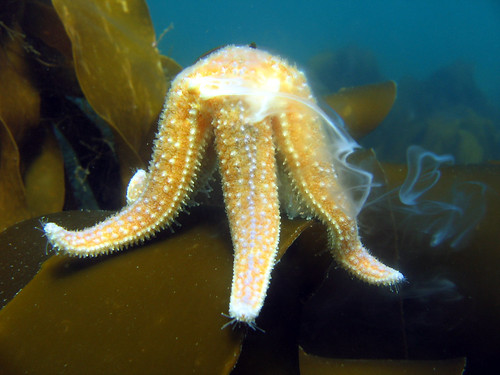
2. Spawning! There were no pics of actual Leptasterias spawning, so here instead is a closely related Asterias. I have discussed this spawning on armtips position here. It is observed widely across cold water and tropical species.
spawning starfish
Image by Tom Ashton
Spawning in Leptasterias polaris males begins as the water gets cold, about 2 degrees C. 

Sperm (male cells) are negatively buoyant, or in other words, they sink to the bottom and form sort of a film. The sperm then go dormant until they come into contact with the female's eggs..

3. The Female Pinwheel formation. Stimulated by the males, and following the deposition of sperm on the bottoms, the females proceed to eject the eggs onto the sperm so that fertilization can proceed.

The deposition of the eggs onto the sperm re-activates the sperm allowing them to combine and fertilize.

During this phase, the females adopt this "pinwheel" formation
From Mercier's L. polaris site
Here (from Figure 5 in Mercier & Hamel) we see a close up of eggs UNDER the female in C. Which then grow up into the cute as the dickens starfish in D.  Growth was after about 5 and half months.
4. After fertilization, development proceeds. Here's a summary panel of the different stages. The top row is the developing embryo. It continues through different stages until it reaches "J." 

At that point the animal is practically ready to move off on its own..
Figure 9 showing development from embryos to small starfish 
Interestingly, Hamel & Mercer found that the development proceeded on its own if the embryos were unbrooded.  They suggest that brooding is behavior which protects the embryos/juvenile starfish from debris and other materials. Animals observed in the field were clear of excess materials.

Protection was also a likely consideration since unprotected embryos/juvenile starfish were rapidly devoured by sea urchins or other grazing animals if they were not protected by the adult. 


 The whole cycle is sumarized in this convenient cartoon!
Figure 4 from Hamel & Mercier 1995
There were MANY more details! If the topic of brooding interests you I urge you to check it out!

BUT That's NOT the end of it!  

5. Brooding is diverse.  SEVERAL different species of sea stars brood. Almost all of them are either cold-water species, living in the deep-sea or at the poles. Sometimes brooding is in temperate water species.. But typically not in the tropics.

Brooding also takes different forms. The oral 'mouth' or gastric brooding mode is but one kind. Here is Diplasterias from the Antarctic!  MANY starfish in the Antarctic brood juvenile starfish!
Diplasterias brandti
from the Smithsonian NMNH USARP
For example, in the suspension feeding brisingids, the Antarctic species Odinella nutrix, broods babies  in special chambers made from the arm spines present between each of the arms.
There is the strange Japanese/Russian/North Paciic Trophodiscus (go here to see more) Juveniles are brooding on the TOP of the animal among the spines (called paxillae) that compose the surface of the disk.
Here is a living specimen. Image by colleague Yoichi Kogure!
Close up
And then there's Tosia neossia, recently discovered in Australia. This species broods but without actually keeping the babies physically on the body. They are kept spread out near the animal... See the orange dots in the picture below?  That's the juveniles...  I wrote about this species here.
Here's the tiny Tosia crawling larvae!
And in the deep-sea, there is the weird "sea daisy" Xyloplax!
And that's not to mention brooding in sea urchins, ophiuroids, crinoids and sea cucumbers! and MANY other invertebrates!  Starfish brooding is just the tip of the iceberg!
Tuesday, July 20, 2010

Another Worry From Global Warming: Parasites that EAT Starfish SPERM!!!


This week, we have what sounds like a horrific title: Starfish Sperm Eating Parasites!

Parasites are weird and freaky...and how many people out there knew that Sea Stars even HAD parasites???

yes! they do. So, let's get to it!
1. The Parasite- and....it does WHAT???
So, in the early 2000s, Bill Stickle, a marine biologist at Louisiana State University authored several studies looking at the parasitic relationship between a ciliated protozoan Orchitophrya stellarum (described way back in 1907) and several different sea stars from the North Pacific.

in a series of papers published by his lab, including this one (2005), this one (2007) and this one (2001) (this wasn't all of them) , they describe the close relationship this parasite has with its host(s).

2. Orchitophrya LIVES AMONG and EATS starfish Sperm! Yes that's right! These little single-celled animals probably enter through the gonopores (although there's lots of big spaces for a tiny critter to enter on a starfish) and invade the gonads/testes of male sea stars (location indicated below with red arrows) and get right to work eating up all of their little starfish baby-makers!

Interestingly, the parasites do NOT attack the ovaries (female reproductive structures).

Apparently, these parasites were FILLED with phagosomes (digestive bodies) which included numerous sperm in various stages of digestion.

Here is a pic of one of these guys right in the middle of a spermalicious FEAST!

This has some MAJOR impact on the amount of sperm produced by the host species, which are particularly ripe in brooding winter males and spring-summer broadcasting males (i.e., when they are ejecting sperm into the water and females are ejecting eggs into the water at the same time).

But WHAT species? Well, apparently, these parasites like asteriids..which are very familiar beasts such as (this is an incomplete list)

Pisaster ochraceus
Leptasterias spp.
and...the North Pacific Asterias amurensis (now invasive in Australia). Early studies on the interaction between the parasite and their hosts were actually performed on this species...
The Atlantic Asterias forbesi, was actually one of the first species discovered to host the parasite-from populations in Europe and the east coast of North America, which may be where it originated. But its unclear how/where this happened..

3. Orchitophrya is a KICK-ASS Starfish sperm-eating Parasite! (but can live life on its own)

Stickle's lab discovered that the parasites CAN actually live outside and away from sea stars, but they become smaller, they become less developed and their mouth actually moves away from the front of their body!!

Now, when you FEED them asteriid starfish sperm? ALL of these changes REVERSE themselves!! So, Orchitophrya is considered a "facultative" parasite...that is it can live free of the host when it needs to do so.

The range of the parasite seems to have gotten as far south as Washington but based on several of the surveys taken there were only a few regions that had unusually low sperm outputs from parasitized male adults.

3. When it gets (global warming) HOT, the parasites get BUSY.
There has been much concern over what will happen to various marine invertebrates as global warming intensifies. And there has been some concern about how, even our local faunas, such as the Ochre Stars will be affected.

A new paper by Amanda Bates, Bill Stickle and Christopher Harley in the Journal of Experimental Marine Biology and Ecology uses some lab results to postulate what might happen to Orchitophrya under higher temperature conditions...

The authors isolated the parasite and cultured it. Then exposed it to Pisaster ochraceus
and Patiria miniata
at variable temperatures-the control versus 10 and 15 degrees C.

Interestingly, the parasite much prefers Pisaster to Patiria, which further details how specific the relationship is...Orchitophyra likes asteriids (e.g., Pisaster, Evasterias, and Asterias)

Higher temperatures led not only to increased DENSITY of parasites but also infection INTENSITY.. That is, greater amounts of the male testes were infected.

The end result?

After 21 days, so much of the sperm in the testes has been consumed that effectively, the hosts have partly to completely lost their "reproductive potential". That's effectively castration (emasculation?). Yikes!

So, what does that mean?

As all good scientists do, the authors warn that lab results don't always translate directly into what you see out in the "wild". There's a lot of variation in temperature of local areas and of course, the various populations and so on.. and more work needs to be done..

HOWEVER, they do note an interesting case of temperature increase of 1.5 degrees C per decade from 1976 to 1997 in Tokyo Bay. The temperature increase corresponded to the first detection of the parasite in Tokyo Bay in 1996! So, maybe some cause for concern is here?
This is a great example of how global warming's effect could conceivably extend beyond simply the direct effects on marine faunas. Who knows what weird combination of dominos could be altered?

In this case, the changes in water chemistry may benefit some asteroids (as indicated here), but on the other hand, SO will their parasites!

Speaking of unintended impacts, I can only wonder how many extra hits I will get from disappointed people who were looking for out of context key words in this blog's title... :-)

Monday, November 16, 2009

Meet...The Farallons: ROCKY Intertidal Wilderness of San Francisco!!!!

So, one of my esteemed colleagues at the California Academy of Sciences-Dr. Rebecca Johnson Rodgers, who has worked with the Echinoblog while teaching at San Francisco State,is currently out on the Farallon Islands with the Rocky Shore Partnership monitoring various intertidal invertebrate critters. So, I wanted to give them some bloggy love:
Click here for their blog...
For those who are not familiar, the Farallon Islands are some remote islands, about 27 miles outside the Golden Gate Bridge (outside of San Francisco Bay).. Here is the Wikipedia page for the Farallons for more..

But the short version is, that they are remote islands that are protected as a wildlife refuge. The Farallons are great for birdwatching and have lots of great (hopefully still...) pristine intertidal reef habitat.

Plus, as a bunch of rocky islands out on the outskirts of San Francisco Bay, you get lots of this...


Along with many of the classic California invertebrate fauna..

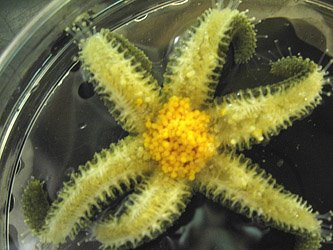
Leptasterias "hexactis", shown here with brooding eggs!! This is part of the Leptasterias species complex which I have written about here and here
and, of course, the good ol' workhorse starfish Pisaster ochraceus, which I will be writing up in the blog later THIS WEEK!!!

and just because they're so dang beautiful...these mollusks too!!! This used to be called Tonicella lineata, but I think the name's been changed recently...
....and back in the Paleozoic when I took Intertidal Ecology, this thing was called Calliostoma, but I gots no idea what the kids are calling it these days!
GO check out the Rocky Shore Partnership BLOG and I'll be back in a few days with some PISASTEROUS starfishy goodness for all o' y'all!

Sunday, March 15, 2009

A Big Deal over a Little Starfish: The Leptasterias Species Complex!!

Ah Spring! As the sun emerges and the tides on the west coast go out, so also the many marine biology students! And so too come the many welcome questions!!
One of the more common questions I've been getting recently has been about this little six-rayed starfish called Leptasterias.....
Its commonly found and is quite a resplendent little animal (in California only about 1-2 cm across).
Leptasterias is quite widespread, extending from the North Atlantic through the Arctic to the cold-temperate North Pacific (Alaska to Southern California). The species in California are nearly always SIX rayed, but the ones in the Arctic and the Atlantic are often five rayed. They are often found to brood eggs and juveniles (but this is a story for another day).

The name "leptos" (in Leptasterias) refers to the Greek for "small, delicate or thin" (with asterias meaning star) alluding to the small, delicate size that many Leptasterias spp. are known for (although some Arctic species can be quite large!)

Leptasterias is a great example of how evolution is both a vexing puzzle and fascinating conundrum for the interested biologist. How can something that is so well known, and play such an important role in our understanding of marine ecology ALSO be so evasive that we don't even know what to call it???

Species in this genus form what is called a species complex. Here is a convenient definition from Wikipedia:
a group of species which satisfy the biological definition of species, that is, they are reproductively isolated from each other, but their morphology is very similar (in some cases virtually identical).
Put another way, this could be interpreted as sort of a "snapshot of evolution" in the works...There is such subtle divergence among closely related species that they we can barely tell them apart!!

Since the late 19th and early 20th Century, scientists, such as pre-eminent starfish biologist Walter K. Fisher at Hopkins Marine Station, have recognized the difficult lines between species along the west coast of North America.
Breaking this down:
  • Leptasterias spp. are found in Southern California up through Oregon, Washington to Canada, Alaska (and the Aleutians) up through the Arctic Circle and down into the North Atlantic.
  • At the far ends of where they are found they differ substantially.. But between any two "species" that are physically close to one another? The external features that are used to tell them apart becomes REALLY close.
  • Several Leptasterias spp. in California for example-L. aequalis, L. pusilla, L. hexactis. All of the names have gone back and forth into synonymy about what is "valid". Walter K. Fisher identified dozens of "forma" and "subspecies" when he formally monographed the species in 1930, making identifications difficult at best.
Figurin' It Out...
In the mid 90s, David Foltz, a population geneticist (and colleague) at Louisiana State University in Baton Rouge and student Jon Flowers got involved with the Leptasterias questions and he applied a variety of allozyme and later molecular tools towards the many species of Leptasterias and its near kin.
Results can be found in a great many of his papers including this one, this one and this one.

They sampled primarily from Alaska to California and discovered several different lineages of Leptasterias...especially in California where they identified 6 apparently distinct cryptic species in Leptasterias "hexactis" and "aequalis"!!!
So, what do you call these?

Right now, this is a pretty tricky question which I typically answer as good news/bad news.

What's the bad news? We are only at the first step. What comes next is the 'synch' up between the molecular /DNA characterisation of the species in Leptasterias AND the taxonomy.
  • More sampling will be needed to further resolve the molecular picture
  • More taxonomy will need to be done to follow once the above gets done.
What's the good news? We have a good idea what's going on and it seems pretty clear about what will need to be done.

So, the issue is NOT that the taxonomy itself is hopelessly confused (altho it IS very complicated) but that it just hasn't caught up with some of the more.... formal nomenclatural "loose ends"...Give it time!

Believe it or not, Leptasterias isn't the "worst" species complex problem/question known out there... (either on the west coast of North America or the world....)!!!

Wednesday, February 11, 2009

Echinoderm Sex pt. 2! More ALL-Star PSEUDOCOPULATION!

Whew! Okay...so, where were we? OH yes... PSEUDOCOPULATION!!
I was surprised how many different starfish and brittle stars will "do it" And when and where does it occur?
http://farm3.static.flickr.com/2117/2257347026_00181fb348.jpg?v=0
One of the curious things I noticed was that all the papers out there note how it "optimizes fertilization success" or somesuch thing.. But the begs the question, if that's the case, then why don't all of them do it?

A mystery.

Almost all of the other taxa I was able to learn about were either temperate-cold water or lived in the deep-sea with Archaster being one of the only tropical species I was able to find info on as exhibiting pseudocopulation

Interestingly, in these other colder water taxa, pseudocopulation is triggered by a change (either an increase or decrease) in tempeature and the time to spawn is much shorter relative to the pseudopulation to spawn ratio in the tropical Archaster.

What else pseudocopulates?? Let's look at some hot starfish on starfish, brittle star on brittle star ACTION!! Bwucka Wow wow! indeed!

1. Leptasterias polaris
From a study by Jean-Francois Hamel and Annie Mercier at the University of Quebec at Rimouski is an account of the large six rayed Leptasterias polaris.
Leptasterias polaris is a typically solitary species UNTIL the early winter, around November-December, when they start to aggregate and become more...intimate..

Pseudocopulation became more frequent in early December and peaked just before the main spawning period in late December as the water temps reached a range of 3-4 degrees.

Unlike Archaster..there is no sex-specific order..just big clumps of Teh pseudopsex!

Then in January..it stops and the stars go back to ignoring each other.

2. Neosmilaster georgianus
From the Antarctic we have the asteriid starfish Neosmilaster georgianus as reported by Marc Slattery and Sid Bosch!

N. georgianus was reported to reproduce throughout the year but the pseudocopulatory behavior was observed in the austral spring/summer in September/October.

Before the action starts, there is "exploratory contact behavior" as the animals touch each other up with males initiating contact with females.

This is followed by the males mounting the females (so in this species the female is on the bottom). Sometimes 3 or more males will be involved... But in all cases only the bottom one is female!

Because the attraction of males to females is thought to be rooted in pheromones or some other chemotactic stimulus, its possible that one male pairing might actually attract other males to a reproductively active female!

This whole thing takes place over the course of minutes to hours. Interestingly, pairing events were observed to be relatively rare throughout the population studied.

Spawning happens a few hours later (as opposed to 2 months in the tropical Archaster)

On the whole, this suggested that at least for the study area, reproduction occurred at low rates throughout the year.

3. Ophiura robusta

Finally, a neat article on Arctic/subArctic pseudocopulation and other "aggregative" reproductive behavior from the Gulf of St. Lawrence by John Himmelman and others!

Their paper not only observed mass spawning in ophiuroids but also the asteriid, Asterias vulgaris (=Asterias rubens). Perhaps something like this?
IMG_0210
Among these ophiuroids, including Ophiura robusta and Ophiopholis aculeata, some would wrap its arms around the central disk or engage in a seething orgy of reproductive optimization!! in which 3 to 5 of individuals would wrap their arms around each other!!
The first individual to spawn was observed to be male, followed by the females, suggesting that there is some pheromonal or chemical cue.

Interestingly, animals in this region began their spawn in the summer (as opposed to Leptasterias polaris which lives in a similar kind of environment) in reaction to increasing (vs. decreasing in L. polaris) temperature!

Ultimately, these would spawn, with animals crawling up to high platforms or elevated surfaces with the disk raised to "optimize fertilization success".

This gallery has some AWESOME pictures of ophiuroid spawning with this posture..

4.
Unknown Deep-Sea Bahamian ophiuroid.
sorry. I got nothing on this.. But pretty cool, eh? I'm not even sure what species? Maybe Ophiomusium?
So..on that note...have a great pseudocopulating weekend!