 |
| Image taken by Barry Fackler |
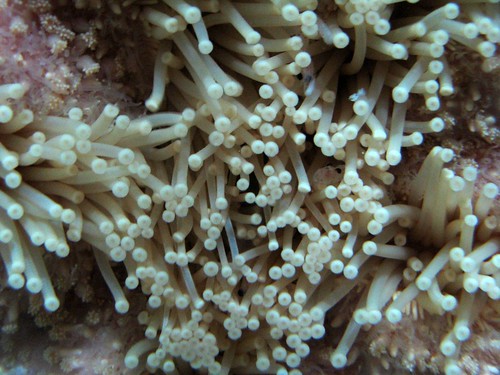
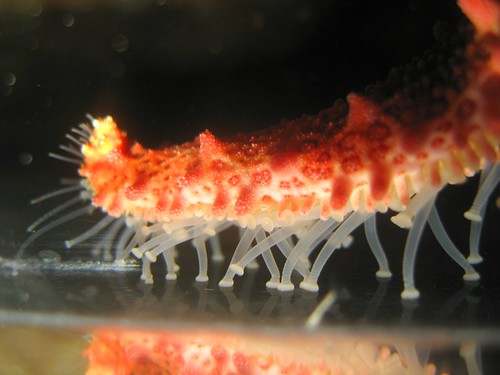
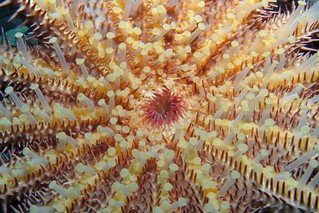
A few months ago, I wrote a post that summarized ongoing developments showing how the tube feet in echinoderms (best seen in sea stars and sea urchins) was primarily based on a 2-part glue/adhesive system.
Do tube feet actually use suction as has been historically thought/taught??
The whole "tube feet use suction" paradigm is a powerful one that has been observed since some of the earliest work on starfish in the 1840s.
Its a powerful and seemingly straightforward idea. Tube feet have what appears to be a suction cup on the tip of their tube feet, and so, therefore, shouldn't it work like one??
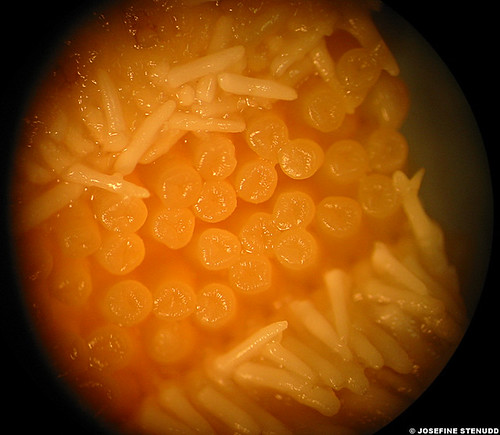 |
| Image by "ratexla"/Josefine Stenudo |
The suction cup idea is pervasive and can be seen in many pop culture references.
How pervasive? The authors of the paper I use below cite Peach the sea star from the recent movie Finding Nemo by Pixar- Peach uses the popping sounds that one associates with a rubber sucker!!

A new, recent paper from the bioadhesion labs of Patrick Flammang in Belgium, and Romana Santos and Elise Hennebert in Portugal have demonstrated several experiments that in fact, tube feet rely on adhesion (as outlined here before) and NOT on suction. This paper is OPEN ACCESS and can be found here at the Proceedings of the 7th European Echinoderm Conference!
The paper is important to people who study echinoderms but is very straightforward and pretty easy to understand... The authors work primarily on two species as test subjects:
The common N. Atlantic sea star Asterias rubens
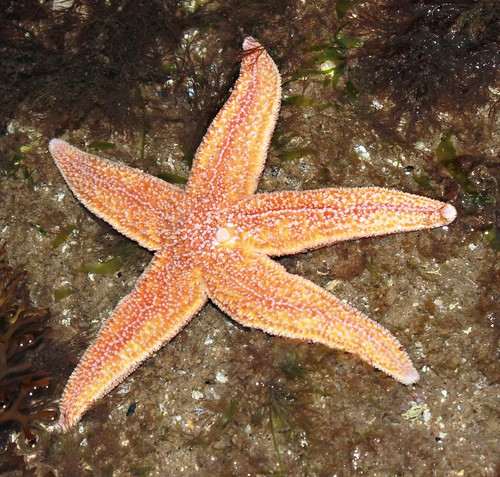 |
| Image by Juncea |
and the European urchin Paracentrotus lividus...
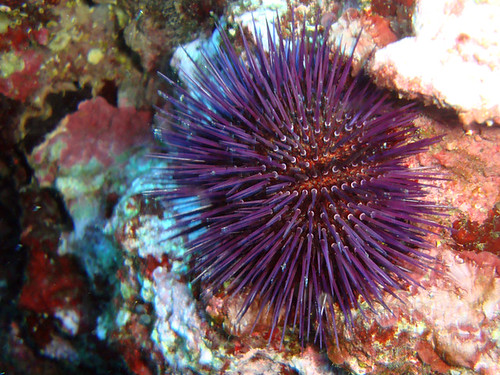 |
| Photo by Marco Cortesi |
Even before this recent work on adhesion in tube feet, there had been indicators, some years ago that suction was not the only force in tube feet at play. Why?
First-A study from 1985 (Thomas & Hermans) showed that echinoderms have been observed adhering to screens, meshes and grates-so how would a suction cup work if they were being applied on a porous surface with no way to create a vaccum?
Second.Tube feet leave footprints such as this one which leave behind residue suggesting a glue or adhesive was at play..

1. Observing the tube feet directly!
The physics of your basic suction cup model is pretty straightforward. The suction cup creates a large suction cavity between the attached foot and the substrate (i.e., the ground).
When you put a suction cup down, you press the top down and pull it up. This creates the suction cavity that attaches the suction cup to the ground..that's what you would expect.
Tube feet from Asterias (the starfish) and Paracentrotus (the urchin) were sampled immediately after it was clear they were attached, and photographed with a Scanning Electron Microscope. Histological (i.e. tissue) sections were also taken...
The top two pics (A+B) show an unattached tube foot.. But C through F? all show those attached to the bottom.
 |
| Figure 1 from Hennebert, Santos and Flammang, 2012 |
The authors indicate that suction may still play a secondary role, serving in conjunction with the adhesion/glue but for the most part it doesn't look like suction is a primary influence here.
2. Measuring the Attachment Strength of the tube feet
A. Measuring the strength or tenacity (in terms of Force or Tenacity) of sea urchins as they hung from a glass plate at different angles.
They tested the adhesion of the tube feet on glass relative to detachment force (how hard they pulled) and pulling angle (the direction). That is they tried to pull it off and at different angles on a smooth glass surface.
B. Measure strength and tenacity on a porous bottom

CONCLUSION! And so, not only has prior work (see earlier blog post) shown the huge role of adhesion/glue in the way tube feet work but now, the original historical model..i.e., tube feet use suction has been pretty effectively undermined if not disproven outright!
Its possible of course that there are further refinements to how all of this works in sea cucumbers and crinoids but starfish and sea urchins have always been the "model organism" for studying tube feet in echinoderms.
They tested the adhesion of the tube feet on glass relative to detachment force (how hard they pulled) and pulling angle (the direction). That is they tried to pull it off and at different angles on a smooth glass surface.
 |
| fr. Fig. 3A in Hennebert et al. 2013 |
If this were truly suction then the tube feet would slide (i.e., no resistance) and the amount of suction would decrease. There was no (or at least no statistical) relationship between the detachment force and the pulling angle.
B. Measure strength and tenacity on a porous bottom
This one was more straightforward-if tube feet are anchored by suction, then an imperfect bottom (i.e. substrate) won't really work well as a good anchoring ground.
The authors used a sheet of plastic with holes present in the surface. They measured tube feet with a device that measure the force and tenacity and then recorded the footprints based on whether they completely, partially or did not cover the holes.
Prediction: If the tube feet use suction-the force measurements for strength and tenacity would be significantly affected. But if adhesion was at play, then the holes should make no difference.
Basically, this experiment mirrors the early observations of watching starfish or urchins moving around on a metal grate or mesh. How important can suction be if the animal can move on a non-porous surface?
No statistical differences were found between the different groups (i.e., the tube feet that walked over a complete, partial or covered hole).
Its possible of course that there are further refinements to how all of this works in sea cucumbers and crinoids but starfish and sea urchins have always been the "model organism" for studying tube feet in echinoderms.
One of the oldest and most widely known perceptions about echinoderms? Not the case. Evidence is slowly building up against it and an important lesson in science that even the most long-standing ideas can be overturned when you look at the facts with the right questions!