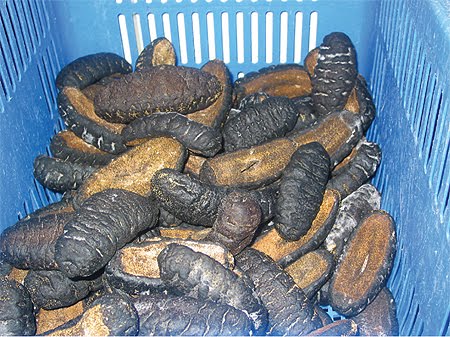
Today- SEA CUCUMBER STUFF!
yeah, yeah, cukes get all the good stories! This is based on
a new paper (2010) by Wolkenhauer et al. in the Journal of the Marine Biological Association of the United Kingdom which examines the role the tropical Indo-Pacific species
Holothuria scabra and its relationship with tropical seagrass beds!
The subject species,
Holothuria scabra is a widespread Indo-Pacific species. It occurs in Asia, Australia and Madagascar in the Indian Ocean in sandy, shallow-water, eel grass beds. Presence below indicated by yellow...
 (this map from OBIS-here)
Its a pretty neat beast. It can actually BURY itself into the sandy substrate. Presumably, it is this aspect which earns it, the common name the "SANDFISH".
Yes, if you thought "starfish" was bad.."Sandfish" is even worse and will make your broil in your juices!
But what makes, this beast, such a focus of concern is that
H. scabra is a widely fished species which has, in some
places has seen complete population destruction from overfishing. (here)
This has motivated MANY studies in sea cucumber ecology and biology. Why?
Because when you remove them, WHAT happens to the habitat they're taken from?? WHAT was their ecological role BEFORE they ended up being sauteed with mushroom sauce??
The STUDY
Wolkenhauer et al., undertook their study in Moreton Bay, in south-east Queensland in Australia in 2003 and 2004.
The authors tested the presence/absence/density of
H. scabra relative to its surroundings.
They caged areas off and separated places where cukes were either present/excluded/ Or impeded by the cages.
The authors are careful to note that their study was potentially affected by the time of the year and the number of replicate times they performed the study...but the outcome and its impact remains important.
They also surveyed the sea grass species (
Cymodocera serrulata) checking biomass, size, dry weight and several other factors relative to the abundance of the sea cucumbers in the caged areas.
The RESULTS The short version is: Removing sea cucumbers AFFECTS SEA GRASS systems. In the words of the authors: "seagrass systems may suffer in the absence of holothurians..."
Now, for the sake of space, I'm not going to include EVERY little bit of uncertainty and statistical variation in the data but I will boil it down and say that while there is still DOUBT, there is definitely some signal that suggests exclusion of sea cucumbers from an area will affect seagrass productivity. but here are some choice bits...
Losing Seagrass....
Here is their Figure 3, which shows the two experiments showing average seagrass productivity during the 2003 and 2004 experiments. In this particular experiment
examining seagrass biomass there has been a significant decrease over the study period when the cucumbes are REMOVED.

So, what is it about sea cucumbers that makes sea grass beds THAT much more productive when cukes are around??
By ingesting all that sediment and sand and burying itself in the sediment, this kicks up all of the good organic food into the water and can knock loose food and nutrients that would be usable by the seagrass bed and other nearby plants and organisms.
Seagrass beds might also be taking advantage of sea cucumber "ammonium excretions" (which some humans would call "pee" but I would not) into the local ecosystem., thus feeding the surrounding plants and animals.
How much affect would this have??
This paper is one of the foundations of understanding how this "nutrient cycle" could work..
As we've seen before, Sea urchin poop is an important
force in kelp ecosystems... (click here to see).
Nutrients and Why tiny Algae is important..
Their Figure 4 shows change in benthic microalgal biomass.
Basically, the amount of organic matter present.. clearly increases when sea cucumbers are excluded (EX below).

To quote Egon Spengler "Peter, that would be BAD"
Why? Well, it turns out that with NO holothurians eatin' their algae, bacteria and detritus, you actually see an INCREASE in the certain organic materials.
There are other studies in subtropical settings which show that algae and bacterial production is REDUCED when sea cucumbers are GRAZING. Up to 10 to 40% of bacterial carbon produced in the summer is apparently taken by sea cucumbers.
This is conceivably a HUGE impact on the productivity of a region!!
With the cukes gone, who eats the bacteria????The full impact of this hasn't been totally explored but just some hypotheticals you may be familiar with-
What happens in your aquarium tank when you've got too much nutrients and bacteria again???? Your nutrient balance is out of whack. Think of your stomach suddenly producing too much gas. Or a lake with too much algae.
Conclusions: What Do We Take Away from This?
There is a logical chain of events/implication from Wolkenhauer's results.
Sea cucumbers are part of the "natural filtration" function that seagrass beds serve in marine ecosystems.
By burying themselves and freeing up the sediment, they encourage other ecological interactions around them which causes the flow of nutrients and so on.
REMOVAL of sea cucumbers from this system through destructive overfishing, could conceivably harm the seagrass bed/seagrass system

And why save sea grass?
Well, for one thing, other commercially fished FISH and many other species live there. But they serve to filter nutrients and chemical inputs to the marine environment among other reasons. which can be found at
Sea grass Watch.org. But to boil it down:
Seagrass beds are ecologically IMPORTANT.
Removal of just this ONE species,
H. scabra showed an impact on the system.
Could the lowly sea cucumber could potentially be the ecological lynchpin to the ecological health of seagrass beds??