|
| From J. Mallefet's Lab Page |
Their evolution is replete with adaptations to survival that are kind of mind blowing but as with all insanely unusual things, the ideas can be a little unsettling and frankly... a little SPOOOOKKKYY................
1. They don't seem to know when to die...
Most biologists have noticed that echinoderms don't quite die immediately when threatened with the kind of life-threatening injuries that many would consider life-threatening. Or else..its the WRONG part of the animal that seems to go on living... [Yes, some do regenerate (and that will be a subject for a future post!) but not all.] Some examples:
The Story of Stumpy
Here is a true story (although I don't remember who told me this story originally)
Years ago, following a lab accident or perhaps a crab run amok, the disk and 4 arms from a sand starfish (Luidia clathrata) was separated from the mid to end part of its 5th arm.

Contrary to popular myth, not all starfish can regrow a complete body from just the arm. This one certainly could not.
This separated arm tip (which was named "Stumpy") was kept in the water table and continued to move around for weeks to months...(I honestly don't remember how long but it was a long time).
Stumpy was even "fed" clams, which it apparently moved via tube feet to where it thought the mouth was. These clams would move up the tube foot groove and then just...fall out when it reached the disk location. No disk! (and thus no mouth)
It was never clear to me if Stumpy just sort of died on its own or if it creeped everyone out so much that they eventually just preserved it in the lab somewhere.
This isn't necessarily unusual "behavior." One can often observe the arm of a brittle star sometimes continue to move long after it is separated....
Presumably a combination of the unusual radial nervous system and the separated body part's ability to sustain itself using sea water (and nutrients) were responsible for this tenacious behavior?
But why believe an echinoderm zombie story when you can simply watch it...
Here is a "Zombie" Sea Urchin..The animal is broken open with insides removed and yet....IT LIVES
And another...
But on the OTHER hand.....
2. Uh... Do Echinoderms ever die of natural causes??
As a person who has worked in and out of museums and aquariums, one of the things you notice is how some species kept in captivity become bigger and bigger..
Some species such as Pycnopodia helianthoides (from the North Pacific coast)
 |
| Photo by Allison Gong |
 |
| Photo by Mr. J. Volz |
Now, to be clear-they do die. Diseases, aquarium mishaps, introduced predators and so on.
But under optimal conditions?? I have had people watching these cold water species live on for over 10 years (but I'll be honest I would need to verify) and more than once I've been asked "Do they EVER just die of natural causes??"
And honestly, I don't know if they do. Some accounts from the 1960s reported that they became "reproductively senile" but this account was speculative.
The idea of echinoderms as long-lived is not necessarily new. Here is a post I wrote back in 2009 about how ancient sea urchins can get.
So next time you go into say hello to a large sunflower star at your local aquarium-pay it some respect. It might be much older than you are...
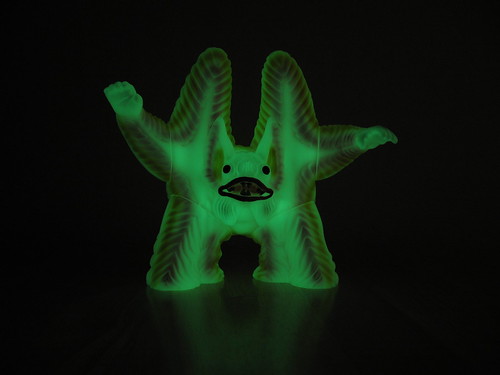
3. Some of them GLOW in the Dark!
There is a whole POST worth of stuff on bioluminesence in echinoderms! And at some point in the near future I will write up more about it..but for now accept that a LOT of echinoderms glow!
|
| Image from J. Mallefet's lab page |
Most people seem to have a fairly benign impression of echinoderms. Harmless shapes that sit on the bottom of the sea floor that make up part of a dreamy seascape...
Here at the Echinoblog I've done everything I can to change this image!
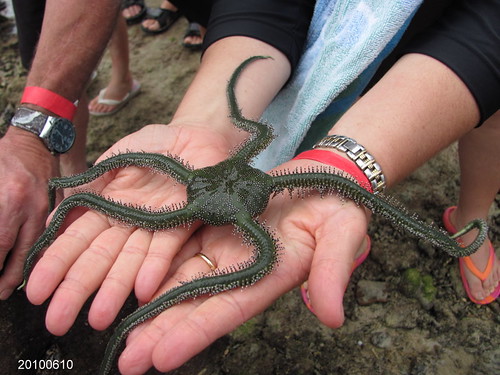
Many starfish and brittle stars can capture MOVING prey and do so in a variety of surprising ways. Imagine ANY of these things as dog or even COW sized and humans would be more respectful of the humble echinoderm...

And just for good measure? Here's an earlier post featuring brittle stars that capture squid or fish if they come too close, rending it apart into pieces!! click here.

5. Dried Echinoderms are MUMMIES, NOT shells
This is probably one of the more macabre things that I've made note of before. Undoubtedly we have all seen starfish decorations for the holidays and weddings??
For example- here's a huge 50 rayed starfish from Antarctica-Labidiaster annulatus which is not only sizeable (up to 2 feet across) but it catches MOVING KRILL with its arms and devours them alive! (yes I've mentioned it before but its one of my favorites!)

And here is the giant tropical brittle star Ophiarachna. Go here to a bunch of links about how this monstrous giant (sometimes) green ophiuroid captures moving fish prey!
And just for good measure? Here's an earlier post featuring brittle stars that capture squid or fish if they come too close, rending it apart into pieces!! click here.

5. Dried Echinoderms are MUMMIES, NOT shells
This is probably one of the more macabre things that I've made note of before. Undoubtedly we have all seen starfish decorations for the holidays and weddings??
 |
| A sad Pisaster ochraceus |
 |
| sad Linckia laevigata |
When sea star (or ANY echinoderm) is prepared dried this way?
This isn't the same as some shell. There is/was skin on them. THESE ARE MUMMIES.
What you are doing above? Is like putting funny clothes on a skeleton or a mummy like this... (which I suppose is fine if you realize what you're doing..)

HAPPY HALLOWEEN!!