 What are those holes in Sand Dollars for???
So..probably everyone has SEEN sand dollars or knows what a sand dollar is... (just fyi..they are highly modified sea urchins!).
Most live in shallow tropical to temperate water environments all around the world. They largely live in unconsolidated sediment on organic detritus and when they die, their bodies (also called a "test") frequently wash up on beaches and such..
They come in a wide diversity of shapes and forms. If you live in colder type northern climates, you think of sand dollars as looking like this:
 (Echinarachnius parma from the NHM database)
BUT if you live in tropical climates, sand dollars look more like this...
These are familiar to the tropical beach-goer and names such as "keyhole sand dollar" or "keyhole urchins". One of the most obvious features are the presence of BIG holes or prominent notches on the sides of the test (aka the body). These are called lunules.
This is their story.
The data and results for this are taken from a neat paper by Malcolm Telford (1981-Hydrodynamic Interpretation of Sand Dollar Morphology. Bull. Mar. Sci .31(3):605-622) who takes a biophysics/ hydrodynamic interpretation.
Our understanding starts with this basic tutorial on (oddly enough) how airplanes fly.
While watching this, replace "airplane wing" with "sand dollar"
Let's take a peek!
Okay...So, what's going on here?
Sand dollars, such as Echinarachnius, tested with wind tunnels and dye+water flow simulators where lunules were ABSENT showed a relatively high coefficient of lift!
What that means is that the same pressure differential that makes airplanes fly is accomplished more easily where lunules are absent.
Essentially the hydrodynamic flow moves over the discoid form of a sand dollar like Echinarachnius smoothly and easily.

But what happens with a "keyhole" sand dollar such as Encope or Mellita??
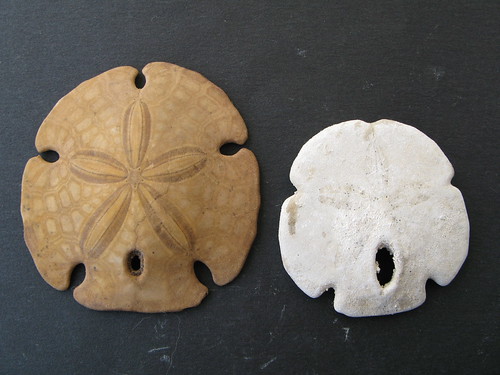 |
| Image by Jani Oravisjärvi |
Lunules REDUCE lift either by interfering with hydrodynamic flow or by "relieving" pressure from the under surface!! i.e., they INTERRUPT and LOWER the coefficient of lift!
To put this simply..they KEEP THE SAND DOLLAR FROM BEING "BLOWN" away!!
 One quotation from his paper sentence sums up the important bit very nicely
The lunules of Mellita reduce lift by providing channels to bleed off excess pressure from the oral surface. This is shown by the clear flow of water (which was marked with dye)...through the lunules.Telford used three different sea urchin tests as models, and each one had its own specific modifications and stories..

For example, the edges of the body and around the lunules of this Encope for example are actually modified into pressure drainage channels (i.e., places where lift is further weakened)!
Subtle modifications, such as the absence of tube feet in these areas are also present.
After seeing how lunules and notches can affect and help these animals from attaining "lift-off" one has to wonder then, what happens with critters like these rotulid sand dollars with the odd notches and lunules below??
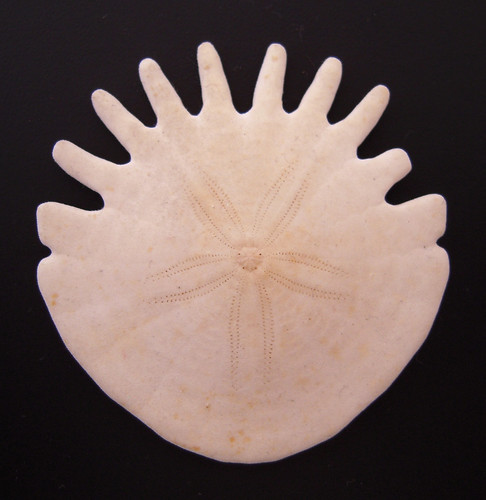 |
| Image by Bellwizard via Flickr |
 |
But how do the urchins WITHOUT lunules solve this problem?? Go here to see all about sand dollar weight belts!

