Showing posts with label teeth. Show all posts

Wednesday, June 15, 2016

Sea Urchin Biomimicry! Echinoids Inspiring Applications from knives to glue!

Tiny teeth
Its been awhile since i've done a "What have we learned from Echinoderms?" type post.. So, this week a news round up about the utility of sea urchins and their inspired applications!

Although I talk about several different inspriations, two of the stories below focus is the elaborate jaw mechanism in sea urchins known as Aristotle's Lantern! A nice basic definition can be found at the Echinoid page on The Natural History Museum in London (here). 

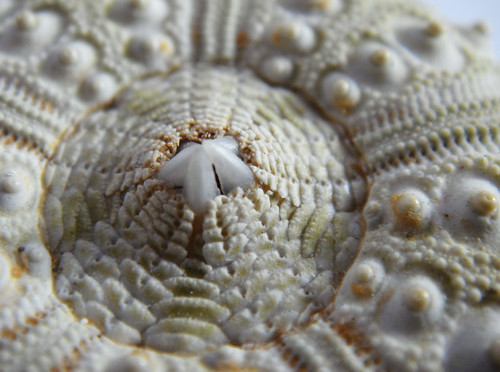
Aristotle's Lantern is this weird yellow piece in the picture below. These sit over the mouth opening and the "teeth" or jaws of the sea urchin emerge through the bottom..

This illustration gives you an idea of the orientation
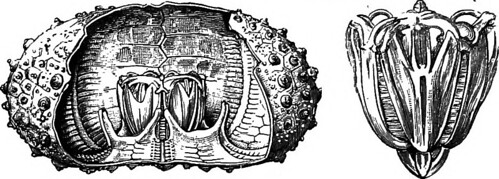
Image from page 201 of "Elementary text-book of zoology" (1902)

And here's a video that allows you to see the teeth emerging through the oral opening and back again. 
Urchins use these teeth to rasp algae and other food off the substrate. They are quite effective when one considers just how much algae a sea urchin eats!

ALL of the stories below are part of a field known as biomimicry!

Basically, taking the idea/engineering from ACTUAL biological structures that have demonstrated effectiveness and reverse-engineering them so that they can be used in industrial or other applications!! Urchins have been quite the inspriation of late! Here's a round up of some of the recent and more interesting ones!

1. Self Sharpening Blades/Knives! 
Based on this account in Advanced Functional Materials and a summary in National Geographic (here) sea urchin teeth were studied with x-rays and determined to occur in separate layers with different structural textures which are interlaced between softer organic layers.                                       
One of the textural layers breaks very easily but is also replaced very easily. These areas get "torn away" whenever the teeth on sea urchin jaws are used.. but are also replaced quite quickly! 

Thus, functionally, the teeth grow continuously and are thus CONSTANTLY being rejuvenated and are essentially always sharp! 


2. Sea Urchin Jaws Inspire Space Exploration??

You can also just watch this video account of the whole thing...

Here's an Italian "bionic model" of how the Aristotle's Lantern jaw might work.. Kind of similar to the way a claw in one of those arcade "grab claw" games works! 


3. Architecture: Urchin Test Shape distributes Stress! 
Its been commented upon at sites such as these that the "oblate" shape of sea urchin skeletons (i.e., the test) is very effective at distributing stress evenly over the surface. Thus, the shape of urchin skeletons might actually be useful for inspiring better shapes in building! 
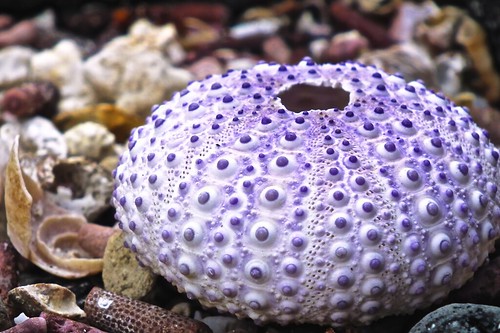
urchin test
...and then of course, there's the TARDIS in Doctor Who! 


4. Sea Urchin Spines Inspire Idea for Concrete! 
A paper by Seto et al in PNAS from 2012 studied the physical structure of sea urchin spines and discovered that they were composed of crystals that were bound together with a second type of calcium carbonate, acting as sort of a mortar, but with no crystal structure. These give the spines a highly resistant texture that suggest a better way to make fracture resistant materials.  A summary of this was in this BBC story.  and yet even more can be found on this blog about Mesocrystals and concrete! 
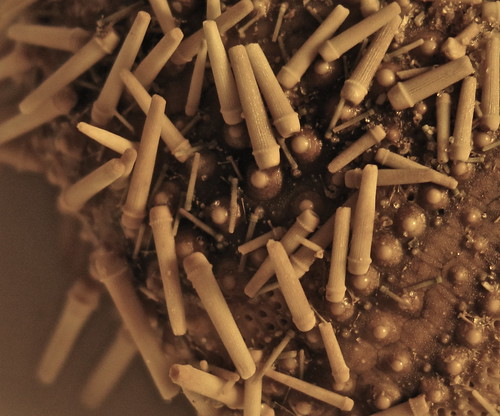
Sea Urchin spines
5. Adhesives!
Amazing sea urchin tube feet

Instead of "suction" as had been believed for decades, it turns out that urchin tube feet work on a chemical adhesive basis! In other words,, they STICK instead of SUCK!  You can go through a brief summary of these details here. 

These provide a lot of potential for marine adhesives if the means of adhesion can be understood and "reverse-engineered"!

Other posts in the "What good are echinoderms" series to be found HERE   
and here! 

Tuesday, February 5, 2013

Brittle Stars Have TEETH! What do they use them for?

Brittle stars are everywhere. They are the most speciose of all the living echinoderms with over 2000 species (probably MUCH more than that!).

At this moment in time, for studying brittle stars we live in a privileged time because we have several new workers who have taken to studying the various and weird lives of brittle stars!

One distinctive feature of brittle stars that researchers that study morphology have always known about are the unusual jaws present on the mouth of brittle stars. These jaws vary between individual groups of  brittle stars. Its one of the fundamental ways that brittle star taxonomists tell them apart.
These jaws are superficially similar to the ones we see in other animals in that some of them have "teeth" (called oral papillae) and other features which distinguish them.

But other than their usefulness in telling them apart, what function do these "teeth" serve?

A recent open access paper by Karin Boos, an author at the 7th European Echinoderm Conference held in 2010 (available here) addresses and discusses how the jaws might function relative to the feeding biology of two European brittle star species.

First off, Boos reviewed the feeding modes of two species with fairly distinct jaws and teeth.

One of the studied organisms, Ophiothrix fragilis is covered with many needle-like and bristling spines...
Images below by Hsacdirk
Brittle stars. Ophiothrix fragilis.

In life, they hold their arms up into the water and are almost always observed in this position in order to obtain food from water currents. Ophiothrix is a filter feeder.

They gather up food on their arms, which is then moved to the mouth via tube feet.
Brittle stars. Ophiothrix fragilis.

The other species studied was Ophiura albida which is more of a generalist. A sort of opportunistic feeder. Sometimes scavenging on dead animals but sometimes feeding on other smaller animals.

Each species has a different life mode and presumably the morphology, i.e., the teeth of each species reflects how each individual species lives.
Ophiura albida
Image by Danielguip
A brittle star from a completely different group (ie. family) and with a very different set of choppers! Here is Boos' Figure 1 which shows the two "teeth" types side by side. Ophiothrix on the left vs. Ophiura on the right.
Figure 1 from Boos 2013
1. Predator? Or generalist? type jaw/teeth in Ophiura.
Boos takes some pretty nice profile images (her Figure 2) of the papillae (=the "teeth") that allow her to infer some function.
top of pic is the oral surface, bottom is top or aboral. Fig. 2d-3
Boos argued that these teeth are in fact "predaceous (=predatory) dental equipment". Note how all of the "teeth" (=the papillae) were pointy. These, Boos argues, are used in gripping or spearing captured prey before ingestion.

It doesn't take much to take this consideration seriously. Here is some classic video from Neptune Canada showing what looks like Ophiura sp. fighting it out with another individual over some food.


and don't forget this blog about "brittlestars of death" as we saw Ophiura sarsii attacking mobile prey! (vertebrates even!)

Other related members also have jaws/teeth that sort of look like this. Maybe more of these are more predatory than we thought?

2. Ophiothrix-Sharp teeth! 
Ophiothrix (and related genera of brittle stars) occur widely in temperate AND especially in tropical waters. They can be quite striking and colorful..
Electric brittle-star (Ophiothrix sp), GBR, Australia
Image by Arthur Anker
Blue lined brittle star (Ophiothrix lineocaerulea)
thanks to Wild Singapore!

Feeding in Ophiothrix is nicely shown in this video. Food caught on the spines, is moved by tube feet along the arm to the mouth, where the food ball, called a bolus is devoured.


Ophiothrix and indeed ALL members of the Ophiothricidae are well-known in the taxonomic literature for having these unusually striking types of teeth.
Here's a close up!  Usually with a very comb-like appearance... MANY papillae (ie teeth) on each "jaw"
From imaging these teeth in profile, Boos notes that the "teeth" are arrowhead shaped and pretty sharp but also pretty wide.

Boos states that this combination of "sharp" and "wide" serves to cut up and crush the bolus of food as it enters the mouth. Boos argues that the teeth would also be effective for devouring diatoms and/or grabbing parts of or complete  invertebrates in addition to big chunks of scavenged flesh.

And onwards? 
There are LOTS more brittle stars where that came from...  As I had indicated earlier, the "jaws" and "teeth" have been used heavily to classify and identify brittle stars but none were really good at understanding function...

Boos's efforts are a start. Interpretation of these structures has been surprisingly unseen in the literature. 

This for example, is an ophiacanthid from the Atlantic..
                                  
 Has a jaw similar to that of Ophiothrix....kinda.
And this euryalid ophiuroid (aka a serpent star)
expl2355

Further data from observations of actual feeding and perhaps even closer observations with x-rays and measurements of brittle star biophysics may give us more insight into how brittle stars feed!