Showing posts sorted by relevance for query Paris. Sort by date Show all posts

Wednesday, October 23, 2013

Paris! The city of lights? Or the city of the Octopus?


October 26, 2013. UPDATED with more! 

PARIS! I've just arrived and hard at work with my colleagues at the Museum national d'Histoire naturelle!  But this week has been crazy. Wi-fi down, taking care of last minute projects and so forth on top of travel and jet lag.

So this week the blog is about a curious set of street art I've seen. OCTOPUSES all around Paris! 

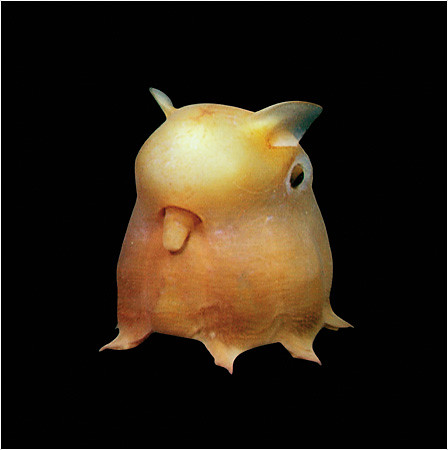
These are often painted or posted surreptitiously around Paris in strange corners and rarely travelled nooks around the city. Based on the arm length and overall appearance they appear to most closely resemble the "dumbo" octopus -something like Grimpateuthis or Opisthoteuthis but I'm pretty sure the artist has mainly taken the image from his own imagination...
                           dumbo octopus

This one actually bears a striking resemblance


They all have the same basic shape but vary by character....  The following I have seen...


These I found on Flickr and elsewhere...  
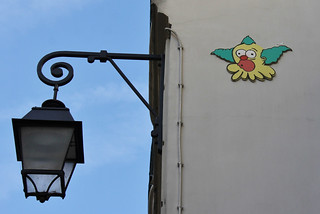
KRUSTY! 
Gzup_8449 rue du Temple Paris 03
image by meuh1246
The old Japanese superhero Spectreman! 
Gzup_3585 passage Lisa Paris 11
Image by meuh1246
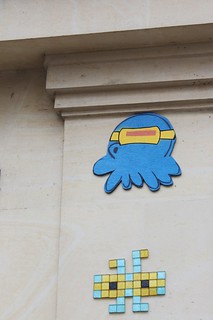
Cyclops from the X-Men
Gzup_5111 rue Vavin Paris 06
Image by meuh 1246
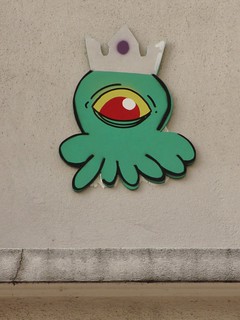
King cyclopopod! 
Gzup_8666 rue Jean-Marie Jego Paris 13

and extra bonus! GIANT CEPHALOPOD mounted on a Paris building wall!


Some Halloween fun next week!

Tuesday, November 29, 2011

Treasure! The Funky and Exotic Sea Urchins of Paris!

I am continuing my ongoing blogs from Paris for the next month or so, where I am working at the Museum national d'Histoire naturelle!
When one thinks of Paris, one envisions all sorts of exotic and wonderous experiences- postcards, people, exotic burlesque shows, and food...
From the perspective of a biologist, the museum in Paris is EQUALLY exotic!

Why? Because the Paris museum (the French equivalent to the Smithsonian's National Museum of Natural History) receives MANY specimens from exotic, deep-sea locales around the world.

Because I don't typically get access to many of these specimens, I thought I would share some choice samples from the collections with all of you..

How exotic are these?

Well, to start-I'm not entirely certain that everything I'm showing you below has actually been described in the scientific literature... MANY new species await discovery in the French vaults..
Goniocidaris from deep-sea habitats in the tropical Indo-Pacific..
The most obvious feature here being the bizarrely shaped spines that look like big inverted umbrellas!
A second species of Goniocidaris (also from the deep-sea Indo-Pacific)

Instead of the large spines ending in big flattened horn-thing, these spines are lance-shaped and have a progression of smaller and smaller spines and flanges..
What do the unusual spine shapes do? How are they adaptive? Defensive? Reproductive?

I wrote a blog about a similar cidaroid sea urchin called Psychocidaris. (click here to see!)

Here's a big, deep-sea sea urchin the size of a pumpkin called Echinus melo!
Another large animal that we know practically nothing about...
And finally, we end with one of the more exotic sand dollars.. a genus called Rotula from the African coast in the tropical Atlantic..
Weird are the many strange flanges and holes! What do they do?

Well, in other sand dollars they deflect the hydrodynamic flow.. Go here to see this explanation!
and just for kicks..here's the bottom or ORAL SURFACE of one.. yes-even these weirdly shaped sand dollars have the tiny, "fur-like" spines covering them and with the channels that lead to the mouth...
More next week...as Echinoblog in Paris continues!

Monday, December 1, 2014

The Strange Deep-Sea Ophiuroids of Paris! Featuring Dr. Tim O'Hara!


Bonjour once again!! So, my trip to Paris has all but ended and I'll be returning to the United States in a few days. The trip has been a challenging one. The laptop crashed and was out of the loop for two weeks and left me without a computer for data collection and etc..

So, much of my trip has been "old school".. working with paper and notes labelling jars with species names as best as I can...
Although data collection has not been as efficient as I like, I have done the Paris Museum (my host) some good by identifying a massive number of specimens in the collection...
I not only got through many of these older specimens but several of the newer ones as well...
All said and done, I've identified around 900 specimen lots for the museum. Given that Paris probably contains the largest collections of asteroids in the world, that is no small feat!!

But one of the GREAT things about this trip is that my visit, inadvertently overlapped with a trip being undertaken by one of my colleagues. Dr. Tim O'Hara at the Museum Victoria in Melbourne, Australia!! One of the world experts on ophiuroid systematics and ecology! 

I have written about Tim's work before:
  1. This new species of the Australian starfish Tosia, which was described by one of his students.
  2. This fantastic biogeographic pattern in brittle stars which he published several years ago! 
  3. Tim was also the one who identified and, in part, documented "Brittle Star city"
Tim and I are friends from waaaay back. We worked together in the museum in 1999 before either of had our PhDs and its strange to think of that being almost 15 years ago...  

I had a great chance to learn about weird brittle stars from Tim and so I did!!

Learning about weird, deep-sea brittle stars with Dr. Tim O'Hara from Museum Victoria! 
Tim was working with deep-sea biologists at the Paris Museum who are interested in New Caledonia.  (I am one of them).  Some may remember that this time last year, a huge new marine reserve was created in the New Caledonia region. 

Thus, Dr. O'Hara's ecological and taxonomic expertise was brought to bear... not only to identify brittle stars...
but ALSO to share his new cutting edge research with the greater scientific community! A recent paper by Dr. O'Hara has used cutting edge "Next Gen" technology, using over 425 genes to reconstruct the "family history" of the Brittle Stars.  

Its noteworthy not only for the fact that he used an exhaustive amount of genetic data, but he was able to sample and identify ALL the brittle stars necessary for the study! Not an easy feat when you can count the total number of brittle star  taxonomy experts in the world on one hand! 

Here is Tim giving the presentation to a full room of French scientists and colleagues (myself included) in the Paris Museum...

The important part of ALL of Tim's work is being able to identify all of these strange, deep-sea brittle stars from distant parts of the world...  and he was happy to share several of these with me...

1. Amphiophiura insolita!! Don't know much about it, but its got a spectacular rose-like disk pattern...
This specimen of Amphiophiura bakeri was huge! Almost 2 cm across! It looked like an egg had grown five arms! 
2. These two different species of the deep-sea Ophiomusium make it easy to see why brittle stars are so difficult to work with and identify.


3. The tiny male living on the large female Ophiosphaera insignis!!  Notice all the white arrows.. Those point out the arms of the tiny, smaller male.  He lives on the female.

Its unusual for there to be two distinct sexes in echinoderms. In this case, it is thought that this might be a pattern similar to that observed in anglerfish. The male is essentially a parasite on the female. 


4. One of the strangest of deep-sea ophiuroids is almost never seen by most people. This is the ophiuroid Ophiomyces, which has this bizarre sac-like disk membrane..  


Its certainly freaky enough that its hard to believe that the picture really captures what the animal looks like, so here's an actual specimen. Its only a few cm across..
Here's one museum specimen, which as treated with metal for scanning electron microscopy...Its still kind of a surreal looking animal....
  

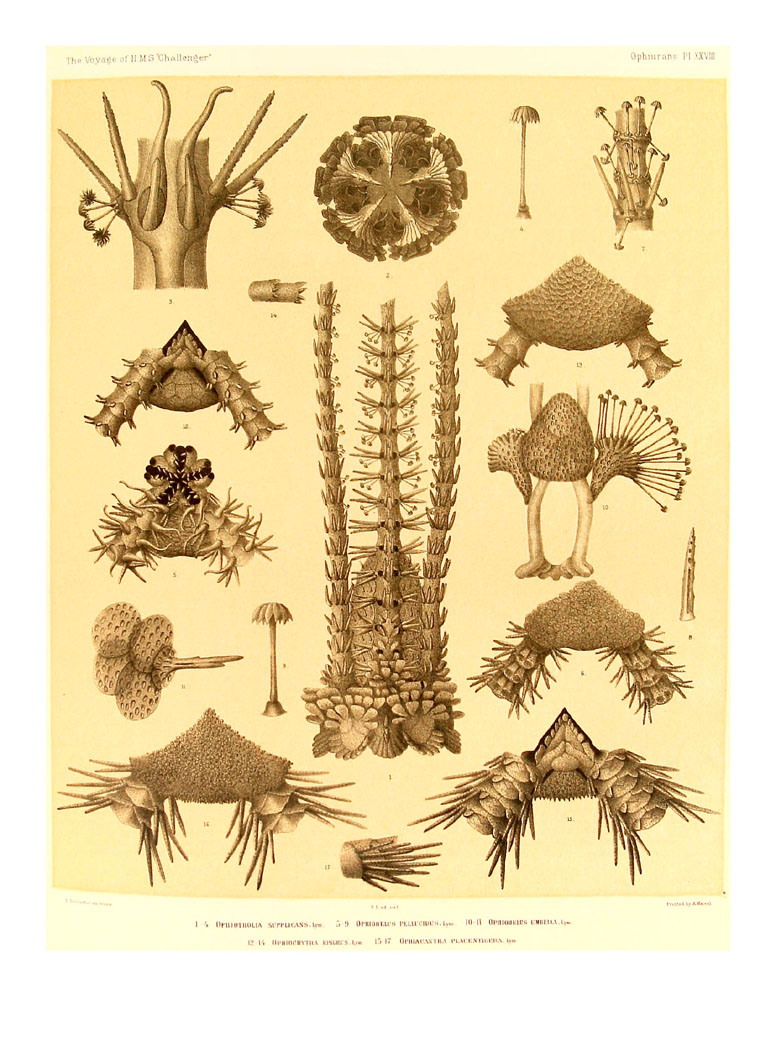
5. A related brittle star is this genus, Ophiotholia, which differs in having funny little hooks on its spines... but has a more distinctly conical disk and specimens are always found with arms locked upwards.

Again, a fairly small animal, only about 1-2 cm across. The drawn image on the left is from a plate of this species from the HMS Challenger vs. the right one which is an actual specimen...

       
And amazingly, thanks to all of his molecular work, Tim now also has a very good idea where these strange critters go in the big "tree" of ophiuroid evolution!! 

Ophiuroids are just a whole bunch of crazy sh*t that just makes my mind POP!!