Showing posts with label cidaroid. Show all posts

Wednesday, November 18, 2015

Paris! Urchins in Abstract!

This week: more showy echinoderms from one of the greatest museums in the world! Paris! Here's another study in abstracts-focusing mainly on sea urchins!

Last week was all about starfish mouths & their spines, etc.

I've blogged before about sea urchins from Paris. Here's one...

and an older one..

And a similar type of blog from my visit to the natural history museum in Tokyo! 

Alien landscapes? Weird colors? Vs. Spines, mouth plates and sea urchin skeleton! Enjoy!

The duo colored spines of the urchin Salmacis
The "teeth" of a "pancake urchin"

Oral spines on this cidaroid urchin. Yikes!
The naturally orange colored spines of this cidaroid (Compsocidaris?)
Natural green and purple stripes on these urchin spines!
More green and purple colors on this cidaroid urchin!
The large crazy spines of Goniocidaris and what lies beneath! 


Friday, September 25, 2015

Know your Deep-Sea Urchins! (Okeanos echinoid edition!)


Leg 4 of the Hohonu Moana Okeanos Explorer Expedition has begun! (here is the link to live feed!)

We have new investigators Scott France (on invertebrates) and MacKenzie Gerringer (on fishes) studying the huge diversity of deep-sea corals, sponges and other life in the northern Hawaiian Islands region.

The Hawaiian region brings with it a very different fauna from the one we saw in the Atlantic Okeanos cruises. There's actually quite a bit more diversity in the Pacific in sea stars, and many other echinoderms. So I thought I would offer a guide to some of the more prominent groups of echinoderms that we are likely to encounter in these deep-sea habitats: the sea urchins!!

Most everyone is familiar with the spiny balls that one observes in the intertidal or while SCUBA diving. 
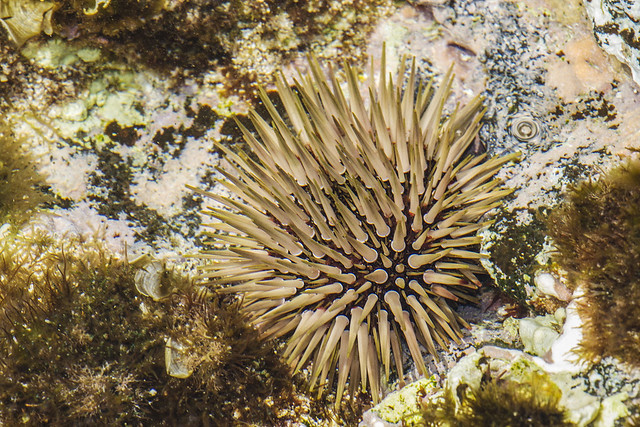
Burrowing Urchin, Echinometra mathaei
And basically, sea urchins in the deep appear the same.. BUT many of them are unusual in some way.  Different adaptations or different evolutionary histories and there's much more to them than the "typical" urchins most people encounter in shallower depths. 

Here are some of the more commonly encountered sea urchins we will likely encounter in the Hawaiian region (below about 1000 m). These are also pretty typical of deep-sea settings throughout the Indo-Pacific.

There ARE a few that aren't noted here. Mostly the "irregular" urchins such as sand dollars, or sea biscuits. 


1. Aspidodiadema This is a genus of unusual deep-sea urchins that is represented in Hawaii and in many tropical deep-sea habitats in the Pacific as well as one species in the Atlantic. These have really long spines that it uses for locomotion in conjunction with its tube feet.

There's apparently more than one species of Aspidodiadema in Hawaii, but so far we've been calling the one seen by Okeanos, Aspidodiadema hawaiiense. Upon looking at both images, there do seem to be some differences but its unclear without a specimen to examine..
Here's a nice moving GIF of this Aspidodiadema species on the move! 
This image shows the same type of animal as the one above but with a mysterious bag like extension emerging from the top. Possibly an anal sac as we see in diadematid urchins?? Unclear.
In comparing them, this second one seems to be lighter in color... 

2. Caenopedina! This genus is a member of the family Pedinidae, of which it is the only living member. This genus is widely occurring mostly in deep-sea habitats. 

According to the Hawaiian Undersea Research Lab's Animal ID guide, there are two recognized species in the region: 

Caenopedina pulchella This species shows these very thick spines which are brightly colored green and purple!
The small individual above seems to have much smaller spines relative to this larger one.. but the colors patterns appear consistent..

This second species is Caenopedina hawaiiensis and it seems to show a very different appearance... 
3. Echinothuriid Urchins! These are one of the most frequently encountered sea urchins in deep-sea settings. Commonly referred to as "pancake urchins" or "tam o shanter" urchins, their body shape is suspended by water pressure, so when removed from the ocean into say, a bucket on the deck of a ship, their very soft skeletons collapse into a flat "pancake" like shape.

I've written on these animals plenty of times here and here and their shallow-water relatives here

One caveat about this section: I'm not sure that any of these can be correctly identified..so I'm keeping it vague. At least for now. 

But salient features of the urchins as a group include: 
1. Needle sharp spines which can be pretty dang painful!
2. Cute little walking legs with special "hooves" on their spines 
We've seen at least 2 species.. this purple species..
Rewatching yesterday's #okeanos dive: sea #urchin w/ mittens on its spines #Hawaii, Lone Cone ~1800m pic.twitter.com/kEL4cTtBIn
There's this slightly different pink echinothuriid
 this grey species                            

Echinothuriids are a frequently encountered group in the deep-sea. We will likely encounter more of them..

4. Cidaroid Urchins! One of the other "typical" urchins one encounters in the deep-sea is that cidaroids.  This is a fairly old group of urchins, which branched off early in the history of urchins and has a fairly good Mesozoic fossil record (see here).   

Cidaroids are unusual for urchins in that they lack skin on their spines, which results in an overabundance of "fouling" animals which can settle and grow on them. I've briefly talked about the ecological importance of this here. 

We've also seen cidaroids with a CRAZY range of spine shapes and morphologies, such as what I summarized here
                           
Cidaroids are not just predators on corals as shown below, but are also likely predators on stalked and other crinoids as I've posted about previously..

A nice diversity of cidaroid urchins in the deep-sea Hawaiian Islands.. More at the HURL gallery here  but sadly we've really only seen a few at the deep depths Okeanos has been exploring..

Histocidaris variabilis.. note the barnacles growing on the spines...


Stereocidaris hawaiiensis

Possibly Stylocidaris calacantha.  This one was observed high up in the branches of this bamboo coral, likely feeding on the polyps..

Tuesday, August 20, 2013

Strange Urchin Spines! Past and Present!

Tylocidaris clavigera from the Cretaceous of England Stunning image from the BMNH Echinoid Page. here
SEA URCHINS! Everyone kinda knows the basic idea: round spiny ball that lives in the ocean but most folks aren't as familiar with how CRAZY the spines can get. ESPECIALLY in the fossil record!

Most of these taxa are either cidaroid sea urchins or closely related to them. Cidaroids are considered a "stem group" among sea urchins. That is to say, they arise early in the evolutionary history of the group. They have a different jaw apparatus and vary in several other respects. Including the unusual absence of an epidermis from the spines, which permits growth of various other organisms on the surface. I've written about this here.  

Cidaroids may also be very important in understanding deep-sea dynamics and the historical ecology of other echinoderms, such as crinoids (feather stars). See that article here.  They have been around for quite awhile.. and have been known since the Paleozoic..

But some of the CRAZIEST urchins occur from the Mesozoic, that is during the time best known for the dinosaurs. Oceans were widespread during this time

One of these neat urchins is the Mesozoic (Jurassic to the Cretaceous) to recent cidaroid urchin, Tylocidaris.

Tylocidaris appears to have MASSIVE, club-shaped spines which were presumably used for defense..
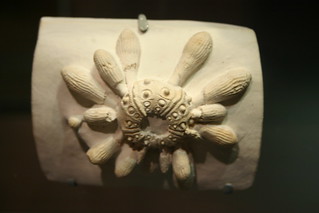
Sea Urchin (cast)
Image of a cast by Ryan Somma
Here is some bewildering diversity of Tylocidaris spines, which all look like maces or big notched watermelons!  Presumably these were used as defense against predators.

MUCH thanks for the images from this Danish gentleman's excellent page about fossil sea urchins! 

These spines are from a Cretaceous Tylocidaris  sp.
Image by Søren Bo Andersen fr. his website
More Tylocidaris spines!
Image by Søren Bo Andersen fr. his website
 ..and still more!
Image by Søren Bo Andersen fr. his website
Interestingly, the British Museum's sea urchin website also indicates that a LIVING member of this family is still kicking around.. the unusual Psychocidaris!
Psychocidaris oshimai..

Curiously, the spines seem to be made up primarily of this weird cortex like covering...
Here's a video from a mineral/fossil show showing a bunch of fossil Tylocidaris-like urchins to a jazzy tune!


SIMILAR URCHINS...
the Jurassic Pseudocidaris mamossa Big CLUB like spines!
www.fossilplanet.com,pseudocidaris mamossa,erizo fosil,fossil echinoid,jurassic,kimmeridgian,mesozoic ,fossilplanet
Image by Fernando Bravo
Asterocidaris  spp. 
And just in case you thought only fossil urchins could have all the fun! here' an assortment of neat urchins that are alive TODAY which bear bizarrely shaped spines...
But note that the spines aren't just huge and club-like.. they have all of this weird ornamentaton. What could their function be? defense? assist in reproduction somehow?

Goniocidaris sp. from the South Pacific. (MNHN Paris collection)

A second Goniocidaris species.. with very different spine patterns..

Morphology-seemingly simple and straightforward... and yet, what do the animals use them for?

Tuesday, November 29, 2011

Treasure! The Funky and Exotic Sea Urchins of Paris!

I am continuing my ongoing blogs from Paris for the next month or so, where I am working at the Museum national d'Histoire naturelle!
When one thinks of Paris, one envisions all sorts of exotic and wonderous experiences- postcards, people, exotic burlesque shows, and food...
From the perspective of a biologist, the museum in Paris is EQUALLY exotic!

Why? Because the Paris museum (the French equivalent to the Smithsonian's National Museum of Natural History) receives MANY specimens from exotic, deep-sea locales around the world.

Because I don't typically get access to many of these specimens, I thought I would share some choice samples from the collections with all of you..

How exotic are these?

Well, to start-I'm not entirely certain that everything I'm showing you below has actually been described in the scientific literature... MANY new species await discovery in the French vaults..
Goniocidaris from deep-sea habitats in the tropical Indo-Pacific..
The most obvious feature here being the bizarrely shaped spines that look like big inverted umbrellas!
A second species of Goniocidaris (also from the deep-sea Indo-Pacific)

Instead of the large spines ending in big flattened horn-thing, these spines are lance-shaped and have a progression of smaller and smaller spines and flanges..
What do the unusual spine shapes do? How are they adaptive? Defensive? Reproductive?

I wrote a blog about a similar cidaroid sea urchin called Psychocidaris. (click here to see!)

Here's a big, deep-sea sea urchin the size of a pumpkin called Echinus melo!
Another large animal that we know practically nothing about...
And finally, we end with one of the more exotic sand dollars.. a genus called Rotula from the African coast in the tropical Atlantic..
Weird are the many strange flanges and holes! What do they do?

Well, in other sand dollars they deflect the hydrodynamic flow.. Go here to see this explanation!
and just for kicks..here's the bottom or ORAL SURFACE of one.. yes-even these weirdly shaped sand dollars have the tiny, "fur-like" spines covering them and with the channels that lead to the mouth...
More next week...as Echinoblog in Paris continues!