Showing posts with label fossil. Show all posts

Tuesday, April 5, 2016

Crinoid Fossil Forest Revisited!

This week I thought it would be fun to revisit the wonderful world of stalked crinoids!  I've previously looked at photo galleries of deep-sea living stalked crinoids here and a few from the Hawaiian Okeanos expedition.

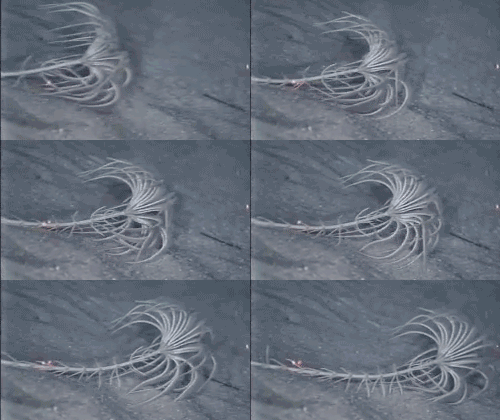
Here's a hyocrinid "pinwheel" crinoid form the Okeanos dive to Indonesia! (INDEX-SATAL 2010)

For those who might not be familiar with stalked crinoids, they are the ancient ancestors of modern day feather stars (aka comatulid crinoids).
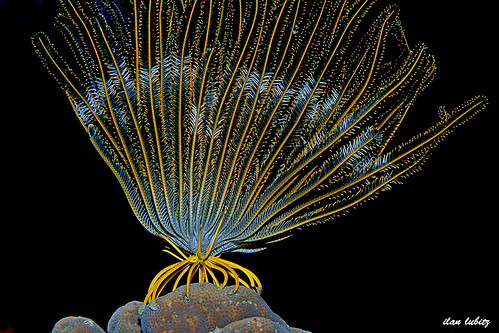
feather star  Oxycomanthus bennetti

Stalked crinoids are fundamentally composed of three main regions: the calyx (or cup), arms and stalk which is very nicely illustrated by this diagram from the Field Museum in Chicago!

Stalked crinoids feed on food particles in the water column using their arms which they move down to the mouth located at the top of the calyx (or cup). The stalked and unstalked forms have an unusual relationship which you can read about in an earlier post here.
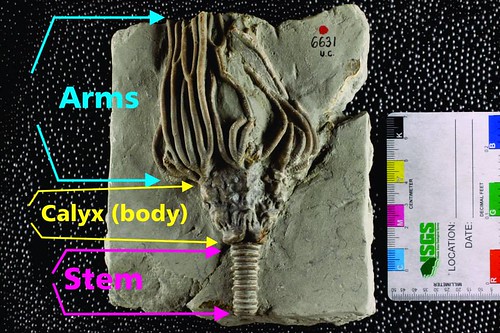
Sea Lily Fossil
The high point of stalked crinoid diversity was in the Paleozoic, some 250 to 540 million years ago in the time before dinosaurs..there  existed a HUGE diversity of stalked crinoids.. and even DURING the time of the dinosaurs in the Mesozoic there were still quite a few of them (as I'll share below)..

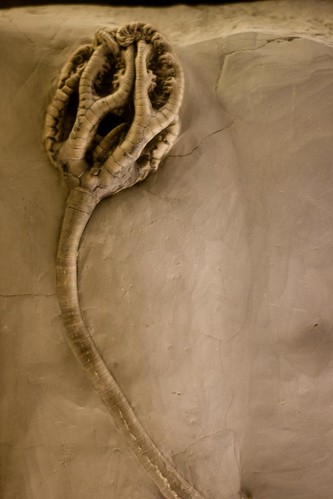
Let's start off with this gorgeous one called Acanthocrinus rex! from the lower Devonian of Germany. This image was reported by crinoid scientist Hans Hess as "certainly one of the most beautiful crinoids ever found.." Sadly, this specimen was lost in World War II.
This image from: https://geo-ebooks.tumblr.com/post/127610816184/acanthocrinus-rex-j%C3%A4kel-from-the-lower-devonian
The images below are a nice set of Paleozoic crinoids by James St. John on Flickr..

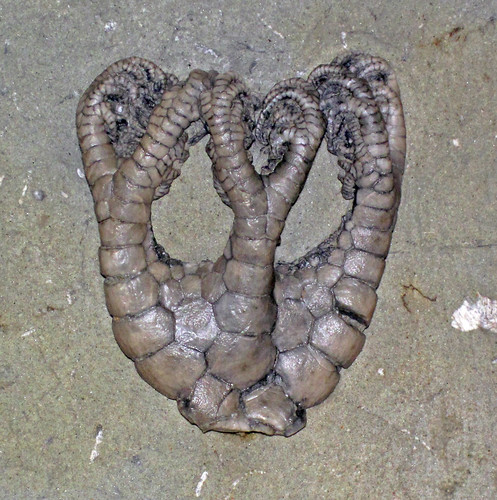
Here is the Paleozoic Taxocrinus colletti from the Edwardsville Formation, Lower Mississippian; Crawfordsville area, Montgomery County, Indiana, USA.
Taxocrinus colletti fossil crinoid (Edwardsville Formation, Lower Mississippian; Crawfordsville area, Montgomery County, Indiana, USA)
A striking one called Platycrinites saffordi from the Edwardsville Formation, Lower Mississippian; Crawfordsville area, Montgomery County, Indiana, USA.
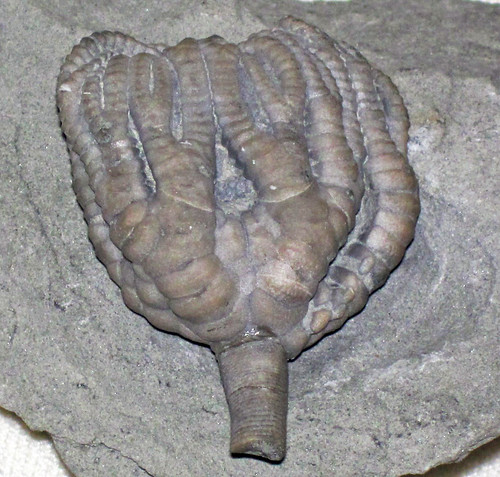
Platycrinites saffordi fossil crinoid (Edwardsville Formation, Lower Mississippian; Crawfordsville area, Montgomery County, Indiana, USA)

One with some strikingly different arm branching patterns: Onychocrinus exculptus from the Edwardsville Formation, Lower Mississippian; Crawfordsville area, Montgomery County, Indiana, USA.
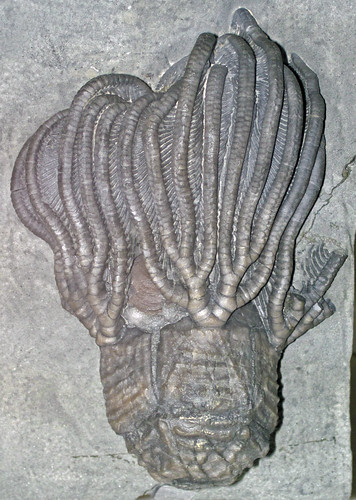
Onychocrinus exculptus fossil crinoid (Edwardsville Formation, Lower Mississippian; Crawfordsville area, Montgomery County, Indiana, USA)

Here is: Onychocrinus ulrichi a fossil crinoid from the Edwardsville Formation, Lower Mississippian; Crawfordsville area, Montgomery County, Indiana, USA.
Onychocrinus ulrichi fossil crinoid (Edwardsville Formation, Lower Mississippian; Crawfordsville area, Montgomery County, Indiana, USA)
David Clark on Twitter brings us this interesting one with large spines emerging from the calyx! The aptly named Acanthocrinus! (from the Devonian of New York)
This next series is from Elrina753 (thanks for the awesome images!) from the Houston Museum of Natural Science. These look like the Mississippian, Platycrinites
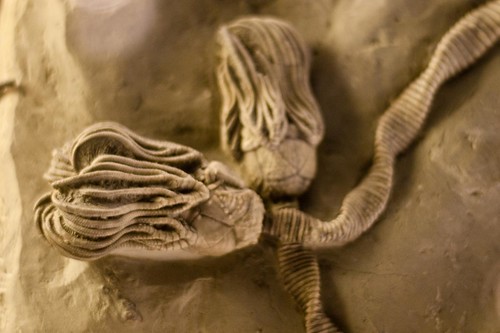
Crinoids
Crinoids
Another gorgeous one from the Houston Museum of Natural Science: Onychocrinus exsculptus
Onychocrinus exsculptus

And this third one from Houston which I don't have a name for...
Crinoids

An interesting Paleozoic one called Eretmocrinus (no other info, so unsure if ID is correct) but the arms have very unusual morphology. Notice how they become paddle like towards the tips! 
Eretmocrinus

And from the displays/collections in Washington DC at the NMNH.. the massive Jurassic Seirocrinus which was actually thought to be pelagic and might have attached to floating logs! More on these two unusual swimming/floating crinoids here.


The bizarre Uintacrinus which some thought might have actually dragged its arms over the bottom as as it floated by...

Wednesday, March 30, 2016

Natural History Art Spotlight: John Meszaros & Nocturnal Sea!

I haven't done an art blog in quite awhile and this week I thought it would be cool to feature one of my favorite natural history illustrators! John Meszaros at Nocturnal Sea!   and here is John's Deviant Art Gallery! if you'd like to see more.  and his Facebook Page with many cool pictures! 

You may already be familiar with some of Jon's work as he illustrated the recently described new species Xenoturbella monstrosa based on research at Scripps by Greg Rouse et al. 
Here's the real deal for comparison. The illustration above shows the ecology of Xenoturbella as described by Rouse et al.. so however.. unusual the image may seem it is based in real science!

Another striking image that I LOVE is this one from Jon featuring the hydrothermal vents of Antarctica, featured a few years ago here. But specifically.. the unusual multi-armed STARFISH that live there!


They apparently fed on the weird fleshy barnacles that live there as well as possibly the "Hoff crabs"! 
For comparison..
Jon has always had great taste in subjects for his paintings! (and good colors to match) Here is the famous swimming sea cucumber, Enypniastes exima. Which you can also buy as a shirt! 

and Yes....the swimming sea cucumber is REAL

Another one of my favorites is Megalodicopia hians! the deep-sea predatory tunicate! Another lovely painting! And yes.. here's where you can get the shirt! 
Jon draws inspiration from a wide range of habitats in nature! Fortunately they are all unusual!!

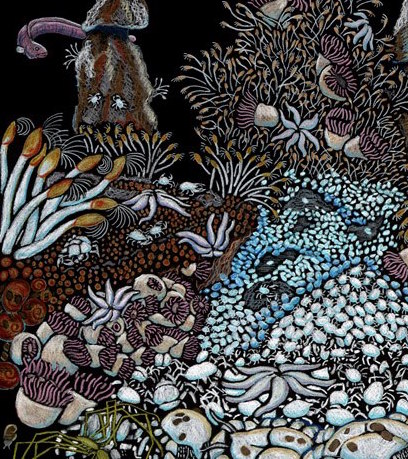
Here's a GREAT one called "Inner Space 2" which shows a bunch of very small pond-water type animals and protists...

The big "tree-like" things are actually rotifers in the genus Floscularia! He actually goes into a detailed description of everything in this picture on his Deviant Art page for this illustration.  All of the things in this painting are actually microbial organisms that you might find in a drop of water in a freshwater pond or lake! There are bryozoans and even ciliates (protists)! 

Inner Space 2 by NocturnalSea on DeviantArt

Another great piece of art shows none other than one of the weirdest, little animals known-the Loricifera! Here as part of this anoxic habitat inspired by a brine pool from the Mediterranean.


Cabinet of Curiosities:  An Anoxic Metazoan by NocturnalSea on DeviantArt

Here is a nice cross section of tropical invertebrates.. including not just the colorful and already surreal nudibranch Bornellia, but also one of my favorite sea urchins, the "shingle urchin" Colobocentrotus as I wrote about it here.  and here for the biophysics of their ability to hold on...


John also does some pretty AWESOME paleontological reconstructions! 

Here we have some art depicting the Sirius Passet laggerstatten from Greenland. A Cambrian deposit which is faunistically similar to the Chiangjiang and actually pre-dating the Burgess Shale fauna..


Sirius Passet fauna by NocturnalSea on DeviantArt

The following two are more of my favorites taken from the Cambrian faunas.

LOBOPODS! Remember Hallucigenia and the other weird critters from the Burgess Shale? These were arthropod-worm like animals that were thought to be distant ancestors to velvet worms..


Lobopods by NocturnalSea on DeviantArt
And in the same vein, here are anomalocarids.. species of Cambrian arthropods related to/inspired by the famous Burgess Shale Anomalocaris


Anomalocaris group by NocturnalSea on DeviantArt

And as all artists are want to do..here's a more fanciful creation inspired by real Paleozoic animals. Included here just for the sheer fantastic artistry of it!

False Ammonite by NocturnalSea on DeviantArt

Here he's clearly taken a VERY echinoderm-centric take on the Great Race. We have some echinoderm larvae in there as well as a brittle star and some five-part symmetry that any worshipper of the great Cthulhu would approve of (if they were not seeking to bring about the end of humanity that is! )

Haeckel Yithian by NocturnalSea on DeviantArt

Tuesday, May 6, 2014

Stalked Crinoid Round-Up!


CRINOIDS!  These are considered the oldest of all the living echinoderm groups. Fossils of crinoids are commonplace in the Paleozoic (see examples here). 

Most modern crinoids go by the name "feather stars" (for example here) because their adult forms no longer retain the long stalk present in these older forms. This heritage, however, IS retained in feather stars, which have a stalk when they are juveniles (see this post)

Crinoid feeding biology is fundamentally a simple matter. Arms are outstretched into the water current and food is caught by the branching on the arms and moved to the mouth present in the cup (also called the calyx which is a damn good Scrabble word).

Of the approximately 600 species of crinoids alive today, about 95 of them are stalked but belong to a diversity of different genera, family and species. Nearly all of these live in the deep-sea where they occur at great depth, ranging down to the deepest known depths (9000 meters!)

NEW species of stalked crinoids continue to be discovered!! Such as this Antarctic species described by my French colleagues at the Museum national d'Histoire naturelle in Paris.

One of the primary differences in overall morphology is how and whether they are attached.. As you can see, the yellow Hyocrinus  (family Hyocrinidae) on the left side is permanently anchored to the rock, whereas the Endoxocrinus (Isocrinidae) on the right side has a stalk that ends as kind of a tail, which allows it to crawl around and move. (presumably to escape predators as outlined here).


Feather Stars (i.e., unstalked crinoids) occur mostly in shallow water and can actually swim if threatened.. (see here). 

Today, I just thought it would be cool to share the diversity of stalked crinoids that are around TODAY.   Life modes of fossil species can be pretty amazing as outlined here.

We start with an unusual stalked crinoid.. Neogymnocrinus richeri in the Sclerocrinidae...

These have a short stalk with these thick, unusual arms and a palm-like cup. Its possible these feed a little more aggressively than their other filter-feeding cousins... 


Endoxocrinus? (I think) from the tropical Atlantic


An interesting stalked crinoid I don't recognize with distinct segments on the stalk..  from Indonesia)

Another interesting one with only 5 arms..(from Vailu'lu Seamount in the central tropical Pacific). Dr. Marc Eleaume at the Paris museum thinks this might be Guillecrinus neocaledonicus

The distinct yellow stalked crinoid Hyocrinus  from the North Pacific


A red stalked crinoid species from Indonesia. Probably Proisocrinus ruberrimus according to Marc Eleaume at the Paris museum.

Close up


Another interesting red stalked crinoid from Indonesia. Note the weird fuzz on the stalk? Possibly hydroids or some other kind of animal.... 

Some of you may remember that we saw a stalked crinoid in the North Atlantic via the Okeanos dive last year which ALSO had these interesting growths on the stalk... 
                            
                                  
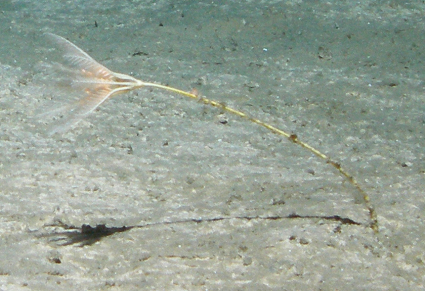
Here's one of the deepest occurring kinds of stalked crinoids, a bathycrinid which seems to be anchored in sediment..
image from SERPENT archive
Like their shallow water counterparts, its not unusual to find several stalked crinoids in the same place, taking advantage of a good water current for feeding... which makes for an almost surreal deep-sea bottom...

Tuesday, August 20, 2013

Strange Urchin Spines! Past and Present!

Tylocidaris clavigera from the Cretaceous of England Stunning image from the BMNH Echinoid Page. here
SEA URCHINS! Everyone kinda knows the basic idea: round spiny ball that lives in the ocean but most folks aren't as familiar with how CRAZY the spines can get. ESPECIALLY in the fossil record!

Most of these taxa are either cidaroid sea urchins or closely related to them. Cidaroids are considered a "stem group" among sea urchins. That is to say, they arise early in the evolutionary history of the group. They have a different jaw apparatus and vary in several other respects. Including the unusual absence of an epidermis from the spines, which permits growth of various other organisms on the surface. I've written about this here.  

Cidaroids may also be very important in understanding deep-sea dynamics and the historical ecology of other echinoderms, such as crinoids (feather stars). See that article here.  They have been around for quite awhile.. and have been known since the Paleozoic..

But some of the CRAZIEST urchins occur from the Mesozoic, that is during the time best known for the dinosaurs. Oceans were widespread during this time

One of these neat urchins is the Mesozoic (Jurassic to the Cretaceous) to recent cidaroid urchin, Tylocidaris.

Tylocidaris appears to have MASSIVE, club-shaped spines which were presumably used for defense..
Sea Urchin (cast)
Image of a cast by Ryan Somma
Here is some bewildering diversity of Tylocidaris spines, which all look like maces or big notched watermelons!  Presumably these were used as defense against predators.

MUCH thanks for the images from this Danish gentleman's excellent page about fossil sea urchins! 

These spines are from a Cretaceous Tylocidaris  sp.
Image by Søren Bo Andersen fr. his website
More Tylocidaris spines!
Image by Søren Bo Andersen fr. his website
 ..and still more!
Image by Søren Bo Andersen fr. his website
Interestingly, the British Museum's sea urchin website also indicates that a LIVING member of this family is still kicking around.. the unusual Psychocidaris!
Psychocidaris oshimai..

Curiously, the spines seem to be made up primarily of this weird cortex like covering...
Here's a video from a mineral/fossil show showing a bunch of fossil Tylocidaris-like urchins to a jazzy tune!


SIMILAR URCHINS...
the Jurassic Pseudocidaris mamossa Big CLUB like spines!
www.fossilplanet.com,pseudocidaris mamossa,erizo fosil,fossil echinoid,jurassic,kimmeridgian,mesozoic ,fossilplanet
Image by Fernando Bravo
Asterocidaris  spp. 
And just in case you thought only fossil urchins could have all the fun! here' an assortment of neat urchins that are alive TODAY which bear bizarrely shaped spines...
But note that the spines aren't just huge and club-like.. they have all of this weird ornamentaton. What could their function be? defense? assist in reproduction somehow?

Goniocidaris sp. from the South Pacific. (MNHN Paris collection)

A second Goniocidaris species.. with very different spine patterns..

Morphology-seemingly simple and straightforward... and yet, what do the animals use them for?

Tuesday, March 12, 2013

A spotlight on Echinoderm Art

Things got a bit busy this week  and I've been discovering the wonders of the natural history side of DeviantArt!

MANY creative and wonderful artists out there and I thought it would be cool to showcase some of the notable ones, especially the ones that can be compared against the "originals"

Frankly, I'm pretty impressed. At one time, a LOT of these animals were known only to a handful of specialists in the world. And NOW?People make them into art!! That's amazing!

Here's a few...
Enypniastes! The deep-sea Swimming Sea cucumber! I blogged about these HERE.
Here are some video of the original inspiration!


SEA PIGS! The sea cucumber called Scotoplanes! I wrote a bit on this HERE.
OINK!
and holiday classics!
An interesting one with a Chinese art theme

A digital sea pig

Here's a link to a neat one called "Sea Pig Nouveau" that sadly, was not embeddable..but click here.

and of course, here's the original..

What follows here are some PALEOZOIC fossils, with added colors and "reconstructed" onto a Paleozoic sea bottom as if they were alive...
I try to compare some of these with actual fossils...

Ophiocistioids! Strange Paleozoic forms! I wrote about these only awhile ago HERE.
Here is an actual fossil of the ophiocistioid Eucladia from Yale's collection

Cystoid echinoderms from the Paleozoic!  I'll blog more about the various Paleozoic echinoderms some day, but there's easily as many extinct echinoderm fossil groups (most of them with stems) as living groups.   This image has a nice assortment of them from the Ordovician of New York..
Here are the three primary critters for comparison! The light olive one in the upper right corner, wrapped around the bryozoans is called Cupulocrinus jewetti
Image by Paleoportal. Photo by Joe Koniecki
The artist indicates the blue individual as the cystoid Pleurocystites squamosus 
Image from Paleoportal. Photo by Joe Koniecki
Here's another.. the brown one with all the unusual spines? tentacles along the sides? Is identified as Glyptocystites multiporus. Here's a fossil from the Ordovician in Ontario for comparison
Image from Paleoportal. Photo by Joe Koniecki

Tuesday, February 23, 2010

GIANT, floaty, swimmy fossil CRINOIDS! The Dinosaurs of the Fossil Echinoderm World!

Today's post is BIG!

These fossil echinoderms are not ONLY freakishly BIG, BUT to add a little "weird" to it...THEY FLOAT!!! (most echinoderms almost always live on the sea bottom)

So, that you can see how different these critters are relative to the "normal" ones... some introductory crinoid background.

Here is what the most commonly encountered "feather star" aka an "unstalked crinoid" looks like...
(from Chuck Messing's crinoid website)

...and here's some basic anatomy and etc. about the other body form of crinoids with a stalk. These "stalked" crinoids are the ancestral forms and are what you see in the fossil record.

(from the Echinoderm TOL website)

Most of them live on the sea bottom. Sometimes attached and sometimes with a long tail. Go HERE to an older blog I wrote, which has a little bit about their ecology.

What I'm about to say may turn what you know...UPSIDE DOWN!!!

It turns out FOSSIL crinoids from the Jurassic (about 145-200 Mya) and the Devonian (360-416 Mya) did something that NO modern crinoids are known to do!! They were PELAGIC.
in other words...THEY COULD "SWIM". (well..some only float) :-)

Much of the info for this section is from this paper by Seilacher & Hauff 2004.

Basically, there were FOUR kinds of floating crinoids. Here is a handy guide from Seilacher & Hauff (Fig. 1) with the water current flow (added in blue) for emphasis.

Crinoids are all filter feeders.

So, those big cups with all of the arms on them??

They hold them into the water current and food as the water passes through them. The crinoids that float do essentially the same thing but sit in the middle or the top of the water column instead of the bottom.


Here's the different kinds of floating aka pelagic crinoids.


1. "Floaty" crinoids that float on driftwood.

(modified image from Seilacher & Hauff 2004)

These are the best known planktonic crinoid and occur in the Jurassic (145-200 mya) rocks of Germany but have also been collected from China.

They are often preserved attached to driftwood. The stalks were thought to be kind of elastic and used as sort of a filter-feeding "drag net" as they floated through the water..

The fossil deposits of these animals are often excellently preserved.
This includes several genera including Seirocrinus, Traumatocrinus, and Melocrinus and several of them are often found together in huge colonies.

The other really obvious thing about these floating crinoids is that they are HUGE!! They are probably the LARGEST crinoids known!!

IN FACT, they are probably the largest (or at least the longest) ECHINODERMS that the world has ever seen!

See the slab above? There must be at least 50 individual animals (counting the filter feeding cups) on this floating log.
How big are they?? The stalks on these crinoids can approach TWENTY METERS (60 FEET!). The filter feeding cups get to be easily a METER (about 3 feet) in diameter. Here's ME next to a single fossil of Seilocrinus in the museum for scale. Its not as big as some..but STILL....its LARGE.

2. Crinoids with BUOYANT floats!

(modified image from Seilacher & Hauff 2004)

These are interpreted as actually having a FLOAT!!!

That's RIGHT.

They are positively BUOYANT. Similar to the ones above, these were thought to drag their feeding arms, sort of like a tow-net, filtering food from the water.

These were called Scyphocrinites and they were from the Lower Devonian. The big "floats" of these animals are actually fossils called loboliths. They're filled with big porous, presumably air or gas filled calcium carbonate balls. Wow.

3. Stemless floaty crinoids!
(modified image from Seilacher & Hauff 2004)

These are unusual STEMLESS crinoids..but they aren't comatulid crinoids (i.e., not the same as the ones around today)

Genus name is Saccocoma and these fossils are found from the Upper Jurassic Solnhofen limestone in Germany. Its thought by some that these were free-swimming..possibly floating in the water column.

4. Floating Bottom "dredge" crinoids!
(modified image from Seilacher & Hauff 2004)

This is one is just crazy (or at least the interpretation is!).

This one is called Uintacrinus from the Upper Cretaceous and its thought that these had a gas or air-filled cup and that they DRAGGED their arms along the bottom.
Functionally, this makes for one of the strangest terms I've ever heard.."Hemipelagic dredger".

A swimming bottom, deposit feeder. The arms DRAG along the bottom like a frakkin' DREDGE net!!!
Do ya' see that big mess behind my head?? That's because my mind is BLOWN!

(Thanks to Mary Sangrey and the IZ Paleontology department for assistance with photography and specimens!)