Showing posts with label Paleozoic. Show all posts

Tuesday, April 26, 2016

The Diversity of Echinoderm Anuses!

Juvenile urchin
This week, in the category of "one of those posts only Echinoblog could write"! Let us explore the vibrant diversity of echinoderm anal structures!! Perfectly SAFE for Work! even though it contains the word "anal" and "anuses" several times! WOO!!

Echinoderms are pentaradial (aka pentameral). That is they show a form of radial symmetry wherein their body always occurs around a top-down axis in five parts (although arms, etc. may vary).

As a consequence, the overall dynamic of their life mode is different from an animal with bilateral symmetry. No face, no "front" or "back". Thus, the way food moves through the body is different depending on where the mouth is located and consequently, where the anus is located!!

Since each living class of echinoderms has a fairly unique shape and body morphology, each group has a bunch of unusual specializations that function to facilitate the expulsion of poop!

To be honest, not every member of each class below has what is shown below. These are unusually prominent examples..but it still begs the question "What is it used for?"  How many other animals have so many unusual anal adpations??

5. Crinoids: Anal Chimneys & Pyramids
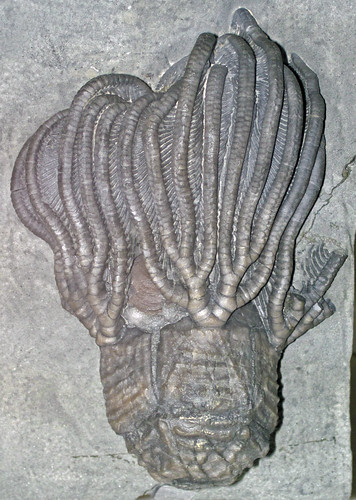
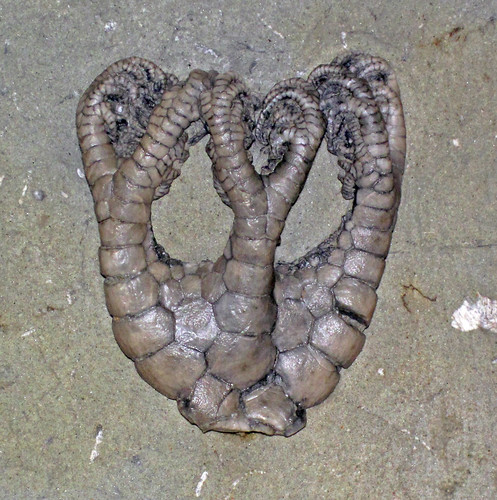
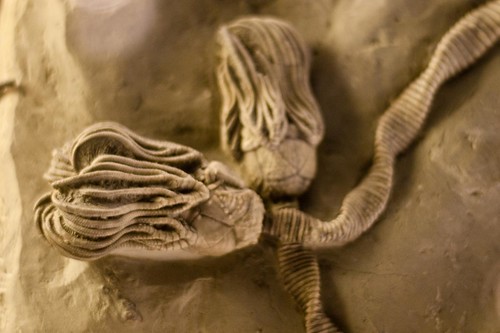
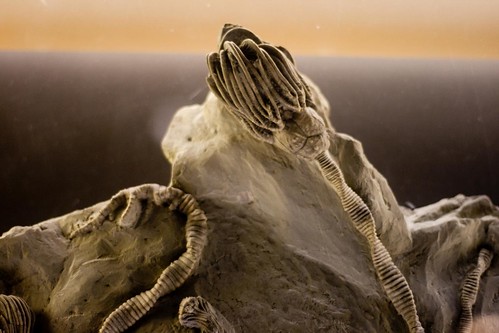
So, crinoids are suspension feeders. They almost kind of resemble plants. Most living ones are known as "feather stars" and are basically cups with arms for filtering water. But earlier forms of crinoids are known as "stalked crinoids" which have a stalk. I had a gallery of the older Paleozoic ones here a few weeks ago..

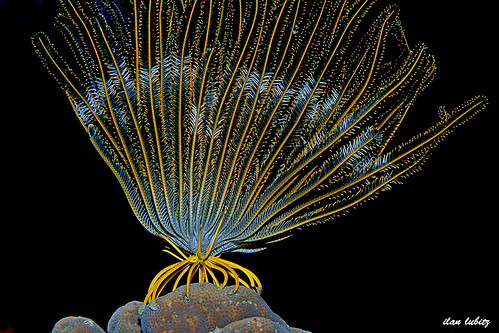
Here's a living one from the recent Okeanos Expedition to the Marianas region to give you an idea of what they look like..

So, the mouth in stalked crinoids is inside that cup at the base of where all those arms converge. The anus for these animals is ALSO in the cup. So, there's likely a strategy/adaptation for these animals to push the poop/excreta OUT of the anus, such at it does not end up getting "re-eaten" by the mouth...

According to Fossil Crinoids by Hess et al.  there were several fossil (Paleozoic) forms which had fairly straightforward strategies for dealing with ensuring that poop was discharged FAR from the mouth..

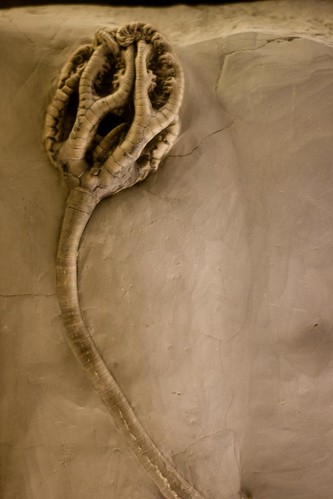
For example, here is the Mississippian Uperocrinus nashvillae with an explanatory diagram from Fig. 37 of Hess et al's book. Basically that huge pointed structure on top? That's called the anal tube  (or sometimes in other animals.. an anal pyramid or even an anal chimney!)

These extended structures serve to project the anus (and the excreted poop) well AWAY from the mouth (the feeding arms would come off right at that wide "ledge" around the center of the specimen..


There was a surprising diversity of these structures. Here's another one called Macrocrinus verneuilianus which is a fossil from the Carboniferous (the Paleozoic). The drawing below is taken from the Wooster Geologist blog and they point out that the elongate anal tube (in the lower left hand corner) aka the anal chimney may have even served an additional function beyond simply transporting poop away from the mouth:
The tube allowed waste products to be whisked away far from the mouth of the crinoid, which was at the base of the arms. Some researchers suggest that the long tube served another function as well: it may have helped stabilize and direct the filter-feeding fan of outstretched arms in a stiff current, something like the tail of an airplane or a panel on a weather vane.
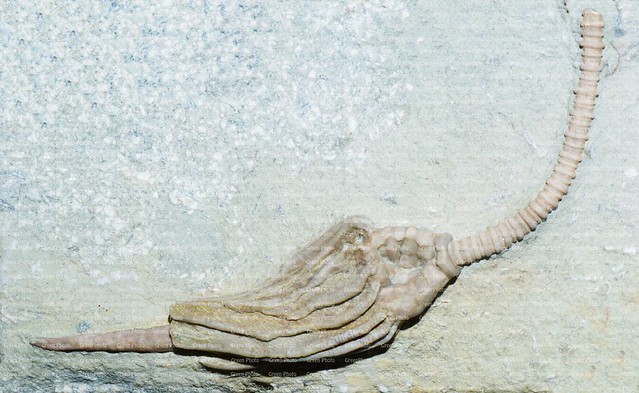
Macrocrinus mundulus, Macrocrinus, Batocrinidae, Monobathrida, Crinoidea, Echinodermata, Deuteriostomia, Bilatera, LOCALITY- Montgomery Country - Indiana - USA, CARBONIFERO,

One last weird crinoid is this one: Bicidiocrinus wetherbyi
Another Mississippian (i.e Paleozoic) stalked crinoid.. and this is kinda weird. So, there's the cup and the arms and that cone is the anal cone (=tube, pyramid, chimney, etc.) BUT it also has this weird additional protective "spiniferous canopy" around it!!

The diagram on the right shows this fully "reconstructed"..

and the reconstruction from Hess et al. Fossil Crinoids-which is a GREAT book for these useful facts!                              
Ultimately, there is probably a WHOLE blog post or 5 about Paleozoic crinoids and what we know about their paleoecology.. I briefly touched on the snails that parasitize their anuses here.... 

One LAST MINUTE ADDITION: David Clark (@clarkeocrinus) provides this ASTONISHING Proteriocrinus with a very considerable anal chimney!! which looks to extend nearly the length of the cup and arms!
4. Sea Urchins: (Diadematidae) Anal Sac
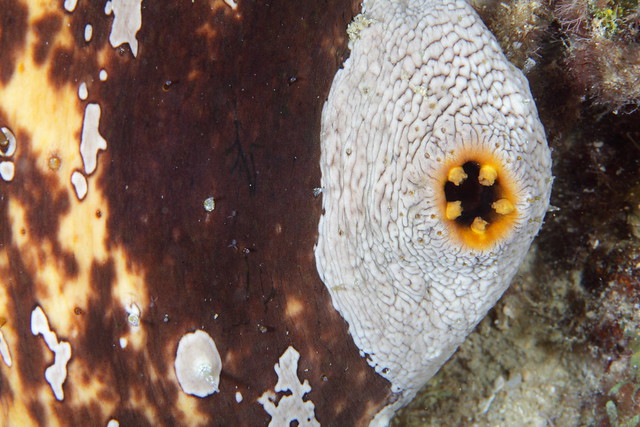
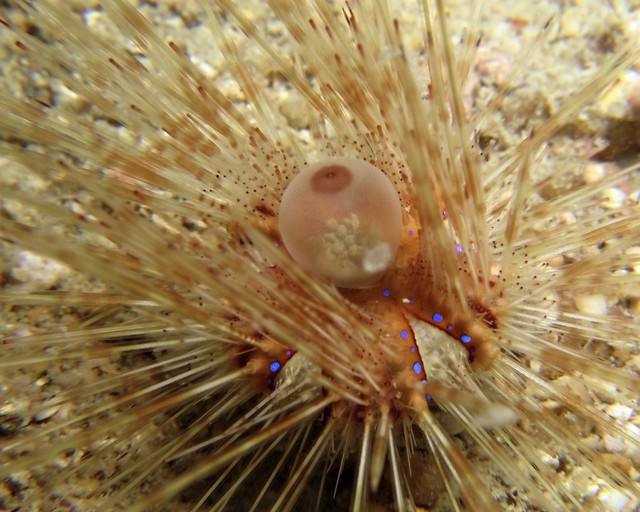
Probably one of the best known but most poorly recognized of the various echinoderm anal structures is the ANAL SAC in diadematid (diadematoid?) sea urchins.

This includes Diadema, Astropyga, Echinothrix and all of urchins in this family. Usually these are tropical and characterized by long, sharp spines AND a very distinctive "anal sac" present on the TOP of the body.

The problem is that many people see this big eye-shaped ball on the top of the sea urchin body and assume that it is an eye of some kind...
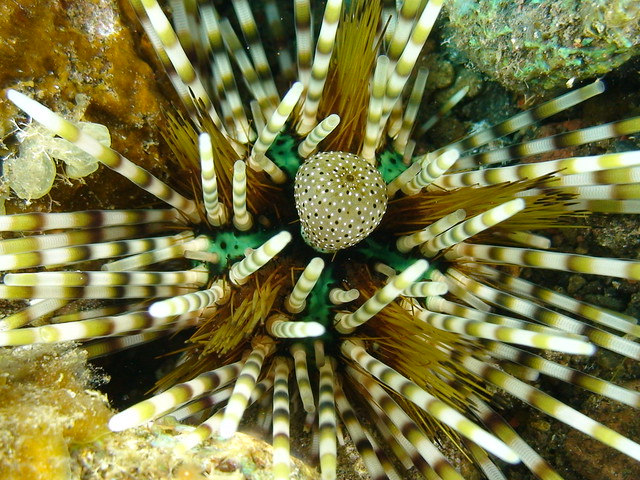
Echinothrix calamaris urchin ind12b 0149
I can tell you most DEFINITIVELY that this structure is NOT the eye. I actually explained in great detail here how this was actually the unusual ANAL SAC which is characteristic of this type of sea urchin for an error in New Scientist.

That said, they DID publish a WONDERFUL picture by David Fleetham of Astropyga radiata venting poop OUT of the anal sac!!

Basically, this is a transparent or translucent bulb or sac extension from the anus through which feces passes on its way out of the body.

See those little round things that look like corn kernals? Sea urchin poop!
Here's another great pic found on Flickr, taken by Eunice Khoo of what looks like a small Astropyga sp. clearly showing poop THROUGH the transparent walls of its anal sac (aka anal cone).. 

Very nice capture. 
Juvenile urchin
But why take my word for it??  Go ahead and watch it here in this video of what looks like either Diadema or Echinothrix..  The poop event takes place at about 0:15 into the video.
               
But its not JUST shallow-water diadematid urchins that have this anal sac. Here's a deep-water Aspidodiadema from the recent Hawaiian Okeanos expedition. I talk a bit about these here

These were videos of these animals from 2000-3000 METERS below the surface. Aspidodiadematid urchins are classified in the same general group as diadematids. and they too seem to have this anal sac or cone...

3. Ophiuroids: Alas..brittle stars got no anus. In fact, food goes in and goes out the SAME hole: the MOUTH. So..bummer.
Brittle star oral side

2. Anal (or Epiproctal) Cone
Sea Stars/Starfish in a larger group called the Paxillosida (the mud and/or sand stars) have a specialized structure which sits right on the center of the disk called the anal or epiproctal cone.

A brief anatomical note- Although historically called an "anal cone" these starfish don't actually have a complete gut and so, the opening on the disk center is not actually the anus since it doesn't connect with the interestine. Hence the name "epiproctal":  EPI is Greek for "upon" and PROCT is Greek for "anus".. hence the cone or structure UPON the anus..
The cone is basically an outpocketing of the body, extending UPWARDS through the sediment
From (Fig. 2 from Shick 1976)
To quote myself from a few years ago:
Observations of Ctenodiscus under hypoxic conditions led to the illustration above. Basically, its thought that the cone gets more enlarged as hypoxia and hydrogen sulfide increases. The extension of the cone extends through the surface, with the tip at the surface. For your typical 6.0 cm diameter animal, these animals can have a cone that can attain 3 to 4 cm and extend 2 to 3 cm above the mud. It can leave this extended for over an hour. As the picture suggests, it can move around and push through sediment as the mud shifts, and etc. So, it can move around.
This also serves to make the top surface of the animal thinner, allowing easier gas exchange and opening up a channel to the surface water above the sediment surface!!
From Shick 1976 Marine Biology: http://link.springer.com/article/10.1007/BF00387613#page-1
So, in truth, the "anal cones" in these mud stars is NOT really an anus. Its where the anus would be located in other species..and so the labelling of this stucture is kind of a misnomer.. as they are not really used for defecation.

Other "mud stars" such as this deep-sea (3000-6000 m) Porcellanaster also have well-developed "anal cones". These starfish sit buried in sediment with these projections sitting up through the sediment. 
In contrast this shallower water Astropecten armatus has a much less developed anal or epiproctal cone. This is also related to the fact that it occurs in shallower water and tends to bury itself in somewhat less sediment compared to the above two species..
from CSU Fullerton: http://biology.fullerton.edu/biol317/ftm/ft_s15_cat_4_25_15.html

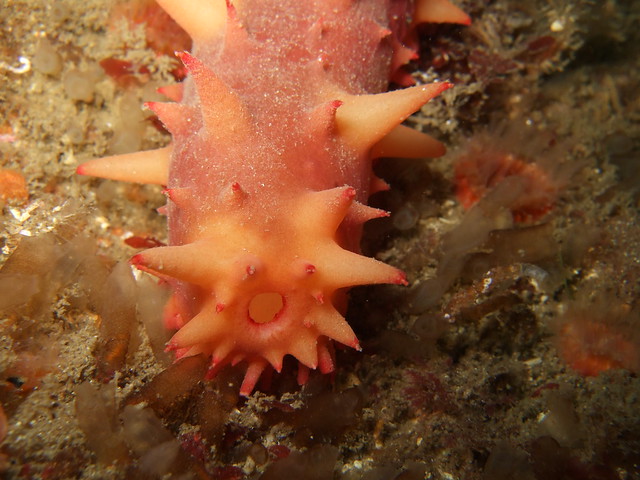
1. Sea Cucumbers (Holothuroidea): Anal Teeth
And finally, one of the best known of echinoderm anal defenses: the anal teeth in sea cucumbers!

I've reported on these before. There's at least one interpretation that these structures are defensive in nature and work to keep pearlfishes (and likely other commensals or parasites) from inhabiting the cloaca.

There's quite a few crabs and shrimps that live in and around sea cucumber anuses. See more here.
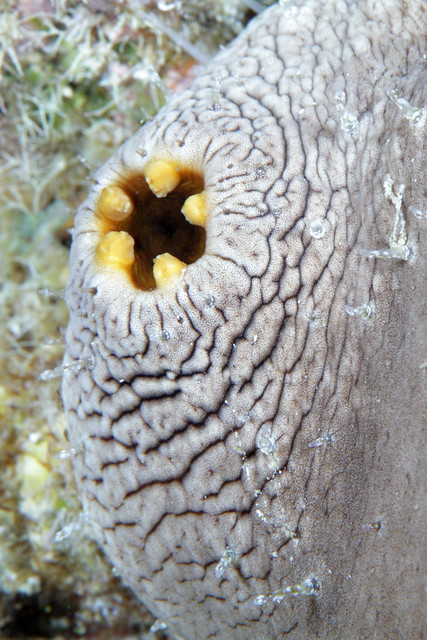
Sea Cucumber Anus

Sea Cucumber Anus

Sea cucumbers get kind of a special award for using their cloacal and other "ass end" chambers most efficiently..especially since some species can actually FEED and BREATH as water passes through the anal opening!! Read more about that here.
DSCF2985.JPG

So there you have it! The Astonishing Anuses of the Echinoderm World! 

Tuesday, April 5, 2016

Crinoid Fossil Forest Revisited!

This week I thought it would be fun to revisit the wonderful world of stalked crinoids!  I've previously looked at photo galleries of deep-sea living stalked crinoids here and a few from the Hawaiian Okeanos expedition.

Here's a hyocrinid "pinwheel" crinoid form the Okeanos dive to Indonesia! (INDEX-SATAL 2010)

For those who might not be familiar with stalked crinoids, they are the ancient ancestors of modern day feather stars (aka comatulid crinoids).
feather star  Oxycomanthus bennetti

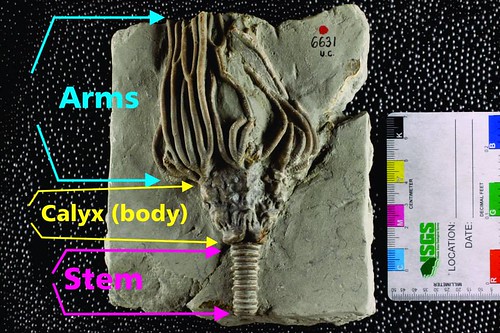
Stalked crinoids are fundamentally composed of three main regions: the calyx (or cup), arms and stalk which is very nicely illustrated by this diagram from the Field Museum in Chicago!

Stalked crinoids feed on food particles in the water column using their arms which they move down to the mouth located at the top of the calyx (or cup). The stalked and unstalked forms have an unusual relationship which you can read about in an earlier post here.
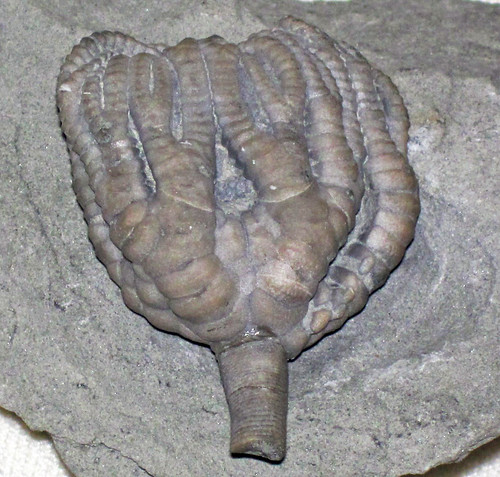
Sea Lily Fossil
The high point of stalked crinoid diversity was in the Paleozoic, some 250 to 540 million years ago in the time before dinosaurs..there  existed a HUGE diversity of stalked crinoids.. and even DURING the time of the dinosaurs in the Mesozoic there were still quite a few of them (as I'll share below)..

Let's start off with this gorgeous one called Acanthocrinus rex! from the lower Devonian of Germany. This image was reported by crinoid scientist Hans Hess as "certainly one of the most beautiful crinoids ever found.." Sadly, this specimen was lost in World War II.
This image from: https://geo-ebooks.tumblr.com/post/127610816184/acanthocrinus-rex-j%C3%A4kel-from-the-lower-devonian
The images below are a nice set of Paleozoic crinoids by James St. John on Flickr..

Here is the Paleozoic Taxocrinus colletti from the Edwardsville Formation, Lower Mississippian; Crawfordsville area, Montgomery County, Indiana, USA.
Taxocrinus colletti fossil crinoid (Edwardsville Formation, Lower Mississippian; Crawfordsville area, Montgomery County, Indiana, USA)
A striking one called Platycrinites saffordi from the Edwardsville Formation, Lower Mississippian; Crawfordsville area, Montgomery County, Indiana, USA.
Platycrinites saffordi fossil crinoid (Edwardsville Formation, Lower Mississippian; Crawfordsville area, Montgomery County, Indiana, USA)

One with some strikingly different arm branching patterns: Onychocrinus exculptus from the Edwardsville Formation, Lower Mississippian; Crawfordsville area, Montgomery County, Indiana, USA.
Onychocrinus exculptus fossil crinoid (Edwardsville Formation, Lower Mississippian; Crawfordsville area, Montgomery County, Indiana, USA)

Here is: Onychocrinus ulrichi a fossil crinoid from the Edwardsville Formation, Lower Mississippian; Crawfordsville area, Montgomery County, Indiana, USA.
Onychocrinus ulrichi fossil crinoid (Edwardsville Formation, Lower Mississippian; Crawfordsville area, Montgomery County, Indiana, USA)
David Clark on Twitter brings us this interesting one with large spines emerging from the calyx! The aptly named Acanthocrinus! (from the Devonian of New York)
This next series is from Elrina753 (thanks for the awesome images!) from the Houston Museum of Natural Science. These look like the Mississippian, Platycrinites
Crinoids
Crinoids
Another gorgeous one from the Houston Museum of Natural Science: Onychocrinus exsculptus
Onychocrinus exsculptus

And this third one from Houston which I don't have a name for...
Crinoids

An interesting Paleozoic one called Eretmocrinus (no other info, so unsure if ID is correct) but the arms have very unusual morphology. Notice how they become paddle like towards the tips! 
Eretmocrinus

And from the displays/collections in Washington DC at the NMNH.. the massive Jurassic Seirocrinus which was actually thought to be pelagic and might have attached to floating logs! More on these two unusual swimming/floating crinoids here.


The bizarre Uintacrinus which some thought might have actually dragged its arms over the bottom as as it floated by...

Wednesday, March 18, 2015

Pyritized Fossils! All that Glitters is not gold...sometimes it's MORE!

this image via Wikipedia
This week, I crack open my geology files and tell you a little about an interesting preservational process known as pyritization! 

This is actually a special type of preservation called permineralization, where an inorganic mineral "replaces" or forms a cast of a particular structure. Mostly hard parts, but soft parts are also replaced, as we'll see.

Pyritization involves the mineral iron sulfide (FeS2), (also known as pyrite or fool's gold)..which will replace the 'hard parts' (shells, skeletons, etc.) present on animals during preservation. 

This mode of preservation actually involves biology!! Bacteria, which are present during the decay of the original organism will produce sulfide. If you've ever seen something dead and buried, that rotten egg smell that accompanies the blackened tissue is the sulfide.

The bacteria in combination with minerals in the sediment/soil can lead to unusual conditions leading to the formation of pyrite which eventually becomes infused with the fossil, sometimes replacing the hard parts and sometimes even the soft parts..

Here are some neat examples...

Pyritized Devonian brachiopod! Paraspifier bownockeri. Image by James St. John


A Devonian goniatite (fossil cephalopod), Tomoceras unlangulare. Image by James St. John

unidentified pyritized ammonite


Some show exceptionally fine details!  Here are sutures on the shell..

And pyritized detail inside the shell

Endoskeletons and soft parts can also be pyritized, resulting in exceptionally preserved specimens!

Here is the Devonian Furcaster paleozoicus..a Paleozoic brittle star from the famous Hunsruck slate in Germany

A nice write up of this area, and the exceptional preservation seen there can be found on this website.                    .
A Pyritizied Devonian crinoid Arthroacantha

But probably one of the most exceptional examples of pyritization is when it captures soft tissues, such as on the trilobite, Triarthus

There were actually soft parts preserved on these trilobites, allowing for some fairly accurate reconstructions of the morphology...

Here's some with a size reference... the soft tissue preservation is remarkable...


and even trace fossils! Here's a worm tube with crystalline pyrite!

Wednesday, October 15, 2014

Five Points About The Fossil History of Echinoderms! Happy National Fossil Day!

Happy National Fossil Day!
Every few years I'm in a position to share some more love about echinoderms and fossils. I've done this on previous National Fossil Days and tried to shed some light on the often arcane world of fossil echinoderms...

Here's one on paleocology & fossil parasites..

A nice gallery of fossil crinoids..   and this classic piece on giant floating/pelagic crinoids! 

Paleozoic Echinoderms: The Ophiocystioids!  and the Helicoplacoids! 

A LOT of the REALLY weird stuff in echinoderms takes place in the days of the Paleozoic, some 245 to 541 MILLION YEARS Ago... There was a lot of crazy stuff (evolutionarily speaking) happening then. Echinoderms, as a lineage PREDATE Dinosaurs and they've been around since before vertebrates walked on land.

But here's a bunch of interesting facts I've cobbled together to better understand and appreciate fossil echinoderms and their history!!

5. Animal Body Type can bias preservation. This is really a dynamic of fossil preservation which is true for almost ANYTHING. In order for animals or any organism to undergo the fossilization process, it has to "survive" long enough to be buried and then kept together so that it undergoes the process.  MANY factors can affect which animals/organisms/whatever are preserved in the fossil record. The study of how different factors affect fossil preservation is called taphonomy and it affects our perception of the history of life on the planet.

One of those factors is the physical strength of the body itself. Is it delicate? Is it REALLY strong and tough?? Delicate, soft bodies tend NOT to preserve very well (although they can exceptionally) but some bodies with very heavy and strongly calcified bodies are MORE likely to preserve.

So for example, these starfish, in life would have a fairly chalky body. They hold together pretty well when all the tissue is removed.
Here's a whole bunch of crinoid stems preserved in limestone. These are pieces of the "stalk" in stalked crinoids. Hard parts that are pretty structurally solid. You're most likely to find this of all the pieces of a crinoid (aka a "stone lily").

4. Preservation Environment is important. So, here's the thing. The fossilization process requires pretty RAPID burial of the subject organism/animal, whatever for fossilization to eventually take place.  Which brings us to another "bias" of preservation: The environment!!

If the animal lives in an environment in which it is predisposed to be buried ANYWAY, that makes it THAT much MORE likely that it will be preserved. One good example are sand dollars (or really anything which lives buried).

Sand dollars have a pretty solid skeleton but ALSO live buried in sand. Sometimes, they can be killed by burial and pretty much just get preserved there in the sediment as it turns into rock.
                           

and voila! (yes, its not the same species but play along, its not easy finding matching videos and pictures of fossil sand dollars! )

3. There were MORE KINDS of Echinoderms in the Paleozoic!
One of the oldest questions from biologists unfamiliar with the fossil record is, "Why haven't you completely figured out the evolutionary history (i.e. phylogeny) of Echinoderms yet?? There's only FIVE of them!"

Yes. Only five LIVING groups (crinoids, sea stars, brittle stars, sea urchins & sea cucumbers) are around today. BUT when you get into the VERY earliest days of echinoderms in the Paleozoic (245-541 MILLION years ago), you have easily TRIPLE the number of groups! (i.e. classes) and a crazy diversity of body plans NOT seen today!

You got things that look like crinoids. Disc-shaped echinoderms. Accordian-shaped, asymmetrical echinoderms. Weird, crazy tentacle-balls. and all sorts of natural "experiments" in Echinoderm morphology.

A crazy panoply of things! Oh, to go back in a time machine to see when rock was young!
                           
2. The Roots of Recent Echinoderms were there...
Picking up on the crazy, diversity of echinoderms mentioned above its worth mentioning that the ancestors of MODERN echinoderms were seen among them.

Ophiocistioids for example are intermediate between sea urchins and sea cucumbers.

Also in the Paleozoic, we had the early ancestors to brittle stars and sea stars.  Today, the brittle stars and sea stars distinctive looking in appearance that we can easily tell them apart, but looking at those early forms was NOT so easy...

Can you imagine walking around in the Paleozoic seas and seeing something that was NOT quite a starfish but also NOT quite a brittle star!! Something in between....

That's kind of why some paleontologists get so twitchy about what you call a "sea star" versus a "brittle star". They have LITERALLY spent years arguing WHY that is the case..

1. The Permian/Triassic Extinction Changed everything
So, then at the END of the Paleozoic, in the Permian, you have one of the most devastating MASS EXTINCTIONS known to life on Earth at the Permian-Triassic Boundary. That is the end of the Paleozoic and the beginning of the Mesozoic (i..e time of the dinosaurs).

This extinction was huge. 96% of marine species were wiped out. Part of this? All those aforementioned echinoderm classes.. (about 15 of them)? GONE.

Only survivors from FIVE groups survived to live on today.   Here's a cartoon of this from Echinoblog Art Department!
Echinoblog Art Department Lives on!
Any one of these could be a whole blog post but this gives you a short summary of some dynamics involved with the rich fossil history of the Echinoderms! Happy National Fossil Day! 

Wednesday, March 12, 2014

Echinoderm & The Invertebrate Zoology Toys of Japan! Echinoblog Travelog Pt. 3

Japan is known for some of the biggest and most successful and widely known toys throughout the world. Giant robots! Godzilla! Pokemon! Sailor Moon! Hello Kitty!  For whatever reason, when you think about toys, Japan comes to mind.

During my travels, it's also become apparent how the interests of the people reflect on the diversity of toys that are available to everyone, from casually interested kid to hardcore collector.

Japan amazingly produces several toys of different species from not only the deep-sea but also from "deep time" with many fossils and so on. What makes these so amazing to me is that they were even made!  

Although some the plushies might have been made for a specific show, most were made for the general populace as either collectibles or items that interest the consumer.

To me, THAT is a huge message. There's folks in Japan who buy these because they think these creatures are interesting! You can even buy deep-sea biology books at 7-11 in Japan! 

1. Enypniastes! Take for example, the swimming deep-sea sea cucumber Enyniastes. You can read about this and other swimming sea cucumbers here
                                              
This amazing species is captured as a tiny highly detailed replica, known as a gashapon. They are obtained from specific gashapon machines, but these days most folks just buy them individually at special shops throught the "hobby" distrcts of Japan, such as Akihabara or at Nakano Broadway. 

These are highly detailed, come with a stand and are about 1-2 cm tall. 
Somewhat more specialized is the plushy Enypniastes obtained via the gift shop at the National Museum of Nature & Science! These are larger as you can see below...
2. Sea Pigs! Yup. they got em'... Remember my original post here??  Deep-sea sea cucumbers with legs that for some reason combine cute and creepy!
No fewer than TWO brands of sea pig gashapon (again, small highly detailed plastic models of Scotoplanes globosa)                 
This cool plush toy from the gift shop at the National Museum of Nature & Science in Tokyo!
3. We've all heard/seen of the famous Japanese giant plush Bathynomus/giant isopod toy! 
and yes, it is indeed soft and cuddly! Perfect for those cold nights when your teddy bears and undependable stuffed mammals have run out on you! 
BUT what about the Giant Bathynomus-inspired designer vinyl action figure! Stands a good 10 inches tall with ray-gun!
Made by and for collectors, I've seen diferent sizes and color variations of this toy...
 ranging from 60 to $600.00! Some of them even glow in the dark! 

Plush toys are gaining momentum, there's even a set of Paleozoic invertebrate plushies!!
    The National Museum of Nature and Science of Tokyo had a fun set of Paleozoic invertebrates made into plushies!  Here's a carpoid! (Paleozoic echinoderm) But there was a whole Cambrian set which I'm not showing here...
                                     
4. But the BIGGEST THING? small toys.  Also known as gashapon!  As mentioned earlier, tiny little 2-6 cm replicas of the real thing. Part of different sets following various themes for collectors..

For example, highly detailed Paleozoic invertebrates! Eurypterids and trilobites! (carpoids & others are also available).


Ammonoids! and more!
You want crabs and other crustaceans?  YOU GOT IT! Anatomically accurate tiny plastic replicas of different crab families! Calappids! Portunids! Leucotheids! There's actually a second set with various lobsters and so forth...
 You want NUDIBRANCHS? Done.
And of course there's a lot of your requisite whale, deep-sea fish, jellies and so on.. But here's a pretty cool commemorative set!  Remember back when they had FIRST footage of the living deep-sea giant squid Architeuthis?? 

Yup, a commemorative and official (by the NMNS), Architeuthis squid gashapon set! With sperm whales and everything!