Showing posts with label Japan. Show all posts

Wednesday, October 21, 2015

Japanese Invertebrates, Spirits & Monsters! Animals that inspire yokai (妖怪) & more!

Its October! Which means we are around the corner from Halloween! Many of you have seen how I have expressed a strong interest in Japanese science fiction and pop culture.  One of my starfish has even been made into a toy! 

My research over the last few years has taken me not only to Japan but also gotten me interested in the nomenclature of various Japanese starfish species!!

Although many of these are essentially common names, they are surprisingly standardized and are widely recognized in addition to the western Latin names.  While studying these I also encountered a few other cool stories about invertebrates which have been part of Japanese folklore and myth.

So this week: The Invertebrate-Japanese folklore connection! Names & monsters/spirits inspired by invertebrates!!

I thank Matt Alt of AltJapan and Dr. Toshihiko Fujita of the National Museum of Nature & Science for providing me with some of the the information in today's post!

1. The Oni Hitode
  So, the term yokai (妖怪) refers to a spirit or ghost , most of which have a strong root in Japanese folklore and myth. There are a great MANY types, some of which are listed here and Wikipedia of course!  Perhaps one of the types of yokai which I see popularly presented in pop culture and literature and in some Western sources is a demon called an Oni, of which one face is represented below...
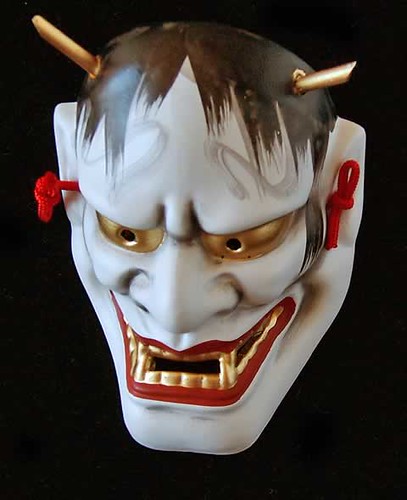
Oni Mask
The spines on the head are a characteristic feature of this yokai. Its this characteristic which has most likely been lent to Acanthaster planci,  the crown of thorns starfish which is known in Japanese as the Oni Hitode or "Demon starfish" 鬼ヒトデ
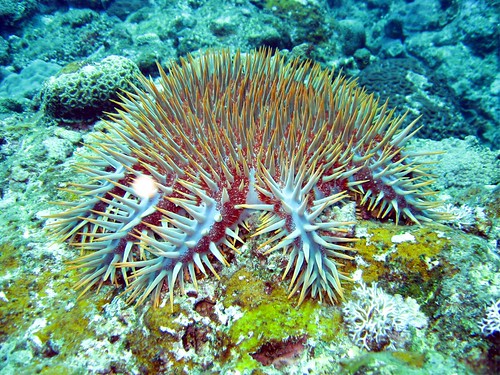
Crown of Thorns
Here's another kawaii I found of the Oni-hitode, which from what I understand was part of a"Kill the crown of thorn starfish" campaign. Acanthaster planci, is a fairly well known predator of coral and has been undergoing massive population booms leading to frequent efforts to remove them.
From this Japanese site 
And of course, the inevitable transformation of the crown of thorns starfish into a kaijin or "human sized" monster to be defeated by a snorkel-adorned Kamen Rider! 

2. Higuruma Hitode (or not?)
Another cool Japanese starfish name is one this deep-sea brisingid starfish, Brisingaster robillardi.

I've described brisingid sea stars at length here. Deep-sea species which feed on prey in water currents using "velcro" (tiny claws) on their spines. More great images of these animals here.

The common name for this species is called the Higuruma Hitode which sounds GREAT! Hitode is Japanese for starfish. But What is a "Higuruma"??

Higuruma is apparently one name for a ghost/yokai called Kasha (whose name apparently translates to "flaming chariot" who carts the corpses of sinners off to the underworld (thanks to Matt Alt for this info). I suppose in this case the "corpses of sinners" are represented by small crustacean prey! Muahaha!

The resemblance between the flames (the arms) emerging from the wheel  (the disk) is how this starfish was likely named! Pretty neat!
Image from Dr. Fujita
To give you a better idea, here is a very similar "fire wheel" type yokai called Wanyudo, which translates to "wheel monk" and who apparently steals the souls of those who gaze upon it. Apparently many yokai can be similar in appearance

It also shows the "flames from wheel" appearance that this starfish takes after...
Image via the Yokai Attack! FB group
Interestingly, Higuruma hitode was actually assigned to a similar species called Novodinia pacifica so perhaps Brisingaster robillardi  should be referred to as a Wanyudo hitode or perhaps a Kasha hitode??


3. The Sazae-oni aka the "Snail Ogre" 栄螺鬼
This yokai is apparently one of the more malevolent ones and according to Yokai.com is a dangerous spirt that pretends to be a beautiful drowning woman in order to lure and feed on sailors.

There's a whole mythology about these yokai which involves pirates and monsters biting off their testicles.  You can read the colorful version here. 
Image by Toriyama Sekien via wikipedia and also this Japanese site
These yokai are actually based on horned turban snails, Turbo cornutus which look like this
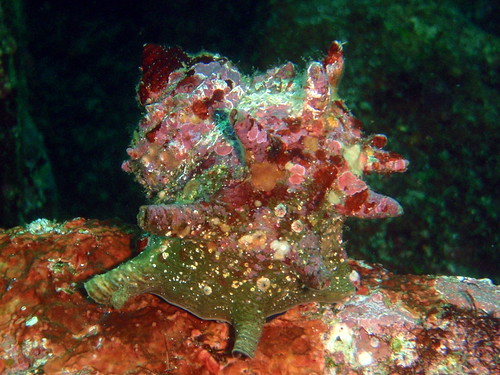
#791 horned turban (サザエ)
These snails in Japan are called sazae (hence the name "snail demon"and are eaten throughout Japan, often grilled in their own shell
Sazae being grilled in IH Cooking Heater

This species of snail is widely familiar to the Japanese and was even made into a kaiju called Gogo in the show Ultra Q, the precursor to Ultraman!

4. Hekigani ヘイケガニ The "samurai crabs"(the crab Heikeopsis japonica)
This "ghost" is actually more of a ghost story. It basically relates the story of this crab, Hekeopsis japonica which often have a very human-like face on their carapace (i.e., the top side of the skeleton).
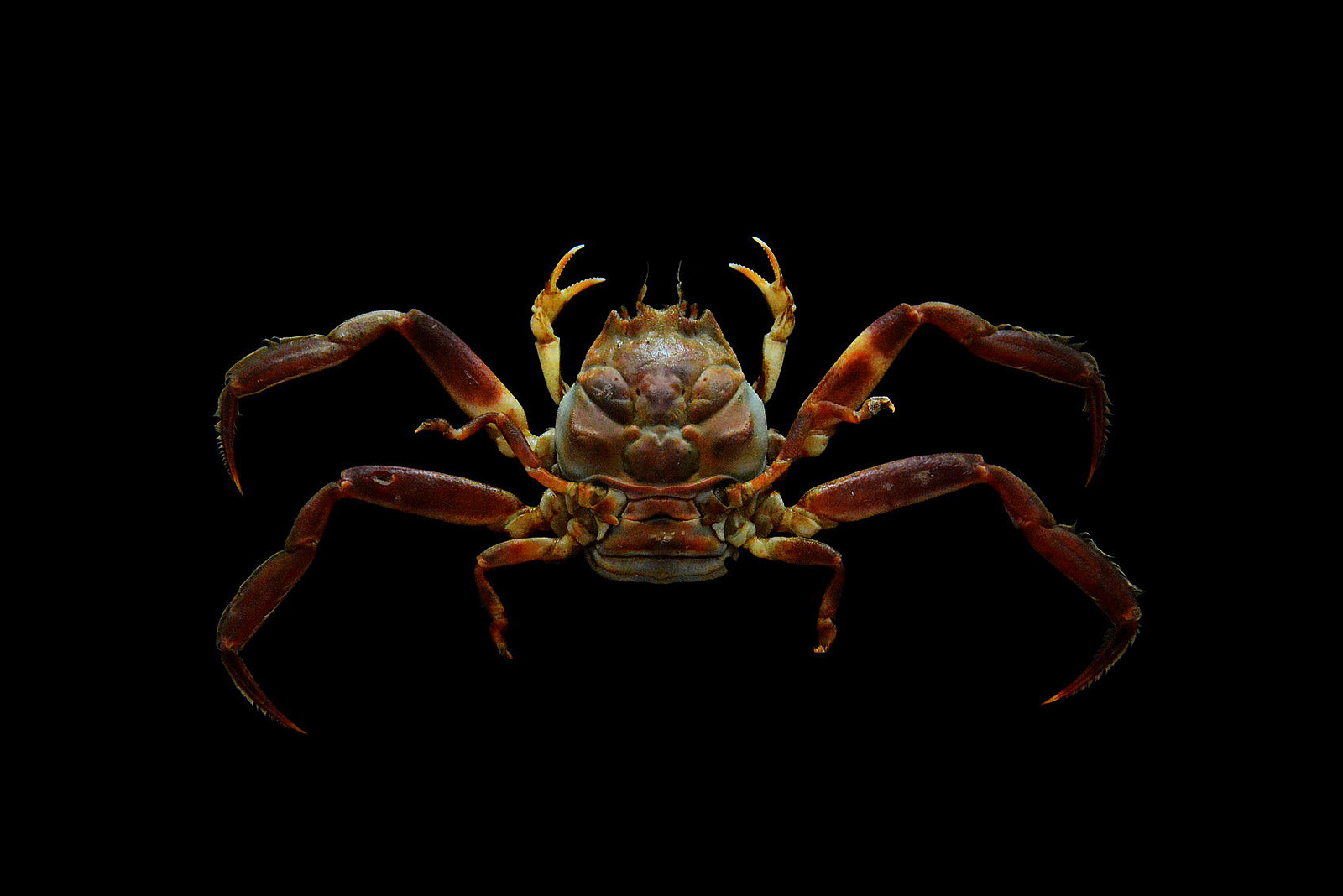
Heikegani 日本平家蟹
This species is referred to as the "samurai crab"?   Why? The "faces" on these crabs (actually the fine morphology of the carapace) have been thought to be the reincarnations of Japanese Heikie warriors defeated at the Battle of Dan-no-ura as told in The Tale of the Heike. Wikipedia has a nice summary of this event.

But here's a gorgeous painting which shows this event in various stages..
Image by Utagawa Kuniyoshi via Wikipedia
This crab species was also made famous by Carl Sagan who discussed them as an example of inadvertent character selection on Cosmos. You can watch this segment here


4a. The Kani-Oni: DEMON CRAB!! 
While doing research for this post I came across this creature, the Kani oni! aka the Crab Demon.   I couldn't find out much about it, but I did realize one thing..
 Thereare only THREE pairs of legs per side.  This is a characteristic feature of lithod crabs, which are actually more closely related to hermit crabs. "Proper crabs" such as the Japanese spider crabs have 4 legs on each side. 

But this species is very similar to this species, Lithodes aequispina (unconfirmed ID). Thus, the ghost crab does seem to be something in the Lithodidae. 
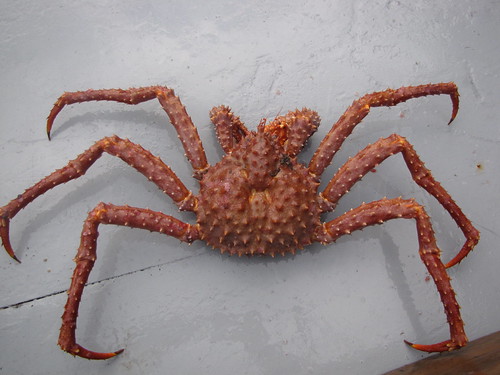
Golden King Crab (Lithodes aequispina)
The spines on the crab might allude to another species of lithode crab which has bigger and more prominent spines on the carapace, such as this one.
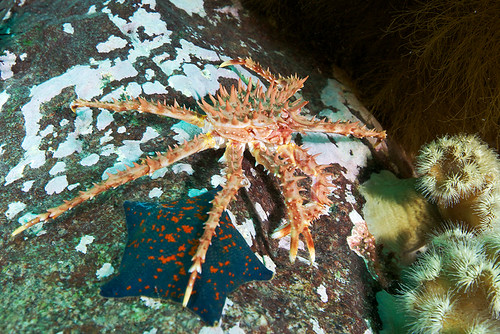
Paralithodes camtschaticus 5

5. The Umibōzu 海坊主
So this particular ghost isn't actually based on an invertebrate..but it gets honorable mention..

The name Umibozu translates to "Ocean or Sea, Buddhist Monk" and have been explained as the ghosts of drowned buddhist monks.  They are apparently haunted spirits of the ocean and mentioning their name invokes bad luck for ships at sea.
From all the accounts that I could find, there are apparently different "morphotypes" of what Umibozu look like with some images looking a bit more of a human shape...

The Umibozu tend to be rarely seen and considered somewhat mysterious..

I happened to notice a curious coincidence between these and Opisthoteuthis, aka one of the "dumbo octopuses"! But nah.. the umibozu are FAR more menacing! 

NEXT WEEK: NUDIBRANCHS!

Thursday, January 29, 2015

Weird stuff! One of the starfish I described will be a....TOY???? #EchinoblogInJapan2015

Back in 2003,  I described this very ODD deep-sea starfish. Astrosarkus idipi, a weird and HUGE sea star which had a pretty weird body plan.. You can read my full post about it here.  It occurs in relatively deep-water and is pretty big. About the size of a pumpkin. This species was honored by Quentin Wheeler & Sara Pennak as one of the world's most amazing 100 species! 


My Japanese colleagues discovered more specimens of this species a few years ago in Japanese waters and named it 竜宮桜ヒトデ aka the "deep-sea cherry blossom starfish". The english name was more like "Pumpkin Starfish" But cultural differences, dontcha know...

Today, one of my Japanese colleagues emails me THIS ad for a new series of Japanese "candy toys" aka gashapon. I've discussed how the Japanese LOVE their little, highly detailed toys (here)..

This series is entitled "Deep-sea Sushi"and features various deep-sea animals on little sushi rice things...

The series includes, from left to right:

1. The Dumbo octopus aka Opisthoteuthis californiana
2. the Giant isopod, Bathynomus, probably B. giganteus aka ダイオウグソクムシ(大王具足虫). Read more about the Japanese obsession with giant isopods here.
3. The big deep-sea Oarfish
4. The Anglerfish.
5. Blobfish.

....and 6: ASTROSARKUS IDIPII!!  SOMEONE IS GOING TO MAKE A TOY OUT OF A STARFISH I DESCRIBED!!

I had no idea this was being done and I certainly am not getting any money for this. I'm going to have to buy this set if I want one.. I'm not even entirely sure who makes them. 

Weird day. 

Tuesday, January 27, 2015

Echinoblog In Japan 2015: A Visit to JAMSTEC!!


Greetings to everyone from Japan! Yes. I missed last week.. transit and jet lag just wiped me out..but this week.. something a little longer and .. SPECIAL!!

An exclusive look at specimens and technology at JAMSTEC, the Japanese Agency for Marine Earth Science and Technology!! 

I'm here visiting the National Museum of Nature and Science, Japan's equivalent to its Smithsonian or National Museum of Natural History, where I am studying Japanese starfishes and trying to identify the total number of species in the region. This includes the discovery of new species, clarifying the taxonmy and relationships of known species and etc..

Some of my earlier efforts in Japan from 2014 included some stuff from here and stuff here  and even more here.

Fortunately, the NMNS has some ties with the oceanographic institution JAMSTEC, which is sort of the Japanese version of Wood's Hole Oceanographic Institution or NOAA...  and so, a visit!

My gratitude to Dr. Toshihiko Fujita for arranging the visit! And my thanks to his student Miki for making sure that I did not get lost in the THREE hour trip via the Japanese rail system to get there!

Deep-Sea Invertebrates!! 
The JAMSTEC collections had many interesting specimens.....

In addition to my research, I also got to see some unusual species I don't ordinarily get to see.. for example the armored snail, Cyrsomallon sp. , which you can read about here... 
Along side a 500 yen coin for scale...

Later that day, we got a fantastic opportunity to tour the two JAMSTEC research vessels! 

Shinkai 6500!! 
Most famous of course is the world famous Shinkai 6500, one of the few manned subs left in the world... which was being refit.. 
but still VERY impressive! 
You may remember that the Shinkai recently returned from a world tour in 2013!! ! during the Quelle 2013 expedition


The Research Vessels! 
the R/V Kairei (Japanese for ridge), which operates the research ROV Kaiko 7000.  I've never seen what shipboard life has been like on board vessels in other countries, so this was pretty neat! 
The ROV Kaiko 7000 was not on board the Kairei.. but you could see that its a HUGE submarine robot!!  That blue carrige on the left?? THAT is where the Kaiko usually sits before being deployed by the crane on the right...

Here's the Bridge
Here is their ROV control room.. normally completely darkened with big computer/TV screens... NOTE how clean the floor is.. The WHOLE computer and video room is IMMACULATE...
It is kept SO clean, that you actually take your shoes off before entering INTO the control/video ROV room!!!  Which frankly.. was a first for me...


MESS HALL! Yes. they have a rice cooker...


In the Mess Hall, one of the things I loved was that ALL of their tea pots, cups, etc. have the JAMSTEC logo on them!!! How cool is that??
                           

The bathrooms were different compared to a western ship, which typically only use showers. Here's the men's common area bathing room.. two showers PLUS a BATH TUB!  Its customary to take a nice hot bath in Japan.. but still, a shift from what I'm accustomed to...
Still... a bathtub at sea?? Sure. I'd try it!

And of course, a highly sophisticated Japanese electric toilet!!!

The R/V Kaiyo (Japanese for ocean)
Is a bit different..a catamoran with twin hulls... which is similar in overall morphology to the R/V Western Flyer operated by MBARI.. The Kaiyo is a bit older and due to be retired next year..


But is a VERY stable platform...
Aft View...
                            

Miscellanous Fun Stuff seen around JAMSTEC

1.  Deep-Sea Origami Invertebrates: (Giant Isopod, Dumbo octopus and crab below)

2.Deep Sea chemosynthetic clams on display in the JAMSTEC exhibition halll

3. A life size reproduction of the Shinkai observation module!!
4. Cool Gift Shop stuff including pencils with CORE sample markings!!   
                                       
Note that the R/V Chikyu is yet ANOTHER one of the JAMSTEC research vessels, which is the platform for the Ocean Drilling Project! 


I am EXTREMELY grateful to my JAMSTEC hosts: Dr. Katsunori Fujikura, who provided the tour as well as Dr. Takashi Hosono and Marika Ichiyanagi of the JAMSTEC data management group!!