Echinodermata! Starfish! Sea Urchins! Sea Cucumbers! Stone Lillies! Feather Stars! Blastozoans! Sea Daisies!
Marine invertebrates found throughout the world's oceans with a rich and ancient fossil legacy. Their biology and evolution includes a wide range of crazy and wonderful things. Let me share those things with YOU!
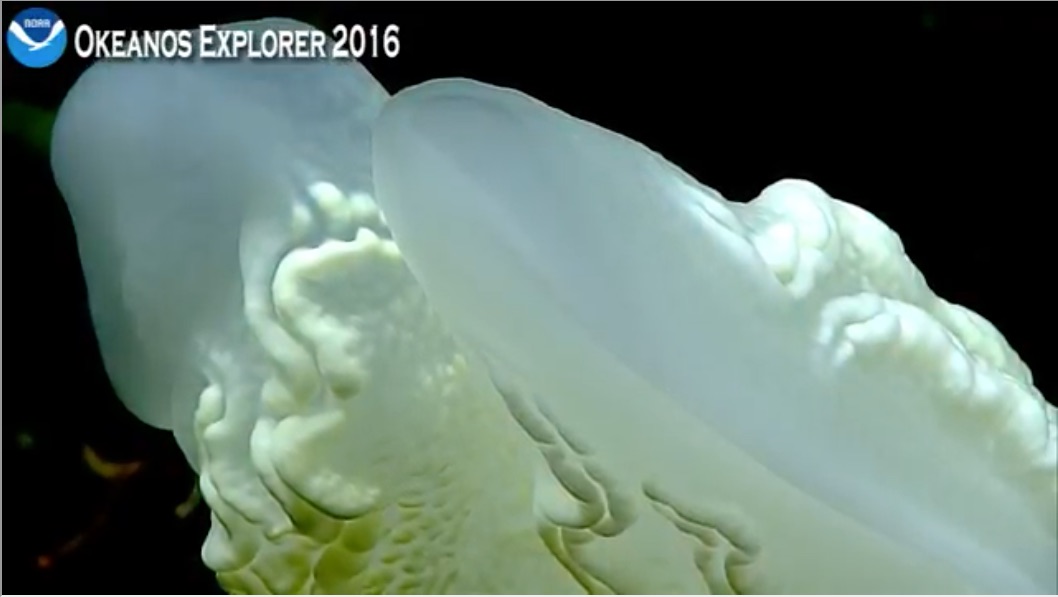
But what are some of the more SPECTACULAR animals they have been seeing?? Here's a highlight of the ones I consider just singularly amazing! 1. Big White Lyrocteis-like Benthic Ctenophore (aka comb jelly)
The last year or two has seen a HUGE awareness of these strange animals. Basically they are the bottom version of swimming comb jellies aka ctenophores. Although gelatinous, they are possibly VERY distinct from proper jellyfish.
This newly discovered white animal has a very different surface texture and so far has NOT been observed to extend its feeding tentacles! It has the same "rabbit ears" or "harp" shaped body as Lyrocteis but is it even the same thing?? Interesting!
2. Stunning sea anemone in the family Aliciidae!
This one was just stunning and weird all at the same time. It kind of looks like a strange gelatinous Christmas Tree! From Ahyi Seamount, 275 meters
Fortunately Dr. Chris Kelley of HURL had seen one of these before. The withdrawn version of a seldom seen sea anemone in the family Aliciidae.
Here's a picture from the HURL database showing it extended. You can see the knobs on the body. Beautiful..but wow. Unusual.
3. The Sea Anemone (from) Liponema!
ANOTHER bizarre sea anemone. These go by the common name "pom pom anemones" or "tumbleweed" anemones... Why? Because they actually have a very loose connection to the bottoms and can actually ROLL along when they want to move!!
This pic from Pagan Volcano and Supply Reef from about 336 m
Here's a separate species called Liponema brevicornis doing JUST that thing! Rolling along the bottom like a big pink fuzzy snow ball!!
Image borrowed from Actinaria.com http://actiniaria.com/liponema_brevicornis.php
4. Neat looking sea anemone called Isactinernus! About which it seems there is very little known.... But it has these very distinct tentacled lobes
Here it is OPEN (seen on Pagan Volcano, 345 m)
and here it is CLOSED (this was seen on Supply Reef)
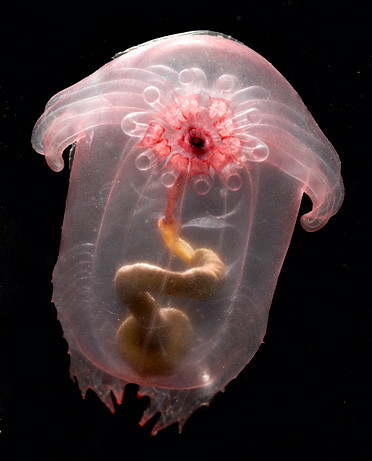
5. The Ever Majestic swimming sea cucumber Enypniastes!
This splendid picture taken in the famous Mariana Trench from a dizzying 5, 775 meters! DEEP!
6. SEA URCHINS GALORE!!
Here's a stunning urchin with Christmas colors! Caenopedina probably C. pulchella based on what I've been able to find on it..
Handsome red cidaroid sea urchin from Moag Crater, 327 meters
7. And some New Species of Snails...
This is what's called a slit shell snail or a member of the family Pleurotamariidae. Long story short: deep-sea snails but with similar shells observed in the fossil record. This gives them "Living Fossil" status and their beauty and color makes them valuable to shell collectors..
The one the Okeanos Explorer has been seeing? Probably a new species according to Chong Cheng at JAMSTEC (@squamiferum on Twitter).
Those yellow balls on the body extensions? Apparently those are luminescent organs! Not previously seen in this genus..making this a very likely NEW species (thanks to Dr. Gosliner for the determination!)
Japan is known for some of the biggest and most successful and widely known toys throughout the world. Giant robots! Godzilla! Pokemon! Sailor Moon! Hello Kitty! For whatever reason, when you think about toys, Japan comes to mind.
During my travels, it's also become apparent how the interests of the people reflect on the diversity of toys that are available to everyone, from casually interested kid to hardcore collector.
Japan amazingly produces several toys of different species from not only the deep-sea but also from "deep time" with many fossils and so on. What makes these so amazing to me is that they were even made!
Although some the plushies might have been made for a specific show, most were made for the general populace as either collectibles or items that interest the consumer.
This amazing species is captured as a tiny highly detailed replica, known as a gashapon. They are obtained from specific gashapon machines, but these days most folks just buy them individually at special shops throught the "hobby" distrcts of Japan, such as Akihabara or at Nakano Broadway.
These are highly detailed, come with a stand and are about 1-2 cm tall.
Somewhat more specialized is the plushy Enypniastes obtained via the gift shop at the National Museum of Nature & Science! These are larger as you can see below...
2. Sea Pigs! Yup. they got em'... Remember my original post here?? Deep-sea sea cucumbers with legs that for some reason combine cute and creepy!
No fewer than TWO brands of sea pig gashapon (again, small highly detailed plastic models of Scotoplanes globosa)
This cool plush toy from the gift shop at the National Museum of Nature & Science in Tokyo!
3. We've all heard/seen of the famous Japanese giant plush Bathynomus/giant isopod toy!
and yes, it is indeed soft and cuddly! Perfect for those cold nights when your teddy bears and undependable stuffed mammals have run out on you!
BUT what about the Giant Bathynomus-inspired designer vinyl action figure! Stands a good 10 inches tall with ray-gun!
Made by and for collectors, I've seen diferent sizes and color variations of this toy...
ranging from 60 to $600.00! Some of them even glow in the dark!
Plush toys are gaining momentum, there's even a set of Paleozoic invertebrate plushies!! The National Museum of Nature and Science of Tokyo had a fun set of Paleozoic invertebrates made into plushies! Here's a carpoid! (Paleozoic echinoderm) But there was a whole Cambrian set which I'm not showing here... 4. But the BIGGEST THING? small toys. Also known as gashapon! As mentioned earlier, tiny little 2-6 cm replicas of the real thing. Part of different sets following various themes for collectors..
For example, highly detailed Paleozoic invertebrates! Eurypterids and trilobites! (carpoids & others are also available).
Ammonoids! and more!
You want crabs and other crustaceans? YOU GOT IT! Anatomically accurate tiny plastic replicas of different crab families! Calappids! Portunids! Leucotheids! There's actually a second set with various lobsters and so forth...
You want NUDIBRANCHS? Done.
And of course there's a lot of your requisite whale, deep-sea fish, jellies and so on.. But here's a pretty cool commemorative set! Remember back when they had FIRST footage of the living deep-sea giant squid Architeuthis??
Yup, a commemorative and official (by the NMNS),Architeuthis squid gashapon set! With sperm whales and everything!
Things got a bit busy this week and I've been discovering the wonders of the natural history side of DeviantArt!
MANY creative and wonderful artists out there and I thought it would be cool to showcase some of the notable ones, especially the ones that can be compared against the "originals"
Frankly, I'm pretty impressed. At one time, a LOT of these animals were known only to a handful of specialists in the world. And NOW?People make them into art!! That's amazing!
What follows here are some PALEOZOIC fossils, with added colors and "reconstructed" onto a Paleozoic sea bottom as if they were alive... I try to compare some of these with actual fossils...
Here is an actual fossil of the ophiocistioid Eucladia from Yale's collection
Cystoid echinoderms from the Paleozoic! I'll blog more about the various Paleozoic echinoderms some day, but there's easily as many extinct echinoderm fossil groups (most of them with stems) as living groups. This image has a nice assortment of them from the Ordovician of New York..
Here are the three primary critters for comparison! The light olive one in the upper right corner, wrapped around the bryozoans is called Cupulocrinus jewetti
Here's another.. the brown one with all the unusual spines? tentacles along the sides? Is identified as Glyptocystites multiporus. Here's a fossil from the Ordovician in Ontario for comparison
This week! Everyone has seen them but what do we actually KNOW about SWIMMING sea cucumbers?? Let's find out!
Sea cucumbers are the very wormiest looking of echinoderms. In one sense-they resemble giant earthworms, in that they digest organic particles from the sediment which they pick up with their feeding "arms" which places food into their mouth.
They eat and they poop. The organics are processed through their intestine and left as "clean" castings via the other end. They live mostly on sea bottoms.
Dave Pawson was gracious to help provide info for the first three points..
Proper swimming sea cucumbers haven't been observed to eviscerate (expel intestines as a defense) like the shallow ones do, in fact, its unclear if they eviscerate at all.
The bodies of swimming sea cucumbers are often VERY gelatinous and composed mostly of water, such that they are often neutrally buoyant-and are often "pushed" around by currents created by nearby submersibles.
Its thought that a large proportion of sea cucumbers are capable of swimming.
All "proper" deep-sea cukes live in the deep-sea.. often in the neighborhood of 500-6000 meters deep! (Mt. Everest is about 8848 meters tall) and individual species are often occur widely-so the SAME SPECIES might be present in several different oceans!
1. There are Different KINDS of Swimming Behavior! Facultativeaka The Cuke CAN swim but only in an emergency! It turns out that most sea cucumbers are capable of some kind of swimming behavior but most only do so as an "extreme" response to predators.
For example, this shallow water North Pacific sea cucumber Parastichopus can undulate its body and move out of the way when it senses the predatory sunflower star (Pycnopodia) in close proximity.
Benthopelagic
So, the word "benthos" refers to the bottom and "pelagios" refers to the watery 3-D space that exists above it which makes up most of the ocean. Some animals (not just sea cucumbers) actually live a life that places them somewhere in between the two.. Hence the name.. "bentho-pelagic."
It turns out that MANY species of "swimming" sea cucumber only spend PART of their life actually swimming. You can see this in this video.. It lands and takes off again..
A paper by the Japanese deep-sea biologist Suguru Ohta (which you can download here) studied the deep-sea swimming sea cucumber Enypniastes in Japan.
Ohta-san produced this excellent diagram showing the swimming behavior of Enypniastes relative to the direction of the current and the swimming behavior/motion/actions of the animal.
At a recent scientific gathering, it was noted that upon "take off" Enypniastes will Poop!
..the ubiquitous swimmer Enypniastes eximia always swims down to the bottom to load up its intestine with delicious mud (and it feeds very rapidly for a sea cucumber, stuffing handfuls of sediment into its mouth as if there's no tomorrow), and then it swims away with a full intestine.
An image presented below shows this behavior as the animal has "landed". You can see the feeding tentacles which gather fine flaky organic matter called "marine snow" and put it into its mouth.
Potentially, this shows that behavior can be complex and related to things like growth.
TRULY PELAGIC
So far we've only seen sea cucumbers that swim but are not actually pelagic.. that is, they do not LIVE in the three dimensional space of the ocean like a jellyfish.
but there is ONE species which DOES SWIM ALL the time. In other words a TRUE swimming sea cucumber. Let me introduce you to Pelagothuria natatrix. Miller and Pawson describe this species as "...perhaps the most bizarre holothurian species in existence."
and yes.. it does have that Lovecraftian/Elder Thing-Mountains of Madness vibe going on doesn't it??
Image by Katulu on Flickr
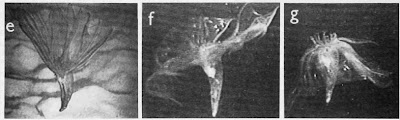
Why? Here are some drawings of the animal. The mouth and feeding arms face "upwards" and are recognizable but they sit at the center of a jellyfish-like veil on strongly gelatinous body.
Here is the veil extended. Mouth facing upward... That veil/umbrella? seems to be formed from the tube feet or podia modified into this swimming apparatus.
More detail on the mouth with the feeding arms shown in a radiating pattern around the mouth..
and more detail on the feeding arms at center and the tentacle-like veil around it. Miller and Pawson report that its food apparently consists of pelagic food sources: organic particles in the water, pelagic snail shells and other small floating debris.
Pelagothuria is known primarily from the deeps of the Atlantic, Pacific and Indian Ocean between 596 to 6776 meters.
Here are pictures from Miller and Pawson's monograph which show some of the few images of the animal alive.
Realize that a sea cucumber that is ACTING LIKE A JELLYFISH is pretty frakkin' WEIRD even for an echinoderm.
2. Why Do Swimming Sea Cucumbers Swim??
Miller and Pawson offer several possible reasons:
Avoiding Predators. The facultative swimmers obviously run in response to a predator-so why not the others? Swimming takes them out of harms way quickly and effectively.
Escape Physical Danger. Swimming sea cucumbers can maneuver themselves out of the way of underwater mudslides and other physical hazards.
Getting around aka "dispersal". Swimming or floating is a good way of getting around to find food, spread your genetic material. Many species are cosmopolitan-that is, they are found in ALL the world's oceans.
Go Where the food is. Remember when I wrote about sea pigs? What those sea cucumbers and others LOVE more than anything is fresh, delicious goo and junk that has just fallen onto the sea floor. Swimming is one way to pursue that tasty, yummy food.
Absorb nutrients from the water. Could there also be further dissolved food (organic matter) that the animals could absorb through their body wall?
3. How many different KINDS of swimming sea cucumbers are there and how are they different from "typical" sea cucumbers??
There are swimming sea cucumbers in ALL of the major groups of sea cucumbers. Miller and Pawson summarize accounts and find 25 different species that have been recorded swimming or are capable of swimming even a little. Five of those seem to be shallow-water with the remaining inhabiting deep-water.
Most deep-sea swimming cukes belong to the families Pelagothuriidae, Elpidiide, Psychropotidae, and the Synallactidae with the adaptations for swimming seemingly haven arisen in the evolution of sea cucumbers at different times in their history. 4. What else is there about swimming sea cucumbers that you aren't telling me??
At least a couple species glow in the dark! Enypniastes is thought to use its bioluminescence to scare off potential predators. See this paper for more..