Showing posts with label sea anemone. Show all posts

Tuesday, April 25, 2017

Okeanos Follow-up: Giant Sea-Spiders EAT! Cnidarians, Anemones, Hydroids & Corals! oh my!

Many of you know that I occasionally "call in" when the NOAA deep-sea research platform Okeanos Explorer goes out to see on its missions. (remember the next leg BEGINS APRIL 27  http://oceanexplorer.noaa.gov/okeanos/media/exstream/exstream.html)

Mostly I call in on starfishes or echinoderm biology..but I do have a broad interest in deep-sea biology. And I just LOVE seeing observations like the one above: a weird animal doing something no one is familiar with!

And the BEST thing about Okeanos Explorer? EVERYONE can enjoy it along with you!! Here's a BUNCH of Sea spider observations from the Atlantic Okeanos Explorer in 2014! 

...BUT of course, our ship and shore-side scientists can't know EVERYTHING. We'll often observe an event, many of us make note of it in case we see it again and often times we'll move on.... forgetting about it until such a time when the observation comes up again.

ONE such observation was one from 2014 on the Atlantic Physalia Seamount wherein we observed a sea spider in the genus Colossendeis sp. with its proboscis (that's the long cigar shaped feeding tube) stuckINTO into this hydroid (an animal similar to a Hydra from freshwater)! Was this feeding? Was it NEW?
Physalia Seamount in the North Atlantic
A brief into: Sea spiders are not spiders. They belong to a group known as the Pycnogonids (also called the pantopods) which are mysterious arthropods. Some folks consider them distantly related to the greater group of arachnids whereas others think they are even more unusual...

Most sea spiders are pretty tiny and are less than about an inch (2 cm) across and its not unusual for them to be quite cryptic. So even though they can be present, you really DO have to look for them...
Here a photoessay of tropical, shallow water species by scientist/photographer Arthur Anker displaying some spectactular colors!   Here's a spectacular male carrying eggs..
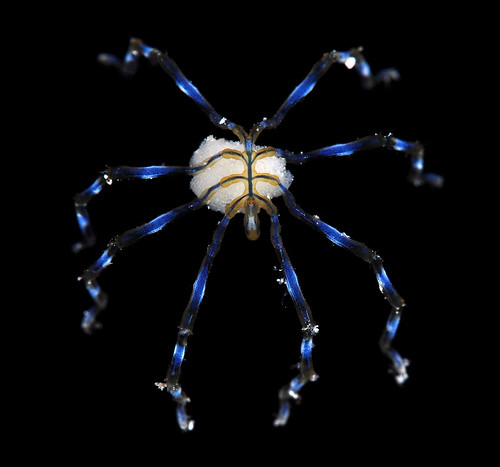
Male ovigerous sea spider (Pycnogonida)

Many live in shallow water but are never seen (hidden and small)... but that's NOT a problem with the deep-sea and Antarctic species!  There's one frequently encountered genus: Colossendeis which is one of the largest known sea spiders reaching a leg-to-leg diameter of over 50 cm! that's almost a FOOT and a HALF!

Most members of Colossendeis live in the proper deep ocean abyss: roughly 1000 to 5000 m and also in Antarctica where the cold-waters allow them to occur in relatively shallow water settings.

Note also the sizeable cigar shaped projection at the top end! That's called the PROBOSCIS! That will be important later! That is presumably what they use to feed.
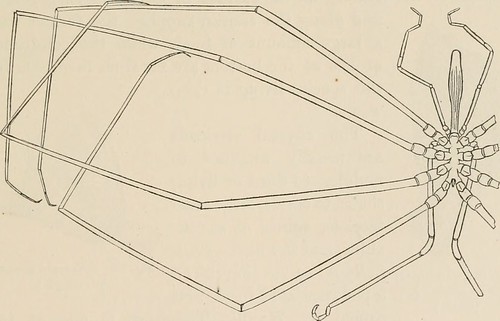
Image from page 96 of "A contribution to American thalassography; three cruises of the United States Coast and geodetic survey steamer "Blake," in the Gulf of Mexico, in the Caribbean Sea, and along the Atlantic coast of the United States, from 1877 to 18
Unfortunately, there is relatively little information known about sea spiders..... And the deep-sea species? Even less!

So, were the observations something unusual? Has science encountered something like that before??

But much to my delight: YES! There WAS a previous account of sea spiders feeding! and WOO HOO!  It turns out my friends at the Monterey Bay Aquarium Research Institute in Moss Landing, California actually observed something JUST LIKE THIS in 2010!!! Here was their blog post about it! 


The paper, by Caren Braby, Vicky Pearse, Bonnie Bain and Bob Vrijenhoek was published in Invertebrate Biology in 2009, 128(4): 359-363. and it documented "Pycnogonid-cnidarian trophic interaction in the deep Monterey Submarine Canyon"

They observed the same genus, Colossendeis, but at least two species, C. gigas and C. japonica feeding on commonly encountered sea anemones in the deeps of Monterey Canyon.
Braby's paper reveals that only Colossendeis in Antarctica had been observed feeding. These animals fed on limpets and bristle worms and in 1999 sea spiders were observed feeding on sea anemones

Braby et al.'s observations were the first for deep-sea Colossendeis (as opposed to Antarctic) species. Her team's work focused on their feeding on the deep-sea "pom pom anemone" Liponema brevicornis, an unusual sea anemone which literally "rolls" along the bottom of the deep-sea in a manner similar to a tumbleweed!

After the last 2017 Okeanos leg in the Phoenix Islands, I rounded up a BUNCH of the sea spider-feeding observations and decided to share them here as a comparison! Who knows? perhaps it will inspire a further paper!

Remember that NOAA's Okeanos Explorer program has captured these images and made them available for EVERYONE's enjoyment! Please remember that the next time someone talks about government funded science!

Pacific Observations! Over the last few weeks of the Phoenix Island expedition, we saw a BOUNTY of sea spider feeding observations!  

Winslow Reef: This one had its proboscis firmly ensconced into this flytrap anemone and was apparently sucking something out of it! The rather lethargic looking appearance is likely the result of being on the receiving end of whatever is going on here...

And ANOTHER on Winslow Reef! that was QUITE a dive! Here's another flytrap anemone with a sea spider attacking it!   As we saw earlier from Monterey Canyon, sea anemones and other cnidarians seem to be one kind of preferred food!

Baker Island we saw one attacking what was identified as a cup coral...The proboscis seemed to be "drinking" pretty heavily on this one...


Howland Island.....and just for good measure they saw this one crawling over a glass sponge

More Atlantic Feeding? Here we had a sea spider in the Atlantic Nygren Canyon which has been identified as Pallenopsis (thanks to Bonnie Bain), climbing and possibly feeding on this sea pen.

So, unfortunately I'm not really a sea spider taxonomist, so beyond the genus Colossendeis, I'm not sure how many species we are looking at here..but images such as this inspire many questions: Is predation specific to species? Or generalized?  How significant are these events to the ecosystem?
Do sea spiders attack the big colonial corals as well?

Stay tuned for the next exciting episode!

Sunday, June 26, 2016

Stunning Highlights from Okeanos 3rd leg of the Marianas Expedition!!


This last week has been a busy one-made even more momentous with all of the very AMAZING observations made by this last leg of the Okeanos Explorer as it explores various seamounts and other sites in the Marianas Islands! A whole bunch of information on the geological setting and the various study areas can be found on their website here
The entire mission overview can be found on NOAA Okeanos Explorer pages here and of course the LIVE VIDEO is on click away! (when they are broadcasting-usually from about 6pm to midnight Eastern time)

But what are some of the more SPECTACULAR animals they have been seeing?? Here's a highlight of the ones I consider just singularly amazing!

1. Big White Lyrocteis-like Benthic Ctenophore (aka comb jelly)
The last year or two has seen a HUGE awareness of these strange animals. Basically they are the bottom version of swimming comb jellies aka ctenophores. Although gelatinous, they are possibly VERY distinct from proper jellyfish.

We have seen a fair number of these on earlier Okeanos dives (as we see here) and I've written a post (here) about Lyrocteis aka the "Harp comb jelly" which occurs widely in the Pacific.

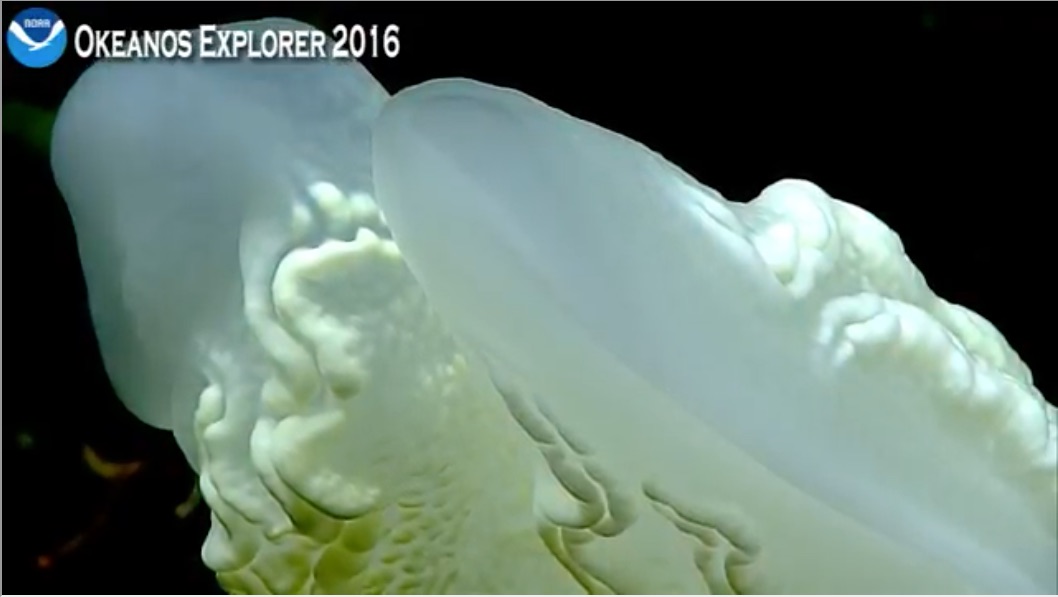
This newly discovered white animal has a very different surface texture and so far has NOT been observed to extend its feeding tentacles! It has the same "rabbit ears" or "harp" shaped body as Lyrocteis but is it even the same thing??   Interesting!


2. Stunning sea anemone in the family Aliciidae! 
This one was just stunning and weird all at the same time. It kind of looks like a strange gelatinous Christmas Tree! From Ahyi Seamount, 275 meters

Fortunately Dr. Chris Kelley of HURL had seen one of these before. The withdrawn version of a seldom seen sea anemone in the family Aliciidae.

Here's a picture from the HURL database showing it extended. You can see the knobs on the body. Beautiful..but wow. Unusual.


3. The Sea Anemone (from) Liponema
ANOTHER bizarre sea anemone. These go by the common name "pom pom anemones" or "tumbleweed" anemones... Why? Because they actually have a very loose connection to the bottoms and can actually ROLL along when they want to move!!

This pic from Pagan Volcano and Supply Reef from about 336 m
Here's a separate species called Liponema brevicornis doing JUST that thing! Rolling along the bottom like a big pink fuzzy snow ball!! 
Image borrowed from Actinaria.com http://actiniaria.com/liponema_brevicornis.php
4. Neat looking sea anemone called Isactinernus! About which it seems there is very little known.... But it has these very distinct tentacled lobes 

Here it is OPEN (seen on Pagan Volcano, 345 m)
and here it is CLOSED (this was seen on Supply Reef)

5. The Ever Majestic swimming sea cucumber Enypniastes
This splendid picture taken in the famous Mariana Trench from a dizzying 5, 775 meters!  DEEP!

6. SEA URCHINS GALORE!! 
Here's a stunning urchin with Christmas colors! Caenopedina probably C. pulchella based on what I've been able to find on it.. 


Handsome red cidaroid sea urchin from Moag Crater, 327 meters

An aspidodiadematid urchin, possibly Aspidodiadema from Eifuku Seamount, 420 m. Want to learn more about these urchins with crazy long spines that act as walking legs?? GO HERE.
 7. And some New Species of Snails...
This is what's called a slit shell snail or a member of the family Pleurotamariidae. Long story short: deep-sea snails but with similar shells observed in the fossil record. This gives them "Living Fossil" status and their beauty and color makes them valuable to shell collectors..

The one the Okeanos Explorer has been seeing? Probably a new species according to Chong Cheng at JAMSTEC (@squamiferum on Twitter).
and this STUNNING nudibranch, probably the genus Kaloplocamus, according to Dr. Terry Gosliner at the California Academy of Sciences! 

Those yellow balls on the body extensions? Apparently those are luminescent organs! Not previously seen in this genus..making this a very likely NEW species (thanks to Dr. Gosliner for the determination!)

And anyway.. THERE's MORE to COME!