Showing posts with label Caenopedina. Show all posts

Sunday, June 26, 2016

Stunning Highlights from Okeanos 3rd leg of the Marianas Expedition!!


This last week has been a busy one-made even more momentous with all of the very AMAZING observations made by this last leg of the Okeanos Explorer as it explores various seamounts and other sites in the Marianas Islands! A whole bunch of information on the geological setting and the various study areas can be found on their website here
The entire mission overview can be found on NOAA Okeanos Explorer pages here and of course the LIVE VIDEO is on click away! (when they are broadcasting-usually from about 6pm to midnight Eastern time)

But what are some of the more SPECTACULAR animals they have been seeing?? Here's a highlight of the ones I consider just singularly amazing!

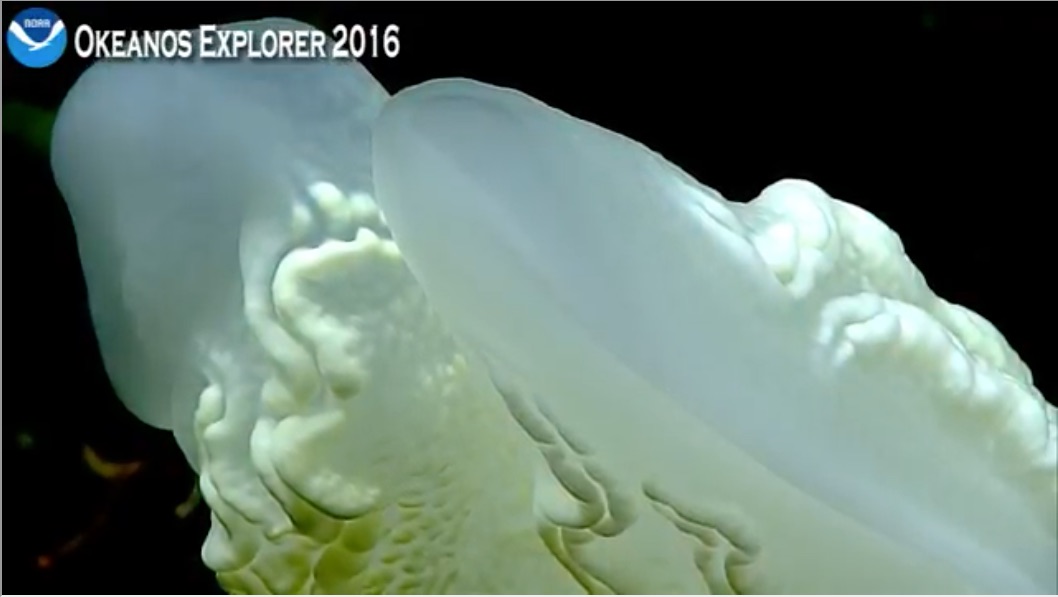
1. Big White Lyrocteis-like Benthic Ctenophore (aka comb jelly)
The last year or two has seen a HUGE awareness of these strange animals. Basically they are the bottom version of swimming comb jellies aka ctenophores. Although gelatinous, they are possibly VERY distinct from proper jellyfish.

We have seen a fair number of these on earlier Okeanos dives (as we see here) and I've written a post (here) about Lyrocteis aka the "Harp comb jelly" which occurs widely in the Pacific.

This newly discovered white animal has a very different surface texture and so far has NOT been observed to extend its feeding tentacles! It has the same "rabbit ears" or "harp" shaped body as Lyrocteis but is it even the same thing??   Interesting!


2. Stunning sea anemone in the family Aliciidae! 
This one was just stunning and weird all at the same time. It kind of looks like a strange gelatinous Christmas Tree! From Ahyi Seamount, 275 meters

Fortunately Dr. Chris Kelley of HURL had seen one of these before. The withdrawn version of a seldom seen sea anemone in the family Aliciidae.

Here's a picture from the HURL database showing it extended. You can see the knobs on the body. Beautiful..but wow. Unusual.


3. The Sea Anemone (from) Liponema
ANOTHER bizarre sea anemone. These go by the common name "pom pom anemones" or "tumbleweed" anemones... Why? Because they actually have a very loose connection to the bottoms and can actually ROLL along when they want to move!!

This pic from Pagan Volcano and Supply Reef from about 336 m
Here's a separate species called Liponema brevicornis doing JUST that thing! Rolling along the bottom like a big pink fuzzy snow ball!! 
Image borrowed from Actinaria.com http://actiniaria.com/liponema_brevicornis.php
4. Neat looking sea anemone called Isactinernus! About which it seems there is very little known.... But it has these very distinct tentacled lobes 

Here it is OPEN (seen on Pagan Volcano, 345 m)
and here it is CLOSED (this was seen on Supply Reef)

5. The Ever Majestic swimming sea cucumber Enypniastes
This splendid picture taken in the famous Mariana Trench from a dizzying 5, 775 meters!  DEEP!

6. SEA URCHINS GALORE!! 
Here's a stunning urchin with Christmas colors! Caenopedina probably C. pulchella based on what I've been able to find on it.. 


Handsome red cidaroid sea urchin from Moag Crater, 327 meters

An aspidodiadematid urchin, possibly Aspidodiadema from Eifuku Seamount, 420 m. Want to learn more about these urchins with crazy long spines that act as walking legs?? GO HERE.
 7. And some New Species of Snails...
This is what's called a slit shell snail or a member of the family Pleurotamariidae. Long story short: deep-sea snails but with similar shells observed in the fossil record. This gives them "Living Fossil" status and their beauty and color makes them valuable to shell collectors..

The one the Okeanos Explorer has been seeing? Probably a new species according to Chong Cheng at JAMSTEC (@squamiferum on Twitter).
and this STUNNING nudibranch, probably the genus Kaloplocamus, according to Dr. Terry Gosliner at the California Academy of Sciences! 

Those yellow balls on the body extensions? Apparently those are luminescent organs! Not previously seen in this genus..making this a very likely NEW species (thanks to Dr. Gosliner for the determination!)

And anyway.. THERE's MORE to COME! 

Friday, September 25, 2015

Know your Deep-Sea Urchins! (Okeanos echinoid edition!)


Leg 4 of the Hohonu Moana Okeanos Explorer Expedition has begun! (here is the link to live feed!)

We have new investigators Scott France (on invertebrates) and MacKenzie Gerringer (on fishes) studying the huge diversity of deep-sea corals, sponges and other life in the northern Hawaiian Islands region.

The Hawaiian region brings with it a very different fauna from the one we saw in the Atlantic Okeanos cruises. There's actually quite a bit more diversity in the Pacific in sea stars, and many other echinoderms. So I thought I would offer a guide to some of the more prominent groups of echinoderms that we are likely to encounter in these deep-sea habitats: the sea urchins!!

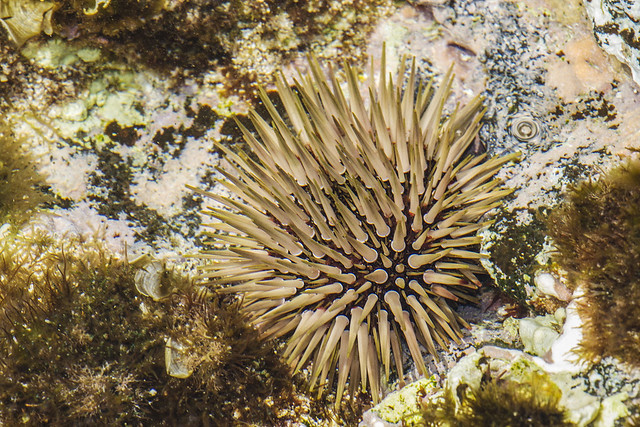
Most everyone is familiar with the spiny balls that one observes in the intertidal or while SCUBA diving. 
Burrowing Urchin, Echinometra mathaei
And basically, sea urchins in the deep appear the same.. BUT many of them are unusual in some way.  Different adaptations or different evolutionary histories and there's much more to them than the "typical" urchins most people encounter in shallower depths. 

Here are some of the more commonly encountered sea urchins we will likely encounter in the Hawaiian region (below about 1000 m). These are also pretty typical of deep-sea settings throughout the Indo-Pacific.

There ARE a few that aren't noted here. Mostly the "irregular" urchins such as sand dollars, or sea biscuits. 


1. Aspidodiadema This is a genus of unusual deep-sea urchins that is represented in Hawaii and in many tropical deep-sea habitats in the Pacific as well as one species in the Atlantic. These have really long spines that it uses for locomotion in conjunction with its tube feet.

There's apparently more than one species of Aspidodiadema in Hawaii, but so far we've been calling the one seen by Okeanos, Aspidodiadema hawaiiense. Upon looking at both images, there do seem to be some differences but its unclear without a specimen to examine..
Here's a nice moving GIF of this Aspidodiadema species on the move! 
This image shows the same type of animal as the one above but with a mysterious bag like extension emerging from the top. Possibly an anal sac as we see in diadematid urchins?? Unclear.
In comparing them, this second one seems to be lighter in color... 

2. Caenopedina! This genus is a member of the family Pedinidae, of which it is the only living member. This genus is widely occurring mostly in deep-sea habitats. 

According to the Hawaiian Undersea Research Lab's Animal ID guide, there are two recognized species in the region: 

Caenopedina pulchella This species shows these very thick spines which are brightly colored green and purple!
The small individual above seems to have much smaller spines relative to this larger one.. but the colors patterns appear consistent..

This second species is Caenopedina hawaiiensis and it seems to show a very different appearance... 
3. Echinothuriid Urchins! These are one of the most frequently encountered sea urchins in deep-sea settings. Commonly referred to as "pancake urchins" or "tam o shanter" urchins, their body shape is suspended by water pressure, so when removed from the ocean into say, a bucket on the deck of a ship, their very soft skeletons collapse into a flat "pancake" like shape.

I've written on these animals plenty of times here and here and their shallow-water relatives here

One caveat about this section: I'm not sure that any of these can be correctly identified..so I'm keeping it vague. At least for now. 

But salient features of the urchins as a group include: 
1. Needle sharp spines which can be pretty dang painful!
2. Cute little walking legs with special "hooves" on their spines 
We've seen at least 2 species.. this purple species..
Rewatching yesterday's #okeanos dive: sea #urchin w/ mittens on its spines #Hawaii, Lone Cone ~1800m pic.twitter.com/kEL4cTtBIn
There's this slightly different pink echinothuriid
 this grey species                            

Echinothuriids are a frequently encountered group in the deep-sea. We will likely encounter more of them..

4. Cidaroid Urchins! One of the other "typical" urchins one encounters in the deep-sea is that cidaroids.  This is a fairly old group of urchins, which branched off early in the history of urchins and has a fairly good Mesozoic fossil record (see here).   

Cidaroids are unusual for urchins in that they lack skin on their spines, which results in an overabundance of "fouling" animals which can settle and grow on them. I've briefly talked about the ecological importance of this here. 

We've also seen cidaroids with a CRAZY range of spine shapes and morphologies, such as what I summarized here
                           
Cidaroids are not just predators on corals as shown below, but are also likely predators on stalked and other crinoids as I've posted about previously..

A nice diversity of cidaroid urchins in the deep-sea Hawaiian Islands.. More at the HURL gallery here  but sadly we've really only seen a few at the deep depths Okeanos has been exploring..

Histocidaris variabilis.. note the barnacles growing on the spines...


Stereocidaris hawaiiensis

Possibly Stylocidaris calacantha.  This one was observed high up in the branches of this bamboo coral, likely feeding on the polyps..