Showing posts with label Hawaii. Show all posts

Friday, September 25, 2015

Know your Deep-Sea Urchins! (Okeanos echinoid edition!)


Leg 4 of the Hohonu Moana Okeanos Explorer Expedition has begun! (here is the link to live feed!)

We have new investigators Scott France (on invertebrates) and MacKenzie Gerringer (on fishes) studying the huge diversity of deep-sea corals, sponges and other life in the northern Hawaiian Islands region.

The Hawaiian region brings with it a very different fauna from the one we saw in the Atlantic Okeanos cruises. There's actually quite a bit more diversity in the Pacific in sea stars, and many other echinoderms. So I thought I would offer a guide to some of the more prominent groups of echinoderms that we are likely to encounter in these deep-sea habitats: the sea urchins!!

Most everyone is familiar with the spiny balls that one observes in the intertidal or while SCUBA diving. 
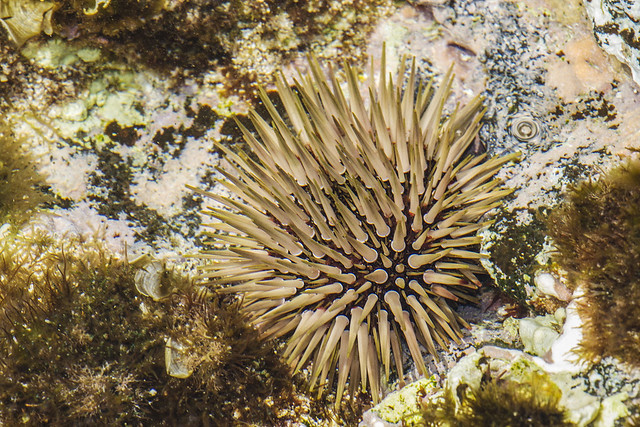
Burrowing Urchin, Echinometra mathaei
And basically, sea urchins in the deep appear the same.. BUT many of them are unusual in some way.  Different adaptations or different evolutionary histories and there's much more to them than the "typical" urchins most people encounter in shallower depths. 

Here are some of the more commonly encountered sea urchins we will likely encounter in the Hawaiian region (below about 1000 m). These are also pretty typical of deep-sea settings throughout the Indo-Pacific.

There ARE a few that aren't noted here. Mostly the "irregular" urchins such as sand dollars, or sea biscuits. 


1. Aspidodiadema This is a genus of unusual deep-sea urchins that is represented in Hawaii and in many tropical deep-sea habitats in the Pacific as well as one species in the Atlantic. These have really long spines that it uses for locomotion in conjunction with its tube feet.

There's apparently more than one species of Aspidodiadema in Hawaii, but so far we've been calling the one seen by Okeanos, Aspidodiadema hawaiiense. Upon looking at both images, there do seem to be some differences but its unclear without a specimen to examine..
Here's a nice moving GIF of this Aspidodiadema species on the move! 
This image shows the same type of animal as the one above but with a mysterious bag like extension emerging from the top. Possibly an anal sac as we see in diadematid urchins?? Unclear.
In comparing them, this second one seems to be lighter in color... 

2. Caenopedina! This genus is a member of the family Pedinidae, of which it is the only living member. This genus is widely occurring mostly in deep-sea habitats. 

According to the Hawaiian Undersea Research Lab's Animal ID guide, there are two recognized species in the region: 

Caenopedina pulchella This species shows these very thick spines which are brightly colored green and purple!
The small individual above seems to have much smaller spines relative to this larger one.. but the colors patterns appear consistent..

This second species is Caenopedina hawaiiensis and it seems to show a very different appearance... 
3. Echinothuriid Urchins! These are one of the most frequently encountered sea urchins in deep-sea settings. Commonly referred to as "pancake urchins" or "tam o shanter" urchins, their body shape is suspended by water pressure, so when removed from the ocean into say, a bucket on the deck of a ship, their very soft skeletons collapse into a flat "pancake" like shape.

I've written on these animals plenty of times here and here and their shallow-water relatives here

One caveat about this section: I'm not sure that any of these can be correctly identified..so I'm keeping it vague. At least for now. 

But salient features of the urchins as a group include: 
1. Needle sharp spines which can be pretty dang painful!
2. Cute little walking legs with special "hooves" on their spines 
We've seen at least 2 species.. this purple species..
Rewatching yesterday's #okeanos dive: sea #urchin w/ mittens on its spines #Hawaii, Lone Cone ~1800m pic.twitter.com/kEL4cTtBIn
There's this slightly different pink echinothuriid
 this grey species                            

Echinothuriids are a frequently encountered group in the deep-sea. We will likely encounter more of them..

4. Cidaroid Urchins! One of the other "typical" urchins one encounters in the deep-sea is that cidaroids.  This is a fairly old group of urchins, which branched off early in the history of urchins and has a fairly good Mesozoic fossil record (see here).   

Cidaroids are unusual for urchins in that they lack skin on their spines, which results in an overabundance of "fouling" animals which can settle and grow on them. I've briefly talked about the ecological importance of this here. 

We've also seen cidaroids with a CRAZY range of spine shapes and morphologies, such as what I summarized here
                           
Cidaroids are not just predators on corals as shown below, but are also likely predators on stalked and other crinoids as I've posted about previously..

A nice diversity of cidaroid urchins in the deep-sea Hawaiian Islands.. More at the HURL gallery here  but sadly we've really only seen a few at the deep depths Okeanos has been exploring..

Histocidaris variabilis.. note the barnacles growing on the spines...


Stereocidaris hawaiiensis

Possibly Stylocidaris calacantha.  This one was observed high up in the branches of this bamboo coral, likely feeding on the polyps..

Friday, August 14, 2015

This Week in Okeanos! A digest of Hawaiian deep-sea invertebrates seen over the last week!

Over the last few days, the R/V Okeanos Explorer has deployed its Remotely Operated Vehicle, the Deep Discoverer into some of the deepest waters in the Hawaiian Islands region, specifically in the Papahānaumokuākea Marine National Monument!  Many of the study areas have never been studied before.

The Okeanos Explorer's primary objective here is to map and document the communites which form the habitat and primary fauna of this region. And so, a majority of their time goes towards studying the many, MANY deep-sea sponges and corals which make up these habitats. 

The main page for the NOAA Hawaiian Expedition can be found here.

Their LIVE feed can be found here.


I've been tweeting the LIVE stream of the Okeanos' various discoveries and last week I documented the many, MANY different types of glass sponges seen by the Okeanos Explorer

This week I thought I would just digest some of the various discoveries made which I thought warranted a place in today's post! Although most of the screengrabs here are mine, I am ETERNALLY grateful to the Facebook Underwater screengrab group! 

1. Is this the world's LARGEST KNOWN SPONGE??? (Glass sponge or otherwise??)

Here was a pic of the ROV Deep Discoverer NEXT to the sponge. it was approximately 3.5 m long X 2.5 m tall, that's about 11 feet x 8 feet LONG!
Sponges and corals are known as "ecosystem engineers" because they play host to numerous other species and essentially become huge hubs of biodiversity. Many, MANY other animals live on these sponge colonies: brittle stars, starfish, squat lobsters, etc. the list goes on...


SOMETIMES, the community is a little more permanent than others. Here's a shrimp which lives inside this "glass cage" sponge. This species mates and lives inside the sponge for the rest of its life...

This story, of the "Venus flower basket" which is a pretty obvious deep-sea invertebrate "love story" is seen in the genus Euplectella. One can find more accounts of this story all over, such as here. 


2. Starfish FEED on glass sponges!
You wouldn't think there would be much on a glass sponge to eat, being composed primarily of... glass (see last week) but there IS that syncytium, the weird cytoplasm like stuff that covers the glass skeleton and a starfish has gotta eat.. 

Some goniasterid that is not clearly identifiable..
A "wolf pack" of Henricia sp. approaching on and feeding on this fallen glass sponge..

3. There are multiple species of deep-sea starfish which feed on corals too! 
One of my primary research interests and one of my favorite things to watch are deep-sea goniasterid starfish feeding on corals. I worked on these for my PhD and have described several new species of these animals (here) and here.  and even here

In Hawaii, there are several species of coral-devouring sea stars. Many of them display a fairly prominent border of spines around their body...

Calliaster pedicellaris
                          
Evoplosoma, probably E. forcipifera
and a new species I described last year, Hippasteria muscipula

4. Special Weird Deep-Sea Treats! The Bottom-living or "dandelion" siphonophore!!
A siphonophore is a gelatinous animal that is a sort of colonial jellyfish closely related to the Portuguese man-o-war. Siphonophores are best known as swimmers in the pelagic or open ocean. In the deep-sea, there are some species which live near the sea bottom and float above the surface, dragging their tentacles along the surface..
If the weird beast above seems kinda familiar, you may have seen another species of this "dandelion" siphonophore in other news....such as this one from Africa which has been making the news rounds as a weird "spaghetti monster"

The mystery of the million barnacle plates! The bottom was littered with millions of barnacle plates, but WHERE ARE THE BARNACLES??
 We did see a few, but were they even the same species??

5. and my personal favorite..a sea urchin called Aspidodiadema hawaiiensis! A strange sea urchin that looks like the spider robot from Johnny Quest! I've mentioned these before in my post about HURL's deep-sea Hawaiian urchins
                       
These seem to move around via a combination of their tube feet and these long bowed spines which seem to extend to the surface.
Also of interest are the beak-like structures near the base. These are called pedicellariae and given how large and prominent they are, I would speculate that they are extended for defense. Perhaps to protect the tube feet??
I also love these animals because they resemble the "robot spy" from Johnny Quest! 
And yeah, post this week was a bit late. Laptop in the shop! More next week! 

Wednesday, July 29, 2015

Deep-Sea Citizen Science??? Okeanos Begins August 1 in the Hawaiian Islands!

NOAA Ocean Explorer: NOAA Ship Okeanos Explorer: Galapagos Rift Exploration 2011 - EX1103 Leg2

At the moment, the Explorer has been mapping the region and you can see all of this live, but come Saturday you'll be able to watch the actual EXPLORATION of the Hawaiian deep-sea here:
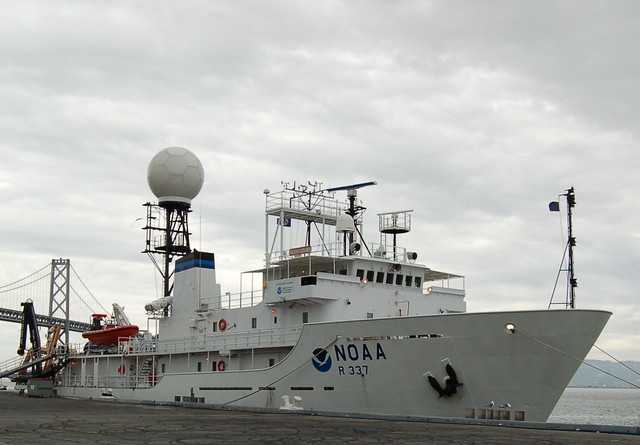
NOAA Ship Okeanos Explorer (R 337)
                             
Why am I so Farkin' excited about this??
I've been studying deep-sea Hawaiian starfish since the mid 1990s and in fact, my very first EVER publication was a checklist of Hawaiian starfish based on material at the Bishop Museum in Honolulu. In 2001 I got to actually go to the BOTTOM of the Hawaiian deeps! (about 1000 m I think?) in the submersible Pisces V

So, to actually be able to SEE all of these species with High-Definition video?? EXCITING!!

What Sorts of Starfish and other Echinoderms Will We See??
As with past Okeanos Explorer dives, the dives will involve a Remotely Operated Vehicle deployed to the deep-sea with narration but also with ONSHORE support via phone, computer and social media. That includes me and a veritable ARMY of other marine biologists, including ecologists, taxonomists (i.e. people who identify different species) and geologists.

I've helped summarize the various starfish species seen on Okeanos Explorer dives in the North Atlantic (here).  But the diversity in the Hawaiian region and especially in the Pacific is fair bit MORE diverse!
and even though there's been a deep-sea research operation in Hawaii for the last 30 years or so, the truth is, we don't know a lot about many of the animals which live out here. So, the chances of our seeing something new out here? I would think those chances are VERY good!

The folks at the Hawaiian Undersea Research Laboratory have an "ID Gallery" not just of Sea stars but of ALL the many different animals found at depth here... from crustaceans to corals and sea urchins to fish! 

There's the potential to encounter one of approximately 55 species of deep-sea asteroids described in the Hawaiian region (that's not including any shallow water species).
I've had the pleasure of describing at least four NEW species in the Hawaiian region, including  Apollonaster kelleyi, named for Dr. Chris Kelley who will be one of the science leads on the Okeanos team!
We may even get to see my other new species, Astroceramus eldredgei (named for Lu Eldredge at the Bishop Museum) in glorious feeding action!
Image courtesy of HURL
Here are some posts I've written about the deep-sea Hawaiian fauna, including
BUT WAIT! That's not all! What about the Citizen Science part I mentioned!!! 
The Okeanos live stream has played a big role in part of a new and fascinating dynamic to deep-sea research!  Citizen Science!

Now ANYONE around the world can watch a live streamed research cruise! (Note: Google is GREAT at helping calculate the time differences in different parts of the world).

But how does the citizen science thing work?

Screengrab software is pretty much a free feature on computers. My macintosh has it and I'm pretty sure most PCs have it. And if it doesn't already come with it, you can probably download some free software for it.  There are even software apps that allow you to take short movies off the video feed.

So, basically, ANYONE can basically take a screengrab off the feed and contribute to a larger community of scientists and other interested people who are interested in deep-sea biology!!

IF YOU SEE SOMETHING NEW you will see it along WITH the scientists and the entire world!
Who knows? Maybe a screengrab that YOU take could lead to a new discovery!!

Where do you find these and how do you contribute?

There's TWITTER of course! Hashtag it with #Okeanos and Boom! there it goes!  If I can, I actually make it a point to LIVE TWEET any identifications and observations I make off the live stream..
In addition to my Twitter handle: @echinoblog, others scientists and biologists who are usually watching include
@ademopoulos An ecologist at the US Geological Survey
@DrChrisKellogg A microbiologist/coral biologist
@CarinaDSLR A marine biology PhD student 

But there are often many, many more...

The other interesting option is the FACEBOOK Underwater webcams Screenshot Group!  So, basically if you join, this group is made up of nearly 1000 people (some scientists but many are not) that are just taking and posting screengrabs from underwater live stream video including R/V Nautilus and Okeanos Explorer.

There's usually someone on taking a grab of something almost 24 hours a day. If you missed that cute dumbo octopus?? Not to worry, in all liklihood, someone took a screen grab of it on this group!

If you see something during the Okeanos feed, you can usually ask someone on Twitter or in the Facebook group and one can usually get a response the same day.. There are innumerable taxonomists and scientists monitoring. Some will call in on the phone, which you'll be able to hear on the live stream, others may add information via the Facebook group while others such as myself may Tweet an answer.

New discoveries happen pretty regularly. New behavior. New species. Sometimes even rarely seen species!  On the last Okeanos Cruise, you may remember that they observed a deep-sea starfish which had not been seen since 1878 (130 years!)

Who knows what we shall discover in Hawaii???

Tuesday, March 10, 2015

New Deep-sea Starfishes honor Hawaiian Scientists!


This week I talk about 2 new species of deep-sea starfishes from Hawaii described in my new paper published by Zootaxa

courtesy of Wikipedia! 
The paper has a very special meaning to me because it honors a scientist who was instrumental in getting my career started: Dr. Lu Eldredge, who passed away in 2013. 

Lu was a scientist at the Bishop Museum's Invertebrate Zoology department and was also the Executive Secretary of the Pacific Science Association

Lu had roots in the study of crustaceans but over the years had become sort of a polymath, studying everything from coral reefs to invasive species. A full pdf article of his scientific contributions can be found for download here.

Lu took a chance on me, early in my career and funded a visit for me to study the Bishop Museum echinoderm collections back in 1997 (or thereabouts). The funding was basic. I stayed at the YMCA and worked at the museum for about a month. No air conditioning. I ate at Zippys every day. Got lost on the bus pretty regularly, but swam in the pool every day. A difficult but fond time in my life.  

This was one of my first "real" museum visits and I learned a lot about being a research scientist and got my feet wet doing basic field work (we did some collecting) and studying museum collections.

While I was working, I found this specimen which I initially misidentified but later discovered was a species previously undescribed from Hawaiian waters.. A genus known as Astroceramus
The genus name is very descriptive. In the latin, "Astro" refers to the star shape and "ceramo" (or -ceramus) refers to "tile" So "Star shaped tile". This probably alludes to the very tile-shaped plates that comprise the animal's surface
And so, I have named this handsome starfish species for Lu : Astroceramus eldredgei which loosely translates to "Eldredge's ceramic star."

But there's MORE to this species than just a specimen!! The Hawaiian Undersea Research Laboratory has observed this species alive!! 
and more than that! they have observed it feeding on some of the deep-sea corals in the area.. Here is one image showing it feeding on the distinctive blue-colored deep-sea plexaurid octocoral, Astromuricea theophilasi
So, not only is it a cool looking beast but it is also likely an ecologically important one! and joins the ranks of the many other deep-sea corallivores I have written about...

A footnote about how new species often await "discovery" for YEARS before being found? The specimens described in my paper?  Date back to 1966! that's 4 years before I was born!

Lu Eldredge was a well-known and beloved personality within the context of biodiversity in the Hawaiian scene. There was a FULL volume of papers published in his honor published by the Bishop Museum which is summarized here. 

Among the other species named in Lu's name? SIX different types of crabs as well as an isopod and a coral...
  • Porcellanopagurus eldredgei, a bivalve-carrying Hermit Crab from Guam
  • Leptomithrax eldredgei, a new species of majid crab from Hong Kong
  • Forestiana lucius, a xanthid crab
  • Pseudomiccipe eldredgei, a majid crab
  • Petrolisthes eldredgeian Indo-west Pacific porcellanid crab 
  • Homola eldredgei, a homolid crab
  • Psammocora eldredgei, a scleractinian coral
  • Avada eldredgei, a parasitic isopod
Lu will be missed but through his work and his legacy he will be remembered.


Apollonaster kelleyi! 

I also honor another Hawaiian colleague, who remains very active with the Hawaiian Undersea Research Laboratory (HURL) and has been a great supporter of my work! Dr. Christopher Kelley, who is one of the primary scientists at HURL!!   Another bio of Chris can be found here.
from Nat Geo!
Chris does a lot. In addition to managing their video database, he runs any number of deep-sea and submersible projects and has done a LOT to further our understanding of marine resources (including fisheries) in the Hawaiian region.
From the University of Manoa page
You may recall that Chris has helped me with a few of my prior posts showing in situ images of various Hawaiian deep-sea echinoderms.  Such as this one with the asteroids and this one with deep-sea sea urchins

He's worked hard to provide everyone with a guide to Hawaiian deep-sea animals (here)! 

Apollonaster is genus in the same family as Astroceramus, the Goniasteridae. The name has an interesting history.. as it was named in honor of the Apollo 11 voyage which landed the first men on the moon. An apt genus to honor a deep-sea scientist!
Prior to this species being discovered, Apollonaster was known only from the tropical Atlantic! Could this be evidence that this was a species which occurred in both oceans before the closure of the Panamanian ishtmus??
A shallow water example of connectivity via a species occurring between these two oceans was detailed by one of my earlier posts on another sea star called Heliaster.