Showing posts with label Aspidodiadema. Show all posts

Wednesday, March 2, 2016

Echinoderms with Spines for Walkin'

OKEANOS Explorer is BACK!!! And even though they've only been able to venture into the field for two days, there's already some AWESOME video which inspires this week's post!! 

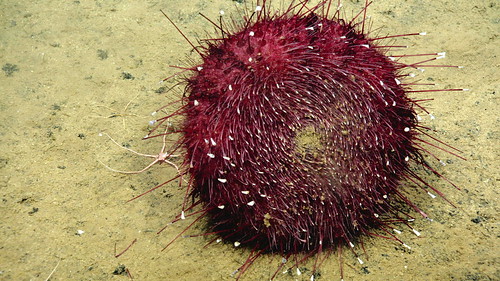
Sunday, the ROV spied this awesome beast, a weird sea urchin in the genus Aspidodiadema. Although there's at least one species known in this area, A. hawaiiensis, I'm not sure that this is the same thing.

I've talked about this urchin before.  The spines bow out from the central body and touch the bottom rather than simply projecting outward as they do in other species. They are unusual in that they use their spines to "walk" along the sea bottom.

Here's a diagram of another species but with the "walking tips" clearly deployed on the bottom


On Sunday, they spied ANOTHER Aspidodiadema sp. But the video actually captured the unusual TIPS of the walking spines!!!
Do you see those round, circular tips that are on the tips of the spines??

Look at the red arrows below pointing to the "walking cups" on the spines that the urchin uses to move!
What's also kind of interesting is that this animal (and I think a few others) were actually CLIMBING a rock face and not just walking along a flat surface as diagrammed by Mortensen back in the day. So, these do a lot more than just just support..

Think of the spines like the long legs on the spider robot from Johnny Quest!

The "walking tips" of the spines look sort of like little hooves that the spines use to gain purchase on the substrate probably in conjunction with the tube feet. The center illustration shows what the bottom of that "hoof" looks like as you look directly up into it.. basically a modified spine tip adapted to aid in movement!

So, we HAVE seen something like this before in  Echinothuriid or "tam o shanter" or "pancake" urchins! 

I've done this story more than a few times..with one of the most recent accounts here.

Long story short: The urchin walks on a bunch of little legs with modified tips that ALSO resemble hooves! 

Look for the little white tips on the spines around the bottom edge!! Those are how it moves around on the soft-muddy substrate.
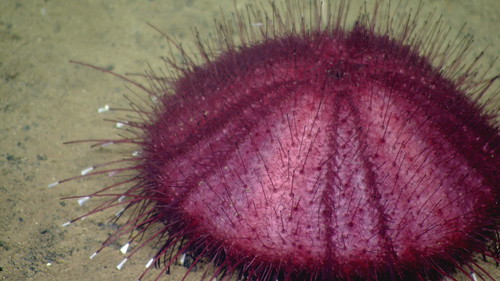
Spiny sea urchin
Sea Urchin underbelly
Here's a close up of what those look like!!! Superficially similar to the ones in Aspidodiadema!  At least in shape..
But wait.. There's MORE????   How about in STARFISH???
That's right! I'm pretty sure I've found spines that might serve in a similar (or maybe opposite?) fashion in deep-sea sea stars!  The filter-feeding Brisingids!! (here)

I just published a paper last year which documents some work I did recently on Hawaiian brisingids!
The starfish actually live on old munitions and junky metal debris.. I wrote about it here

The species was named Brisingenes margoae in honor of Dr. Margo Edwards at the University of Hawaii! She is a professor of geophysics working on mapping this unusual munitions filled terrain! 

She was head of the project and invited my participation! 
After collecting these starfish I noted something rather interesting.. the tips of the spines that occur on along the tube foot grooves were stained brown from contact with the metal casings they were sitting on! 

The one on the right shows the brown tip on one spine..
 This suggested that these were actually inset or even anchored into the surface rather than just kind of pointing away as has been suggested from watching them filter feed..

But when you look further at some other species, you see that there's probably an additional way for them to remains stabilized on whatever bottom they happen to be sitting on..
Here's a close up of some of those spines in one species from the North Pacific.. The tips are kind of wide and hoof-like! Similar to what you see in Aspidodiadema and the echinothuriid urchins! 
The case for the functioning of these spines is still sort of at the "hypothesis" stage at the moment..but it seems like a good argument all things considered. It seems likely that they serve at least in part as anchors. But do they use them to move also? Little walking legs? Something in between? Do they vary depending on where they live?

This all makes sense though. Spines are how these animals interact with their environment. In these deep-sea habitats where you have a lot of water currents and unstable bottoms, these spines help them. Either as support or to help move efficiently where a soft tube foot might not.

Weird. But I love figuring out strange sh*t like this!!

Friday, September 25, 2015

Know your Deep-Sea Urchins! (Okeanos echinoid edition!)


Leg 4 of the Hohonu Moana Okeanos Explorer Expedition has begun! (here is the link to live feed!)

We have new investigators Scott France (on invertebrates) and MacKenzie Gerringer (on fishes) studying the huge diversity of deep-sea corals, sponges and other life in the northern Hawaiian Islands region.

The Hawaiian region brings with it a very different fauna from the one we saw in the Atlantic Okeanos cruises. There's actually quite a bit more diversity in the Pacific in sea stars, and many other echinoderms. So I thought I would offer a guide to some of the more prominent groups of echinoderms that we are likely to encounter in these deep-sea habitats: the sea urchins!!

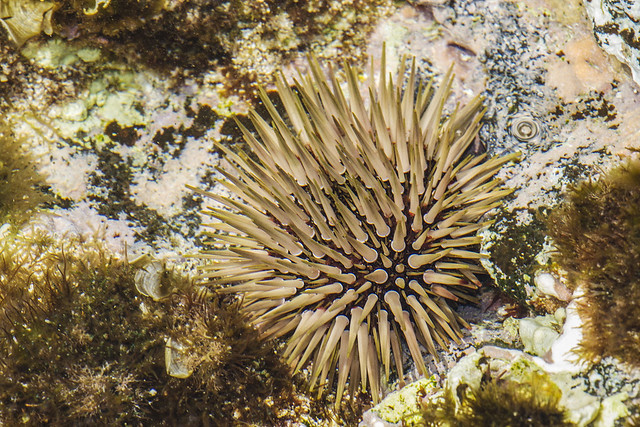
Most everyone is familiar with the spiny balls that one observes in the intertidal or while SCUBA diving. 
Burrowing Urchin, Echinometra mathaei
And basically, sea urchins in the deep appear the same.. BUT many of them are unusual in some way.  Different adaptations or different evolutionary histories and there's much more to them than the "typical" urchins most people encounter in shallower depths. 

Here are some of the more commonly encountered sea urchins we will likely encounter in the Hawaiian region (below about 1000 m). These are also pretty typical of deep-sea settings throughout the Indo-Pacific.

There ARE a few that aren't noted here. Mostly the "irregular" urchins such as sand dollars, or sea biscuits. 


1. Aspidodiadema This is a genus of unusual deep-sea urchins that is represented in Hawaii and in many tropical deep-sea habitats in the Pacific as well as one species in the Atlantic. These have really long spines that it uses for locomotion in conjunction with its tube feet.

There's apparently more than one species of Aspidodiadema in Hawaii, but so far we've been calling the one seen by Okeanos, Aspidodiadema hawaiiense. Upon looking at both images, there do seem to be some differences but its unclear without a specimen to examine..
Here's a nice moving GIF of this Aspidodiadema species on the move! 
This image shows the same type of animal as the one above but with a mysterious bag like extension emerging from the top. Possibly an anal sac as we see in diadematid urchins?? Unclear.
In comparing them, this second one seems to be lighter in color... 

2. Caenopedina! This genus is a member of the family Pedinidae, of which it is the only living member. This genus is widely occurring mostly in deep-sea habitats. 

According to the Hawaiian Undersea Research Lab's Animal ID guide, there are two recognized species in the region: 

Caenopedina pulchella This species shows these very thick spines which are brightly colored green and purple!
The small individual above seems to have much smaller spines relative to this larger one.. but the colors patterns appear consistent..

This second species is Caenopedina hawaiiensis and it seems to show a very different appearance... 
3. Echinothuriid Urchins! These are one of the most frequently encountered sea urchins in deep-sea settings. Commonly referred to as "pancake urchins" or "tam o shanter" urchins, their body shape is suspended by water pressure, so when removed from the ocean into say, a bucket on the deck of a ship, their very soft skeletons collapse into a flat "pancake" like shape.

I've written on these animals plenty of times here and here and their shallow-water relatives here

One caveat about this section: I'm not sure that any of these can be correctly identified..so I'm keeping it vague. At least for now. 

But salient features of the urchins as a group include: 
1. Needle sharp spines which can be pretty dang painful!
2. Cute little walking legs with special "hooves" on their spines 
We've seen at least 2 species.. this purple species..
Rewatching yesterday's #okeanos dive: sea #urchin w/ mittens on its spines #Hawaii, Lone Cone ~1800m pic.twitter.com/kEL4cTtBIn
There's this slightly different pink echinothuriid
 this grey species                            

Echinothuriids are a frequently encountered group in the deep-sea. We will likely encounter more of them..

4. Cidaroid Urchins! One of the other "typical" urchins one encounters in the deep-sea is that cidaroids.  This is a fairly old group of urchins, which branched off early in the history of urchins and has a fairly good Mesozoic fossil record (see here).   

Cidaroids are unusual for urchins in that they lack skin on their spines, which results in an overabundance of "fouling" animals which can settle and grow on them. I've briefly talked about the ecological importance of this here. 

We've also seen cidaroids with a CRAZY range of spine shapes and morphologies, such as what I summarized here
                           
Cidaroids are not just predators on corals as shown below, but are also likely predators on stalked and other crinoids as I've posted about previously..

A nice diversity of cidaroid urchins in the deep-sea Hawaiian Islands.. More at the HURL gallery here  but sadly we've really only seen a few at the deep depths Okeanos has been exploring..

Histocidaris variabilis.. note the barnacles growing on the spines...


Stereocidaris hawaiiensis

Possibly Stylocidaris calacantha.  This one was observed high up in the branches of this bamboo coral, likely feeding on the polyps..

Friday, August 14, 2015

This Week in Okeanos! A digest of Hawaiian deep-sea invertebrates seen over the last week!

Over the last few days, the R/V Okeanos Explorer has deployed its Remotely Operated Vehicle, the Deep Discoverer into some of the deepest waters in the Hawaiian Islands region, specifically in the Papahānaumokuākea Marine National Monument!  Many of the study areas have never been studied before.

The Okeanos Explorer's primary objective here is to map and document the communites which form the habitat and primary fauna of this region. And so, a majority of their time goes towards studying the many, MANY deep-sea sponges and corals which make up these habitats. 

The main page for the NOAA Hawaiian Expedition can be found here.

Their LIVE feed can be found here.


I've been tweeting the LIVE stream of the Okeanos' various discoveries and last week I documented the many, MANY different types of glass sponges seen by the Okeanos Explorer

This week I thought I would just digest some of the various discoveries made which I thought warranted a place in today's post! Although most of the screengrabs here are mine, I am ETERNALLY grateful to the Facebook Underwater screengrab group! 

1. Is this the world's LARGEST KNOWN SPONGE??? (Glass sponge or otherwise??)

Here was a pic of the ROV Deep Discoverer NEXT to the sponge. it was approximately 3.5 m long X 2.5 m tall, that's about 11 feet x 8 feet LONG!
Sponges and corals are known as "ecosystem engineers" because they play host to numerous other species and essentially become huge hubs of biodiversity. Many, MANY other animals live on these sponge colonies: brittle stars, starfish, squat lobsters, etc. the list goes on...


SOMETIMES, the community is a little more permanent than others. Here's a shrimp which lives inside this "glass cage" sponge. This species mates and lives inside the sponge for the rest of its life...

This story, of the "Venus flower basket" which is a pretty obvious deep-sea invertebrate "love story" is seen in the genus Euplectella. One can find more accounts of this story all over, such as here. 


2. Starfish FEED on glass sponges!
You wouldn't think there would be much on a glass sponge to eat, being composed primarily of... glass (see last week) but there IS that syncytium, the weird cytoplasm like stuff that covers the glass skeleton and a starfish has gotta eat.. 

Some goniasterid that is not clearly identifiable..
A "wolf pack" of Henricia sp. approaching on and feeding on this fallen glass sponge..

3. There are multiple species of deep-sea starfish which feed on corals too! 
One of my primary research interests and one of my favorite things to watch are deep-sea goniasterid starfish feeding on corals. I worked on these for my PhD and have described several new species of these animals (here) and here.  and even here

In Hawaii, there are several species of coral-devouring sea stars. Many of them display a fairly prominent border of spines around their body...

Calliaster pedicellaris
                          
Evoplosoma, probably E. forcipifera
and a new species I described last year, Hippasteria muscipula

4. Special Weird Deep-Sea Treats! The Bottom-living or "dandelion" siphonophore!!
A siphonophore is a gelatinous animal that is a sort of colonial jellyfish closely related to the Portuguese man-o-war. Siphonophores are best known as swimmers in the pelagic or open ocean. In the deep-sea, there are some species which live near the sea bottom and float above the surface, dragging their tentacles along the surface..
If the weird beast above seems kinda familiar, you may have seen another species of this "dandelion" siphonophore in other news....such as this one from Africa which has been making the news rounds as a weird "spaghetti monster"

The mystery of the million barnacle plates! The bottom was littered with millions of barnacle plates, but WHERE ARE THE BARNACLES??
 We did see a few, but were they even the same species??

5. and my personal favorite..a sea urchin called Aspidodiadema hawaiiensis! A strange sea urchin that looks like the spider robot from Johnny Quest! I've mentioned these before in my post about HURL's deep-sea Hawaiian urchins
                       
These seem to move around via a combination of their tube feet and these long bowed spines which seem to extend to the surface.
Also of interest are the beak-like structures near the base. These are called pedicellariae and given how large and prominent they are, I would speculate that they are extended for defense. Perhaps to protect the tube feet??
I also love these animals because they resemble the "robot spy" from Johnny Quest! 
And yeah, post this week was a bit late. Laptop in the shop! More next week!