Showing posts with label sea cucumber. Show all posts

Monday, March 6, 2017

Highlights from the recent NOAA Okeanos Explorer Samoa Expedition!

So, here is a nice highlight of various wonderful invertebrates observed by NOAA's deep-sea research vessel, the Okeanos Explorer which for all of 2016 and 2017 will be studying the massive marine reserves of American territory in the tropical Pacific!

DON'T FORGET OKEANOS LIVE FEED RESUMES MARCH 7!


But obviously, not everyone can watch EVERY day during the entire dive. So I present some cool highlights (but invertebrates) from the last leg of the research dive.  

My thanks to Santiago Herrera and Matthew Jackson the biology & geology science leads for this last epxpedition!!

If you have missed it and are interested you can always go to Twitter and search for #Okeanos often with #Samoa or other similar terms.


Also a reminder based on recent news about significant budget cuts to NOAA Remember that NOAA operates the Okeanos Explorer program!!  The oceans represent a HUGE unknown quantity and yet, we have no exploration arm to explore the amazing deeps of the Earth. Deep-sea News has made a GREAT argument about why we need an "Ocean NASA"! And right now, the closest thing NOAA gives us the closest thing to that! 

So, if you enjoy these and other images as well as the livestream RESEARCH and DISCOVERY please contact your congressional representative and LET THEM KNOW: DO NOT DEFUND NOAA.

and now.. onto some cool beasts!!


PROTISTS! 
Most of what I'll present here are animals, but in the deep regions of the ocean, single-celled organisms that are basically HUGE amoebas can develop fairly LARGE structures out of sediment. I've written about them here. Some are called xenophyophores but it turns out that there's a fair diversity of them.

Here's at least one structure observed on Utu Seamount at about 3030 meters! 


SPONGES!! Some of the most commonly encountered animals on these Okeanos dives are sponges. Sponges are relatively simple animals that are basically big masses of cells but some of them use specific kinds of materials to create skeletons.  Some use calcium carbonate, some use a fiber called spongin..and one group which is seen commonly in the deep-sea: glass or silicon dioxide.


Here's a large one with a thick stalk and a large opening on the "head"
This is a cool one: this is a cladorhizid sponge. Many cladorhizid sponges are predatory and I think this one is as well..

those spines emerging off the edge makes it a deadly deep-sea umbrella!
Here's another one from a different angel from Rose Atoll, about 2525 meters! 

This is a glass sponge in the Euplectellidae, which is often identifiable by the unusual "cap" on the top of the sponge.. These are known for having 2 commensal male and female mated shrimps which do not escape from the internal cavity.. 
I missed the name/identification on this one..but I like to point out that those brown "roots" are actually GLASS. Glass sponges often seem to be growing "living" fiber optic cable and have been studied for their optical properties! 

WEIRD CNIDARIANS!!
Cnidarians are of course-those animals with stinging cells and radial symmetry. Jellyfish, sea anemones, hydras, hydroids and so on.They account for a huge diversity in deep-sea habitats! 

This "cosmic jellyfish" has been making the rounds. Its been identified as Benthocodon hyalinus by my colleague Allen Collins at NMFS. It was observed on Utu Seamount at about 3006 meters!! 


Its not unusual for us to see a giant hydroid on these dives.. This one identified tentatively as Corymopha
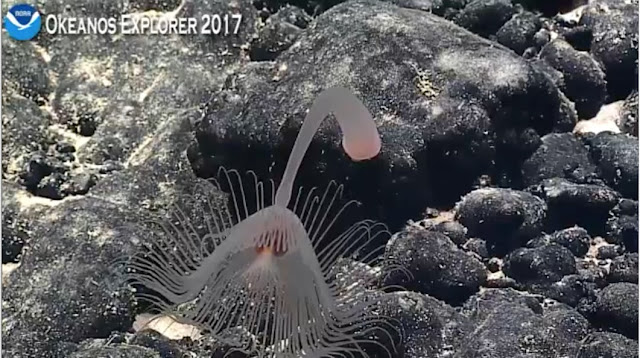

One of the most noteworthy of the cnidarians observed was this Dandelion or benthic siphonophore. Siphonophores are colonial animals which are mostly found swimming though the ocean in long chains which in some instances can be meters long!  Familiar species include the painful Portuguese Man o War. 

BUT the species in this group live attached to the bottom, apparently with a huge array of feeding tentacles extended.. there's a blog about these waiting to be written! hopefully soon...
Similar in lifestyle-check out this tiny bottom living (aka benthic) ctenophore (or comb jelly). I've discussed these at length before here. Again, most comb jellies swim-but then you get these oddballs that have an active bottom life using their long tentacles to capture prey.
A mushroom coral! Rose Atoll, 680 m


Probably the BIG, weird star of this leg was this BIZARRE blobby tree shaped thing! Turns out its a bizarre sea anemone in the family Aliciidae! Its tentacles had been withdrawn...
It turns out we saw one of these during the Marianas expedition LAST year!  Which makes the one above a likely DIFFERENT species from the other one we saw which had yellow buttons rather than white ones..

Dr. Dave Pawson at the National Museum of Natural History was apparently stung by one of these (only 6 inches long) and reported that each of these buttons are batteries of STINGING cells which can cause painful stings that last for several hours!! (click here) 

MOLLUSKS! 
Unsurprisingly, some of the most exciting observations on this last cruise were MOLLUSKS! We don't normally see a lot of snails or clams on these cruises..but we made up for it on this dive! 

Neopilina, MONOPLACOPHORAN! 
Few animals that I know of have what might be considered "holy grail" status. THIS is one of them..

In this case, the mysterious mollusk known as Neopilina! This mysterious mollusk has previously been collected from abyssal and ultrabyssal depths between 4000 and 6000 meters. From both the Atlantic and the Pacific. 

These are rarely collected and in the past were perceived as being VERY important to evolutionary or other ecological studies.  Basically these animals were regarded as ancient AND ancestral mollusks-the "Ur mollusk" if you will. They inspired a LOT of questions about what they were related to and how other mollusks were related to one another.. 

But I think this might be the FIRST time an in situ (in place and ALIVE) observation has been made! I admit that this tiny brown limpet thing does not have the same... presence as say some giant octopus  or squid, but once you know all the history behind it.. well, I say this with no irony-seeing it alive in its habitat was HISTORIC!!


Octopus!  So, of course we are always fond of cephalopods when they turn up! This white translucent octopus species was observed at least twice on the dive at relatively "shallow" depths between 380 and 400 m. This first shot was from Tau seamount.

Note that the webs of skin between the arms were translucent! 
This one was seen at Rose Atoll at about 393 m and it was investigating a series of little holes and caves.. presumably looking for food..


ECHINODERMS!! So, where MY group is concerned I'm always a little biased and have more imagery than of other groups (not as many corals for example). And because I work on starfishes-there's enough pics that I will get to those in another post!

but for now, here's some striking "spiny-skinned" friends that I saw...


This funny beast which I think was in the Deimatidae? Note that as with many deep-sea sea cucumbers, the body wall was translucent and we can see the sediment eaten by the animal THROUGH the body wall! 
The bizarre semi-swimming sea cucumber Psychropotes I blogged about this genus of sea cucumber and the number of species there might in the world oceans! 
This sea cucumber (Paelopatides?) in free swim glide! Moki Seamount about 2083 m WHEEEE!

This interesting fold over backwards behavior of a sea cucumber at Utu Seamount

A sea urchin the family Pedinidae I think? Lovely greenish coloration!
A reddish.. echinothuriid urchin? Aka a "pancake" or "tam o shanter" urchin. I've written about these before  here.  We saw a few different species of these kinds of urchins. But they are difficult to ID from pictures..

MIXED TAXON CRAB + COMBINATION!!
There were at least two interesting cases where we saw crustaceans "team up" with another animal that one does not normally associate.....

1. Decorator crab + cidaroid urchin! This was an odd one. The ROV was observing this cidaroid urchin..and as it changed angles.. it noticed this majiid type "decorator" crab hanging on with its rear legs. We've seen other crabs hanging onto fire urchins in tropical shallow-water habitats as protection-but not seen something like this. Unclear if it is incidental or something that happens regularly...

2. Zoanthid "anemone" PLUS hermit crab! A relationship that has been seen before but no less weird whenever we see it. Basically a sea anemone-like animal called a zoanthid rides and replaces the shell that this hermit crab would normally be wearing..

The crab benefits from the protection and the zoanthid gets driven around by the crab for dispersion, food, etc.. Interesting commensalism!

Here's a nice one seen back in 2015 by Diva Amon!

Tuesday, February 23, 2016

Zen of the Feeding Sea Cucumber

      
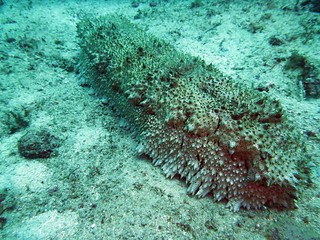
You know what I find relaxing? Sea cucumbers. Specifically watching sea cucumbers just moving along wherever they happen to be and slowly and methodically digesting food from off the bottom of the ocean..

There is a real.. peace from watching them. Slow. Confident. Unworried. Sea pigs and other sea cucumbers... all with their benthic detrital serenity. Its soothing really.
Today: a little gallery showing some nice closeups to ease that tired day today!

Sea cucumbers are versatile creatures. Some species can actually feed with filter feeding apparatus inside their anus  (shown below). If you're not feeding from the front there's always the other end...
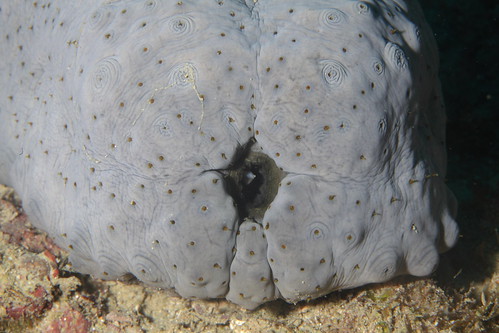
Sea Cucumber Anus
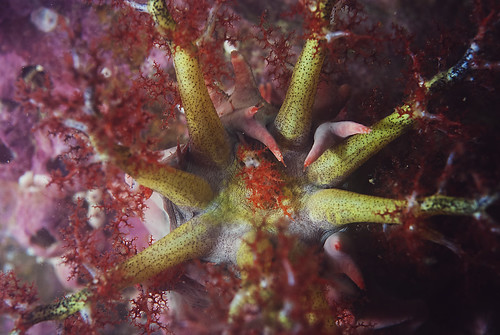
Here's the business end: the mouth on some glass, picking tiny detrital food off the surface. Although "scavenger" and "detritivore" doesn't sound very glamorous, it turns out that this serves a vital function to ecosystems in both shallow and deep-sea ecosystems (see the secrets of sea cucumber poop here! )  Sediment is aerated and "turned over" and doesn't just build up anoxic organics... etc.

here is where it all starts!

                 
Some nice video of a Japanese species showing aforementioned feeding tentacles which are used to pick food off the substratum 

Several more species with their feathery feeding arms extended..


Here's a nice one showing one of the feeding arms with food being moved INTO the mouth...

and here...
Power feeder (Pseudocolochirus violaceus)
and let us end with one of the most beautifully shot sea cucumber feeding videos!! Taken by "liquidguru"! 

Lembeh Magnum Sea Cucumber from liquidguru on Vimeo.

Wednesday, July 15, 2015

Biology we have learned from James Cameron's DeepSea Challenger Expedition!

Image from the Census of Marine life
This week a new paper that I think everyone will be interested in! Remember back in 2012 when filmmaker James Cameron (famous for Terminator 2, Titanic, and Avatar) personally travelled down to the deepest known place on earth (> 10,000 meters!)?

It was in all the papers! There was certainly some good criticism of what was accomplished but many argued that even though Cameron himself did not bring back very much, he did apparently make some collections which were studied by scientists at Scripps Institute of Oceanography in San Diego, California, and as explained by Deep Sea News' Holly Bik even mud from that depth holds the potential for interesting data (here). 

So, here we are now THREE years later and one of the first papers detailing results from Cameron's Expedition has been published!! !

The OPEN ACCESS paper was published just recently in Deep Sea Research in the May 2015 issue, written by Natalya Gallo at Scripps Institution of Oceanography and a host of coauthors, including yes, director James Cameron. 

Cameron famously descended in the one-man submersible, DeepSea Challenger to 10,000 meters where he took some video and grabbed some mud..
I saw him and his team as they stopped in DC on their way up to deposit the sub at Woods Hole Oceanographic awhile back...


This paper by Gallo et al. details not just his dive but ALL of the dives undertaken by the sub during the expedition to the region, including several of the world's deepest trenches, including the New Britain and the Mariana Trench (Challenger Deep).  This totaled seven dives, five general dives and two into the trenches, overall ranging from 884 to 10,908 meters!
Figure 1 from Gallo et al. 2015
Everything was captured on video and these observations are scrutinzed and analyzed!

 What do they report??

1. Organic input was different in the New Britain Trench
In the paper, there is what they call "allochthonous organic input" which is"science speak" for organic external or foreign materials that fall into the deep-sea which was seen more heavily near the New Britain Trench than the other regions sampled.
Figure 4 from Gallo et al. 
In this case: plants and other related material: palm fronds, leaves, sticks, etc. but also carrion or dead animals..  Many of the animals observed interacted with the plant material.. some living on or hiding under..

In contrast, the carrion in the form of bones, etc. contributed food or nutrients to the ecosystem..

I am always keen to remind folks how important what happens at the surface impacts what happens at the deepest depths. Note here at 1000 meters food still falls FROM THE SURFACE.

2. Deep-sea Starfish?
One of the more interesting finds was the observation of these starfish living on bones and woody debris at 8.2 kilometers down! (8200 meters!!)

These were identified as caymanostellids, a weird group of deep-sea starfish which live on wood. No scale was available but known examples of these sea stars are relatively small.

If these are truly from 8.2 kilometer depths, they might be the deepest individuals known for this group! WOO!
I've mentioned the deepest known records of OTHER starfish species here. Some of the deepest records are recorded from 8400 meters! So 8200 meters isn't much of a reach. 

3. Lower abundance & diversity in nutrient poor canyons
Figure 7 from Gallo et al. 

This is the "on the other hand" of the study areas. The New Britain Trench (NBT) at 1000 m was nutrient rich but the Mariana Trench at the nearby Ulithi Atoll region (1100 m) were relatively poor in nutrients.

Correspondingly, the abundance AND diversity of animals observed was much less in the Mariana Trench and Ulithi Atoll regions.

The New Britain Trench site also seemed to demonstrate MORE diversity than the other two studied regions.


4. There is a large and diverse bottom/scavenging community in the New Britain Trench.
 
Figure 10 from Gallo et al. 2015
The New Britain Trench (NBT) seems to be showing a huge diversity relative to the Mariana Trench and this was further seen int terms of scavenging communities such as the amphipods.

Looking at the number of amphipods in each video (per frame) they observed that there was a HUGE difference in the number observed!

Those in the New Britain Trench were MUCH more abundant!

Multiple species were likely present but this assemblage also apparently included the "supergiant" amphipod Alicella gigantea:
Image from the BBC
Sea cucumbers and various crustaceans were also apparently present...

One interesting thing: Absent from ALL the deep localites on this dive?  NO FISH were observed. Its been argued that fish "bottom out" at about 8000 meters and are unable to occur below that.. The observations here seem to be consistent with this data.

5.  Other animal observations.. Potentially new species?? 
Among the few animals observed at depth (from their Figure 9 below) were an odd ulmariid jellyfish (labelled C) as well many other crustaceans (D) which were either mysids or some kind of shrimp like crustacean..
One of the significant discoveries was this "squid worm", a swimming polychaete, likely in the genus Teuthidodrilus from 1 KM down in the New Britain Trench!!  These were originally described from the Philippines. 

5a. The Deepest Known Deuterosotome Known Probably one of the DEEPEST of the critters noted in Gallo et al's paper were, you guessed it! SEA CUCUMBERS.

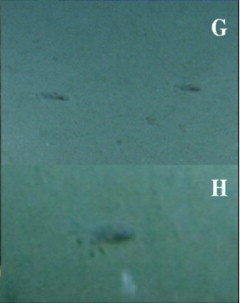
In the Marianas trench at the deepest depth (10,900 meters!) they observed sea cucumbers oriented into the current, which is consistent with behavior seen in deep-sea sea cucumbers like sea pigs  

The animals observed from the deepest point were only tentatively identified as members of the family Elpidiidae (Fig. 10 on the right G & H). They indicate these might possibly have been Peniagone sp.  (Note Peniagone below is only for representative purposes and was NOT from Gallo et al.'s paper!)
Peniagone islandica from EOL

Previously, the deepest known sea cucumber was Myriotrochus brunni which was collected from 10,710 meters in the Mariana Trench.

However, the account by Gallo et al. for the elpidiid sea cucumbers (their Fig. 10, G, H) are from 10,900 meters!! Which yes, makes them the DEEPEST known deuterostome animal!!  (and certainly the deepest known echinoderm!!)

Tuesday, July 15, 2014

Sea Cucumber Skin Up Close! Bizarre & Beautiful!

Thelenota ananas Via Wikipedia commons. Photo by Nick Hobgood
Cool Crowdsourced Photo time! This week..some gorgeous closeups of the neat skin textures on tropical sea cucumbers!

Some of these give you an idea of how colorful and unusual the skin in sea cucumbers can be. This one is called  Thelenota rubolineata (the species name literally means "red lines"). This is an example of what the whole animal of one of the pics below looks like...

What do they feel like? Sort of soft and rubbery. Firm. And yes, people eat these species...

Here's a nice roundup of similar closeup photo essays of other echinoderms 
  1. Here's the one for Up close Starfish! 
  2. Another one showing close ups on Crinoids (aka Feather stars)
  3. COLORS! in brittle stars! 
  4. Crabs that live in sea cucumber anuses! here.
  5. Worms & Snails that live on sea cucumbers! here. 
Below.. you will find many different close ups of the skin of sea cucumbers.


this one is Thelenota I think...


Some striking full body pics...


Wednesday, January 22, 2014

Worms & Snails that Live On/In Sea Cucumbers!

There's something about sea cucumbers which seems to make them attractive as hosts for various other animals.
Some sea cucumbers got clams that live in their throat...
The sea cucumber anal region seems to be popular as a place to live as crabs and of course, pearlfish find good homes there..

This week.. More animals that have made sea cucumbers hosts to their lives!!

Worms!
This scale worm above was identified as Gastrolepidia clavigera, living on its host sea cucumber (apparently Bohadschia graeffei). Image by Arne Kuilman.

This one by Theresa Legler, shows another polynoid worm, but it looks like a different genus/species...

Another similar looking polynoid. Image by Kevin Lee.

This one, by Ben Naden,  seems to be taking advantage of the rough skin texture...


Snails! Most of the snails shown here appear to be members of the Eulimidae, which are a diverse group of snails, which has apparently adapted a parasitic lifestyle. Many of them live on echinoderms. I review some of them here.  

Eulimids basically feed on their hosts. They have a proboscis which is inserted into the bodywall and used to suck out precious bodily fluids and other nutrients!

Here's a neat pic by Eunice Khoo showing several embedded in the epidermis.


A different kind of snail, Melanella sp. living on the sea cucumber Thelenota ananais.


Images below by "wj", what looks to be another set of eulimid snails, feeding on the sea cucumber Colochirus.


and let us not forget that eulimid snails (in this case-the genus Stilapex) ALSO inhabit deep-sea sea cucumbers... (from the sea pig post)
(from the New Zealand R/V Tangaroa weekly log, photo cred-Stefano Schiaparelli, NZ IPY-CAML) 
What makes Sea Cucumbers such desirable housing?  While there's no immediately clear data on the topic, it seems to be important that sea cucumbers are all composed of a soft, edible yet durable, tissue. So, maybe a good house that these protects and feeds?

Tuesday, October 1, 2013

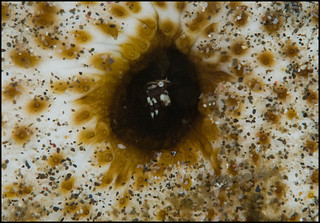
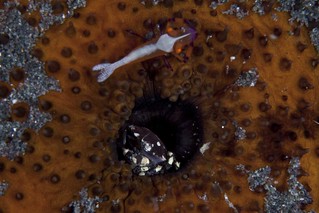
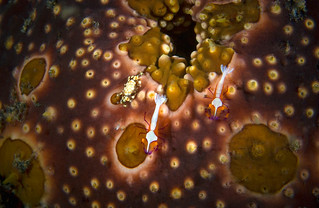
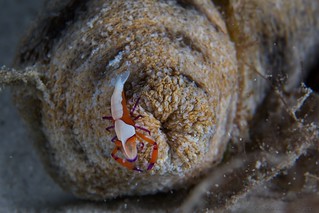
Crabs & Shrimps that Live in Sea Cucumber Anuses!

_MG_2243_0713
Image by Yellowbeetlebug
Crab IMG_1357-2
Image by Jasdivr
One of the things I find fascinating about sea cucumbers is that they're basically a section of intestine, including the mouth and the anus which has evolved to live on its own. We sometimes think of animals by their most prominent features.. jaws in sharks, eyes in insects...

But Sea cucumbers are basically a big living gut! and have developed many unusual ways of living with this body plan..
Sea Cucumber
Image by WhiteBeachDivers
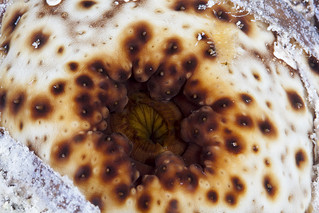
It should not be so unusual that the openings to this "living gut" are especially important. The mouth of course, we see used in feeding but in sea cucumbers, of particular significance seems to be the importance of that second, most prominent opening.. the ANUS!
Another Sea Cucumber Anus
Awesome image by PacificKlaus
This is of course, where inorganic sediment is defecated after the animal has eaten and removed the organic material that fuels its diet...

But SO many other biological functions in sea cucumbers are now being observed in sea cucumbers..

This account for example about how sea cucumbers can FEED through their ANUS. and of course, the simple fact is that sea cucumbers use the anal opening in order to process water over their internal "gills"...

OPEN
Open
Image by Pacific Klaus
and shut! 
Closed
Another fantastic image by Pacific Klaus
And by the way.. Pacific Klaus has assembled an AWESOME photo gallery of echinoderm anuses on Flickr here. 

But of course, sea cucumbers can host several commensal animals. That is, animals which live, in or around the animal as a habitat but which bring neither harm nor advantage to the host sea cucumber..

The most striking example is the "fish-in-sea cucumber-anus" Pearl Fish. Go here to see this. 
or there's video of course...


and just because I can, lets not forget: Anal Teeth!
Sea Cucumber Anus
Image by PacificKlaus
Awhile back I wrote about flatworms living in sea cucumbers and sea urchins..
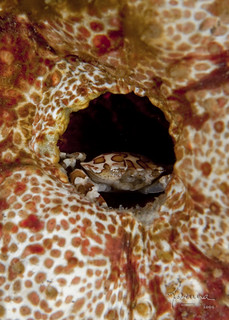
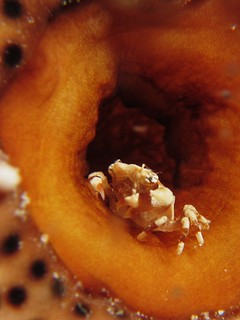
But another evocative animal living in sea cucumber anuses?  These little crabs!
_MG_2243_0713
Image by Yellowbeetlebug
Many of these have been called Lissocarcinus throughout the internet.. but I'm not sure how dependable those names are. They appear to be scavengers taking advantage of any leftover food ..

Is the anal habitation a matter of opportunity? Regular behavior? Species specific?

But clearly, they do seem to make the most out of uh... living in the shadow of greatness...
Sea Cucumber Crab - Where the Sun don't Shine from liquidguru on Vimeo.

Another
DSC_0353
Image by Martin "El Grande" Sequerah
Interestingly, there are also photo accounts of these shrimps living around sea cucumber anuses.. perhaps to take advantage of other organic material?
IMG_2336
Image by Eric Francis
Here are more shrimp+crab anal assemblages...
Lembeh Strait
Image by Swaflyboy
Incidental occurrence? or preference?
shrimp on sea cucumber 2
Image by ScubaSchnauzer
This shrimp seems to have found itself completely embedded in sea cucumber anus!
Imperator Shrimp - Periclimenes Imperator stuck in the anus of a Sea Cucumber
Image by Prillfish
Many questions-what do the crabs and shrimps get out of this? Are they species specific? Is this really a region specific habitat? Or do they just use the whole animal as a house with the anus as a door?