Showing posts with label Holothuroidea. Show all posts

Wednesday, September 21, 2016

Unravelling the secret diversity of Psychropotes! A global sea cucumber mystery!

via the NOAA photo library http://www.photolib.noaa.gov/htmls/expl6751.htm
Today we look at one of the most bizarre deep-sea echinoderms (if not deep-sea ANIMALS) that I know of! the sea cucumber Psychropotes!!  I briefly discussed these in an earlier post on deep-sea sea cucumbers.. but have not had the pleasure of writing something up about them in detail..

Here's some video to give you an idea of what it looks like/how it moves, etc. (I would watch without sound to enjoy the zen of the animal)
               
IF the name doesn't sound familiar, the animal's distinctive appearance definitely stays glued in your head after you've seen one! Imagine a big blobby sea cucumber with what looks to be a HUGE LOBE sticking out of its hind end!


Note the image above contrasted to this diagram showing mouth (top) and anus end (with lobe-bottom).

The genus Psychropotes is derived from the Greek for Psychros which means "cold or frigid" and "potes" which honestly, I could not find a definitive translation for...   One root translated to "flight"? possibly alluding to the ability of this species to swim...And another colleague tells me it might mean "dweller". Ah well, one mystery at a time!!

Psychropotes includes 11 species which occur widely, all around the world in the Atlantic, Pacific, Indian and Southern (but not in the Arctic) oceans in the deep abyss of the world's oceans! That means roughly 2000 to 6000m. They are the deepest of the deep! Considered "classic" deep-sea inhabitants they were collected and described from the HMS Challenger's historic mission.

These can be pretty BIG animals!! as this image from a recent MBARI expedition demonstrates. (with deep-sea biologist Greg Rouse for scale!)
From MBARI https://twitter.com/sarahkeartes/status/593979334056022016


But there is ONE species in particular, P. longicauda (the species name "longi-" means long and "caudex" refers to 'trunk or stem" and alludes to the posterior lobe in the same way that caudal fin refers to the end of a fish) that is of interest.
Individuals all identified as this species, P. longicauda have been observed from oceans all around the world and varies rather widely in many ways. Sea cucumber species are identified based on tiny calcite bits called sclerites which seem to be highly variable.. with differences in sclerite shape varying between different regions.  But do all of these differences amount to different species?  Or variation within ONE species?? 

Here for example was one seen from the recent tropical Pacific Okeanos Explorer cruises. Note that the "lobe" is a different shape. Separate species? Damage? 
This turns out to be a pretty important question to deep-sea biologists. Can there be ONE species present at such a huge scale? Or are there species present that are CRYPTIC or hidden from us by body characteristics alone???

Note the one above with the shorter, forked "lobe" Is it the SAME species as the purple one shown earlier? Is this variation? (such as what we might see in humans who live in different parts of the world) Or are these separate species?


Their study explored the widespread occurrence of this species based on 128 specimens of Psychropotes longicauda collected from THREE different oceans over a 34 year period, from 1977 to 2011!
This represented an INTERNATONAL team of experts from not only the University of Southampton in the United Kingdom but also the Shirshov Institute of Oceanology in Russia, the American Monterey Bay Aquarium Research Institute (MBARI), Scripps Institute of Oceanography and many, others!! 

They sampled tissue for two genetic markers (COI and 16S for those who need to know) across all the sampled individuals in order to compare populations from all around the world. 

The Global Colors of Psychropotes! 
So, here's the result. Scientists use diagrams to show a basic outline of relationships between different populations. Roughly speaking, the greater the distance between the circles the larger the distance between the populations and the greater chance they are separate species...

In the first diagram, the LARGER the circle, the larger the sample size. So the bigger circle represents the largest number of samples. Which were all from the Atlantic Ocean.  

Note the helpful color key so you can tell apart the populations you are seeing below:

Dark Blue= North Atlantic (east)                      
Light Blue= North Atlantic (west)
Yellow= South Indian Ocean
Green= South Atlantic
Red= Northeast Pacific 
Dark Purple= Northwest Pacific
Pink= South Pacific                                                                                               
    
Their figure 2 here shows what is basically the number of "steps" away from one another each population happens to be... The size of each circle represents the sample size. The big patch of BLUE reflects the LARGE sample of ATLANTIC specimens..but note how they are all clustered together. 

Some closer, some farther away.. This means they are all more closely related to one another than to those the others.  But note how many different subgroups are present away from the big blue circle in the middle?  That suggests lots of 

The Red (Northeast and Northwest Pacific) therefore seem to display a somewhat closer relationship to those in the North Atlantic than to those in the Southern hemisphere (yellow, green, pink, etc.)
Figure 2 from Gubili et al. 2016
Their figure 3 below, shows all of the populations in more of a "family tree" (i.e. phylogenetic) perspective..so, not only do we see that all of the Atlantic and Pacific members are "close" but they all occur on a single lineage, which means they were all MUCH more closely related

Two major lineages are most evident in the phylogenetic tree below, Lineages 1 and 2 each with subgroups:  Lin 1A, Lin 1B and Lin 2A and 2B, respectively. 

The pattern is kind of unclear..but there's definitely an Atlantic cluster (Lineage 2) with members that occur in the Indian and Pacific but this seems very separate from the Lineage 1 which seems to include members from all over, including the Indian Ocean and the South Pacific.

Figure 3 from Ghibili et al. 
Ultimately, the two lineages (Lineages 1 and 2) showed > 5% divergence from one another. When compared with other echinoderm species, that much population genetic divergence is enough to recognize a separate species (as opposed to simply a population with structure).

So, YES. One lineage, is the "proper" Psychropotes longicauda species, but there's at LEAST one more which has been "hidden" by the taxonomic definition of Psychropotes longicauda. That is, they all LOOK like the described species but in fact, the differences are FAR more subtle than we had previously recognized! More diversity (i.e., further species) will likely be discovered as more data is collected..

Some of these further subgroups will be so-called "cryptic species" because morphology does not immediately distinguish them. Thus, their status as species is "hidden" by external morphology (but subsequently discovered by genetics).  But now that we are looking, many, MANY more characters that could help distinguish these species could conceivably be discovered.

Other Interesting Observations/Questions..
One interesting factoid was that Psychropotes, and many other deep-sea sea cucumbers only occur in areas of high productivity (i.e. marine snow). Could these nutrient rich regions be related to speciation? and diversity within the species? 
                                      
The authors were able to note changes in the genetic diversity and abundance of the Atlantic lineage across a temporal series! Based on the extensive collections at the National Oceanography Collection at Southampton University, they they observed an uptick in the abundance of small individuals but also a change in the amount of genetic diversity  in relation to an increase in organic flux called the "Amperima Event" in 1996!

They found that there were MORE individuals which belonged to the "Atlantic population" and fewer of those which shoed affinities to other oceans. This might explain why the Atlantic "genetic type" was so well established.  They cautioned that although they didn't have enough of a dataset to show changes over time, they DID say that there WERE changes in the genetic makeup related to the nutrient availability. 

That is a pretty snazzy thing to record from a collection of deep-sea sea cucumbers! 

Is there an Antarctic origin for Psychropotes longicauda? 
The authors argue that the combination of Southern Indian Ocean lineages was consistent with other hypotheses arguing for an Antarctic origin for this widely occurring deep-sea sea cucumber. 

Repeated colonization events from the Antarctic via the Southern Indian Ocean (yellow colored in the figures above)  might explain the many lineages of Psychropotes present throughout the world's oceans as well as the presence of multiple lineages of Indian Ocean Psychropotes versus the derived and consistent clustering of Atlantic and Pacific populations.

(Coincidentally this picture of a Southern Atlantic Psychropotes is yellow!! )
http://archives.starbulletin.com/2007/06/24/news/story02.html

What further mysteries does Psychropotes have in store? I anxiously await the next paper! 

....now if I could only figure out what the "potes" part of Psychropotes means!
And just because, here are some FANTASTIC Psychropotes Bonuses! 

Here was an AWESOME Psychropotes cake by Elizabeth Ross, one of the authors of the study...
And of course Psychropotes stuffed animals.. from Japan of course!! 
from ebay http://www.ebay.com/itm/Psychropotes-varipes-Stuffed-Toy-sea-cucumber-peluches-Kuscheltiere-Japan-Eboshi-/271795943477

Tuesday, July 15, 2014

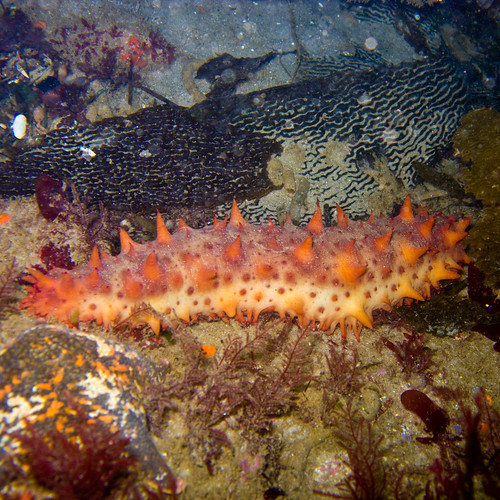
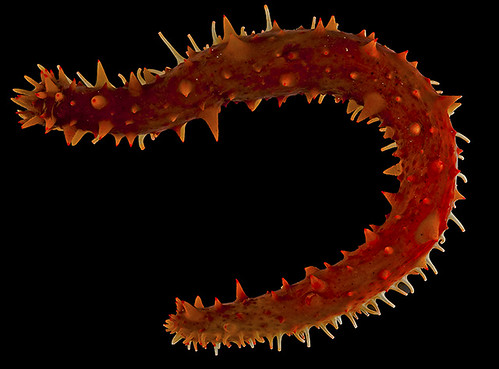
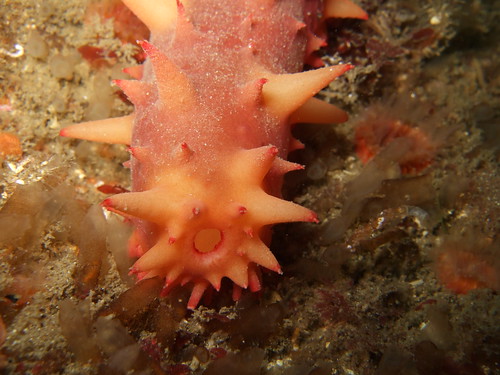
Sea Cucumber Skin Up Close! Bizarre & Beautiful!

Thelenota ananas Via Wikipedia commons. Photo by Nick Hobgood
Cool Crowdsourced Photo time! This week..some gorgeous closeups of the neat skin textures on tropical sea cucumbers!

Some of these give you an idea of how colorful and unusual the skin in sea cucumbers can be. This one is called  Thelenota rubolineata (the species name literally means "red lines"). This is an example of what the whole animal of one of the pics below looks like...

What do they feel like? Sort of soft and rubbery. Firm. And yes, people eat these species...

Here's a nice roundup of similar closeup photo essays of other echinoderms 
  1. Here's the one for Up close Starfish! 
  2. Another one showing close ups on Crinoids (aka Feather stars)
  3. COLORS! in brittle stars! 
  4. Crabs that live in sea cucumber anuses! here.
  5. Worms & Snails that live on sea cucumbers! here. 
Below.. you will find many different close ups of the skin of sea cucumbers.


this one is Thelenota I think...


Some striking full body pics...


Wednesday, January 22, 2014

Worms & Snails that Live On/In Sea Cucumbers!

There's something about sea cucumbers which seems to make them attractive as hosts for various other animals.
Some sea cucumbers got clams that live in their throat...
The sea cucumber anal region seems to be popular as a place to live as crabs and of course, pearlfish find good homes there..

This week.. More animals that have made sea cucumbers hosts to their lives!!

Worms!
This scale worm above was identified as Gastrolepidia clavigera, living on its host sea cucumber (apparently Bohadschia graeffei). Image by Arne Kuilman.

This one by Theresa Legler, shows another polynoid worm, but it looks like a different genus/species...

Another similar looking polynoid. Image by Kevin Lee.

This one, by Ben Naden,  seems to be taking advantage of the rough skin texture...


Snails! Most of the snails shown here appear to be members of the Eulimidae, which are a diverse group of snails, which has apparently adapted a parasitic lifestyle. Many of them live on echinoderms. I review some of them here.  

Eulimids basically feed on their hosts. They have a proboscis which is inserted into the bodywall and used to suck out precious bodily fluids and other nutrients!

Here's a neat pic by Eunice Khoo showing several embedded in the epidermis.


A different kind of snail, Melanella sp. living on the sea cucumber Thelenota ananais.


Images below by "wj", what looks to be another set of eulimid snails, feeding on the sea cucumber Colochirus.


and let us not forget that eulimid snails (in this case-the genus Stilapex) ALSO inhabit deep-sea sea cucumbers... (from the sea pig post)
(from the New Zealand R/V Tangaroa weekly log, photo cred-Stefano Schiaparelli, NZ IPY-CAML) 
What makes Sea Cucumbers such desirable housing?  While there's no immediately clear data on the topic, it seems to be important that sea cucumbers are all composed of a soft, edible yet durable, tissue. So, maybe a good house that these protects and feeds?

Tuesday, June 11, 2013

The Importance of Sea Cucumber Poop!

20111021-143924-Canon PowerShot G12-0720.jpg
Awesome pic by Mevallee
Let's just admit it. Poop is awesome. Its natural, all animals do it and its frakkin' hilarious. PLUS its biologically important to everyone so we can't just stop talking about it..

I have written about the importance of the poop of other echinoderms in prior posts-particularly this one about green sea urchins (Strongylocentrotus droebchiensis)

Recent research has brought a powerful spotlight on not just the ecological, but the overall, importance of sea cucumbers to the environment.  Sea cucumbers occur all over the world and at all depths. Often, when present, they are abundant or at least a significant part of the fauna present.

But the key dynamic present to their importance is that they cycle or process what they eat and what they defecate contributes to the health of the habitat they inhabit.

1. Sea Cucumber poop buffers against ocean acidification on coral reefs
2008-11-26 SAPONA WRECK - Sea cucumber poop
Image by scuba.linda
A paper by Kenneth Schneider (Stanford University) et al., including echinoderm researcher Maria Byrne's  was published in the Journal of Geophysical Research (2011. 116: G04032)  received a lot of press, such as this account (in Australian Geographic) and this one (which has an interview with Byrne) about how sea cucumber "poop" is important to geochemical processes on a coral reef.

I realize that articles about "coral reefs saved by sea cucumber poop" sound kind of silly on the surface, but read and understand below.... (note also the Journal of Geophysical Research? Important stuff gets put in there.)

Coral has to develop or accumulate calcium carbonate, which is the mineral used to compose coral skeletons, at an equal or better than the rate at which the coral loses calcium carbonate via erosion, natural dissolution, etc.

A survey of the sea cucumbers Stichopus herrmanni and Holothuria lecuospilota in One Tree Reef, Australia showed that the sea cucumbers could digest and dissolve so much of the adjoining sediment and rubble (ie the sand) that they actually contributed up to 50% or MORE of the total amount calcium carbonate dissolved over a night time. Presumably this was made available for coral to use for reef development.

Chemically, calcium carbonate is very alkaline or basic. So, sort of like an antacid. What do you do when you have stomach acids that are misbehaving? Drop some of those tablets to "cancel" out the acidity.

So, sea cucumbers contribute calcium carbonate to the coral reef's "chemical budget". They act like a natural antacid to neutralize other acidic environmental sources. Under normal conditions, there's an equilibirum. The abundance or number of sea cucumbers can affect this.

Thus, in theory,  MORE sea cucumbers might produce so MUCH alkalinity (or "basic" poop to the water) that conceivably they could function as a control or at least a buffer against increases in more acidic sea water.  This obviously is important when you consider ocean acidification resulting from global warming.  Sea cucumber poop is an important part of helping to keep the geochemical balance of a coral reef in equilibrium.

2. Sea Cucumbers EAT tasty bottom poop and clean it up!  
Poop is processed into useful nutrients! Over abundance of nutrients (i.e eutrophication) is broken up by sea cucumber feeding!

A recent paper in PLOS one from Thomas MacTavish and colleagues in New Zealand studied a local sea cucumber Australostichopus mollis and how its presence affects the nutrient cycling in its surroundings.

MacTavish and his colleagues studied a nutrient-rich environment covered by algae, mussel feces and other nutirent-rich goodies. Under normal circumstances, these would build up bacteria, ammonia and other factors creating conditions that contribute to the growth of  algae, which ultimately chokes everything else out (aka eutrophication).

But you put a sea cucumber into these settings? They LOVE it! They eat and all sorts of good things happen:
  • Bacterial abundance increases
  • Organic material (i.e., the goo) begins to decompose more quickly
  • Organic materials are redistributed from the marine sediments into the water
Sea cucumbers help to break down organic material and redistribute the nutrients! The poop is an important part of that process.

This has implications....

3. Eating good poop cleans up aquaculture environments
IMG_0694.jpg
Image by Jeremy and Christine
Papers such as the one above, this one focusing on the tropical Stichopus japonicus and this one on Parastichopus californicus in cold-temperate waters all show that many people have picked up on the fact that sea cucumbers are useful animals for breaking up environments that suffer from being choked in nutrients.

Eutrophication-the overabundance of nutrients resulting in undesirable growth of algae and hypoxia-is a common problem in aquacutlure ponds.
Sea Cucumber aquaculture
Image by Smartfish-ioc
But putting a sea cucumber into the mix? A critter that LOVES organic nutrients and gooey stuff like that?  It would go to town! Cleaning up the bottom and cycling those bottom nutrients...  Seems like a win-win solution for cleaning up the bottom of say a fish or mussel farm where feces from the animals accumulate in huge amounts.

So yes. Sometimes sea cucumbers eat poop. And then poop poop, which is probably "cleaner" than what went in the first place...

4. Sea Cucumber poop is good for plants (mangroves, seagrass, etc.), which are part of a healthy ecosystem
P7140072.JPG
Image by Eunice Khoo- "Mermate"
So, by this I don't just mean ONLY the poop-but the animal digesting and then processing the sediment.  This follows everything from the above-they break down organic detritus and make the nutrients available to the water column preventing hypoxia and other bad things going down in the sediment...
(its a great video, but I didn't enter the description!)

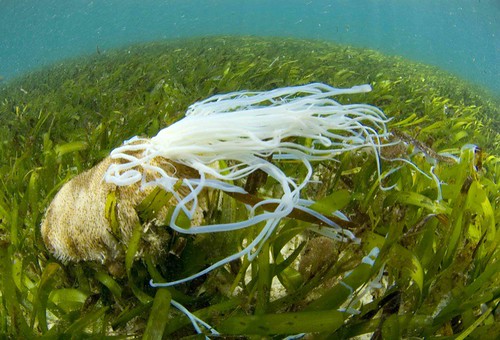
The nutrient cycling role of sea cucumbers has been observed as an important part of ecology. One post I put up awhile back shows that the presence of sea cucumbers leads to more productive sea grass!  and thus a more diverse and healthy tropical ecosystem.

Think of them as earthworms! go through the bottom sediments, eat all the organics and leave the sediment.. that's sea cucumber poop!

5. Deep-Sea Cukes have pretty diverse microbial faunas that live in their guts! (and thus their poop!)

Deep-sea sea cucumbers perform very much the same kind of function as the shallow water ones. They live in much finer mud and are often rained upon by nutrients from the surface. Many of these critters, such as Molpadia (shown here) live buried in the mud.

Most of their overall morphology seems devoted to processing mud..in one end and out the other...
We add to that another spin!  There are whole microbial faunas that live INSIDE their guts! Go to these past posts to read more about them..

Remember just how abundant these can be in the deep sea. Some occur at a density of 220 individuals per square meter!

How much of this fauna comes out in their poop?  How does it contribute to the local environment?

Wednesday, February 20, 2013

The Anus as a Second Mouth! A Sea Cucumber that feeds via its butt!

The Beast
Image by Ken-Ichi
This year it will be FIVE years since I began the Echinoblog in 2008. I always used to worry about having new topics to write about-but I'm quite happy to say that I've yet to run out of fantastic images or new discoveries to be shared.

Today is a good case in point. A GREAT new story from the journal Invertebrate Biology (go here) by two of my favorite colleagues, Will Jaeckle at the Illinois Wesleyan University and Richard Strathmann at Friday Harbor Laboratories in Washington.. a NEW paper that MUST be shared!
This week, Echinoblog brings you:
A sea cucumber that feeds not just using its mouth but ALSO via its butt!!

First, Let's look at some basics...
Jaeckle and Strathmann were studying the Pacific Northwest species Parastichopus californicus-the handsome fellow pictured above (and below)!  These occur along the west coast of North America in relatively shallow water...
Cucumber1_6377 copy1a
Image by Bill Pennell
Here is the primary way that sea cucumbers feed-by using the feeding tentacles surrounding their mouth to ingest tiny food particles or sediment.. as such..
As it turns out, sea cucumbers (and many other invertebrates) use their anus as an opening for pumping water in and out of their bodies!
DSCF2985.JPG
Image by bswift
This whole water pumping into and out of the mouth/anus thing is actually pretty common- a bunch of worms, crustaceans and other echinoderms perform this same thing.

As a generaltiy-sea cucumbers can pump quite a bit of water in and out through their anus-with tropical species measured between 40 to 860 milliliters/hour..that translates to about 3.6 to 4 cups of water per hour! 

Sea cucumbers are essentially a big fleshy tube with a mouth and a butt that pumps water through itself!  Here's the basic anatomy below...
Note those two bluish/white, feathery branches that come off the cloaca and the anus... those are called the respiratory trees.  That is where water enters via the anus and is used to respire or "breathe". The cloaca has muscles that PUMP the water in! 

So, shocking sea cucumber secret # 1!! Sea cucumbers "breathe" through their anus! 

Here's an actual pictures of these below from Jaeckle and Strathmann's paper (Fig. 1)
Note that one branch of these structures
Water enters through the anus and is pumped via the cloaca (and the cloacal muscles) into the respiratory trees (=long tubes with lots of branches), where there is gas exchange or "breathing".

Note the structure labelled rete mirabile, which is a network of blood vessels which interaces with the gut. That will be important later on!

There's a LOT of water that flows through these areas, so conceivably, could these be used for ANOTHER purpose?  Such as.... feeding?

Jaeckle and Strathmann set to find out!  They used biological tracers such as the isotope Carbon-14 which they applied to various algae cells and other nutrients that were added to seawater.

Evidence for the Anus as a Second Mouth!
Folllowing the trail of traced algae through the sea cucumber, Jaeckle and Strathmann tracked the isotopes throughout the body and found out where they were most abundant.

Enter The Rete Mirabile! (this sounds like a great episode of Star Trek doesn't it?) Basically after exposing the sea cucumber to tagged algae they found the tags taken in and were present in highest abundance in the Rete Mirabile which connects the respiratory trees with the gut..

This supports the notion that organic food is drawn in from the respiratory trees and eventually transferred to the gut..
Fig. 3 from Jaeckle & Strathmann
They looked at specific tissue cross-section of the inside of the respiratory trees. Lo and behold the blue bits in the picture reveal that they are inside and being absorbed!
On top of everything else, histology of the INSIDE of the respiratory trees shows internal tissues that you might expect to find in a gut: such as microvilli (tiny finger like doodahs that serve to absorb or secrete. We have these in our intestine) as well as certain kinds of cells in the stomach lining that are recognized in other animals for digesting food.

Note above that they also found tiny ciliates (protozoans) swimming around inside living commensally. ANOTHER feature common to spaces where food is digested.
DSCF2985.JPG
Image by bswift
It had been suggested before that the respiratory trees were used only for respiration/breathing.

But the evidence above suggests but rather something more akin to digestion or UPTAKE of nutrient-like material

In other words:  They use their anus as a SECOND MOUTH!

This phenomena is what the authors term "Bipolar Feeding"

To be sure, its not likely that this means of feeding is as substantial as its primary feeding mode (taking organic materials from sediment or from the bottoms via the mouth) but it does appear to be significant. Also, obtaining food in this way may be an important way to supplement its main feeding mode.

Perhaps the sea cucumber version of an  apéritif with dinner?

How does this fit into the "Big Picture"??
At first glance, all of this sounds more like just weird butt stuff..
But let's remember that this mode of feeding is probably present in a LOT of sea cucumbers, which are ecologically important. Such as this post about tropical sea cucumbers being important to sea grass ecology.   And bear in mind that nutrient cycling is an important consideration these days. A LOT more nutrients go INTO sea cucumbers than perhaps was realized.

Another indicator of how echinoderms might be the ecological "canaries in the coal mine" perhaps?

Information like this may seem like an unusual natural history factoid but conceivably things like this can ultimately be VERY important to the big picture... 

Wednesday, August 22, 2012

Some bonus swimming sea cucumber video!!

Recently made available to the Echinoblog!  by Emily B.!  Some swimming sea cucumber (Enypniastes, I believe..) video from the Gulf of Mexico...


Here's a few more classics-all conveniently here in one place!


A different genus..Paelopatides? 


Yet another..Peniagone


Have a great week!

Tuesday, August 7, 2012

Ophiocistioids! Weird Mystery Fossils from the Paleozoic!

Image from Sollas, 1889
Probably one of the great allures of paleontology and studying fossils, especially OLD fossils, is this:
It's Weird.
Its probably (evolutionarily) Important.
Its Rare (or rarely encountered) and we know almost nothing about it.

Enter the Ophiocistioidea!! 

These were a group of Paleozoic fossils that occurred in the rock record from the Early Ordovician to the Permian (that's about 475 to 254 million years ago!).

Life in the Paleozoic was MUCH different from what we recognize today. Continents and oceans were different and the animals that lived in them were a menagerie of weird evolutionary experiments. Many remain around today, but there are many unusual forms which have been long extinct.
from the U. of Wisconsin Geo page
There are plenty of fossils from the Paleozoic but some had weird solutions to problems and often, we lack paleoecological data. So, it can be quite a mystery trying to deduce HOW and WHAT some of those fossils were when they were alive.

Ophiocistioids look like they escaped from a Cthulhu family reunion.  The name is composed of the Greek words ophis ("snake") and kiste ("box"), (and you can see why below) so the "Snake Box" echinoderms!

These animals were free-living (as far as we can tell) and were basically a low rounded dome-shaped animal with a bunch of tentacle-like, large tube feet emerging from the five radial (=ambulacral) regions.
Image from Sollas, 1889
There are a lot of different kinds of ophiocistioid fossils with some 39 species (with the most species present (n=10) in the Devonian) present in a whopping 15 genera within 6 families found throught the world, but mostly from North America and Europe with some known from Australia.

This might mean there was a huge diversity of them in the past or who knows? Maybe we just found them all. (although the literature suggest new specimens and thus new species are awaiting description!)

A useful paper on diversity of Ophiocistioidea can be found here by M. Reich and R. Haude.

The first one ever discovered with described in 1889 by W.J. Sollas from the Silurian of the United Kingdom.

What do they look like??   Here's a plate from a monograph by American paleontologist Charles Schuchert (1915).  The top figure "reconstructs" from the animal as seen from the top


and the lower plate shows the mouth and the lower surface facing the ground.

This pic gives you some perspective as to what the animal looks like from the side.. The animal below is called Gillocystis polypoda from the Devonian of Australia.

from Jell 1983. Fig 10 of Mem. Ass. Australasian Palaeontols. I, 209-235
Here is the ACTUAL fossil of Gillocystis polypoda to give you a notion of what the fossil looks like by comparison.  (These are actually pretty small..the scale bar is about a cm I think?)
Image from the Museum Victoria Paleo collection
The odd one below is called Volchovia and was described from the Ordovician of Russia. It was much different in that its got these much larger plates arranged into a more discrete upside-down vase like shape.

From the Treatise of Paleontology, Ubaughs 1966
Preservation-What part(s) are we seeing? 
Complete body fossils of ophiocistioids are pretty rare and as you can see-what you get can be pretty varied. 

There are a lot of factors that can affect how readily an animal preserves/fossilizes including the skeleton and relative "stoutness" of the body as well as the liklihood that the environment would be conducive for preservation (in other words-it needs to be buried quickly before the body distintegrates among other things).

In spite of all of these problems, enough fossil material is available that some inference about their life modes has been made. Sometimes you don't get anything left but these tooth like fragments called goniodonts.
From Haude and Langenstrasse, 1976, Fig. 4, Lethaia 9: 179-184
Goniodonts are basically part of the jaw-like apparatus that you can see in the cross-section of the animal below.  These operate differently from say, sea urchins in their orientation. Note how they are oriented horizontally?  It was thought that they operated in more of a "saw" like fashion, shearing off food.

An account of Ophiocistioid jaws can be found in a paper by Haude and Langenstrassen, 1976 in Lethaia, 1976! 
Fig. 1 from Haude and Langenstrassen, 1976, Lethaia

Sometimes, that's it.  Like finding teeth from a vertebrate or scales from a fish.   You can tell it was there-but that's about it. 

How Did They Live?? 
There really isn't a lot of info on how these animals might have lived, but there is some information...


One of the important things to realize about fossil "paleoecology" is that often times, scientist have to deduce the function of a structure from the external morphology of the animals of interest. We work on the underlying assumption that features will behave similarly to features on modern animals (e.g., teeth serve roughly the same purpose on a Paleozoic tetropod as on a modern cat).  This is often what makes it so difficult to work on Paleozoic organisms because sometimes, there is no modern example for comparison...

Haude  looked at two ophiocistioids, Rhenosquama (which resembles Gillocystis below) which has a more well defined skeleton bearing overlapping proper plates

AND podia (tube feet) that have scales on them

from Jell 1983. Fig 10 of Mem. Ass. Australasian Palaeontols. I, 209-235
The "armored" Rhenosquama (above) was compared to a second "naked" genus, Rotasaccus which had a more weakly developed skeleton but instead had small tiny skeletal bits in the very flexible body wall. 

Echinoblog Art Dept. is awesome and don't you forget it!
Tube feet between the two were different. The more strongly armored Rhenosquama could probably move more quickly via longer podia versus the podia on Rotasaccus which had podia with an adhesive disk which suggests it could have climbed up surfaces.

Haude (2004) suggested that the longer, more pointed podia (in the armored form) are similar to the tube feet of some sea cucumbers, such as sea pigs
As opposed to the more suckered tube feet which would have given them the capability for climbing surfaces and maybe living in "algal jungles" and other complicated environments. 

Importance to Understanding Echinoderm Evolution! 
So, amidst all of that discussion of the above discussion of "jaws" and "small skeletal pieces" in the body wall a pattern emerges. One that has not escaped the studious paleontologist.

What modern echinoderm has a jaw arranged into 5 part array set around the mouth like this?  With a dome like body?

Fig. 1 from Haude and Langenstrassen, 1976, Lethaia
That's right a SEA URCHIN or echinoid.
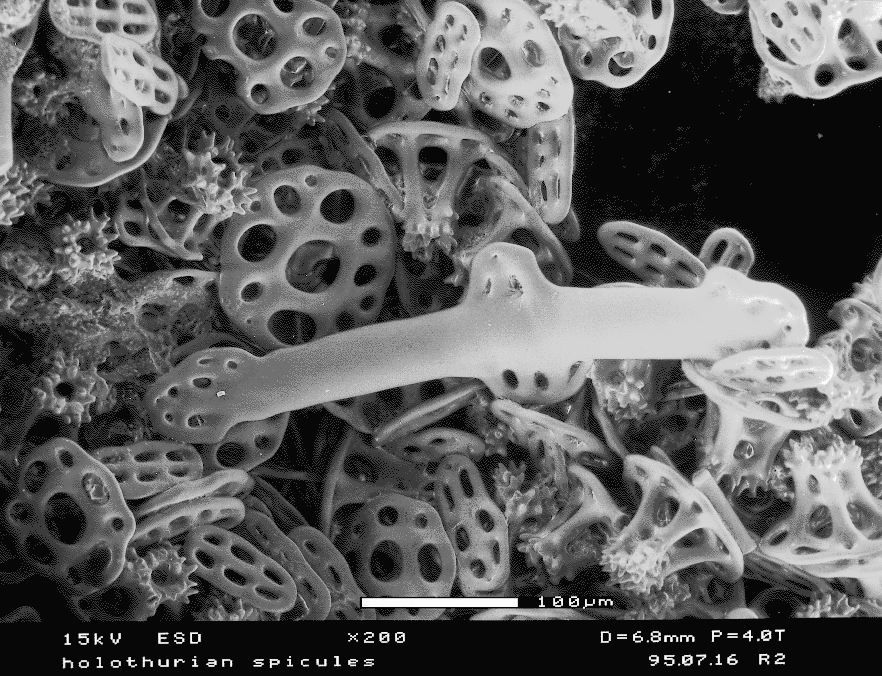
But on the other hand, Rotasaccus (and presumably other taxa) have a fleshy body with skeletal bits! This is most like what is found in sea cucumbers! 
these images from recent sea cucumber. UCMP
Ophiocistioids thus, appear to have a morphology INTERMEDIATE BETWEEN SEA URCHINS AND SEA CUCUMBERS. 

This has actually been so much the case that they have been historically classified as a member of the "Echinozoa" which supports sea cucumbers and sea urchins as closely related. 

One such evolutionary hypothesis (not the only one) is outlined here which posits ophiocistioids as more closely related to sea cucumbers. But I'm sure there have been other arguments may place it more closely to sea urchins.
This node from Mooi, 2001 in Canadian J. Zoology
These fossils invite a lot of intriguing questions that can't simply be explained with extracting DNA from the living members.

Is this form ancestral?  or more like a "dead end"?
What about the evolution of the jaw in sea urchins? 
Is something like an ophiocistioid closely related to early Paleozoic sea urchins? 

What role did such odd but so damn cool looking beasts have in a Paleozoic ecosystem? How does something that look like this, live?  
From the Treatise of Paleontology, Ubaughs 1966
Personally, I'm kind of hoping that some of these turn out to be flying, predatory monsters! Ha! Hollywood here I come!
Image from Sollas, 1889

Tuesday, February 7, 2012

Sea Cucumber Defense Pt.2! Evisceration of Cuvierian Tubules!

Sea Cucumber defence 2
Image from Adam Broadbent on Flickr

Last week I wrote up a general overview of evisceration (and regeneration).

Evisceration is a general term that describes the expulsion of how SOME sea cucumber's "viscera"-intestines, respiratory structures, gonads, etc. (varies with time of year and presumably the species) is EXPELLED through the body wall. Here's a nice video that shows what that looks like..


In many cases-this is interpreted as a defense-but as you read last week, there is some evidence that evisceration can also serve to aid in excretion of waste and to aid in other bodily functions. Some have hypothesized that evisceration serves to expel parasites, such as these lovely pearlfish! That live in the cloacas of sea cucumbers! (Read more on that here and re-live the glory of anal teeth!)

But if we get away from the general phenomena of evisceration-we can focus on the defensive ecology!! Specifically in tropical sea cucumbers in the Aspidochirotida (and I believe only in the Holothuriidae) which have special organs ONLY for eviscerating!

Enter: What are Cuvierian Tubules!
These organs are known as Cuvierian Tubules! Cuvierian Tubules (named for their discoverer-the French zoologist Georges Cuvier)


Cuvierian tubules are branching structures that occur on the respiratory tree (seen above in blue) of sea cucumbers.

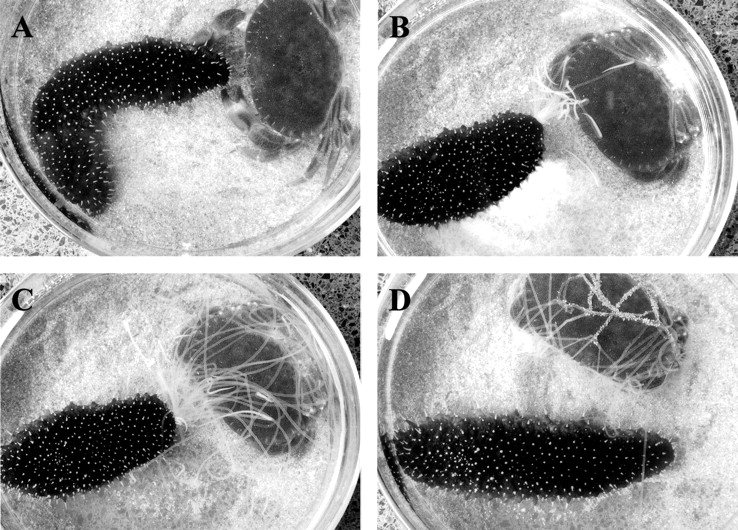
They branch off the respiratory tree and are expelled through the body wall at oncoming predators, such as fish, crabs, or predatory echinoderms, such as sea stars. But how effective are they? How do they work? How do these affect the sea cucumber's day to day ecology?

Ecology and Defense
Much of the information used in this section is taken from an excellent paper by Jean-Francois Hamel and Annie Mercier in Marine & Freshwater Behaviour & Physiology 33: 115-139 and this: physiology and regeneration oriented papers by Didier Vandenspiegel, Michel Jangoux and Patrick Flammang in Biological Bulletin (2000). and this: Patrick Flammang, Jerome Ribesse and Michel Jangoux in Integrative and Comparative Biology 42: 1107-1115.
Hamel and Mercier studied the efficiency of Cuvierian tubules in 3 species of tropical sea cucumbers (note that idents were taken on face value from labels-but used for educational purposes)

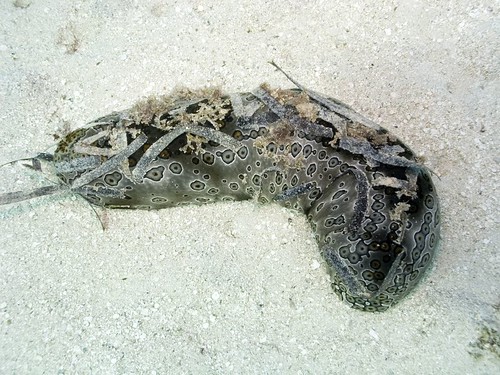
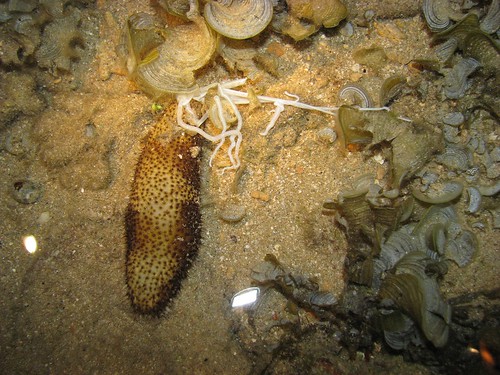
Bohadschia argus
Sea Cucumber - Bohadschia argus - PC092244
Holothuria leucospilota
Long black sea cucumber (Holothuria leucospilota)
and Holothuria marmorata (also called Bohadschia marmorata)
Bohadschia marmorata

Some ecological dynamics...

  • Cuvierian tubules are "shot" from near the anus and so aim is directed at the threatening stimulus.
  • The oral tentacles or mouth seems to be most sensitive to being threatened. Whenever the mouth was stimulated (i.e., threatened) the animal would retract the tentacles and arch the body to orient the anus towards the "stimulated" area. Water was taken in through the anus followed by expulsion of the Cuvierian tubules with expelled water.
  • Interestingly-the slowest reaction by the animal ended to be if it was stimulated or provoked around the anal region. Maybe the rear regenerated more readily??
  • Cuverian tubule "stickyness" was most effective on slower moving predators such as crabs, snails and sea stars (87-100% targeting success). This was generally not as effective against fish (5-35% targeting success)
  • (Fig. 1 from Flammang et al)
  • Lab trials showed that if a potential predator was touched by Cuvierian tubules-about 96% of those predators avoided the sea cucumber for about 3 days.
  • If the sea cucumber LACKED Cuvierian tubules then those individuals were devoured or bitten to death at a higher rate.
  • Tubules that did not ultimately stick to a a surface can be quickly pulled back in or retracted.
  • Even if Cuvierian tubules have been completely exhausted, the other viscera can STILL be used as a defense.
  • Regeneration of Cuvierian Tubules took 15 to 18 days (so about 2 weeks-with complete regeneration in up to 5 weeks)
Flammang and his associates found that tubule "tenacity" or the adhesive strength varied with the surface it was in contact with, temperature and salinity of sea water and the time following expulsion from the body.
Sea Cucumber defence 2
Image from Adam Broadbent on Flickr

Regeneration of Cuvierian Tubules

There's a whole blog that is to be written about all of the various dynamics involved in sea cucumber regeneration.

But what it comes down to is that there are many cells which are "undifferentiated" that is-their use in tissue has not yet been determined by the body's needs.

These "proliferate" or become more numerous and as regeneration begins, these undifferentiated cells decreases and the "specialization" or "differentiation" of cells begins to replace the lost tissues (i.e., the Cuverian Tubules).

Vandenspiegel, Jangoux and Flammang summarized the strategy for Cuverian Tubule defense and regeneration very eloquently and so I repeat it here:
Holothuroid Cuvierian tubules thus constitute a very efficient defensive mechanism. Indeed, in addition to their remarkable structural organization, which accounts for their adhesive and mechanical properties, their large number, sparing use, and particular regeneration dynamics also make them an almost inexhaustible line of defense maintained at limited energy cost.