Showing posts with label cambrian. Show all posts

Wednesday, March 30, 2016

Natural History Art Spotlight: John Meszaros & Nocturnal Sea!

I haven't done an art blog in quite awhile and this week I thought it would be cool to feature one of my favorite natural history illustrators! John Meszaros at Nocturnal Sea!   and here is John's Deviant Art Gallery! if you'd like to see more.  and his Facebook Page with many cool pictures! 

You may already be familiar with some of Jon's work as he illustrated the recently described new species Xenoturbella monstrosa based on research at Scripps by Greg Rouse et al. 
Here's the real deal for comparison. The illustration above shows the ecology of Xenoturbella as described by Rouse et al.. so however.. unusual the image may seem it is based in real science!

Another striking image that I LOVE is this one from Jon featuring the hydrothermal vents of Antarctica, featured a few years ago here. But specifically.. the unusual multi-armed STARFISH that live there!


They apparently fed on the weird fleshy barnacles that live there as well as possibly the "Hoff crabs"! 
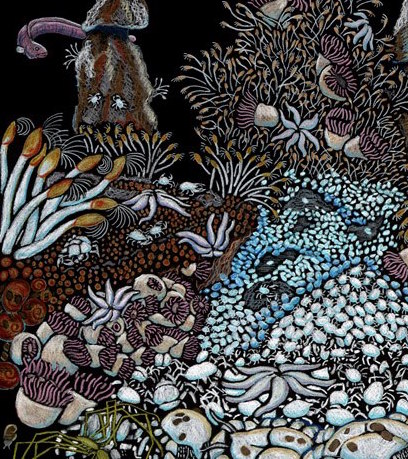
For comparison..
Jon has always had great taste in subjects for his paintings! (and good colors to match) Here is the famous swimming sea cucumber, Enypniastes exima. Which you can also buy as a shirt! 

and Yes....the swimming sea cucumber is REAL

Another one of my favorites is Megalodicopia hians! the deep-sea predatory tunicate! Another lovely painting! And yes.. here's where you can get the shirt! 
Jon draws inspiration from a wide range of habitats in nature! Fortunately they are all unusual!!

Here's a GREAT one called "Inner Space 2" which shows a bunch of very small pond-water type animals and protists...

The big "tree-like" things are actually rotifers in the genus Floscularia! He actually goes into a detailed description of everything in this picture on his Deviant Art page for this illustration.  All of the things in this painting are actually microbial organisms that you might find in a drop of water in a freshwater pond or lake! There are bryozoans and even ciliates (protists)! 

Inner Space 2 by NocturnalSea on DeviantArt

Another great piece of art shows none other than one of the weirdest, little animals known-the Loricifera! Here as part of this anoxic habitat inspired by a brine pool from the Mediterranean.


Cabinet of Curiosities:  An Anoxic Metazoan by NocturnalSea on DeviantArt

Here is a nice cross section of tropical invertebrates.. including not just the colorful and already surreal nudibranch Bornellia, but also one of my favorite sea urchins, the "shingle urchin" Colobocentrotus as I wrote about it here.  and here for the biophysics of their ability to hold on...


John also does some pretty AWESOME paleontological reconstructions! 

Here we have some art depicting the Sirius Passet laggerstatten from Greenland. A Cambrian deposit which is faunistically similar to the Chiangjiang and actually pre-dating the Burgess Shale fauna..


Sirius Passet fauna by NocturnalSea on DeviantArt

The following two are more of my favorites taken from the Cambrian faunas.

LOBOPODS! Remember Hallucigenia and the other weird critters from the Burgess Shale? These were arthropod-worm like animals that were thought to be distant ancestors to velvet worms..


Lobopods by NocturnalSea on DeviantArt
And in the same vein, here are anomalocarids.. species of Cambrian arthropods related to/inspired by the famous Burgess Shale Anomalocaris


Anomalocaris group by NocturnalSea on DeviantArt

And as all artists are want to do..here's a more fanciful creation inspired by real Paleozoic animals. Included here just for the sheer fantastic artistry of it!

False Ammonite by NocturnalSea on DeviantArt

Here he's clearly taken a VERY echinoderm-centric take on the Great Race. We have some echinoderm larvae in there as well as a brittle star and some five-part symmetry that any worshipper of the great Cthulhu would approve of (if they were not seeking to bring about the end of humanity that is! )

Haeckel Yithian by NocturnalSea on DeviantArt

Wednesday, July 1, 2015

Five Things you Probably Didn't Know about Polychaetes! #PolychaeteDay

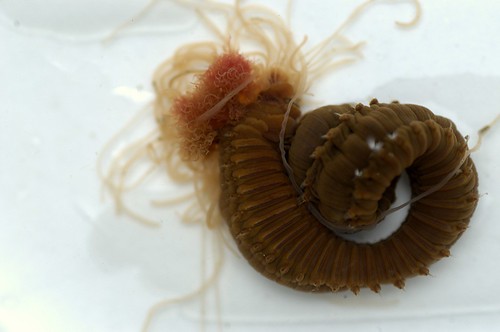
Polychaete worm
This week I celebrate International Polychaete Day which falls on July 1, the birthday of noted polychaete expert Kristian Fauchald, recently of the Smithsonian's NMNH, who passed away in April of this year (2015).


What are polychaete worms? 
Polychaetes are segmented worms, which are distinguished by their leg like structures called parapodia, which each bear distinct bristles (hair-like structures) known as chaetae which are composed of chitin (the material found in arthropod skeletons).
Alitta virens puziko 2
In the traditional sense, polychaetes are usually classified with earthworms and leeches.  But more recent molecular phylogenetic studies have shown that the "Polychaeta" is actually a big messy group that likely includes groups of worms which, at one time might actually have been classified as separate phyla !
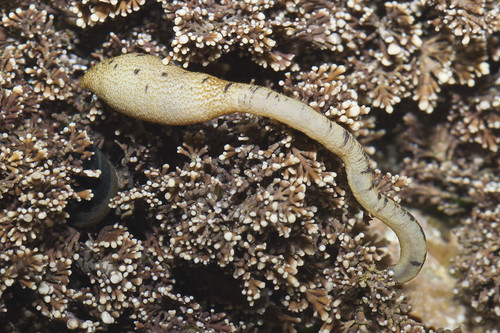
This includes spoon worms (echiurans)
Eastern Pacific echiurans or spoon worms
and peanut worms (sipunculans)
Phasocolosoma agassizii, Agassizi's Peanut Worm
How many are there and where do they live? 
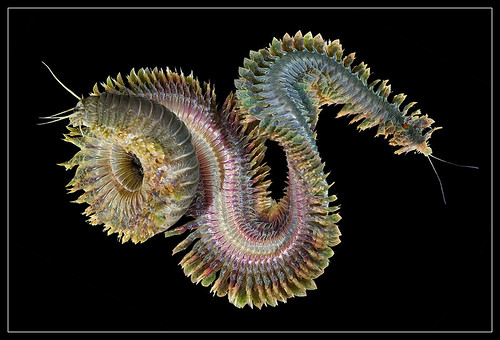
Its thought that there are likely over 13,000 species of polychaetes which live in every ocean and at every depth (intertidal to >7000 m abyssal depths) and indeed a small proportion of them (about 168 species) even live in freshwater. The diversity of polychaetes is stunning. Those 13,000 species reside within 80 families!!

As I've shown in photo essays here (by Arthur Anker), they can be STUNNINGLY beautiful!

and some, such as these forms from Antarctica can be quite huge.

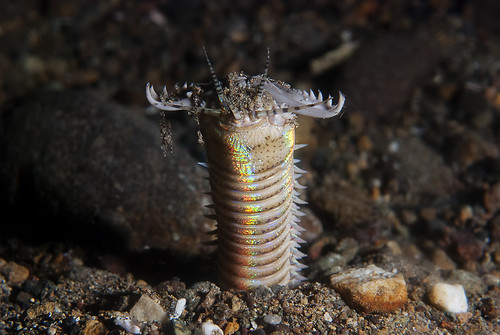
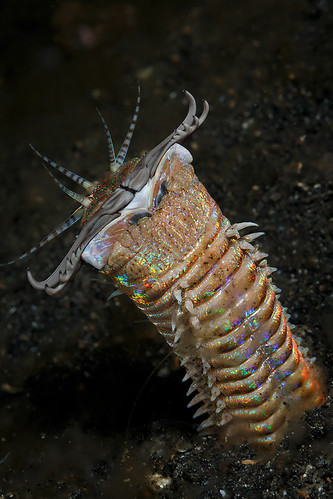
Feeding ranges from deposit feeding on sediment, filter feeding to of course, raptorial predation which has been made famous by the Indo-Pacific Bobbit Worm! (Eunice sp. )
Rise of the bobbitworm! (Eunice aphroditois)
So, here's five subjective things about polychaetes for IPD!!!

1.  Eat the Palolo Worm! Out in Guam and the Solomon Islands, there are several island cultures who are privileged to be around swimming polychaetes during their reproductive periods, where they undergo a stage/morphological transformation known as epitoky.
The worms swim up into the water column en masse as seen here..
                            
These worms are then promptly eaten by the locals. There are many accounts of this, such as here on National Geographic Palolo worm is considered quite the delicacy and is apparently very reminiscent of caviar and is served here on toast. A traditional presentation.
From MrLavalava's blog!
2. Polychaetes that glow in the dark! 
                            
What would any group of invertebrates be without at least a FEW members that glow in the dark??? (i.e., emit bioluminescence?)

I actually found two: this one is the "Bahamas Glow Worm" aka Odontosyllis enopla. This species looks like a more conventional polychaete

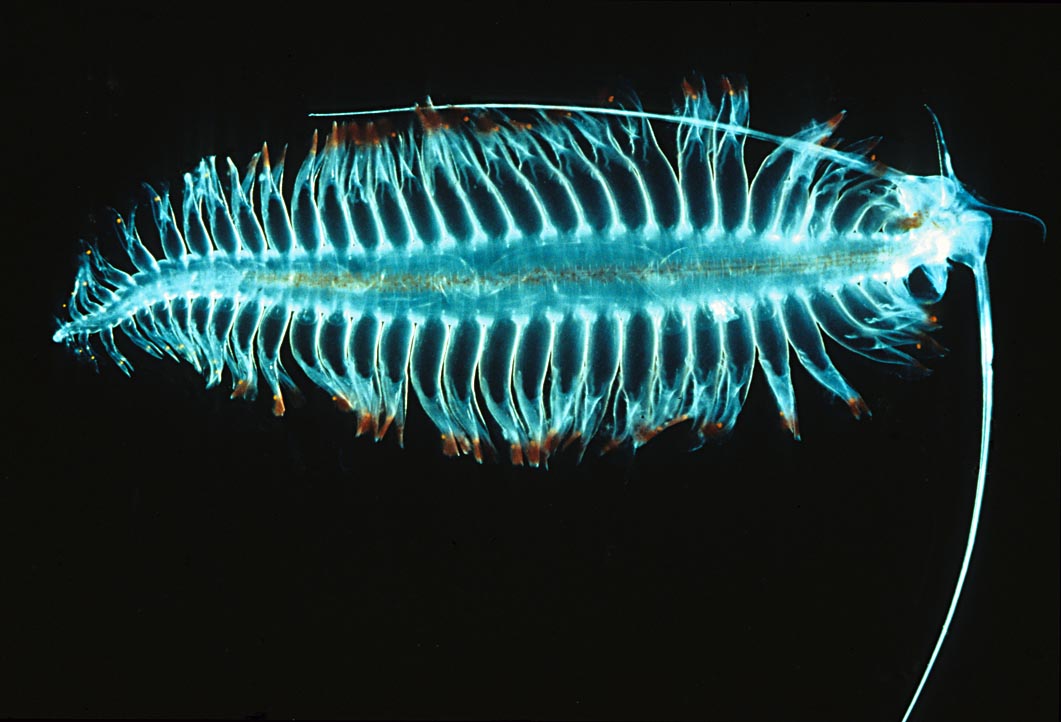
And then you also have the pelagic (aka swimming) polychaete, Tomopteris! which is a bit more unusual given its habitat (the water column)
Image from Wikipedia! 
3. They have a fossil record dating back to the Cambrian
All of the major invertebrate groups can usually be traced back to the very earliest moments in Earth's history when the first evidence of life appears. Polychaetes are no exception.

This pic shows what is thought to be a Cambrian polychaete from the famous Burgess Shale in Canada. It is  appropriately enough called Canadia spinosa
From the Smithsonian's Paleobiology-Cambrian Page! 
The Royal Ontario Museum has a fairly detailed page on this animal here including some nifty paleo art showing what the animal might have looked like alive..
There were apparently a few of these Cambrian polychaetes, including Burgessochaeta,  Phragmochaeta and others..  These were thought to have paddles and interpreted as having the ability to swim. Length: 2-4 cm, so some tiny beasts. 


4. Many polychaete species live in close relationships with other animals
The most photogenic polychaetes might be large predatory ones or possibly even the colorful Christmas tree worms..but there are many polychaetes with a cryptic lifestyle which includes living as a "guest" on other, larger animals.

Sometimes with strong relationships than had been surmised. I wrote about the scale worm Arctonoe vittata a few years ago.  These worms live within the tube foot groove and along the underside of the leather star, Dermasterias imbricata on the Pacific North West coast. 

In experiments, not only did the worms move to the sea stars when separated, but the seastars moved toward the worms! 
Photo by Paul Norwood-from iNaturalist
Scale worms are very dedicated commensals to their hosts.. As I reported from my time in Japan, these stayed with their host, a solasterid until death...


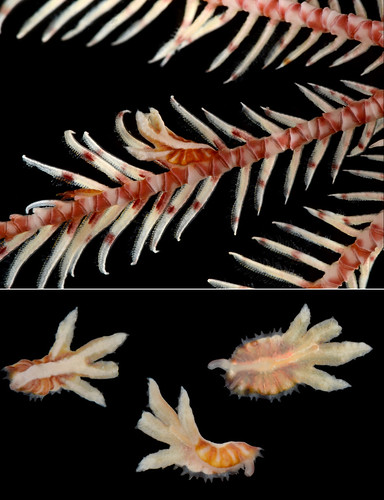
Polychaete worms sometimes have highly specialized relationships. Here are a group of worms known as myzostomes, which are parasites on crinoids. and apparently have been parasitic on crinoids since the Jurassic! (Here
Myzostome 1
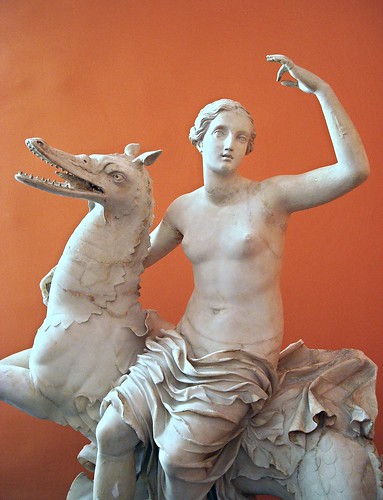
5. Many polychaete names are derived from greek mythology: nereids (nymphs) and goddesses!
A comparison of the names of various nereids (sea nymphs or female water spirits) shows that there are in fact a LOT of them shared by a host of polychaete worms..
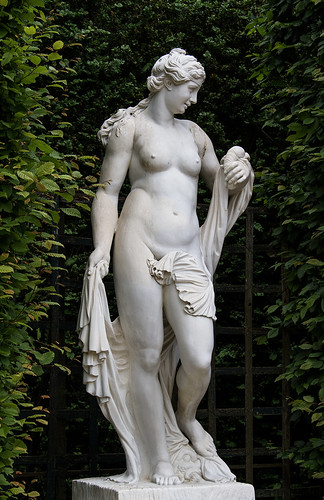
"Nereid on Ketos" from "Pausilypon" in Naples - beginning 1st century AD - Naples Archaeological Museum - "Augustus and Campania" - Exhibition at Archaeological Museum of Naples, until May 4, 2015
Everything from the genus for the "Bobbit Worm" Eunice sp.
Jack in the box Bobbit Worm
to Nereis which is itself, the Greek word for the water god Nereus
The Worm
Amphitrite, Goddess of the Seas...
Amphitrite
and her terebellid namesake..
DSC_8341
While I'm not privy to the original etymology of these names, its not unusual for the original scientists to name organisms which they perceived as beautiful with namesakes which befitted them...

Happy International Polychaete Day! 

Tuesday, February 10, 2015

Natural History in Unexpected Places: WONDERFEST-Japanese Science Fiction Toy Show!

JAPAN! So many amazing things! Sometimes in unexpected places!!

Today, an unusual post. As many of you know I'm currently visiting Japan to study the Sea Stars of Japan at the National Museum of Nature and Science. 

In a happy coincidence with this year's visit, my trip took place at the same time as the massive Japanese science fiction/toy and model-kit show called Wonder Festival.  I have a uh... passing interest in Japanese pop culture.. Godzilla, Ultraman, so forth...and so, why not? I've never been to one.. I wonder what its like??

HUGE. A massive space with a massive crowd! 

Much of it was pretty much what you would expect. Renditions of everyone's favorite Japanese monsters, robots and so on...

But one of the things I had NOT expected was to see how this incredible pool of artists, craftsmakers, modellers, and even retailers were heavily influenced by Natural History! 
In other words: BIOLOGY. ZOOLOGY. FISH! INVERTEBRATES! Even ROCKS!!

Here in this enclave of fantasy were an innumerable number of items which were inspired by the natural world!!  I saw everything from actual animal skulls for sale to various figure kits and monsters inspired by insects, sea stars and more!

I don't know if I should have been surprised but I was VERY impressed by how creative and frankly, f*cking STUNNING some of the art and displays were... and yes much of it for sale.

I've mentioned in other posts, how the Japanese apparently have a pretty huge appreciation for natural history and an inordinate fondness, if not outright obsession with various marine invertebrates.. 


But pictures were encouraged and so here's a cross-sample of things that caught my eye. I'll be honest and say that at the time I didn't think to capture the names of the companies and artists who created these items. And so, the omission of their names is my fault... but knowing how much of these things exist is a pretty awesome fact in and of itself...


A steampunk Fangtooth Fish! My pictures don't do it justice..
 
A real one for comparison...
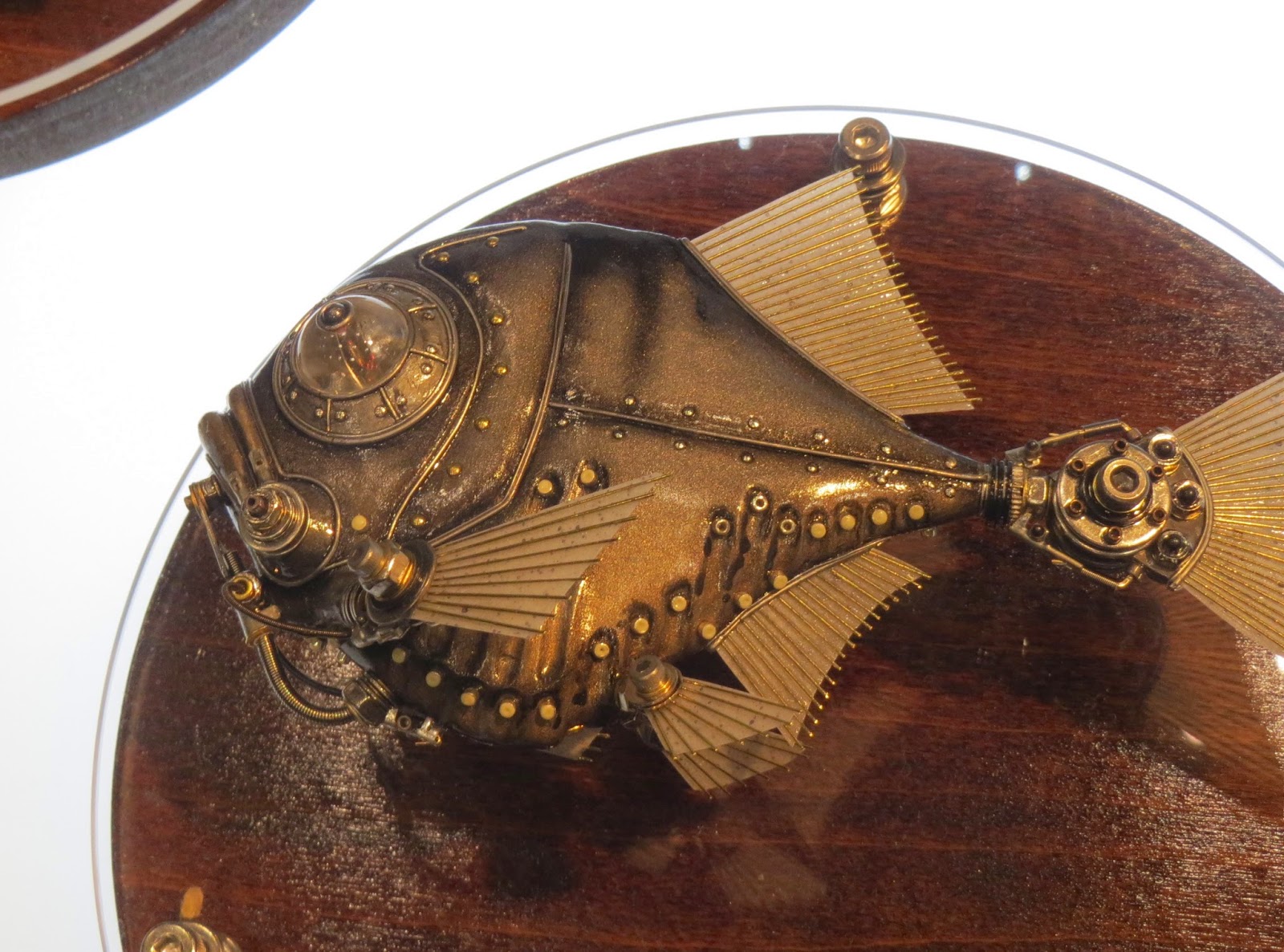
and here is a nice Steampunk rendition of what I believe is Sternoptyx, aka the hatchetfish! another resident of the deep-sea
But steampunk fish were not the only fish in attendance. Actual fish skeletons were also to be had! Here are some cool preps in tiny glass/plastic boxes!!
And one closeup of a particularly cool one...
Invertebrates were also well-represented!! Here are some resin or porcelin (not sure I remember) highly detailed STOMATOPOD figures! Each about 2 inches (6 cm) long. 
Origami has a LONG history in Japan..and so a good representation of paper craft displaying various marine animals was on display...
But MY favorite??? The paper craft model of the Cambrian predator Anomalocaris!! 
STEAM PUNK CEPHALOPODS!!!


Some interesting snails with a skull motif!! 


I don't honestly remember what these figures were made of but they were visually AMAZING.

Here.. some horseshoe crabs that have never looked better! 
Some colorful but more conventional crabs...
Some Coelacanth action! 
A rockin' green lobster! 

And then, there was this guy, who had metal casts of various crabs in various sizes... these are parthenopids I believe (elbow crabs).


One guy was selling these stunning Bismuth samples!! The surface oxidizes giving it these brilliant colors


and of course, you always got the classic: Paleozoic Anomalocaris and Dunkleosteus vinyl figures!