Showing posts with label Indian Ocean. Show all posts

Thursday, December 24, 2015

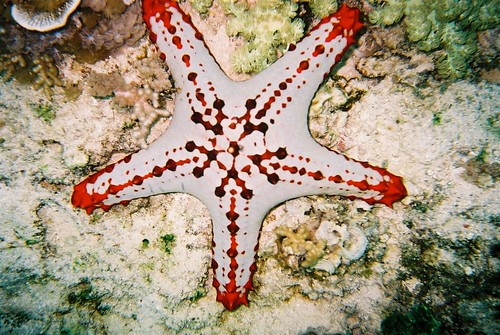
Happy Holidays! Protoreaster lincki! A festively colored tropical Indian Ocean starfish for your winter solstice!

Image taken by Jan Mees. From the World Registry of Marine Species
This week, a photoessay and odd little facts about this very strikingly colored/decorated oreasterid starfish, Protoreaster lincki!  You can check this past post on how to tell Protoreaster species from the similar Pentaceraster species..

This is a shallow-water tropical species known primarily from the western Indian Ocean, especially on the east African coast. The species descriptor "lincki" is named for the German naturalist Johann Heinrich Linck, the author of a noted monograph on sea stars, De stellis marinis liber singularis published in 1733. Johann Linck is also the namesake of the familiar starfish genus Linckia. Many years ago I wrote a little bit about where funky starfish names come from before, especially Nardoa and Luidia.
We really don't know much about the primary biology of this species. Its thought that they feed primarily on microalgal film so presumably they are dependent on the "goo" on sea grass, sea bottoms, etc.  

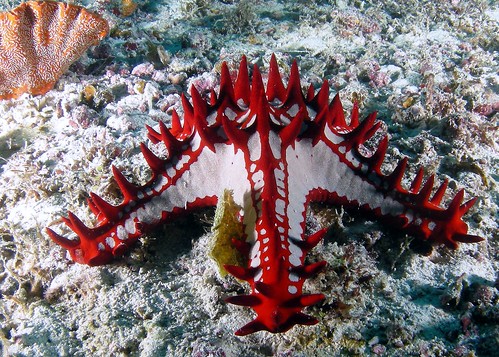
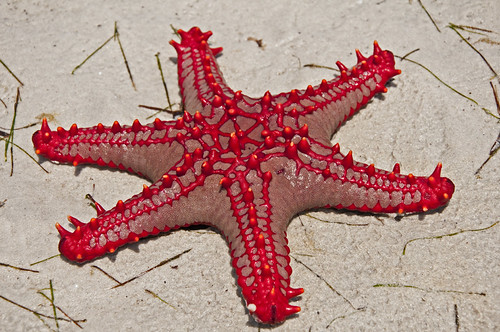
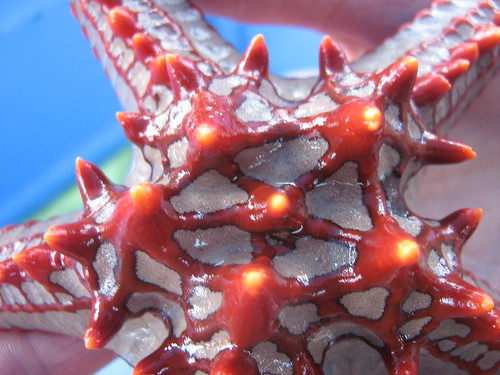
This species is fairly easy to recognize due to its striking red on white coloration, but also the very distinctive pattern of spines and etc... There is some variation however. Spines in some individuals are more conical versus others which are more blunt...
Image taken by Adrian Pingstone 2005 at Bristol Zoo Aquarium, Bristol, England via Wikipedia
red starfish
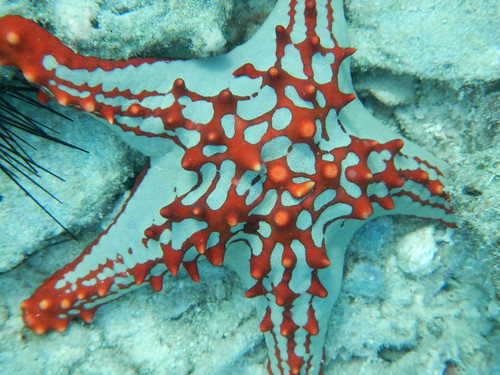
Close up of Starfish (Protoreaster linckii), Kenya.
red-knobbed starfish (Protoreaster linckii)
Red, yellow, and grey starfish
Zanzibar Starfish
The spines on this species and other oreasterid starfish likely serve against larger predators. Its unclear if they are effective against smaller specialized echinoderm predators such as these harlequin shrimp

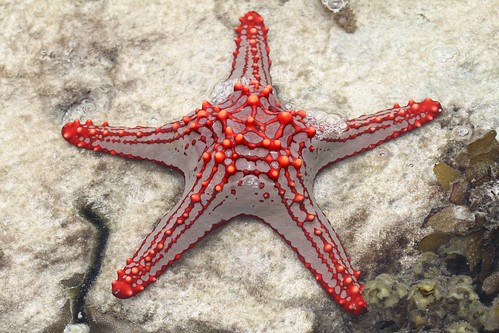
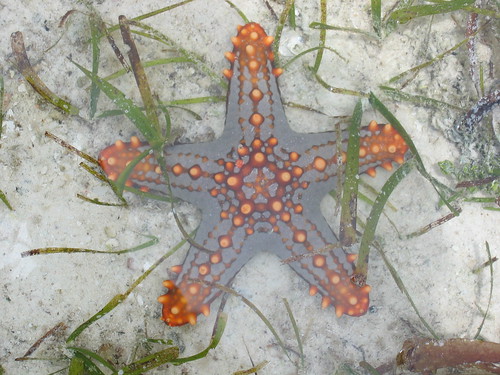
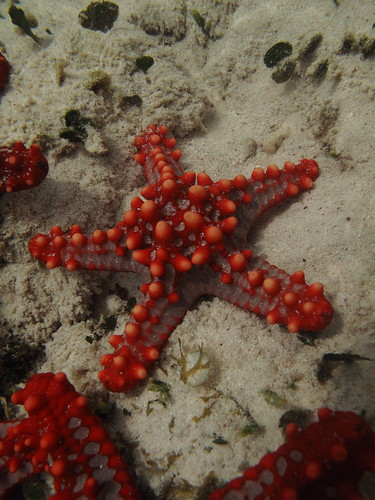
Variation! The skeletal patterns on these sea stars are broadly consistent and distinctive for this species. But in the same way that people can have different hair and skin color, different facial features, etc. starfish show variation in spination, pattern and even color... 

Here are some examples. Its unclear if the differences are simply random or if they correspond to some kind of environmental factor such as food, etc.

Mozambique
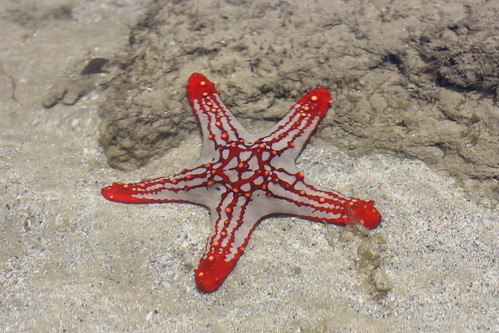
Red-knobbed star

Tanzania, African coast.
DSCN3193
Tanzania, African coast.
Red-knobbed Starfish
Tanzania, African coast
Tanzania March 2009 261
Zanzibar, African coast
Zanzibar 2005 192 (Large)
and the occasional 6 armed variant..
Red star on the beach

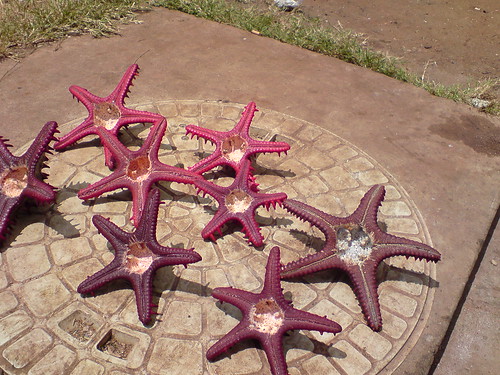
As with the Indo-Pacific species, P. nodosus, this species is fished for the tourist trade. Data about its reproductive abilities and "carrying capacity" for a fishery aren't well documented.
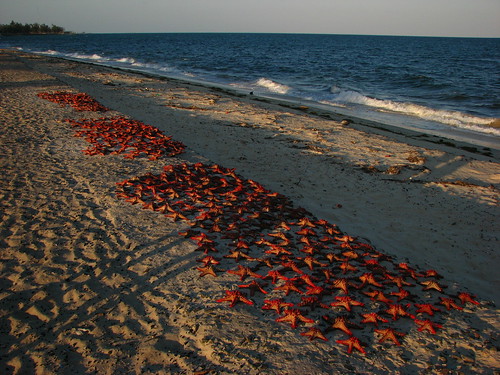
StarfishStarfish flashers

ART! For some odd reason, this species has also served as the inspiration for many distinct types of art. This postage stamp...for Mozambique in 1982 and the more recent rendition below it, including the pastel and of course TATTOOS! 
via the World Registry of Marine Species


Starfish by CreativeCurseKina on DeviantArt

starfish tattoo by SunofKyuss on DeviantArt

Happy Holidays from the Echinoblog!

Tuesday, September 4, 2012

Tiny Brittle Stars from the Indian Ocean Show Diversity and Details!

                                     
This week..I am still catching up from the Echinoderm meeting in Brussels, Belgium but as luck would have it my colleague and brittle star researcher Sabine Stöhr at the Swedish Museum of Natural History was generous enough to share some images from her new paper "Brittle Stars from Seamounts in the Andaman Sea (Indian Ocean); first account with descriptions of new species" co-authored with Sabyasachi Sautya and Baban Ingole from the National Institute of Oceanography in Goa, India. The link to this paper is here. in the Journal of the Marine Biological Association of the United Kingdom.

Stöhr and her colleagues describe brittle stars collected from seamounts in the Indian Ocean (the Andaman Back-Arc basin), which for anyone in this business-is pretty exotic.  

Brittle stars have never been collected from Indian Ocean seamounts and so there is ever the potential for new and interesting species! (or at least further encounters with known ones!)

Six species were identified, including this weird little fellow.. Astrophiura, a species close to Astrophiura tiki. (from 517-671 meters deep).

These are odd little (disk diameter= 6.4 millimeters!) brittle stars that are superficially similar to some deep-sea starfish, such as caymanostellids. I've  shown both these starfish and Astrophiura on the Echinoblog before (here). 
Figure 6 from Stohr et al., 2012
Note the oral surface in the lower picture?  See those 2 paired ball-like things between each radius? Those are gonads! How many times do you get to see that in an ophiuroid??  Its not every day I'll tell ya' that!

Stöhr also described some NEW species from these seamounts at fairly deep-depths (about 373-671 meters)

Pics below show the top surface of the disk which is quite small (2 to 5 millimeter diameter!)

That includes this very rarely encountered genus Ophioleuce, new species Ophioleuce longispinum
For you folks who like to know where scientific names come from- Do ya' see those long spines coming off the arm bases?  Illustrated below..   THAT is where the species "longispinum" which is latin for "Long Spine" comes from...
Figure 2 from Stohr et al. 
Sabine and her colleagues use a Scanning Electron Microscope (aka an SEM) to show a variety of features, including useful skeletal morphology such as the individual arm skeleton (called the arm vertebrae) such as this one to help diagnose this new species..
From Figure 3, Stohr et al. 
Another new species, included this one:  Ophiophyllum minimum was described.  The species "minimum" was named for the very small size of this species (about 1-2.5 millimeters in diameter!)..   shown here via Scanning Electron Microscope...
Figure 4 from Stohr et al.
We often miss a LOT of details when we aren't paying attention to small critters.  That's why the SEM can be so useful. They bring an almost surreal quality to the level of detail present!

Here is a series of close ups of the disk on this species...
and closer!!   The primary disk plates are arranged in a stunning pattern..
This species was also described using a variety of neat skeletal features that look like they were taken out of orbit from an asteroid field!
Figure 5 from Stohr et al. 
The discovery of these species is merely the BEGINNING of a more long-term period of exploration as Stohr and her colleagues ask more questions resulting from the discovery of these species:

  • Are these evidence of endemism of these species on seamounts?  (i.e., do they occur ONLY on these special habitats?)
  • Are they rare or rarely encountered?  Do these reflect uniqueness of the habitat or merely that they have not been collected very often? 
  • Could the morphology of these species suggest an broad overall ecological morphology to living in this unique setting (on the seamount)?
  • How will further specimens inform us about the growth and the evolution of other brittle stars?

 Stay tuned and hopefully we will be able to present more from echinoderms collected from the Indo-Pacific deeps!