Echinodermata! Starfish! Sea Urchins! Sea Cucumbers! Stone Lillies! Feather Stars! Blastozoans! Sea Daisies!
Marine invertebrates found throughout the world's oceans with a rich and ancient fossil legacy. Their biology and evolution includes a wide range of crazy and wonderful things. Let me share those things with YOU!
Remember that Anal Cones are these bizarre floating bulbs that you see atop Astropyga radiata-one kind of fire urchin. This photo by Pauldub shows it nicely...
As does this great video by Rakufuku
I CAN'T be the only person who sees this beast - rudely captured as it expels its guts through its mouth- and thinks of a dramatic scene at the end of the Watchmen graphic novel. In it, a giant alien writhes in its death throes in New York City.(italics are mine)
So, here's the thing. The picture above IS NOT a sea urchin expelling "guts through its mouth."
The author may have been might be thinking of sea cucumbers which expel their guts with great gusto! Here's a thing I wrote about that.
So, what is this a picture of?? This is an ANAL CONE at work! In other words, this is the sac that expels waste from the animal.
This is a structure that is found on the "top" surface of the urchin. Note that the mouth is found on the underside facing "downward" AWAY from its anus and the anal cone. All those little pellets in the sac? Yup. THAT is sea urchin feces. This is the first good picture I have seen which so clearly shows the scatalogical functions of the anal cone! WOO! Yay the things you learn here!
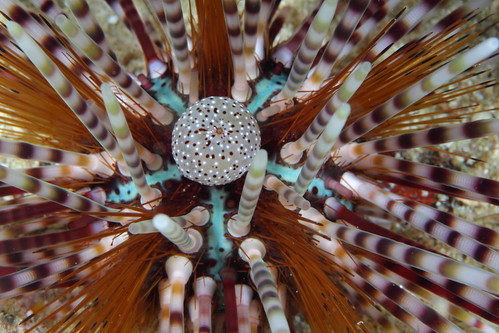
Echinoblog Present your evidence! 1. The Madreporite is plainly visible.
So you know that offset plate that you see on the top of a starfish? I wrote a whole post about them here. In sea urchins they are part of what's called the APICAL SYSTEM that is found on the top of the animal.
Photographer Fleetham's excellent photo skills capture this plate quite nicely... (shown below in the black circle)
P.S. For comic book Watchmen geeks. As much as echinoderms would love to claim Adrian Veidt's mind blowing monstrosity-it really is more cephalopod/squid like...