Showing posts with label Diadematidae. Show all posts

Wednesday, July 13, 2016

Astropyga The Radial, Fiery Star Butt Urchin! Observed insights from Flickr & YouTube!

A happy July week to all of you! So, as we enter into the lull of the summer I present to you some choice Echinoblog image and video picks from various image streams that show off one the internet's most frequently photographed sea urchins! The diadematid ASTROPYGA

Common names of these urchins include "radial urchins" and "fire urchins." But many refer to echinothuriids in the genus Asthenosoma as "proper" Fire Urchins, for obvious reasons.. but mainly because they are VERY painful to get stung by..

Astropyga also appears to have a rather painful array of spines but I'm unsure if these pack quite the toxic wallop that Asthenosoma does..

Astropyga includes four known species, one in the tropical East Pacific and another in the Indo-Pacific and two in the tropical Atlantic. All are known to occur primarily from relatively shallow to mesophotic depths as we saw recently on a Bishop Museum expedition to the "Twilight Zone" (here

But even within the widely occurring Indo-Pacific species. A. radiata there appears to be quite a bit of color variation from the dark colors seen below to the lighter ones.

The genus name can be broken down to "Astro" meaning star and "pyga" which refers to rump or buttocks.. so the name literally translates to "Star Butt"!!.

Why? Well, you see this giant bulb on the surface? That's an extension of the intestine called the anal sac. That's where the POOP comes out! I've talked about that here.  So, basically some wry taxonomist looked at the anal sac and the pentagonal symmetry and decided "yes. The STAR ASS!"
Fire urchin
Flickr and Youtube are GREAT for picking up on natural history observations. Yes, there's always the lack of scientific rigor but sometimes divers just make simple observations. And THAT can be the start of knowledge.

All the images below are probably A. radiata from the Indo-Pacific.

Astropyga scavenging on dead fish! (Lembeh)
Based on a round up of papers I could locate, A. radiata has been reported primarily as a scavengers, feeding on algal debris and other stuff from sediments, etc. But if this image is accurate (and not posed) they occasionally much on dead fish as well. This is actually consistent with other sea urchin feeding habits, so I feel comfortable in presenting it here..
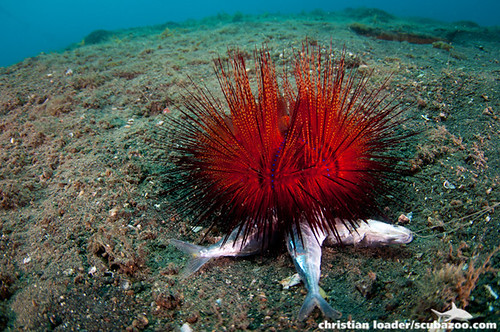
Radial Sea Urchin feeding on dead fish - Lembeh

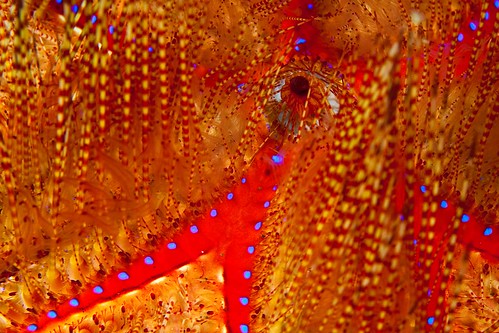
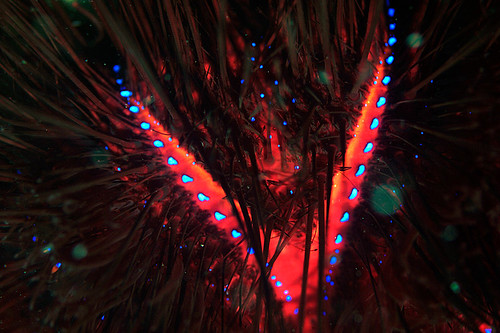
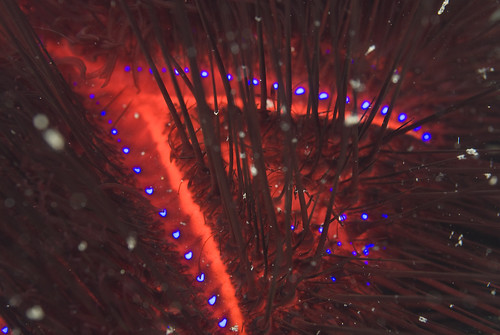
Blue Iridescent Spots! Its been speculated that these are photoreceptors but they've not been tested and its unclear exactly what their function is.. But they immediately stick out when observed on an otherwise bright red sea urchin! 
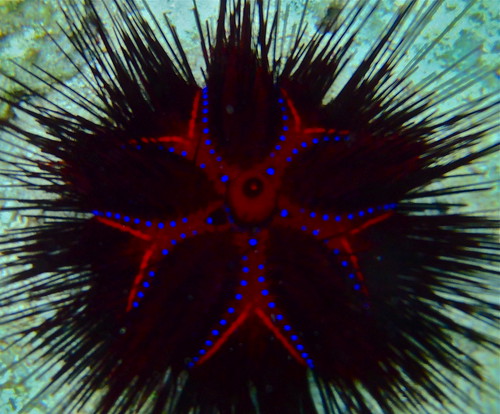
Astropyga radiata, Red sea urchin
Fire Urchin
75
magnificent urchin

Spawning!
This speaks for itself. As with other echinoderms I've shown here (such as the sea cucumbers) just because you see white fluid being emitted its not actually clear what sexes of the species are present. The fluids likely represent BOTH sperm AND eggs. 
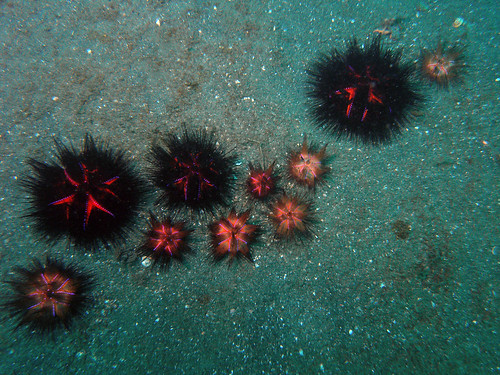
Sometimes this species form large aggregations, which are most likely to help facilitate their reproduction and sexy time!
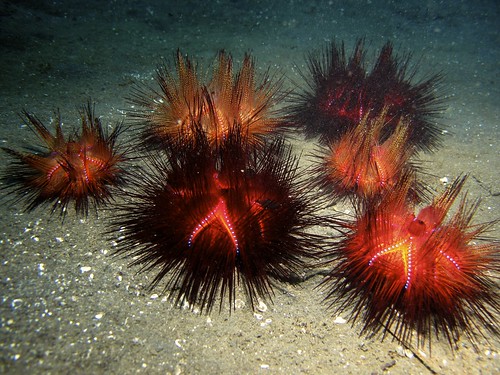
Urchins unite!Magnificent Urchin family
Astropyga moves surprisingly quickly!
While I haven't actually seen one of these alive and close up, its pretty clear that even for sea urchins they are capable of a surprisingly brisk sprints! and across some unusual terrains to boot! 

That's quite a lot of coordination of spines and tube feet at play.. 

here's a bunch of them in what looks like a mating aggregation, moving en masse!

Better yet! here's Astropyga moving in TIME LAPSE!

my first underwater timelapse from prodtv on Vimeo.

Crustacean Relationships! 
Sea urchins are basically big spiny balls that seldom move and surprise! surprise! There never seems to be a shortage of OTHER, smaller animals that can take advantage of this as "habitat."

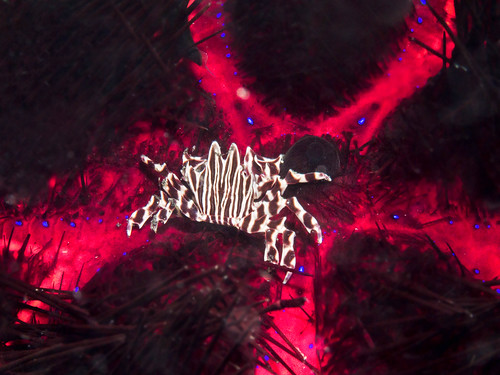
 Crab Commensals!  These don't seem to be as bad as the crabs on Asthenosoma, (the proper fire urchins) simply because these don't seem to "dig" themselves into the urchin surface. Spines on Astropyga seem long enough to provide adequate protection as-is...
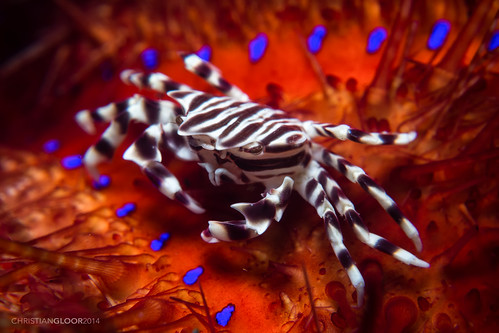
Walking on fire!
ZEBRA CRAB ON FIRE URCHIN, LEMBEH STRAIT

and vice versa?? Probably one of the most unusual things I've seen imaged by divers since Flickr and YouTube became a thing has been this.. Crabs in the family Dorippidae that PICK UP urchins, sea anemones and carry them on their carapace in order to use them as sort of a defense as they walk along the sea bottom.
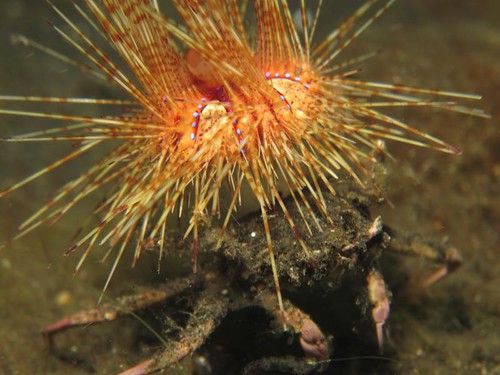
IMG_1077
But why explain? When you can just watch...

...and of course.. POOPING!
And finally, one of the things that we LOVE to watch urchins doing? POOPING! Something that is arguably part of their namesake!  Here's the time I corrected New Scientist on their mistaken urchin pooping picture! 

Here's a whole post on echinoderm anuses for your reading pleasure! 
Here's a lovely shot entitled "Radiant Crap" by Eunice Khoo!
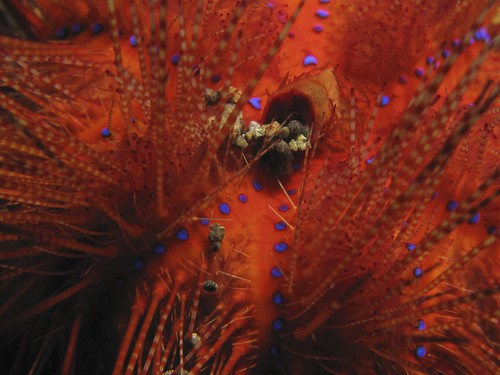
Radiant crap!
And of course there's pooping AND commensal crabs! TOGETHER.
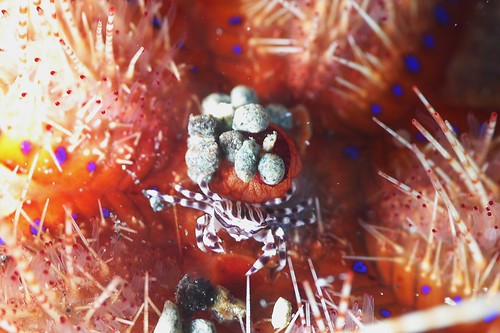
Urchin crab - Zebrida adamsii - T Tebal

Saturday, June 16, 2012

Follow up on the Anal Cone! (thanks to the New Scientist)

(Photo by David Fleetham) 
So, a few weeks ago I posted this bit about the enigmatic nature of anal cones in diadematid sea urchins. What do they do?

Remember that Anal Cones are these bizarre floating bulbs that you see atop Astropyga radiata-one kind of fire urchin. This photo by Pauldub shows it nicely...
                 Fire urchin
As does this great video by Rakufuku


Well, earlier this week, the New Scientist posted this great photo and blog taken by marine nature photographer David Fleetham of a sea urchin from off the coat of Maui.

about which the writer, Rowan Hooper sez this

Full Quote:
I CAN'T be the only person who sees this beast - rudely captured as it expels its guts through its mouth - and thinks of a dramatic scene at the end of the  Watchmen graphic novel. In it, a giant alien writhes in its death throes in New York City.(italics are mine)
So, here's the thing. The picture above IS NOT a sea urchin expelling  "guts through its mouth." 
The author may have been might be thinking of sea cucumbers which expel their guts with great gusto! Here's a thing I wrote about that.

So, what is this a picture of??  This is an ANAL CONE at work!  In other words, this is the sac that expels waste from the animal.
This is a structure that is found on the "top" surface of the urchin. Note that the mouth is found on the underside facing "downward" AWAY from its anus and the anal cone.

All those little pellets in the sac? Yup. THAT is sea urchin feces. This is the first good picture I have seen which so clearly shows the scatalogical functions of the anal cone!  WOO!

Yay the things you learn here! 

Echinoblog Present your evidence!

1. The Madreporite is plainly visible.

So you know that offset plate that you see on the top of a starfish? I wrote a whole post about them here.  In sea urchins they are part of what's called the APICAL SYSTEM that is found on the top of the animal.

Photographer Fleetham's excellent photo skills capture this plate quite nicely... (shown below in the black circle)

Here is a nice photo from the British Museum's Echinoid Database of the cleaned test showing the madreporite Darkened in the upper right.


2. That brown tuft at the tip of the structure? Is the same as what's present in other close ups

                    Fire urchin

 Add to the fact that the mouth space would be a lot larger. Image from the British Museum's Echinoid directory

Its also worth noting that photographer Fleetham noted that this was "expelling waste" and not "expelling guts" as noted above. 

So my thanks to the New Scientist and photographer David Fleetham for capturing what is probably a bit of undocumented biology! 

P.S. For comic book Watchmen geeks. As much as echinoderms would love to claim Adrian Veidt's mind blowing monstrosity-it really is more cephalopod/squid like...


Tuesday, May 29, 2012

ANAL CONES! Diadematid sea urchin mysteries!


Lembeh Strait April 2012-0026.jpg

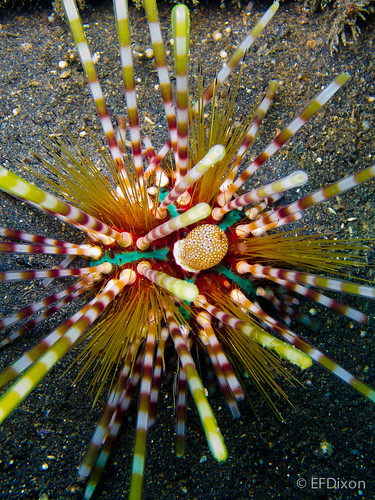
Echinothrix from Lembeh Strait Photo (above) by Efdixon

Another day when pictures say more than words!  What is an anal cone???

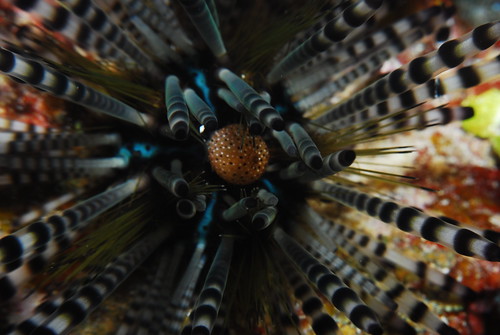
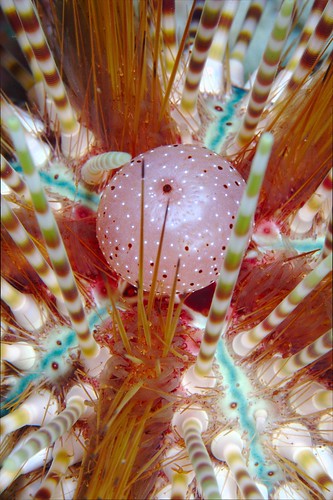
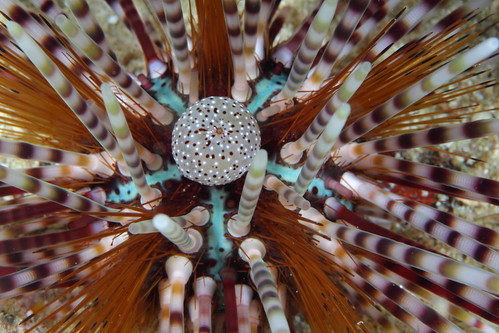
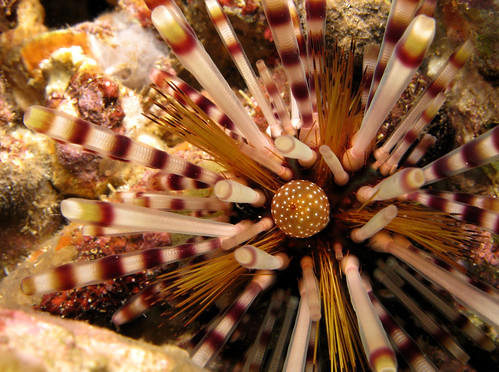
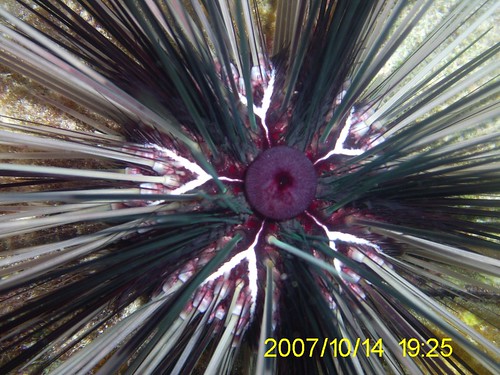
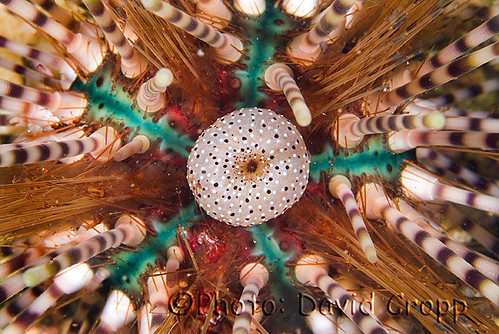
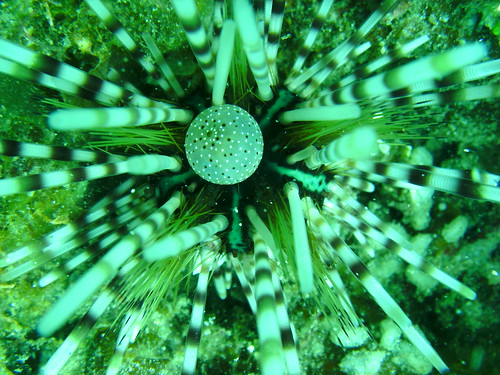
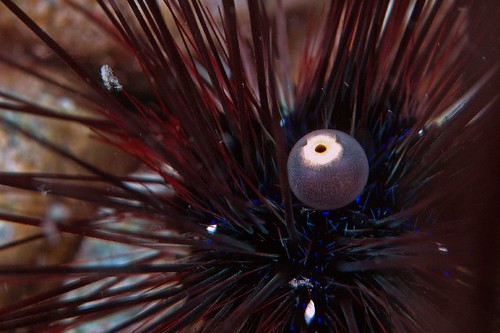
The anal cone is the weird, prominent bulb-shaped bit (its white in the species below) that is sitting on the top of the test (i.e., the body) in sea urchins of the family Diadematidae, which are well-known for their big long sharp spines....

But what function does it serve?? 
The Anal cone seemingly falls into the "poorly understood" category but I did find some explanations..

Ailsa Clark from Echinoderms of the Seychelles (pg. 84)  
Another peculiarity of this family is that there is an elongated anal cone or sac which is commonly inflated like a small balloon in the centre of the upper side. This may gently roll around its attachment and is believed to have a respiratory function".

Hendler et al. (1995) in the book Sea Stars, Sea Urchins, and Allies, Echinoderms of Florida and the Caribbean note in the tropical Atlantic Astropyga magnifica
As in Diadema antillarum, the anal cone enables the animal to eject feces away from the body.
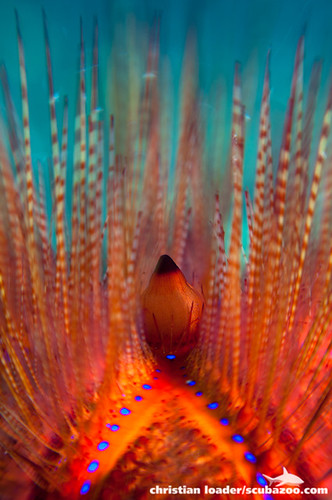
So here's a diversity of anal cones from various diadematid urchins! If they are for ejecting feces then these are some of the most aesthetically pleasing feces ejecting structures that I've seen among animals!

I believe this is Echinothrix from Hawaii
Urchin
Photo above by JLambus

Astropyga from Sulawasi (photo below by pauldub)

Fire urchin

Astropyga from Indonesia
Fire Urchin Close Up

Photo above by PacificKlaus

Another by PacificKlaus. Looks to be Echinothrix? from Okinawa, Japan
Urchin

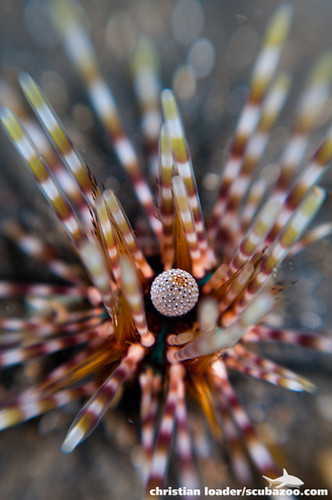
Astropyga from Lembeh, Indonesia
Sea Urchin - Lensbaby macro - Lembeh

Photo above by Christian Loader

Another by Christian Loader. Maybe Echinothrix from Lembeh,
Double-spined Sea Urchin - Lensbaby macro - Lembeh

Sea Urchin Closeup
From Echinotrhix calamaris from Papua New Guinea. Photo below by jabaezam

Diadema? from tropical Atlantic
close up of spiny urchin
Photo above by marcsdad50

Echinothrix from Sulawasi (photo below by fisheyedave aka David Cropp)
DSCF0348

Echinothrix? from Lembeh Strait (Photo by Ruary James Allan)
Urchin


Here's one from Diadema (the Philippines). Photo below by maxette
sea urchin