Showing posts with label Cretaceous. Show all posts

Wednesday, January 7, 2015

Pegaster stichos A Cretaceous California starfish example of Paleo History!!

This week, I am in California on my way to Japan! I am visiting the world-renowned Invertebrate Zoology & Geology department at the California Academy of Sciences in San Francisco! 

I used to work here when I was a grad student at San Francisco State University in the 90s and as such I have a long-standing relationship with colleagues at the museum.
While going through the collections, I encountered a specimen of this awesome classic fossil, the Cretaceous Pegaster stichos, a starfish belonging to the family Stichasteridae described by my former PhD advisor, Dan Blake and Dallas Peterson in 1993 in the Journal of Paleontology. Their specimen is below...

                                
The CAS specimen (CASG 68139)  is also from the Cretaceous of California... (my thanks to Dr. Peter Roopnarine @peterroopnarine and Collection Manager Dr. Jean deMouthe for their help!)

If some of you are "old timer" San Franciscans.. you may even recognize that this fossil was originally on display in the old CAS Life Through Time Exhibit!!
                                
These specimens (and others like them) are powerful pieces of evidence for how the distributional ranges of marine animals has changed over time. 

but first.. just a little introduction so we're all on the same page...

The starfish in question belongs to the Stichasteridae, which is a group of forcipulate starfishes. I wrote about the curious pattern of biogeographically arranged lineages in the family tree of these animals awhile back...

Note the purple arrow below. The Stichasterids are down at the base of the tree. Given that the record of this whole group goes back to the Triassic, the fact that they are still around is pretty cool.
BUT most members of the Stichasteridae in MODERN oceans live mostly in the Southern Hemisphere (shown here by Stichaster australis), usually seen in Australia, New Zealand and/or the cold-temperate part of South America

As I've blogged before, shallow water members of this family are often times convergent with sea stars in a different family, the Asteriidae from intertidal habitats in the Northern Hemisphere..

But most members of the Stichasteridae are absent from the Northern Hemisphere EXCEPT in the deep-sea, such as this Neomorphaster we saw in a 2013 Okeanos Expedition, where they can be surprisingly abundant..

The only other EXCEPTION to this occurrence in the northern hemisphere is from FOSSILS!! 

Behold this awesome specimen of the Cretaceous stichasterid, Pegaster stichos!! 
                                 
So, this shows that at ONE TIME, this group of sea stars lived in the Northern Hemisphere and in the Pacific, perhaps even more widely than was previously known. Note also that in this time period, a good chunk of the west coast of North America was underwater...as well as a good parts of Texas and the south..
From NPR: http://media.npr.org/assets/img/2012/10/09/late-cretaceous_wide-e3fc2fd33eac021deb4b6ac5b4d87cb80d50f9f2.jpg?s=6
For most of us, we think of the Cretaceous as the time of the dinosaurs and other big marine reptiles!
from the NPS National fossil DAY page! 
But MANY a starfish and sea urchin was around during those days...

and sea urchins of course!

What happened to them??  Extinction apparently. Or maybe they just moved into more friendly waters?   Why?? Any number of factors including sea level and/or climate change.


Where do modern faunas come from? They were here and there.. and sometimes we can see them back then....

Tuesday, October 16, 2012

Fossil Parasites & Commensals! 5 Examples! Happy National Fossil Day!

Various shots of the snail Cyclonema feeding on the anal vent of the crinoid Glyptocrinus decadactylus from the excellent page of the Kentucky Paleontological Society

So, today is National FOSSIL DAY! WOO!!  and y'know, I figure WHAT do people WANT to see on National Fossil Day???

OBVIOUSLY the answer is PARASITES!! (and related stuff like commensals!) Everyone LOVES parasites! Especially echinoderm parasites! Its especially exotic when you can see them as fossils!

To be fair, some of the relationships below are probably better described as "commensal" which means that one derives gain from the host without the host losing resources..

What's often most exciting about these kinds of fossils is that we actually have DIRECT EVIDENCE of animal interaction!  Which for the fossil record is often difficult.

We can see that fish had big bone-crushing teeth and we can even see broken snails nearby on a fossil deposit, but after 300 million years, you have to be careful about conclusions.  This is often what makes good reliable evidence of paleoecology so valuable..

Here are 5 interesting cases of parasitism/associations/commensals on echinoderms from the fossil record! There are undoubtedly more...

Go here to see a neat free review account by paleontologists Tom Baumiller and Forest Gahn with a list of the many different cases! 

1. Paleozoic Platyceratid Snails on Stalked Crinoids!
This one is probably one of the best known among fossils.  Basically there is one Paleozoic group of snails belonging to the family Platyceratidae. They often look like this:
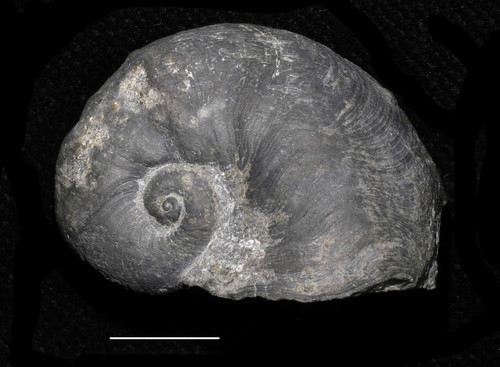
Platyceras  gebhardi - Hamilton group Image by Ivanvlee8 on Flickr

Multiple genera have been observed in a specific position right on top of the calyx or "cup" in stalked crinoids.
 Here's what the animal typically looks like to give you a general bearing.
From the TOL Crinoidea

What the snails seem most interested in is the anal cone found on the TOP of the cup (this is the area where the mouth is found and is surrounded by the feeding arms). They are often found clamped down over the anus.

Most interpretations suggest that platyceratid snails were  COPROPHAGES. That is a special kind of feeding which specializes on consuming POOP!

There are literally dozens of papers on the paleoecology and biology of these animals..and so I will leave this interaction to be written up in a later blog... But platyceratids are found on MANY different crinoids AND other stalked echinoderms from the Paleozoic, such as blastoids (see this account by Tom Baumiller)!

But that will be a story for next time...
snail Cyclonema on Glyptocrinus from the Awesome Kentucky Paleontological Society page! 
2. Snails that are parasites on Cretaceous (Mesozoic) to Paleocene (Cenozoic) sea urchins
This fossil was reported by colleague Christian Neumann (see his website here) and Max Wisshak from this issue of 2009's Palaeogreography, Paleoclimatology, Palaeoecology...

Basically Neumann discovered fossils, such as this Cretaceous urchin Echinocorys conica with this holes and marks in the body...

Fig. 2 from Newmann & Wisshak
and also in this specimen of the same species showing more of these discrete holes on the test...


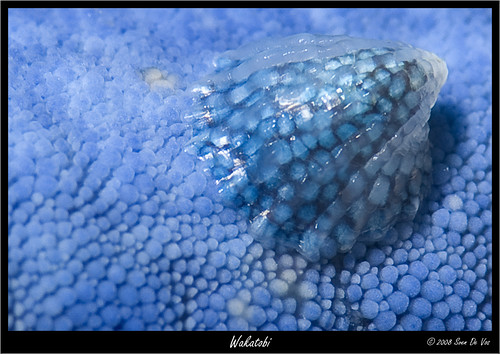
These holes were compared against the kinds of holes made by modern day gastropods in the family Eulimidae which are often seen as parasites on starfish such as the blue Linckia laevigata shown here... (images by Sven DeVos on Flickr)
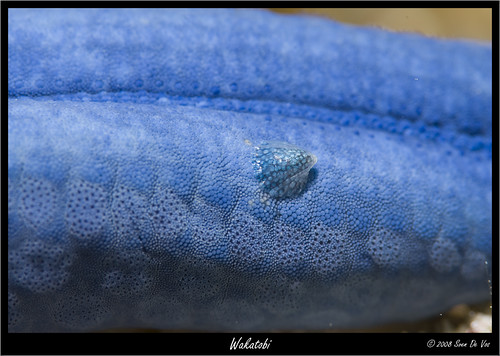
Thyca cristallina (SDV_5874)

Snails like this basically pop their proboscis into the body wall and take advantage of the host as prey. Its thought that they occur on a relatively low number of the total population. 

3. A Shelled amoeba (Foraminifera) parasitic on a Cretaceous Sea Urchin
Christian Neumann and Max Wisshak have yet another paper in Ichnos (fr. 2006)!

This time showing how a shelled amoeba (i.e. a foraminifera also informally referred to as "forams") has parasitized the Cretaceous urchin Echinocorys (same species as the one above).

Their story here is this: Some forams will attach to an animals' shell or other hard bottom. Below is an example of one from the shell of a bivalve.

Notice how it leaves that prominent attachment scar on the right after its been detached...
figure 2 from Neumann and Wisshak from Ichnos
 Neumann and Wisshak observe this on 19 different locations (and thus 19 individual parasitic forams) on the test of this fossil sea urchin! Note that the big curvy worm tube isn't part of the foram traces...

4. Symbiotic Relationship between a polychaete worm that bores into Cretaceous German Sea Urchins
And yet another paper by the industrious Max Wisshak and Christian Neumann in Acta Palaeontologica Polonica 51: 589-597! This one can be downloaded here!

Here Wisshak and Neumann document borings in the sea urchin's skeleton via the work of an industrious polychaete worm-a polydorid!  Such worms bore though hard substrates and are asociated with tunnels such as this:
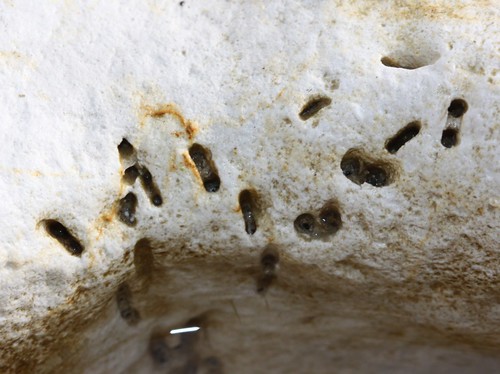
St Margaret's Bay: Polydora borings Image by elegaer on Flickr

But how can you be SURE that these worms didn't just find the dead animal's skeleton and bore through that??   Why make the jump to "These holes were made in the animal when it was alive"???

This cartoon basically shows that following the worm's "boring" through the skeleton and the deformation of the skeleton by the worm..the surface spines and other structures- pedicellarie, etc. ALL REGREW over the area that had been "bored" through!!
Figure 5 from Wisshak and Neumann

Here are pics of the actual borings through the sea urchin test..
Figure 2 from Wisshak and Neumann
5. Jurassic Worm Parasites (Myzostomes) living in crinoid arms
Finally! This neat account was described by colleague Hans Hess in the Journal of Paleontology recently in 2010! (click here for abstract)

Myzostomes are annelid worms (the same group of segmented worms that includes earthworms, scale worms and so forth) that live as parasites on various invertebrates, but especially crinoids!

My colleague Greg Rouse at UC San Diego studies these! Modern day myzostome worms look like this (underside shown):

These worms live on crinoid arms like this (the worms are the brown and yellow bits in the center). Here is Myzostoma fuscomaculatum on the arm of a South African modern crinoid.
Image from South African Southern Underwater Research Group (SURG)
Myzostomes can also form galls on crinoid arms and apparently have done so for a LONG time. As these fossils occur from the JURASSIC...

Fig. from Hess 2010
And there you have it! FIVE awesome echinoderm parasite/commensals from the FOSSIL record no less!  
Hopefully I'll get around to elaborating on those poop-eating snails some day!

Monday, December 8, 2008

pt. 2: The Cretaceous Cookie Ghost of Christmas Past!

Today, let's look at some Cretaceous Cookie Starfish Madness!

Earlier this week, we saw starfish such as these neato-pentagonal...nearly discoid starfish in the family Goniasteridae in the genus Sphaeriodiscus doing a really good impression of Linzer holiday cookies.... (mmmm..)

Before I get into things too deeply, I wanted to credit this AWESOME site, Discovering Cretaceous Echinoderms. Click here to see all of what's below and more!

It turns out that goniasterids with this pentagonal body form have been around for quite a long time.
Most starfish have a really poor fossil record, mostly because the little tiny bits that make up their bodies fall apart not long after the tissue that holds them together rots and gets washed away.

BUT, goniasterid starfish (and other similar taxa) have pretty heavy body skeletons and so, the chances of such a body being preserved increases, especially when there are good environmental opportunities for the animal to be buried quickly...such as in marine environments on a sedimentary bottom.

In the Cretaceous (about 65-145 million years ago), the world is a familiar but different place.
Many of the landmasses are there..but the oceans extend much farther beyond what we know today. There is a massive inland shallow water (i.e., epeiric) sea cutting through Texas and most of western North America. Effectively leaving what we know of the west coast today as an island.

Note that most of northwestern Europe is underwater. This is partly what makes for an unusually well preserved starfish fauna in this part of the world!

The Cretaceous of Europe..especially as studied by English, French, and German paleontologists has documented a huge diversity of fossil starfishes.

This region is famous for its chalky marine deposits...and it is here that we find some of the most abundant spectacular fossil starfish in the world.
Perhaps one of the best known of these Cretaceous starfishes are those species in the genus Metopaster, whose name alludes to architectural structures known as metopes which are "rectangular architectural elements between two triglyphs..".

These were often ornamented or had elaborate sculptures.
(Metopes are the white blocks between the brown)
Don't be fooled by these amazing specimens though! I'd say 98% of the total number of Cretaceous starfish fossil are actually recovered as little pieces called ossicles.

Ossicles look like this:
and can often be found in the hundreds of THOUSANDS.

Much of the European foundation for Cretaceous asteroid systematics is based on the abundance, description and interpretation of these ossicles.

Genera and species have been named solely on the ossicle bits alone.

A lot of it is very tricky..and often involves reconstructing the ossicles, once you've got an idea of what the original body looks like.
(This chart was borrowed from this excellent account of asteroid paleontology in Europe by E.V. and C. W. Wright)

And are often compared with living examples...such as this beastie...
(Eknomiaster beccae)
And often, they will just plain luck out like this specimen and find an actual preserved skeleton! This, is essentially like getting a key to a very hard exam! But it does give you some idea where all the parts go!
That being said, sometimes you get a compromise and you often only get ONE side...

Interestingly, a LOT has been done with starfish "ossicle systematics". My colleague Loic Villier & his associates for example, have been finding a lot of evidence for predation from these fossil bits.

Christian Neumann has found evidence for shark/fish predation on ossicles.

Other ossicle studies have provided insight into the evolution and macroevolution of Mesozoic goniasterids through time!

Ironically, we may actually know MORE about the ecology and biology of Cretaceous goniasterids then that of the living ones!!

Mmm..cookies!!