Showing posts with label biology. Show all posts

Tuesday, August 19, 2014

Because Brisingid Starfish are Fantastic! Stunning Images of Brisingids in the Deep!

This image from NOAA Photo Library. Here. 
Brisingid starfishes were my first professional "love".. I wrote my Masters thesis on them and it was almost 2 years after studying specimens like this...
Before I saw one that was alive!  Now, THAT is dedication for you! 

What are brisingid starfish?? Long story short... Strange deep-sea starfish. They are proper, albeit highly modified sea stars that use their spines, covered with tiny claws which act as velcro to capture tiny prey as food.
This is Novodinia. Photo form NOAA Okeanos Explorer

I was just noticing that there's been a great critical mass of REALLY wonderful pictures of these animals.

For example, here's an amazing close up shot of Novodinia, possibly N. americana from the R/V Okeanos Explorer cruise to the North Atlantic canyons in 2013.  What you're seeing is the disk at the center, surrounded by the many spines covering each of its arms...
This image originally from NOAA Photo Library here. 
shots like these are increasingly common..but trust me when I say that scientists from the mid late 20th Century would have KILLED to have nice high definition picture like this!
Another Pic of Novodinia americana? from 2013. NOAA Photo Library. 
And here was one AMAZING bit of anecdotal observation/biology from the 2013 North Atlantic Okeanos Explorer cruise, this brisingid, unclear which genus, based purely on the pic not only caught a fish but HELD onto it using ONLY its pedicellariae.
Owly Images
Pedicellariae are tiny claw-shaped structures that cover each of those spines..sort of like staples embedded in a sock. These capture various food and prey items.. but mostly it was thought they captured crustaceans. Capturing fish is a bit unusual....

Food caught by the spines and on the surface are then moved down to the underside to the mouth...

Colleague Jackson Chu, provides us with a GREAT pic of the UNDERSIDE of a brisingid, showing the mouth, tube foot grooves and etc.. just what you would expect from any proper sea star...
                    

Here are some stunning panoramic shots of brisingids. Presumably, these occur on places where water currents are favorable for them to capture food...  Both of these are from the North Atlantic via Okeanos Explorer..

These animals feed by holding their arms up into the water and capturing food/prey as it is carried by on the water currents...

This shot was from a spur projecting from the canyon wall in the North Atlantic (Block Canyon) in 2062-2131 m. 

This pic from 2013 Atlantic Canyons Expedition
Here are some great shots from Neptune Canada via Flickr...  A large individual, maybe Brisinga? on a sunken barrel..
                    
some very "at attention" individuals...
                          
Not all species occur on hard bottoms.. Some live on mud and sediment...
This one from the NE Canyons expedition in 2013
And just for a little diversity, From Japan, here is the underside of what I think is Brisingaster or Novodinia... These likely represent an unpublished record of this species in Japan..

Here is what the top side looks like...

Tuesday, April 22, 2014

Learning about Luidia! 5 Things about The OTHER Sand Star!

Luidia clathrata from the Wikipedia page! thank you!
Probably one of the most frequently encountered but unappreciated of starfish is Luidia, a genus of seastar that occurs in tropics all throughout the world. Often times, in shallow-water and seen by MANY but known by few.

Some species, such as this Luidia alternata from the Southeast United States were recently mistaken for brittle stars by some, no-doubt, well intentioned but misinformed journalists! (here) Just to clarify: these are NOT brittle stars. Go here to see some characters you can use to tell them apart.  
I'm talkin' about sea stars in the genus Luidia, which is the only genus in the family Luidiidae. There are 49 species which are found all over the world, mostly in shallow tropical to temperate waters. Some get deep, but not very.. None occur at high latitudes (i.e., Arctic or Antarctic).

This group of starfish is named for the Welsh naturalist Edward Lhuyd who went by the latin name Luidius!

Luidia was an important animal in the big "Which starfish is primitive" arguments in the early 20th Century, and there was one time when this animal was part of a big argument that raged in the pages of the journal Nature...

Let's learn about Luidia!

1. Where Do They Live?
Sea stars in the genus Luidia typically inhabit shallow-water, tropical to temperate water places among sand or mud.  Basically, wherever loose sediment is found. In this respect, they are similar to the better known "sand stars" in the genus Astropecten. (Also a reason why common names don't have much use for scientists).

They use their spines and feet to bury themselves into the sand, or mud or whatever sediment they live in/on....


I would note that the reason you often see these washed up after storms is because so many of these stars live on sandy bottoms. When you have any kind of turbulence they get "blown" up and washed onshore.

2. What Do They Look Like? 
Luidia can be pretty plain looking. But body form in these is pretty distinctive.

Arms are long and straplike (Luidia clathrata from the SE Atlantic shown here).                                  
And kinda flat... (Luidia clathrata shown here)
A close up look shows a lot of square-shaped plates known as "paxillae" with many tiny spinelets...

These vary in size on the center of the disk relative to those on the sides.. Spines are present on the lateral edges of the animal....


Some have elaborate patterns.... (L. maculata from Singapore)

Some with sharp spines!
Even the pointed tube feet have stripes sometimes...!


3. Diversity: How many kinds are there?
As mentioned earlier, there's some 49 species of Luidia known. They occur in the Atlantic, Pacific and Indian Oceans in temperate to tropical waters. A few live in deeper water.

Some, such as this Luidia clathrata from the SE Atlantic coast of North America are 5-rayed and kind of plain looking. Albeit with some coloration..These are pretty medium sized (see pic above) but the disk is maybe about the size of a quarter or a half dollar...
                            
Others, such as this Luidia superba from the Galapagos are HUGE. This species is one of the largest known (see here).  This species gets to be easily 2 feet across....
Others, such as this Luidia latiradiata have kind of a throwing star shape...
Several Luidia species have MORE than 5 arms, often 12-15.  You can see from some of the other videos and pics..these get pretty big also!!


4. What Do They Eat? and How?
Luidia (and the family Luidiidae) are members of the Paxillosida, which is to say the "Mud stars." Almost all of these swallow either prey in sediment or sediment in order to find food.

Luidia is predator and feeds on a variety of prey which live in mud, sand or other sediment. Prey items vary but they include sea urchins, snails, clams, brittle stars, other starfish (see below), sea cucumbers and even tiny crustaceans...

But, as with other members of this group, they lack an eversible stomach (such as what you would see in say, common intertidal starfish). So, they actually just SWALLOW what they eat WHOLE.

You can get an idea of how this works by watching this..

Or this...
From the SERC Invertebrate Gallery
Here's the Galapagos Luidia superba which was caught with a sand dollar in its gut. These usually just spit these out after they're done...


So, yeah. You get the idea. 

5. Ecology! What does Luidia interact with? 
If its one thing I've observed a lot of since starting this blog is how many sea stars are actually HABITATS for other animals. aka 'commensals' wherein the host is unaffected by the presence of the critter taking advantage.

I've written about how closely some polychaete worms have relationships with sea stars before. (here).

A 2002 paper by H. Kohtsuka at Notojima Aquarium and my colleague Toshihiko Fujita at the National Science Museum of Tokyo (Reports of the Noto Marine Center 8: 17-27) shows that several polychate worms live in association with at least two different species of Luidia, including Luidia quinaria and the large, multi-armed L. maculata in the Sea of Japan.

See below Fig. 1 from their paper showing worms in various living positions...

And from awhile back, was this fascinating video by Blennywatcher of this crab running along in association with this L. maculata.  Undoubtedly there are more associations but these two are good examples....


Other BONUS FACTS about Luidia??
A big multi-armed Luidia on its tippy toes?  is REALLY WEIRD... For more info on this GO HERE.
From Catala's Treasures of the Tropic Seas
More cool movement videos! 


Tuesday, June 5, 2012

The Firebrick Star (Asterodiscides truncatus): Some biology from Flickr!

Asterodiscides truncatus (Firebrick Seastar)3, Batemans Marine Park
(photo by NSW National Parks)
I've spoken before about how photostreams like Flickr are intriguing portals that connect scientists and the public with high quality images of animals from "the field."

Another example of a starfish species that falls under the category "about which, little is known..."  but thanks to photographers from Australia and New Zealand we can now see some stunning images of not just its appearance but some biology as well! 

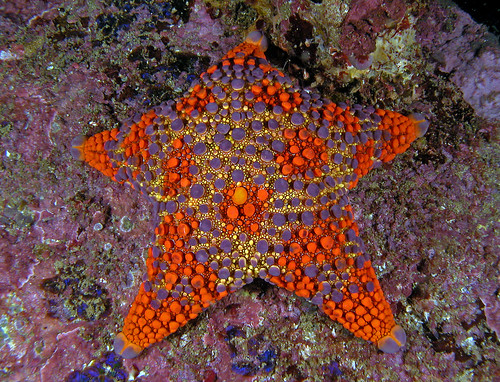
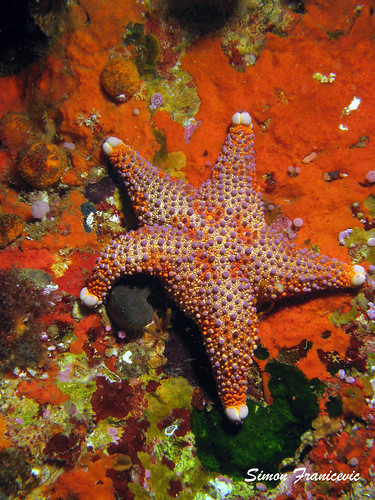
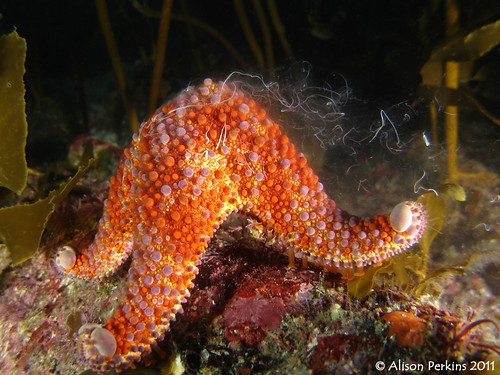
The subject?  A starfish called Asterodiscides truncatus (described in 1911) called "the fire brick starfish" because of the very fiery colored, brick-like tubercles that cover the surface of this species. 
Firebrick Star
Photo above by Simon Franicevic

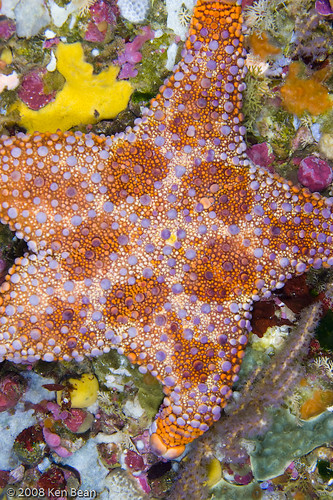
Photo by kbean45
PKnights_032008_ (14 of 20)

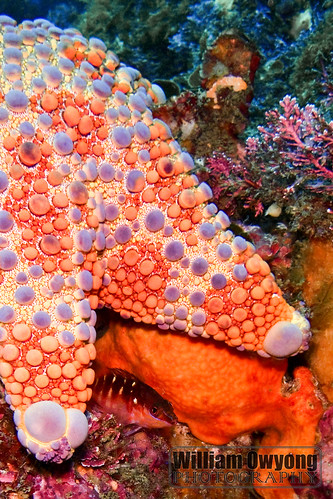
Also.. note the large swollen tubercles at each arm tip which kind of resemble buttocks?? or a pair of toenails?   These features are present in all 18 species of Asterodiscides, which are found throughout the Indo-Pacific from Madagascar to Hawaii/Japan and to the South Pacific. 

Photo by WillOwyong
Firebrick Sea Star and Half Banded Sea Perch

Photo by quikflik
Firebrick Starfish

They tend to occur in deeper water and so there isn't that much known about them. 

They get quite big.. (photo by newtestleopard)
Firebrick Starfish

Some biology from Flickr!

For example, this image by Richard Ling looks to show A. truncatus in feeding position on some bryozoans. 
Sea Star Party

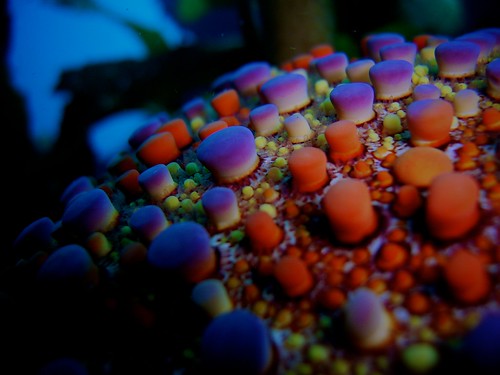
Asterodiscides is shown here in "tippy toe" formation producing gametes! I wrote about this awhile back. The significance isn't well understood-and this is probably the FIRST time this behavior has been documented in this species.
Spawning firebrick
Photo above by cameronandali@yahoo.com.au

These images show various crustacean commensals with A. truncatus.  A shrimp (photo by Rowland Cain)
Fire Brick Seastar & Shrimp - Ulladulla

and an amphipod (also by Rowland Cain)
Amphipod - Auginish Rocks

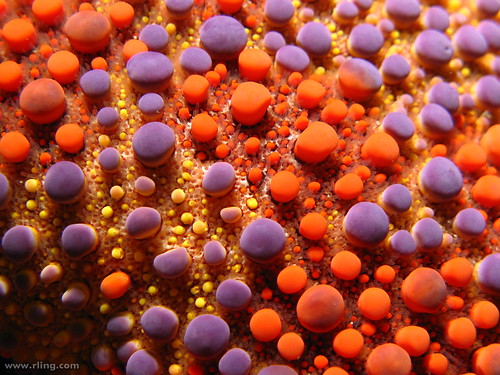
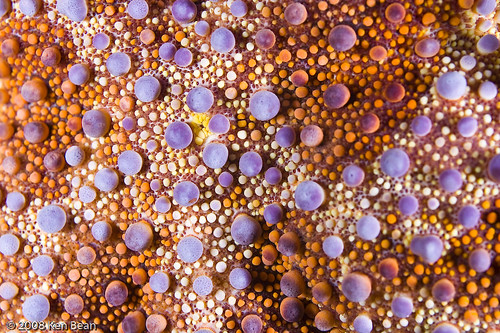
Some great close up shots of the beautifully colored tubercles on the animal's surface
from Richard Ling
Firebrick Sea Star

from Billunder
a closer look at the texture of a Firebrick Sea Star (Asterodiscides truncatus).

from lndr
Asterodiscides texture

from tarasutherland
Firebrick Starfish on Landing Bay Pinnacle, Poor Knights Islands Marine Reserve

from kbean45
PKnights_032008_ (15 of 20)

And here's some video so you can see what they look like alive! Something most scientists have probably not experienced. (I know that I have never seen one of these alive).
My gratitude to all of the photographers who took the time to take such incredible shots and make them available for all. Not only have you made an aesthetic contribution-but perhaps these will inspire a scientific endeavor as well!

Thursday, March 19, 2009

Fun Leptasterias Facts!

What? So, you wanna know more about Leptasterias?

ha! Well, ask an ye shall receive!!!

These are a follow up to the last post and are taken from various papers by Bingham et al. (2004), Foltz et al. (2008) and Pearse & Beauchamp (1986). The best known Leptasterias spp. are the Leptasterias "hexactis" forms from the west coast of North America and Leptasterias polaris in the Arctic/North Atlantic..

Leptasterias
broods! From the big Arctic L. polaris to the tiny subArctic L. "hexactis" forms...
  • The California forms brood from Jan-Feb-March-April and take 6-8 weeks to develop.
  • Larger adults produce larger embryos- a doubling of arm radius in brooding females resulted in a 3 to 4 fold increase in egg production.
  • Larger females produce more eggs but have a harder time carrying them completely through the brooding season.
  • If "quality" and success is related to overall egg volume, then its possible that egg volume an size is possibly a predictor of survival to the juveniles.
Leptasterias brooding posture varies....
The Leptasterias "hexactis" posture......
(from Chia, 1966)
The Leptasterias polaris posture....
(from this website..)
What does Leptasterias eat? Mostly mollusks, barnacles and such...
How long has Leptasterias been around?
Based on some recent work by Dave Foltz and colleagues (including myself) we used several gene markers to estimate how recently the various sister species of Leptasterias diverged!

So, all basically, all of the 'species complex' stuff I wrote about earlier? When did that happen?

That usually suggests a relatively recent speciation time frame. They diversified/speciated/or whatever you want to call it, ONLY about 0.5 to 1.2 Millions of Years Ago (Mya)!

Geologically, that's quite young..but put this into context for people reading this? This starfish likely speciated in the Pleistocene. What else happened in the Pleistocene?


There were glaciers. A LOT of them. Some 30% of Earth was covered by ice.
Glacier Bay Alaska 2007
  • Image by Jeff Huffman
What else was alive in the Pleistocene? (Images from Wikipedia)
File:Pleistocene SA.jpg
File:Human-gender-neutral.png

This little, tiny starfish?? is prolly kinda sorta AS OLD or OLDER THEN HUMANITY (and its pretty young for a starfish!)
....and THAT is the rest of the story!