Showing posts with label food. Show all posts

Tuesday, July 2, 2013

Beautiful & Creepy Things about Tunicates! Echinoblog Off Topic!

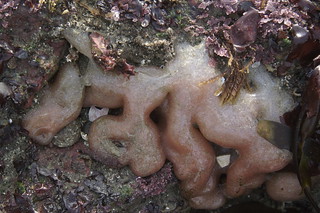
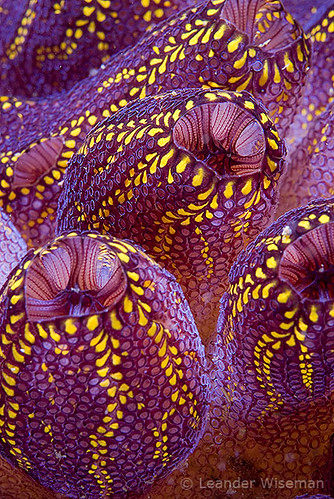
Magnificent Ascidian
Image by Leander Wiseman
Today, a little off topic time for some tunicate love!

For those who are not familiar, tunicates are actually members of the same overall group to which humans and all other vertebrates belong! A subgrouping, called the Tunicata within the larger phylum Chordata. Honestly, the relationship is pretty basic info which you can find with a quick Google search

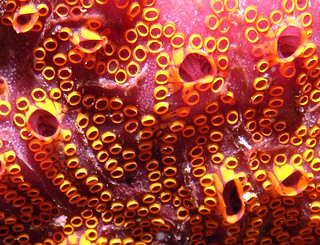
Most times, tunicates are small, out of the way or encrusting (i.e., covering surfaces over a wide area) but can be very abundant, carpeting areas until nothing else grows there..such as this one (Botrylloides diegensis) which is an invasive in San Francisco Bay from Asia.
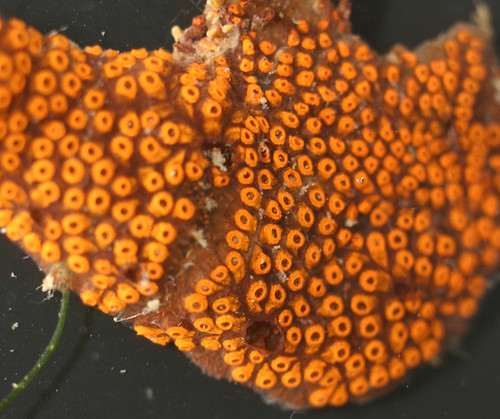
Chain sea squirt (Botrylloides diegensis)
 Image by Luis A Solórzano, KQUEST
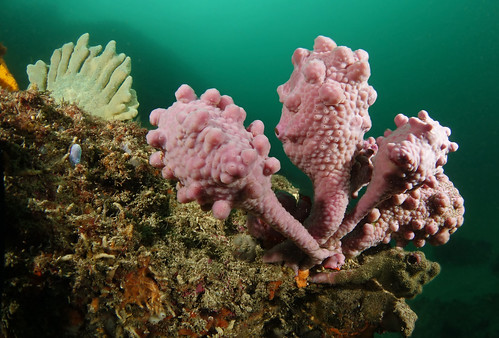
Under many conditions, tunicates are ugly and kind of bland colored things that are common components of fouling communities. Its species such as this one which earn the oh so lovely common name "sea pork"(Amaroucium californicum). And so, they get a bad rap. 
Amaroucium californicum
image by Jkirkhart35
But tunicates are often gorgeous and attractive animals. PLUS, they do weird and unusual (if kinda creepy) things! Let's go see! 

1. Some Basics
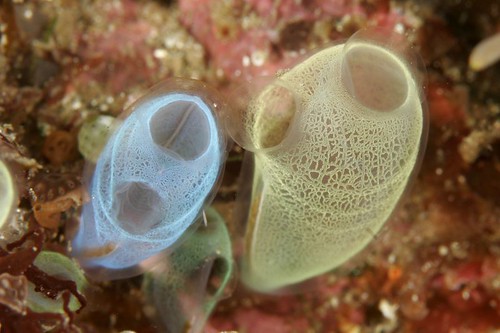
This shows two siphons: one is where water goes IN and the other is where it goes OUT.
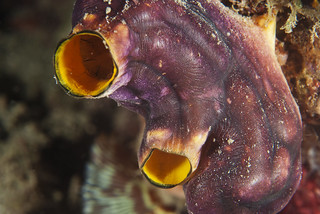
Kidney closeup (Polycarpa aurata)
Image by Arne Kuilman, from Anilao, Philippines
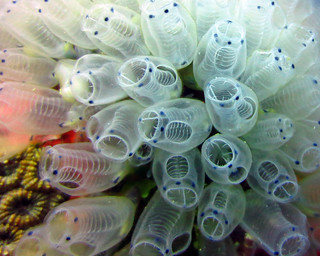
Food gets caught in the "Pharyngeal basket" (=the "filter" for its filter feeding) where it gets moved down to the stomach. A pretty simple overall anatomy. But note, it has well-developed organs that you would find in a proper animal.  This is important later...
From the Marine Life Information Network
This gives you a general idea of the animal as a whole (not sure if this is the exact same species but you get the general notion)
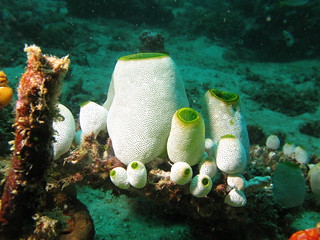
Sea Squirts
Image by Prilfish
 Basket Close ups! 
Green entrance
Image by Steve de Neef
Cross section! the space between the 'tunic" and the feeding basket
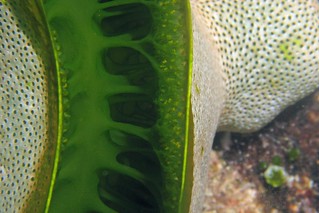
IMG_2969
Image by "stupidhead"
2009_0502_111050
Image by Star Tsai
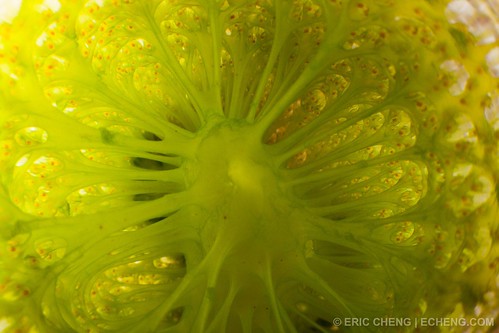
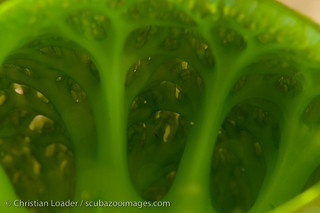
INSIDE the basket!
Alien tunicate, Eastern Fields, Papua New Guinea
Image by Eric Cheng
Tunicate-1
Image by Christian Loader
Roots
Image by Steve de Neef
2. Some Diversity... 
Some tunicates are individuals
_MG_4419
Image by bybegone
Whereas other forms are colonial...
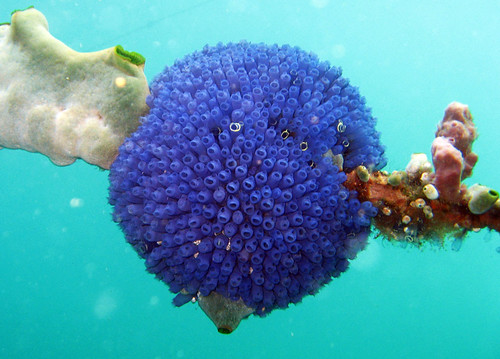
A ball of Bluebells
Image by Patrick Nilsson

Botrylloides magnicoecum from Australia. And yes, those are apparently the REAL colors.
Magnificent Ascidian
Image by Leander Wiseman
Botrylloides leachi from Australia
Leache's compound ascidian - Botrylloides leachi
Image by John Tumbull
clear tunicates 2 edited
Fantastic image by Pat Sinclair
Other tunicates are more....unusual in appearance (I think these are solitary)  BEHOLD! Sea Tulips! Pyura spinifera from Australia!
Here's only a few...
Pyura Spinifera
Giant sea tulip - Pyura spinifera
Here's a LOT of them
Sea Tulips
Image by Richard Ling
Another stalked tunicate, Oxycorynia fascicularis from Anilao in the Philippines
Oxycorynia fascicularis, Stalked Tunicate, Anilao, Philippines
Image by Optical Allusion
Stalked GREEN tunicates! Same species? Oxycorynia fascicularis
Stalked green tunicates
Image by Mer Mate-Eunice Koo
And although I've been focusing on shallow water, I can't get past tunicates without the obligatory showing of the famous DEEP-SEA predatory tunicate (Megalodicopia hians) !! The IN siphon is modified into a mouth and the OUT siphon kicks out the tunicate poop!   Let's let the British narrator take us away!


3. The predatory tunicate is a great segue for the vice versa! People EAT tunicates. As I've outlined here Its called the "sea pineapple" among other things in Asian cultures, but different species (called 'sea violets') are eaten by Europeans..
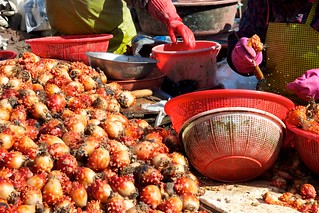
Sea squirts
Image by sjbutterfield2
MMmm........tunicates and kimchi....
Sea Pineapple
Image by Mark Deibert Photography

4. Tunicates are a little creepy 
If tunicates have similar enough tissues (historecognition) ie. are similar enough two physically different individuals can physically FUSE together.

Why say it, when you can SHOW it?

the description from the video:
This video shows a fusion event in progress between compatible individuals of the sea squirt, Botryllus schlosseri. At the beginning, terminal parts of vasculature, called ampullae, which surround the colony, have come into contact (one colony is on the top right, the other on the bottom left, out of the field of view). The ampullae push into each other repeatedly, and finally the cell layers between two ampullae fuse, and results in both individuals sharing a common circulation. 
Fusion can best be seen on the top left, but occurs in several places in the region of interaction. The decision to fuse or reject is based on whether the two colonies 'match' each other, analogous to how humans accept or reject transplants.
See this essay for more.  But bear in mind, tunicates may look simple like sponges-but they aren't! 

Sponges don't have tissue, so those videos where they grind em' up and they get back together?

Not that hard for animals that are still essentially just colonies of cells. Proper ANIMALS with tissues don't typically do stuff like that.  The fusion shown in tunicates above?  That's like you and your family, suddenly fusing into one big amorphous pile. Squicky, eh?

Go here to learn more about this.

5. Where can I learn MORE about tunicates?
*Did you know that tunicates accumulate the metal Vanadium in their body tissues? go here to learn more.
*The Dutch ascidian Site! 
*The Tunicate Web Portal! 
*Will tunicates be used as biofuel? 
and my colleague Jarrett Byrnes writes a blog that often involves tunicates!

Wednesday, January 9, 2013

5 Unusual Invertebrates that People Eat! (it takes an Invert Zoo Class to know what some of them are!)


Okay you invertebrate zoologists out there!! How many phyla can YOU recognize on the plates above???   By the end of this blog you WILL know! (and maybe, you will hate me for telling you)

Everyone seems to have a "Weirdest foods" list out there-but here at Echinoblog we offer you only the STRANGEST sampling of bizarre marine invertebrates cuisine! forget insects, snails or shrimp!

Some of the edible (?) metazoans below are usually only noticed by marine biologists, zoologists and the well-studied biologist!

What better application of knowing the strangest of marine invertebrate phyla can there be than to recognize it on your plate? Its scientific name disguised by colorful cultural argot  or perhaps in a different language?

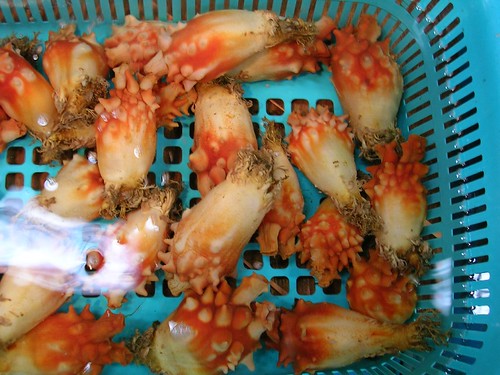
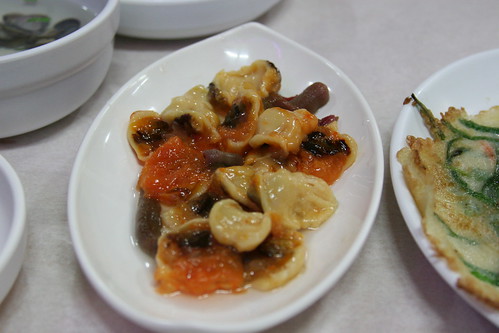
1. SEA SQUIRTS! (Halocynthia sp. possibly H. roretzi). The Korean name for sea squirts as food is: meongge (although there are several more)
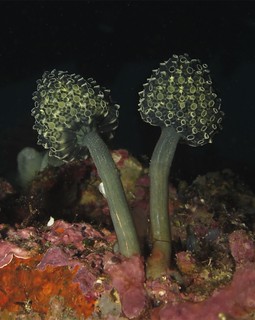
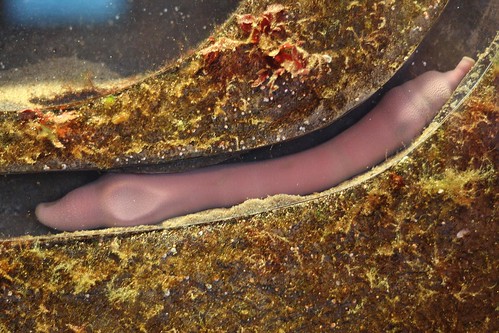
Sea squirts are a kind of tunicate, which are in turn members of the phylum Chordata (the group humans and other vertebrates belong to) and when alive they look like this:
Japan sea animal, Sea Squirts (Class Ascidiacea)
As it turns out, sea squirts are eaten all over the world, including Japan (called hoya and maboya) and Korea (meongge, and in a stew called agujim). They also eat sea squirts in France, Italy, Greece, and Chile .
Images of sea squirts eaten in Korea. Image by scbrianchan
Eating Sea Squirt
image by scbrianchan
A video showing preparation. Sea squirts are filter feeders and processing water through their body is a primary function. Thus, drainage seems to be an important feature...

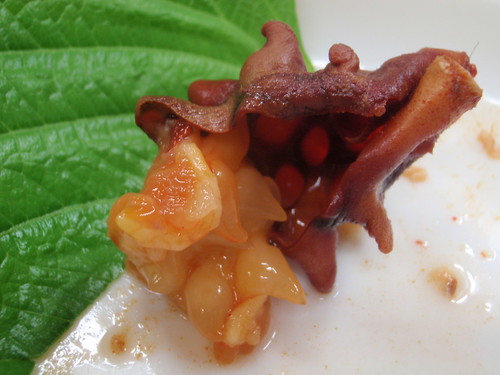
when cooked and prepared it looks like this
sea squirt
image by seoxcookie
or this..
멍게 - sea squirt
Image by toughkidcst
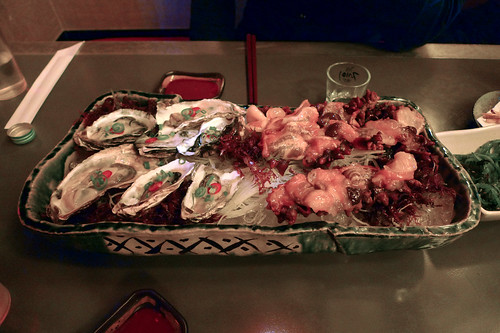
sometimes served with oysters...
Seoul 2009 - Oysters and Sea Squirts - Seoul Izakaya
Image by Food Fetishist
UPDATE February, 2014. I've actually tried hoya in Tokyo! The raw stuff! Its got a very...sour, almost soapy taste. Not for everyone.. but I'm told that its an acquired taste. Folks who grew up with it, LOVE it...


2. ECHIURAN WORMS! aka "fat inkeeper worm" aka "penis fish" aka gaebul (genus Urechis)
Most people have never heard of this phylum of worms. Commonly known as "spoon worms"

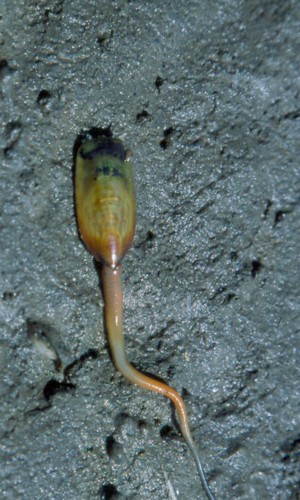
One of the best studied examples is Urechis caupo, occurring on the North pacific coast -living in muddy burrows which serve as homes for many other commensals, including tiny shrimps and fishes.
fat innkeeper worm (urechis caupo)
Image by Peter_r

But in Korea, a related species, Urechis unicintus is collected and eaten!
Apparently it is cut up into segments and served while twitching....
In other cuisines, it is cooked and stir fired..

the picture above? gaebul and mongae aka Echiuran and Sea squirt!!

and uh yeah, there's a belief that eating these imbues men with more virility. That seems unlikely....

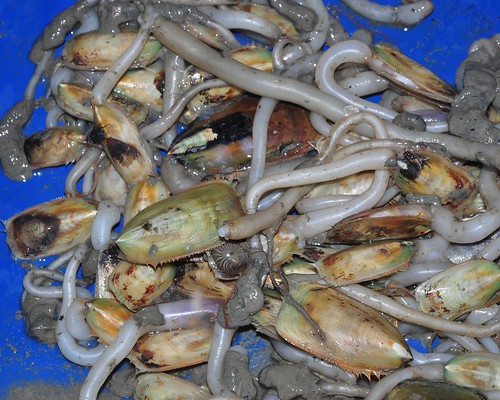
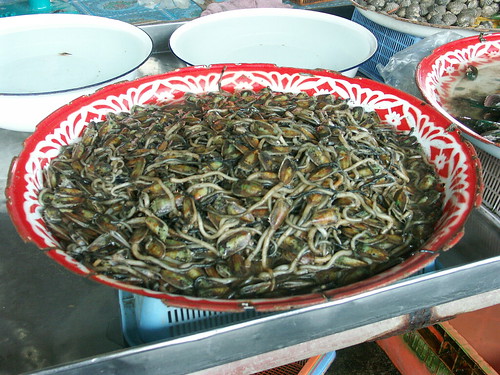
3. INARTICULATE BRACHIOPOD  (Lingula sp.)
Brachiopods are one of the oldest animals observed in the geological record, going as far back as 500 million years. In some cases-they appear relatively unchanged appearing very much as they do as fossils.

and now we eat them.

This gives you an idea of what they look like alive..living in a muddy habitat
亞氏海豆芽 Lingula adamsi Dall
Image by Changhua Coast Conservation Action
There are two shells that fit over the animal on the top and bottom. Bivalves and other clams are fundamentally different in that their shells are oriented on the body left-right. 

In one group, known as the "inarticulate" brachiopods, there is a big fleshy structure called the "peduncle" which emerges from the shell

Biologist Richard Fortey noted that they tasted like "straw' (quote is here).

Here is an image of brachiopods as sold in a food market in Makassar.
Brachiopods (Lingula sp) sold as food on a market in Makassar
Image by Arthur Anker
Here is another from a Thai market.
Lingulids, Thai market
Image by Peter Roopnarine
In Indonesia this dish is called Probolinggo TEBALAN. The blog linked here suggests that Lingula  tastes "sweet and spicy" whereas others I've seen suggest that it is served with a tasty curry.
Huh. Brachiopod curry. NOT something I was expecting to write today!


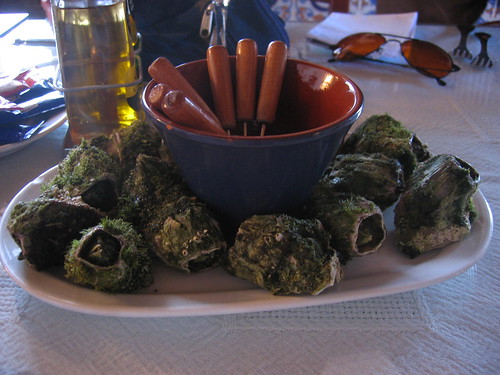
4. STALKED BARNACLES! Barnacles. Those well-known shelled crustaceans that live on docks and use their "legs" to filter feed out of the water like this:
These of course are what's known as "goose" or "goose-necked" barnacles because of the long, prominent stalk attached to the body sitting on top.

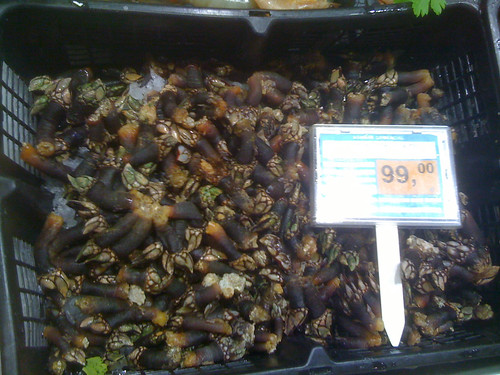
Yes. People eat them! I've seen them in Paris and Belgium.
Percebes [Goose Neck Barnacles]
Imge by RobertoGrego
In some places, barnacles are quite expensive...
Barnacle Prices 99€/kg ($65/lb)
Image by erikamussen

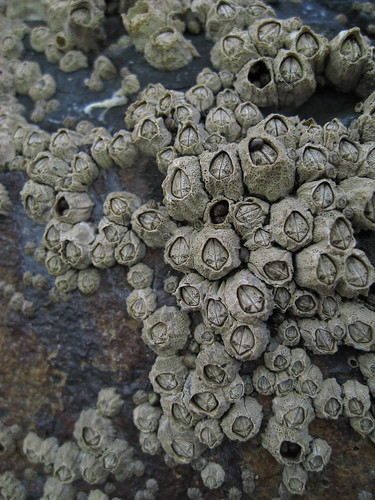
Other "unstalked" barnacles are also eaten! 
barnacles have faces!
Image by charclam
In the Azores and Portugal, these are called cracas!  Basically, these are boiled "acorn" barnacles. 
Cracas bico (barnacles)
Image by Bellyglad
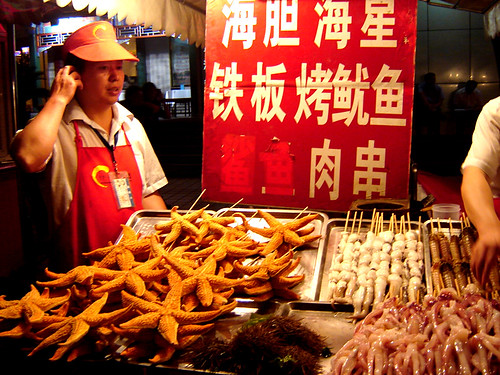
5. SEA STARS! (family Asteriidae- species: Asterias amurensis)
So, first let me distinguish between the "starfish for show" pictures that one sees around like this versus apparently real accounts of people who eat the gonads of starfish as seen in the video below..
didn't know you could eat starfish
Image by Robin G. Ewsing
Honestly, eating sea stars baffles me. And I  recommend against it (as here) and here but obviously, people really eat these.  On the plus side, Asterias amurensis (the species shown below) is a problematic invasive in Australia (as I wrote here)
so maybe there is a silver lining to this?


Tuesday, August 17, 2010

A sea urchin that eats.... WOOD???


Today there is weird deep-sea sea-urchin fun! This great but kind of tucked away paper by Pierre Becker et al. published in 2009 in Les Cahiers de Biologie Marine (50: 343-352) reporting on Ind0-Pacific sea urchins from deep-sea wood falls!

What is Asterechinus elegans??!!

In my experience, the first indication that you've got an interesting story is when you've got an unusual critter that no one's ever heard of...

Case in point: According to the NHM echinoid site, Asterechinus is a member of the Trigonocidaridae, a family SO frakkin' weird that I had never even heard of it or Asterechinus before!
And since the database picture is based on scanned images from the original description and figures by Theodor Mortensen in 1942, the species is rare enough that pictures were NOT immediatley available! And for the NHM database...that's sayin' something!

So, from the paper's Figure 1A comes what is likely to be the FIRST live picture of this animal since 1942 (over 65 years!). Its a small species with the largest never exceeding 25 mm. And look! It lives on...wood!
(Figure 1A from Becker et al. 2009)

These were specimens collected by the French BOA I and SANTOBOA cruises in 2005 and 2006 respectively to the Vanuatu Archipelago. Apparently, a great deal of woodfall organisms were obtained...One of which is written up here..

Here's a deep-sea log to give you kind of an idea of what deep-sea wood looks like..

So before we start on the next section just a brief bit of background- "Wood fall ecology" is part of a relatively new part of marine ecology, including the study of whale falls that studies the influx of massive amounts of organic nutrients to the seafloor's bottom. More on whale falls can be had here.


Because the deep-seafloor lies so far below the sun's immediate influence, it can be relatively poor in nutrients, making ANY kind of potential nutrient deposit, such as a dead whale, unrooted kelp, trees, etc. a BIG event.

A succession of unusual faunas, composed of both fishes and invertebrates, usually springs up around these deep-sea oases when they form. As it turns out, this urchin forms a member of this fauna.
Other wood-related echinoderms include the weird-enigmatic sea daisy Xyloplax!
It Eats Wood!!! (aka Xylophagy!)So, upon collection and preservation, they opened the specimens up and looked at the guts-and lo and behold! The guts of these critters were FILLED with wood!! To quote the paper
Observations on the gut content of all individuals (n=20) revealed that they were mainly composed of numerous wood fragments of different size, shape and colour. For instance some were small light cubes, while others were large dark twigs of up to 7mm long.(!)
Although most sea urchins are known primarily as herbivores, they-like many other animals- naturally LACK the ability to innately digest cellulose from trees. And so, Becker et al. cultured and analyzed the microbes in the gut and came up with this...
There was FILAMENTOUS BACTERIA in their guts!! And all of it was in contact with the woody food in the urchin's intestine...
(from Fig. 2C from Becker et al. 2009)

Tests of these bacteria revealed them to be composed of a variety of bacterial types, including Proteobacteria, Planctomycete, Firmicutes, Cytophaga-Flexibacter-Bacteroides, and Actinobacteria. These were all compared against other known marine bacteria using DNA phylogenetic analysis. And it turns out that the bacteria had CLOSE relationship to a bunch of veeerrryyy interesting other bacteria including
  1. bacteria from the gut of other xylophagous (wood-eating) animals
  2. bacteria from sulphide-rich environments (such as big dead whale falls)
  3. mangrove soils
  4. marine sediments from hydrothermal vents & cold seeps!!
Why is # 4 important? Bacteria function in vent and seep animals to help process toxic substances, such as sulfide, into digestible form in order for the host to process the nutrients. Closely related organisms often share similar qualities...

Although the authors did not have the exact and complete story, the data above, in addition to other elements of the intestinal bacteria flora all STRONGLY suggests that Asterechinus elegans may host a bacterial community in their guts which they use to aid in wood digestion!!

What other animals use a microbial flora in their guts to aid in digestion?

Termites!
Cows!
and People!
(this image from Nature.com)

Finally...if these deep-sea urchins EAT wood..Do they also eat....WITCHES?