Showing posts with label poop. Show all posts

Friday, March 17, 2017

Okeanos Tropical Pacific Highlights: RARE and BRILLIANT Echinoderms!!

Over the last 10 days or so since Okeanos Explorer has resumed its ROV-telepresence based exploration of the Phoenix Islands and adjacent areas in the tropical Pacific they've seen some REMARKABLE animals of all kinds, from corals to siphonophores, crabs to ribbon worms, etc... but particularly ECHINODERMS!

Before I get into the cool pix.. remember NOAA OPERATES Okeanos Explorer!! NOAA has been threatened with severe budget cuts. CONTACT YOUR CONGRESSIONAL REP AND TELL THEM THAT NOAA IS AN ESSENTIAL Agency!

1. PELAGOTHURIA!  The "TRUE" swimming Echinoderm!!
I have written about this amazing animal before when I found an image of it misidentified as a jellyfish in the Galapagos Rift 2011 Okeanos photo gallery and have written at some length about swimming sea cucumbers here.

Basically, almost all sea cucumbers and indeed most echinoderms are benthic..that is they live entirely on the sea floor and never get into the water column the way fish or jellyfish do.. Yes. Some sea cucumbers can swim but ultimately they return to the bottom.

Pelagothuria is unique because it LIVES SWIMMING in the water column! Similar to the way a jellyfish does. As a result of its strange lifestyle, it has MANY bizarre adaptations and looks unlike most other sea cucumbers much less other echinoderms!

Its not a commonly encountered animal..and we live in a wonderous time that we can see several minutes of HD video of this seldom seen animal swimming by...

The video for this can be found HERE:  http://oceanexplorer.noaa.gov/okeanos/explorations/ex1703/dailyupdates/media/video/dive08_seacuke/seacuke.html
Here are the feeding arms extended into the water...


Pelagothuria is contrasted with this other swimming sea cucumber which, after landing on the bottom, poops and then takes off! (from that unnamed seamount off Winslow Reef)


2. The strange irregular urchin Phrissocystis! From Polo Seamount, about 2100 m we saw one of the most seldom seen spatangoid urchins known! These are highly evolutionarily derived sea urchins which live by digging through and swallowing sediment looking for food.

Although they are bristling with spines, they are actually quite delicate. One collected many years ago apparently collapsed as soon as it was brought out of the water in the submersible collection box!

3. A stunning new phyrocrinid stalked crinoid! From an unamed seamount in the Phoenix Island chain, this bold and striking stalked crinoid was observed..and ultimately collected after it was identified as a new species by crinoid scientist Chuck Messing (based on a paper by Tunniclife et al.)

It was quite large with an unusual texture to the stalk and the cup...

4. The "jumping" brittle star Ophioplinthaca
Brittle stars, distant cousins of sea stars, are EVERYWHERE in the ocean. And especially in the deep-sea you can see them inhabiting numerous cracks, crevices and living on corals!

Some are VERY spiny.. such as this species, what I think is called Ophioplinthaca. We've been seeing these ever since the first leg of the Samoa Expedition.  They seem to occur on corals with the tissue removed.. possibly by the ophiuroid itself..

Another curiosity is that these seem to "jump" off their perches as soon as the ROV approaches. Whether this is due to light, vibration, the bow wave of the D2 or disturbance in the "ophiuroid force" (NOTE: Ophiuroid force does not exist) is unclear...


5. The enigmatic sea star Tremaster mirabilis Here's another strange one! A sea star that basically looks like a bowl on the top of a table!

We've seen these before on Atlantic Okeanos dives (see that here) and I wrote about this animal many years ago before people started seeing them alive..

There is nominally ONE species present in almost every ocean in the world.. they've been found in the Atlantic, around New Caledonia, near Hawaii and in the Antarctic. Not sure if they've been found in the Indian Ocean.

Interestingly, these were found in astonishing abundance on one of the seamount dives


5a. The Deep-Sea Slime Star HYMENASTER 
From Titov Seamount was this glorious, glorious deep-sea SLIME STAR, in the genus Hymenaster.

I've written about the shallow water representatives of this genus here. and explored the diversity of Hymenaster in the deep-sea here


*EXTRA! and of course a bunch of weird sea cucumbers!!
A deimatid sea cucumber with many tentacular extensions, this one from Swains Atoll
and this one from Titov Seamount  but they look to be similar if not identical


This one has been seen repeatedly rearing back and presenting what I think is its mouth into the water. so maybe feeding?

A red one from Polo Seamount
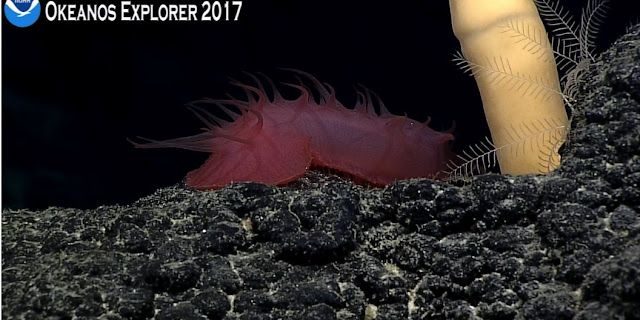
This interesting purple/translucent one from Polo Seamount

Some kind of translucent "sea pig" (family Elpidiidae?) also from Polo Seamount

Tuesday, July 22, 2014

Deep-Sea Poop, Amoebas, Basket Stars, Pinwheel Crinoids and MORE! Pics from the NOAA Deep-sea Photo Archive!

Gulf of Alaska 2004 Expedition. NOAA Office of Ocean Exploration 
This week I have been researching images from deep-sea video on the home page for the NOAA Photo Library, which has housed ALL of the deep-sea and other imagery from NOAA's deep-sea expeditions since 2003, including those of the Okeanos Explorer!

Many of you know that I have participated in the last two R/V Okeanos ROV dives as an onshore advisor. I often identify asteroids (i.e. starfish) and provide other information as I am able. I've only helped them out since 2013 but found lots of their images useful for my research.

You can find NOAA-Okeanos dive screengrab recaps on my blog here for 2013 and here for the recent 2014 dive. 

Those of you on my Twitter account (@echinoblog) have been watching me post links to various pictures as I have been reviewing these pics.. There are literally THOUSANDS of pictures of deep-sea biology, geology and history !!!  Who would be crazy enough to go through all of it one by one???  Yes. Me!

So, for your education and infotainment I have cherry picked many noteworthy images and have showcased them below. (note that ALL images have original links below them)! Enjoy!

Giant Amoeba Houses??
Here's a cool structure made by a giant amoeba called a xenophyophorean! (deep-sea Galapagos) Take a moment to consider that a UNICELLULAR organism could have made this! (and yes, they will eat proper animals!)
From the 2011 NOAA Okeanos Explorer Program, Galapagos Rift Expedition 2011 
But in contrast, what about this from Indonesia??? A Mystery?? Another xenophyophorean?? 
From July 2010 NOAA Okeanos Explorer Program, INDEX-SATAL 2010


Basket Stars Behaving uh... badly? 
What is going on here? I've honestly never seen TWO basket stars so close to one another. What are they doing? Fighting? Doin teh sex? The gorgonocephalid equivalent of a backrub?   Only they know for sure.  (North Atlantic)
From Lophelia II 2008: Deepwater Coral Expedition: Reefs, Rigs, and Wrecks 
Brittle Stars Doing Crazy Things! 
From the Atlantic... Probably just filter feeding, but I don't know that I've ever seen so many of them with their arms all curled up like that just FLAT on the sediment. Weird.
From the Lophelia II 2008: Deepwater Coral Expedition: Reefs, Rigs, and Wrecks 
and more of the same...
from Lophelia II 2008: Deepwater Coral Expedition: Reefs, Rigs, and Wrecks 

Here is what we call in science "a fancy pants brittle star" (note the gorgeous red and white pattern though) on a really extended whip coral (aka antipatharian). Video from the Bahamas in 2009. 
From Bioluminescence 2009 Expedition, NOAA/OER 
And still MORE!
From 2009 Bioluminescence 2009 Expedition, NOAA/OER 
PIN WHEEL CRINOID?? 
A cool looking "pin wheel" stalked crinoid (Hyocrinidae) from Indonesia, a new species currently being worked on by colleagues in Paris. This is what it looks like "open"
From NOAA Okeanos Explorer Program, INDEX-SATAL 2010 
and curiously, this species retracts its arm in repose like this! As the kids say these days "That is pretty whack! "
From NOAA Okeanos Explorer Program, INDEX-SATAL 2010
BIG PACKS OF FILTER FEEDING ECHINODERMS! 
Stalked isocrinid crinoids! From the Marianas Arc, Pacific Ocean! All turned into the current!! 
 Image courtesy of Submarine Ring of Fire 2006 Exploration, NOAA Vents Program 
Also from the Marianas Arc, Pacific Ocean: A crazy huge field of basket stars (Gorgonocephalidae)..
Image from the Submarine Ring of Fire 2006 Exploration, NOAA Vents Program 
Some translucent Swimming Sea Cucumber intestine showing POOP?? 
 from NOAA Okeanos Explorer Program, Mid-Cayman Rise Expedition 2011 
Is this Sea Cucumber Poop??
Exotic Indonesian Sea cucumber poop?  Or possibly from an Acorn Worm? (below)
 From NOAA Okeanos Explorer Program, INDEX-SATAL 2010 
From NOAA Okeanos Explorer Program, INDEX-SATAL 2010
Deep-Sea Urchin POOP! 
Here is a great shot of an Echinothuriid urchin (aka the pancake or tam o shanter urchin) taking a poop!! A Gulf of Mexico species. Contrary to what the labels on the website say, this is defecation and NOT gametes being released.
NOAA Okeanos Explorer Program, Gulf of Mexico 2012 Expedition 
 Deep-sea Urchin Poop! 
NOAA Okeanos Explorer Program, Gulf of Mexico 2012 Expedition 
and a special non-echinoderm poop bonus! Acorn Worm POOP! 
Images from Indonesia.. Worms leaving unique castings in the sediment...
From NOAA Okeanos Explorer Program, INDEX-SATAL 2010 
What I hope is that this will provide a spotlight on NOAA's very EXTENSIVE library of images!

MANY valuable and interesting things in there! Enough for many more posts. But what's most amazing? A lot of it is UNPUBLISHED stuff!!

But its hard to make a guess as to what kinds of things you will find (sometimes because you don't know what you are looking for)  This provides a taste of the diversity and abundance of tantalizing images. Sponges! Corals! Worms! Even protists!