Showing posts with label reproduction. Show all posts

Wednesday, June 24, 2015

Better know The Asterinidae: Familiar & Unfamiliar!

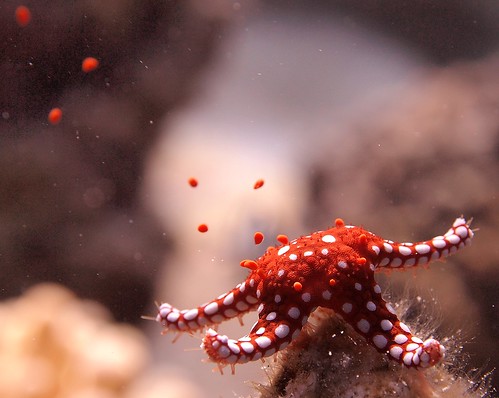
Asteroidia | Asterinidae | Patiriella calcar [Variegated Sea Star] - Flat Rock, Ballina, NSW
A lot of times on the blog, I talk about weird and often unfamiliar groups of echinoderms. But today I thought I would talk a little bit about a family of sea stars, the Asterinidae, which its most likely that most people have seen at some point. They're familiar and as a result, we know quite a lot about some of them..

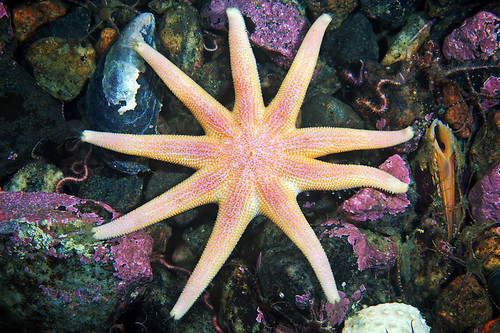
Members of the Asterinidae include some 150 species in over 25 genera spread out all across the world. Everywhere from the deep-sea to under rocks in the tropical Atlantic and Pacific. Most have five rays, whereas others, such as Meridiastra calcar from Australia can have up to 8 or 9..
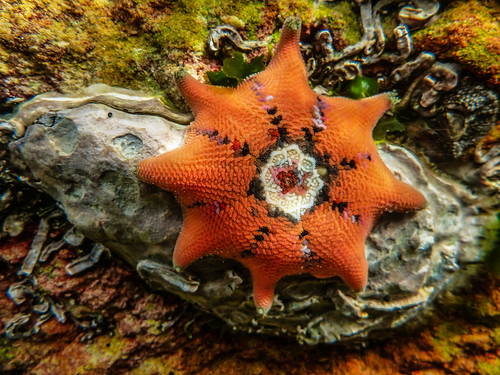
Meridiastra calcar #1, Blackmans Bay
The many species go by several familiar common names: Bat star, cushion star, Knitted star..

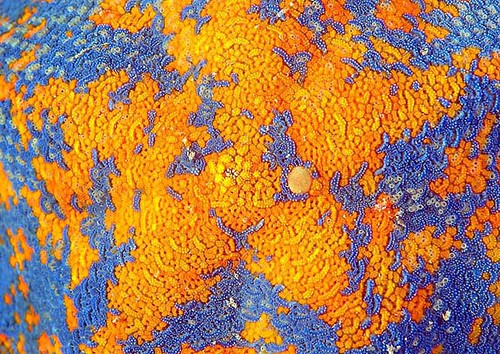
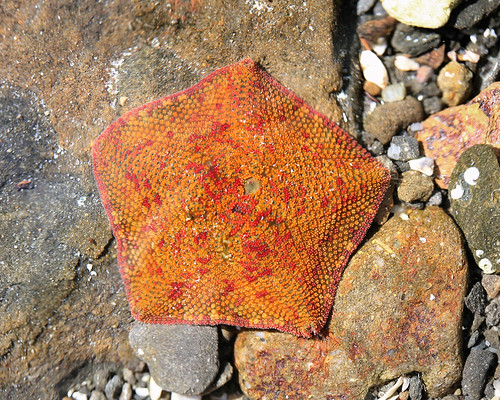
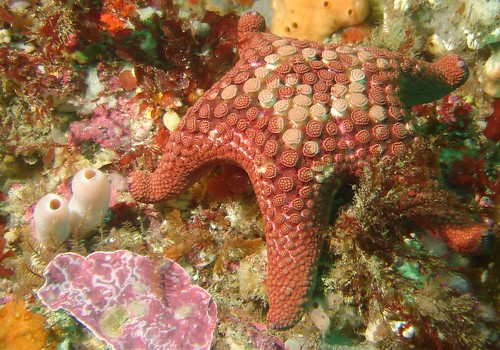
This is actually a good place to identify the very distinctive patterns in asterinids.. namely, these crescent or "knitted" looking plate patterns on the body surface..
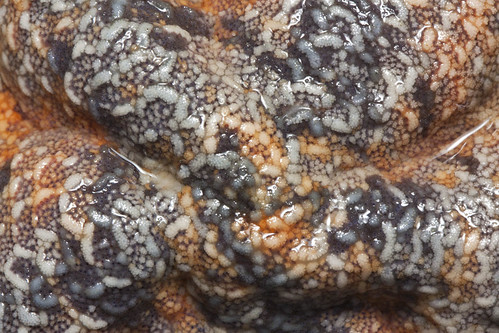
Asterina miniata, Bat Star, Dorsal Surface
               Starphish Asterina (patiria pectinifera) Japan sea, Far East, Primorsky Krai, Russian Federation
In fact, the Japanese word for sea star.. hitode, which means palm, may actually be BASED on an asterinid (Patiria pectinifera).

But for once, there's quite a lot known about them! So here's five subjectively interesting facts about them!
1. They live everywhere
Asterinids occur all over the world with many in shallow water habitats, including under rocks in places as diverse as the North Atlantic. They often live under rocks, or hidden away in cryptic habitats..

There is a HUGE diversity of these tiny little guys. Some are able to reproduce asexually but others just seem to get around.. Being small and easily transported...
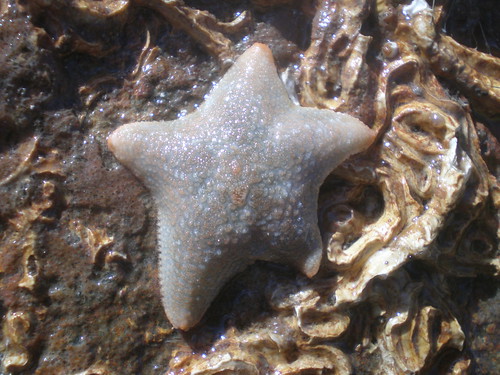
serennig - Asterina gibbosa - cushion star
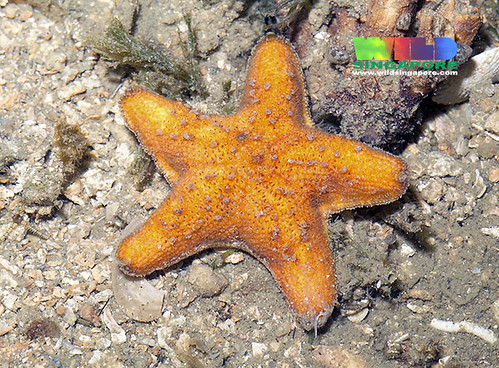
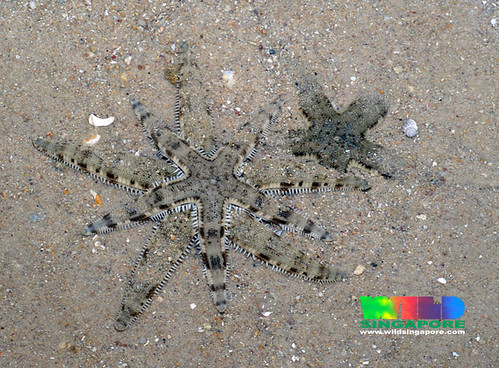
to tropical habitats in Singapore...
Crown sea star (Aquilonastra coronata)
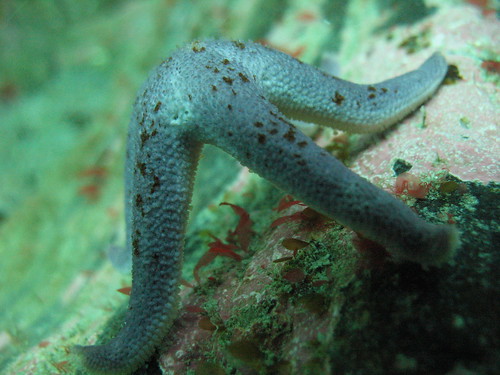
This Callopatiria granifera was a species I observed in Cape Town South Africa!

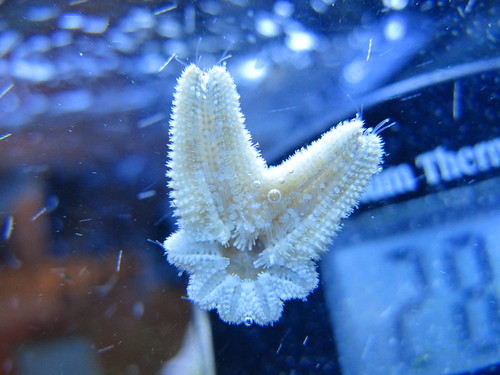
But honestly, one of the places you are MOST likely to encounter them is here.. in a tropical reef aquarium. These tiny ones are most likely in the genus Meridiastra or Aquilonastra.

Again, this is one of those species which is small and easily transported.. Living rock is a GREAT place for them to turn up..

This aquarium species is asexual and once one gets into your aquarium, you're most likely going to have a bunch of them after too long...

So, you can encounter shallow water asterinids almost all over the world! Australia, South Africa, South America, Antarctica, North America, etc, etc.

But as with most starfish groups, there are often weird deep-sea members... Both of these get to be pretty big sized animals.

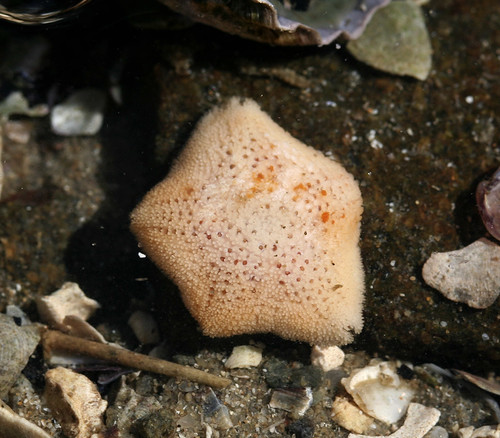
I've mentioned these briefly before.. the flat one on the left is called Anseropoda, which is SO flat that it feels like a cloth rag when you pick it up!  We know very little about it.. Sometimes, small ones are so thin that light shines through them! Its name literally means Ansero for "goose" and "poda" for foot.. So, Goosefoot starfish! These can get to be almost 1.5 feet across!

The one on the right, is called Tremaster mirabilis. Katie Gale and her colleagues found that these will feed on coral in the North Atlantic. As a species it occurs widely around the world including the North Atlantic, the South Pacific and near Antarctica.


 2. Funky Feeding
Asterinids practically EMBODY the classic feeding mode of stomach eversion in sea stars! Here's a classic video I've been showing since the blog started!  It shows the stomach extended out onto the glass and feeding on the algae and other good stuff.  Most other asterindis feed in a similar fashion...
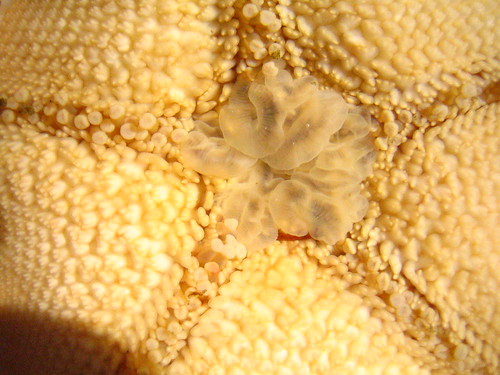
Sea star stomach (Bat star)

BUT some are neat ambush predators!! One species in New Zealand.. Stegnaster inflatus pretends to be a cave and can actually AMBUSH tiny swimming crustaceans!!

One of these days, somebody needs to actually make a video of this thing feeding!
This image from SeaFriends in New Zealand


3. Reproduction! Lots of it!  Asterinids are one of the most heavily studied sea stars because of their many reproductive strategies...

Some, such as this "Asterina panceri"(Asterina gibbosa) actually BROOD their young
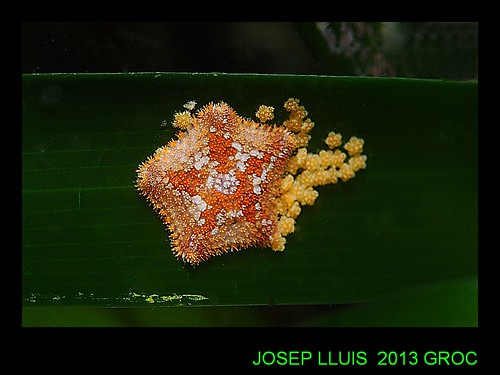
Asterina pancerii birth
From Byrne 1996, Fig. 4h

and I've reported in the past on this other brooding species, which live inside their mother and whose babies will actually EAT one ANOTHER! 


And of course when all else fails, there's always dividing yourself!  Asexual or fissiparous reproduction is why those tiny aquarium stars are so numerous! 
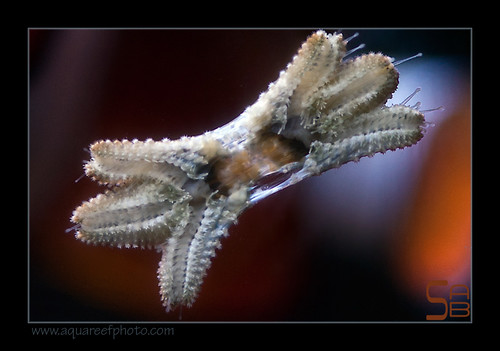
asterina6361_281111
IMG_3451

3.  Commensal Worms! In the Pacific Northwest species, Patiria miniata, its been know for quite some time that there's actually a species of polychaete worm (Ophiodromus pugettensis) that actually lives on the underside!!
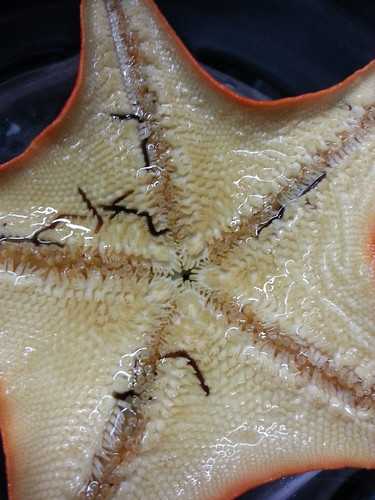
Ophiodromus pugettensis

This is one of the better studied species of asterinids, but there's many other species of Patiria and other species such as Patiriella and Meridiastra which have a similar surface morphology and are conceivably "habitats" for other animals...

4. They are important to the Evolution of Sea Stars!

Here's figure 2 from our paper...
Yeah, I know the image is hard to read, but basically, what I wanted to show was how the Asterinidae seems to show close relations with several other groups of sea stars, including the big multi-armed predators, the Solasteridae
Solaster endeca
and the enigmatic Antarctic Perknaster.. 

Also, the aforementioned Tremaster mirabilis? Sea stars which resemble this species can be found from the Jurassic!  And its position in the tree seems to suggest it might be... interesting..

and of course, there's more I haven't summarized here.. their phylogentic history relative to their various interesting features, etc.. but that's another post!

Wednesday, March 7, 2012

A scientific mystery! Self-Fertilization in Parvulastra exigua

Poorly named seastar
Photo by Nuytsia@Tas on Flickr

Scientists LOVE a good mystery. And biology is full of them. But some are not obvious and are found among the tiniest of creatures....

Case in point, is this tiny little beast called Parvulastra exigua (called Patiriella exigua in older literature)

This tiny species (often about the diameter of a dime or small coin, 1-2 cm across) is present widely across the Indian and Pacific oceans as you can see in the dark brownish pink colored areas on the map below... Primarily in Australia and on the east coast of Africa (Indian Ocean)
(from the World Asteroidea Database listing for P. exigua!)

That little starfish occurs over a HUGE AREA.

When we see invertebrates occurring over an unusually large region we typically assume that its ocean borne larvae are dispersed via ocean currents, carrying the "babies" of this species over a huge area.

Larvae transported in this way are referred to as planktonic that, is they swim and are dispersed via ocean currents. Think of it as similar to the way pollen is blown through the air and carried to far away lands..

But as it turns out, Parvulastra exigua doesn't have planktonic larvae!!

Note the red box below.. There's the animal plus its corresponding bottom-living (non-planktonic) larvae.

A mysterious paradox then enters the scene!

How did such a widely distributed species get around if the larvae DON'T GET carried around on ocean currents??

A recent paper from Maria Byrne's lab at the University of Sydney by Sergio Barbosa and his colleagues in the new issue of Marine Biology adds some new insight into this big question.

Parvulastra exigua has many reproductive strategies!A survey of the biology of P. exigua shows that it has a pretty diverse tool kit of reproductive strategies!
Poorly named seastar

For example, the eggs of P. exigua can be fertilized by the direct release of sperm onto the egg masses!

Now, this may not sound remarkable, but remember that nearly all starfish reproduce by directing their eggs and sperm into the water!

So, this kind of reproduction is ACTUALLY a kind of PSEUDOCOPULATION. Hmmm...where have we seen that before? Go here and see some of my earlier posts on this weird pseudo-sex behavior.

BUT As Dan Savage often says "But wait! That's not all, there's MORE..."

Pseudoexigua exigua are also what's called simultaneous hermaphrodites!! and one funky thing that simultaneous hermaphrodites can do? is to SELF-Fertilize!

Could this have some bearing on the paradoxical distribution mystery?

Could having the powers of outcrossing AND self-fertilzation explain how this tiny starfish gets so far around the ocean??

Barbosa and his colleagues sampled egg masses with evidence of self-fertilization from 5 populations across Australia and here is what they found!!

(Fig. 2 from Barbosa et al.)

The top graph (Fig 2a fr. the paper) shows the % of egg masses with evidence of self-fertilization. The one locality on the far left (from Clovelly) shows that highest abundance of egg masses produced from self-fertilized individuals.

The lower graph shows % of developing embryos in egg masses that had evidence of "selfing" (self-fertilization). The overall "average" % of developing embryos within egg masses that showed fertilization was 8.9% of the total..

So, a significant number of the population can self-fertilize! Some populations do so more than others!

Some Reproductive Dynamics!
  • In other simultaneous hermaphroditic invertebrates the evolution of "selfing" may serve to Eliminate unfavorable genetic material
  • create a way to ENSURE that a population of "your" species persists in times when there are low populations or when there are low numbers of males and females. This strategy has been observed in other species of sea stars and may be a likely explanation here.
  • Given the difference in "selfing" among the five populations surveyed-it seems possible that this is a feature which varies across populations. Why did some of the other populations LACK "selfing" altogether? Why did the Clovelly population have such a relatively high % of it? Environment? Innate population differences?
In biology, we often look to "outcross" or to spread our genetic material across other individuals in a population in order to "reshuffle" or diversify the individuals in the gene pool, thus providing more material for selection.

BUT we have exceptions! Sometimes, "selfing" (i.e reproducing with oneself as a simultaneous hermaphrodite!) and yes, I've always wanted to write that sentence Can give a reproductive advantage. How?

Suppose you are the ONLY member of yourself in some remote location? Creating further progeny from yourself is one way to start a population!

This species, for example, is called Parvulastra vivipara-another hermaphrodite. This species actually BROODS its young (i.e., it has little baby starfish that live on the adult!). P. vivipara produces young but often in isolation for YEARS...
A very local speciality.
(Photo by Nuytsia@Tas)
There are challenges here. Is there enough diversity between your eggs and sperm? How many fertilized eggs mature to the juvenile stage relative to "out-crossed" individuals?
The important point here is that this mixture of reproductive modes..the pseudocopulation, the outcrossing, the "selfing" and so on are all important if not critical to understanding the widespread distribution/ success of this species as it becomes distributed across the oceans!

Monday, February 13, 2012

Valentine's Day-Feb. 14th The Echinoblog Twitter Feed gets SEXY!

Greetings!
So tomorrow as an Echinoblog EVENT! I will be Tweeting as MANY Weird marine invertebrate (and some vertebrate) SEX videos as I can! Sea stars! Nudibranchs! Slugs! Worms! Hermaphrodites! Pseudocopulation! Penis Fencing! Giant Sperm! Yow!

Check out the new Echinoblog Twitter Updates in the side column
Enjoy these pics of the tropical Archaster typicus caught in the act of PSEUDOCOPULATION!! More on that tomorrow..
Common sea star (Archaster typicus)


Common sea star (Archaster typicus)

Tuesday, August 2, 2011

Starfish Standing on their Tippy Toes: The Strangeness of Spawning!

(this image from the book Great British Marine Animals! )
How many times in my professional career have I been approached by a diver or some experienced field biologist with a picture of some animal doing an ODD thing. They bring the picture to me and say "By the way, we see this ALL the time. I'm sure its well known".

And it turns out, that it is NOT well known but it sure seems like it ought to be known! Why don't we know???

Case in point- the topic of today's blog-the "spawning posture" observed in sea stars!! This is the odd stance taken by asteroids as they climb up on their tippy toes with disk sticking upward into the water as well-demonstrated by this tropical goniasterid from Japan, Fromia indica
And sometimes they do it en masse!
While I was researching this topic I was quite surprised to learn that there haven't been ANY studies on how doing this weird "step up on the tippy toes" posture helps or otherwise affects the animal during spawning

One sees this posture in cold water species such as the North Pacific Pisaster brevispinus
(Note that the two images below courtesy of Jan Kocian Photography-used with his permission)
and Evasterias troschelii
and just to show that its apparently not taxon specific, here is the solasterid Solaster stimpsoni


with more pix of this species spawning here for good measure...

But the behavior is seen in MANY other temperate-cold water North Pacific species including Pisaster ochraceus, and even the large Pycnopodia helianthoides (kind of)!
                    
The posture is ALSO seen in tropical species, in addition to Fromia above, we also have examples such as this cushion star, Culcita novaeguineae "standing" up on its arm tips!!

here's the oreasterid Protoreaster nodosus


and this large multi-rayed Luidia from New Caledonia. Its worth noting that this species is about 1 to 2 feet across! So, one of these standing up is uh...kind of creepy..

(From Catala's Treasures of the Tropic Seas)

AND as long as we are on the topic.. ophiuroids (i.e., brittle stars) ALSO display this behavior!
Here's some small green tropical Ophiactis doin' their thing! (best seen in the one on the left)

One might ASSUME that it provides a platform for the gametes as they are emitted, higher into the water column.

But we actually don't know! What one might infer or assume might not (and sometimes just isn't) the case.

People are always surprised when I tell them that.

Often times, you have some behavior or other biology going on-but we just haven't scratched the surface of understanding some of these familiar but surprisingly poorly known species...

And what seems "obvious" to some people becomes a question once you think about it.

For example, why do sea stars NOT always assume such a posture?? Some species, such as this Australian Acanthaster planci (Crown of Thorns) seem to just go for it without the standing on their toes action!
(from the Australian Museum website . Photo by Lyle Vail and Anne Hoggett)

Interestingly there appears to be variation in behavior even within a single species for this behavior!

For example, these images of Ochre stars (Pisaster ochraceus) and Sunflower stars (Pycnopodia helianthoides) (click on each to see) also show some variation in posture as gametes being released. (Note that individual gender can't really be determined without sampling the gametes as there is no sexual dimorphism, but I don't know if the individuals in these pictures were sexed.)

There are a HOST of questions that accompany something as important but as unexplained as these spawning postures!
  • Does the spawning posture maximize reproductive behavior?
  • Why do some species spawn "flat' versus "standing"??
  • Does the posture relate to the amount of gametes produced?
  • Could this behavior be related to seasonal conditions? Nutrients? Current flow?
  • Does behavior vary in cold versus tropical water species??
  • Do different species vary in their reproductive posture?? How many species?
So to that marine biology student without a project out there reading this in the middle of the night?? You want to travel?? You want to unravel the mysteries of the stars?? (Well,...sea stars) You want fabulous riches and fame beyond your wildest imaging?

GO DO THIS!!! (please note that riches and fame are exaggerations and are not necessarily applicable or guaranteed)

And thank me in the Acknowledgments.
So Sayeth the Echinoblog !!

UPDATE
Here are further species documented with this posture...Do you have a picture of a starfish/seastar doing this?  Please let me know in the comments!


Here is Nectria sp. (Goniasteridae) from temperate water Australia. Image by Martin A. Hansen
Starfish
and possibly this Uniophora granifera from temperate Australia
Beaded Seastar
A Henricia (?) from Ireland. Image by David Riordan
Starfish gymnast

The ophidiasterid Leiaster leachi spawning!


another update...May 17, 2013. Linckia spawning..

Here's a nice shot of Linckia laevigata spawning..from Mabini in the Philippines...

Fromia maybe F. ghardaquana from Egypt. Image by Stephen Childs
Starfish shedding eggs
Choriaster granulatus (Oreasteridae) Image by John B. Williams


Tuesday, July 12, 2011

Sexual and Asexual Reproduction in Coscinasterias! Two ways a starfish can get a date on Saturday night!


This week..an interesting story about a little starfish from the temperate-tropics that can go from being ONE to FOUR or even SIX starfish all by itself! An ability I'm sure everyone wishes they had when moving furniture or cleaning your apartment!


The subject of today's blog, is this guy: Coscinasterias acutispina-a member of the Asteriidae that occurs throughout shallow waters in temperate to tropical waters in the Pacific. One sees this species throughout Asia and out to Hawaii (see this past Echinoblog).

And just to give you a sense of what the animal is like alive, here's a neat video of it turning itself over!


But one of the immediate things one notices about this species is how it always seems to have an unusual number of shorter arms. Such as in a specimen like this.

Its been observed over the many years since this species was described in 1862 that this species is what's known as fissiparous, or in other words, the animal is asexual-it can divide into two separate individuals!

The authors raised C. acutispina from embryos to juveniles and proceeded to observe how these individuals underwent asexual fission.

Here, the authors show examples of wild caught adults versus specimens which have undergone fissiparity while in captivity.
(Figure 1 from Shibata et al., 2011)

Ultimately, the authors raised three individuals after 12 months of growing the juveniles and rearing them out. It is quite impressive when you consider this dataset took YEARS to collect!

After awhile, these three began to undergo fission!! On the left side is the amount of time in months that proceed
(Figure 2 from Shibata et al., 2011)

Their results were very intriguing (and were no doubt the result of a long wait!).

Over the course of over a year (19 months), these THREE individuals had essentially divided into TWELVE separate individuals! Not evenly...one individual into four, the second into six and the last into two.

But that wasn't all! After about 1-3 months, each one of the above (following second fission) had gonads and were able to produce reproductive cells (i.e., gametes-eggs or sperm).

So to summarize- the authors provided this handy-dandy flow chart of the "life cycle" of the sexual and asexual life of Coscinasterias acutispina:
(Figure 3 from Shibata et al., 2011)

This is almost kind of reminiscent of the life cycle of something like a jellyfish, which also has alternating sexual and asexual life stages.

The part missing from the paper though is " What so interesting about it in the "big picture"? How is this adaptive for this animal's evolution and/or biology?
Here are some of my thoughts:

1. Dispersal. So, this is probably the most logically obvious benefit to being able to reproduce in this fashion. The more individuals are abundant, the greater they are able to carry your genome farther away. Those that survive and are best adapted-carrying on optimal reproductive material- can presumably also divide and reproduce later on.

2. Could asexual vs. sexual reproduction be more energetically expensive? A paper by Crump and Barker (1985) on the New Zealand species, Coscinasterias calamaria observed that those individuals with better quality food were more inclined to divide than those with poorer quality food. Its not clear to me which mode of reproduction involves more physiological energy..but perhaps different species switch off when times are poor?

Do the ecologists and fissiparous indivdiuals out there have more to add? Feel free to drop them in the comments!

Sunday, April 5, 2009

Starfish Reproduction Via the Performance of Isabella Rosellini


Happy Springtime!
By now, many people have seen the famous series of unusual but uh...compelling videos on inset sex entitled "Green Porno" by
Italian actress/model/philanthropist/director Isabella Rossellini

Here are a series of short clips of her new show "Green Porno 2" featuring primarily sea creatures such as the asexual life of starfish, the protected life of limpets and the bizarre sex life of angler fish. Go here for the general link.

Its short and safe for work unless your office is strict on starfish erotica with people wearing funny costumes!

Go Here for some Hot Starfish Sexfulness!

Some Limpet VaVaVa Voom here!


and...deep-sea Angler Fish Action!