Wednesday, September 17, 2008

Know your Grades of Uni!

So, I recently discovered that there was a California Sea Urchin Commission, complete with their own very interesting website.

What I didn't know was that there are actually GRADES of uni available. The CSUC describes them as such:

The Commission also adopted the following grade names and standards of quality to encourage uniformity throughout the industry, to help retail and consumer customers make better purchasing decisions, and to give assurance of product quality.

“California Gold” - bright gold, yellow or orange color; firm buttery texture; fresh salty ocean scent; and with a sweet buttery taste. Uni sections are large and complete intact pieces. This is exceptionally high-grade uni for use in top quality sushi. (formerly grade A)

“Premium California” - gold, yellow or orange color but less brilliant than California Gold; firm buttery texture; salty ocean scent; with a crisp and nutty taste. Uni sections are smaller but still primarily intact pieces. Premium uni is used for sushi, soups, salads, or combination dishes where uni is the featured item. (formerly grade B)

“Select California” - medium hues of yellow and orange or even tending to brown in color; salty ocean scent; softer creamy texture; with a more neutral nutty taste. Uni may be intact sections but can consist of broken pieces of the other grades. Frequently Select is packaged and shipped frozen. Uses include soups, sauces and dishes where the uni is mixed with other ingredients, including other seafood. (formerly grade C)

And here are Uni's Nutritional Facts!

Monday, September 15, 2008

Why Sea Urchin sushi (uni) tastes SO frakking good!

If you've ever enjoyed the fine diversity of Japanese cuisine, and are a serious sushi connaisseur (as I am) you have probably experienced the singular love of uni-a type of sushi made from the gonads (which produces the roe) of a sea urchin. To be sure, uni is not something everyone "gets" the first time they try sushi.
But, for people who enjoy uni, they REALLY enjoy it. Its a compulsion to order it when they visit the sushi bar!! But why???

Uni has a "euphoria-causing chemical" ingredient (albeit in very small quantities) similar to what you find in cannabis! Yes, pot, marijuana, etc. Specifically, a chemical neurotransmitter called an anandamide,also known as arachidonoylethanolamide or AEA
What are anandamides doing there in the first place?? These are actually naturally occuring chemicals in sea urchin gonads, which are thought to be important in the reproductive system, among other physiological/enzymatic processes associated with sea urchin fertility.
Interestingly, (according to Wired)-some scientists have hybridized the euphoria-causing anandamides from sea urchins in conjunction with the psychoactive chemicals from marijuana in order to better study the endocannabinoid system, which is partly responsible for pleasure and pain signals.

So far, anandamides have been studied in the N. Pacific purple sea urchin, Strongylocentrotus purpuratus and the European sea urchin Paracentrotus lividus.
I've not tried uni from other species (the two other species,S. franciscanus and S. droebachiensis I believe are made into uni). Several species are fished in Australia. One wonders if the amount of anandamide and the perception of taste (and the "high"), varies per species..

That being said can sea urchins handle the fishing stress?
Incidentally, according to one of the papers I foundthe chemical in S. purpuratus can reduce the fertilization capacity of sperm cells. This study was via direct application-not via ingestion, but if you are trying to be fertile, it probably doesn't hurt to lay off the uni, if you're having it every night! (plus uni is quite rich..so you probably can have too much of a good thing!!).

Thursday, September 11, 2008

Holothurian Video Friday!!

The Famous Defense Response of a tropical holothurian


Reddish Holothurian (don't know what it is-but a gorgeous animal) and a bit of Pentaceraster cumingi


"Sea Apple" (Pseudocolochirus violaceus?) Feeding


Click here for an excellent video of this species feeding....

And here is just a long-ass synaptid sea cucumber


Have a Great Weekend!

Tuesday, September 9, 2008

Ye Olde Haeckelian Phylogeny-Brisingids Rule!

So, the other day, was looking through one of my favorite older monographs "On Some Remarkable Forms of Animal Life...Researches on the Structure and Affinity of the Genus Brisinga" by George Ossian Sars, Professor of Zoology at the University of Christiania and came upon this cool older idea of Echinoderm Phylogeny: The phylogeny recounts some very early and....unusual...ideas about metazoan relationships originally developed by Ernst Haeckel and modified by Sars. The monograph was published in 1875. Darwin's ideas on evolution had only been around since 1859.

expn2300
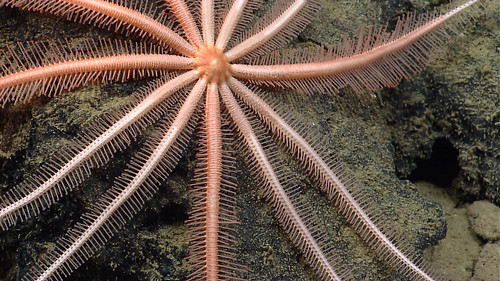
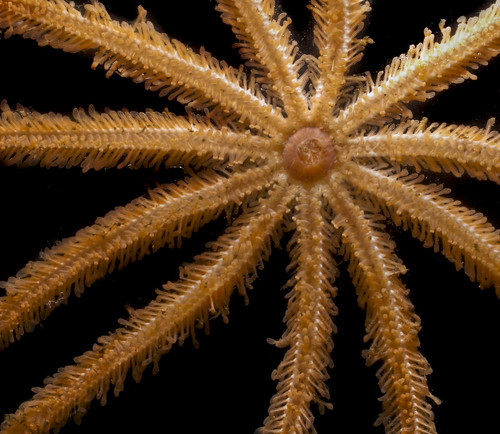
This particular monograph emphasized brisingids, which look sorta like a cross between a "normal" looking starfish and a brittle star:
but what was NEAT and weird about Sars take on this animal's history? The fundamentals of this phylogenetic idea was that the Echinodermata were formed by "Colony Forming Vermes" which was another way of saying "Let's take 5 of these" and turn them into something kinda like this: But Sars hypothesized that brisingids were essentially a separate and independent "step" between these "colony forming vermes" and starfish and other echinoderms...essentially a missing link to ALL echinoderm diversification!! And that seems kinda reasonable (in a naive way)..when you look at it...
Brisingidae family seastar (oral surface)
I could easily see how this could be "spun" this into the ancestor of crinoids, ophiuroids, and asteroids+echinoids+holothuroids!

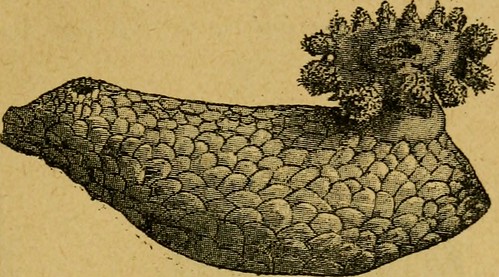
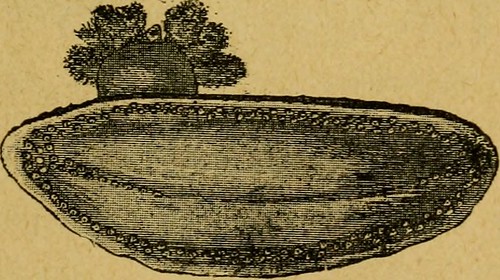
The general gist of the phylogeny from there is that echinoderms were given towards greater "concrescense" or centralization...So from independent worms coalescing to bigger, lumpier things. So holothurians or sea cucumbers would be chief evidence of "concrescence"..especially with something like the armored and essentially sessile Psolus, which was seemingly even LESS pentameral than other cucumbers.
Image from page 38 of "Coelents, inodermes, protozoaires" (echinodermes)Image from page 38 of "Coelents, inodermes, protozoaires" (echinodermes)

Monday, September 1, 2008

Tribute: The Legacy of Cynthia Ahearn


An obituary summarizing Cynthia Ahearn's passing is here.

This is probably not the best summary of Cynthia Ahearn's complete professional contribution, she was one of those people who had far more impact on the field then a paper trail would reveal.

She influenced students, scientists, and visitors..and encouraged the Echinoblog's existence. But I thought it was important that everyone see her tangible contributions.

Anyone who has more or would like to add a story, a contribution, or comment is welcome to do so. I will forward all such statements to John Ahearn.

*Identification of nearly 300,000 echinoderm specimen lots (this is an estimate-there are likely more). One of the few people in the world who had seen almost every echinoderm specimen in the NMNH collections.

*A completely (or near completely) cataloged collection for the NMNH Echinodermata including types.

*Verification of all the types in the NMNH collections (what is present, what condition, how many, etc.).

*Curated NMNH echinoderm collections for over 30 years!

*Editor, writer, and assembler of the original print version of the International Echinoderm Newsletter from 1993-2003.

*Editor of the Virtual Echinoderm Newsletter (designed by Susan Hottenrott)

*Tours of the NMNH Invertebrate Zoology Department collections and educational experiences to generations of students-from high school to undergraduate to high-level officials.

*Hosted international visitors from Mexico, Colombia, South Africa, Australia, Russia and undoubtedly many more then I am aware of..

*Published collaborative research with scientists from Australia, Mexico, Chile, Colombia, Russia, as well as with NMNH curator Dave Pawson.

*Provided professional taxonomic expertise to major scientific institutions around the world, including Woods Hole Oceanographic Institution, the National Marine Fisheries Service, New Zealands Institute of Water & Atmosphere (Wellington, New Zealand), the California Academy of Sciences (in San Francisco, CA), the Museum of Comparative Zoology, the Museum Victoria (in Melbourne, Australia) and many more.

Publications:

O'Loughlin, M. and C. Aheam . 2005. A review of pygal-furrowed Synallactidae (Echinodermata: Holothuriodea), with new species from the Antarctic, Atlantic and Pacific Oceans. Memoirs of the Museum Victoria 62(2): 147-179.
Alicia Durán-González, Alfredo Laguarda-Figueras, Francisco A Solís-Marin, Blanca Estela Buitrón Sánchez, Cynthia Gust Ahearn, Juan Torres-Vega. 2005. Echinoderms (Echinodermata) from the Mexican waters of the Gulf of Mexico. Revista de Biologia Tropical 53(3): 53-68.
Alfredo Laguarda-Figueras, Francisco A Solis-Marín, Alicia Durán-González, Cynthia Gust Ahearn, Blanca Estela Buitrón Sánchez, Juan Torres-Vega .2005. Echinoderms (Echinodermata) of the Mexican Caribbean. Revista de Biologia Tropical 53(3): 109-122.
Francisco A Solís-Marín, Alfredo Laguarda-Figueras, Alicia Durán-González, Cynthia Gust Ahearn, Juan Torres Vega. 2005. Echinoderms (Echinodermata) from the Gulf of California, Mexico. Revista de Biologia Tropical 53(3): 123-137.

Pawson, D.L., D.J. Vance, and C. Ahearn. 2001. Western Atlantic sea cucumbers of the order Molpadiida (Echinodermata; Holothuroidea). Bulletin of the Biological Society of Washington 10: 311-327.
Pawson, D.L. and C. Ahearn 2001. Bathyal Echinoderms of the Galapagos Islands. In: Echinoderms 2000, Barker (ed.) Swets & Zeitlinger, Lisse, pp. 41-46.
Ahearn, C. Gust. 1995. Catalog of the type specimens of sea stars (Echinodermata: Asteroidea) in the National Museum of Natural History, Smithsonian Institution. Smithsonian Contributions to Zoology, No. 572:59 pp.
Ahearn, C. 1994. Family Psolidae: new distributional records from the Antarctic. pp. 503, In Echinoderms Through Time, Proceedings of the Eighth International Echinoderm Conference, Dijon, France. David, Guille, Feral & Roux (eds). Balkema, Rotterdam.
Ahearn, C. 1992. Philippine brittle stars (Echinodermata: Ophiuroidea) described by R. Koehler (1922): A corrected and annotated list of type specimens. Smithsonian Contributions to Zoology, No. 537:15 pp.
Pawson, D.L. and C. Gust. 1981. Holothuria (Platyperona) rowei, a new sea cucumber from Florida (Echinodermata, Holothuroidea). Proceedings of the Biological Society of Washington 94(3): 873-877.