Showing posts sorted by relevance for query top hat. Sort by date Show all posts

Monday, October 26, 2009

The Mystery of Sphaeraster! aka JURASSIC fossil starfish are WEIRD!

(Courtesy & copyright of Christian Neuman in APH 37)


Christian studies fossil echinoderms, especially sea urchins and sea stars and put me onto a new short paper he's written in Arbeitskreis Palaontologie Hannover 37: 92-97! Most of the pics featured today are courtesy of his article!

But...WHAT? You didn't realize that there was such a thing as starfish FOSSILS?

Starfish, like other echinoderms are composed of thousands (maybe even hundreds of thousands) of individual calcium carbonate pieces (called ossicles or plates)! So, when they die, those pieces often get scattered into the sediment or the water or etc.

That is why starfish ossicles are SO rare. When they die, these pieces scatter very easily and they fail to preserve over time.
BUT, sometimes we get lucky! Those pieces get preferentially preserved, sometimes while they are still connected together, articulated into large chunks or EVEN the complete animal!

So, in this case, we have pieces that clue us in to one of the most enigmatic of fossil echinoderms! The Sphaerasteridae! An engimatic group of asteroids from the Jurassic!

While dinosaurs were trying to figure out how to roam the Earth, these guys were happily sitting around in the seas of the Mesozoic!

Initially, the pieces recovered were like this:
(Courtesy & copyright of Christian Neuman in APH 37)

You often recover MANY different pieces. Here we have fragments of Sphaeraster punctatus.More precisely..you get either individual pieces (i.e., individual plates) or a "chunk" of the animal that looks like this.
(Courtesy of Christian Neuman in APH 37)

Eventually, you have enough different fragments, pieces, and etc that you can make a guess as to what the original animal looked like.

Starfish paleontology is a LOT like dinosaur paleontology or assembling an airplane model kit without the instructions! You've got a bunch of pieces and you have to reassemble them into what looks like the right shape!

So..what you've get here..VOILA!! A reconstruction of Sphaeraster punctatus (described by Schondorf in 1906!).
(Courtesy of Christian Neuman in APH 37)

It was weird but not really that big..about 75 mm across from left to right. Now bear in mind this is a RECONSTRUCTON. The fossils aren't nearly as nice as this. But it gives you SOME idea of what it looked like.
BOTTOM (=Actinal) VIEW (Courtesy & copyright of Christian Neuman in APH 37)
TOP (=Abactinal) View (Courtesy & copyright of Christian Neuman in APH 37)

So, what did this odd-looking thing do when it was alive?? One of the most useful ideas for interpreting these fossils and putting them back together is a concept in paleonotology-indeed ALL of Geology-called Uniformitarianism!

Basically, this is the idea is that a lot of the physical processes and relationships that happened in Earth's past are generally the SAME as they are today. So, we look for critters that appear SIMILAR today... Because its possible the same physical forces may have influenced their appearance and body shape (and giving us insight into Sphaeraster!).

For example: The Shingle Sea Urchin Colobocentrotus! Colobocentrotus makes its living by using its flattened spines to deflect waves in its habitat: the harsh intertidal zone in the Indo-Pacific. Interesting.

Its got the plates. Its got the flange around the edge similar to the plates on the reconstruction. BUT its NOT a starfish.
Not directly related-but could it have lived this way??? Possibly.
Could it be Xyloplax?? The mysterious asteroid-like beast with a flange of spines around its edge? These beasts live in the deep-sea on sunken wood where they live flush on the surface.

Again..possibly/probably not related-but could it have lived THIS way??
Or perhaps...the strange "top hat" starfish, Tremaster??
..or could it be The LIVING completely, SPHAERICAL starfish-Podosphaeraster??? At first, these nearly round sea stars WERE thought to belong to the fossil Sphaerasteridae. But over the years, these strange creatures have eventually come to be classified in their own unique family-the Podosphaerasteridae and separated from the fossil Sphaerasteridae.

and while, this is plausible, it should be noted that NOTHING is known about these critters. So, maybe its not a podospherasterid either..? We have some AMAZING body shapes and morphology but we have very little biology to match it up with!

Where does that leave us??

Believe it or not, this is it. This is practically our total state of our knowledge of these animals. These beasts fall into the category "about which, little is known..."

It is a pretty curious place where Paleontology and Deep-sea Taxonomy converge!
  • Both involve specimens (often damaged) with unusual shapes or structures which have been subjects of attempted "interpretation".
  • Both often involve bizarre mophologies without any direct observation of ecology or even fundamental life mode.
  • Both subjects usually involve rarely encountered animals which only exceptionally are discovered intact!
So..from here? What do we need? Maybe the talents of Leonard Nimoy on his "In Search of" show, to help discover some of these weird and rare animals?? (cause they sure are a LOT harder to find then the Loch Ness Monster!)Fantastic. BUT real. :-)

Tuesday, April 25, 2017

Okeanos Follow-up: Giant Sea-Spiders EAT! Cnidarians, Anemones, Hydroids & Corals! oh my!

Many of you know that I occasionally "call in" when the NOAA deep-sea research platform Okeanos Explorer goes out to see on its missions. (remember the next leg BEGINS APRIL 27  http://oceanexplorer.noaa.gov/okeanos/media/exstream/exstream.html)
Mostly I call in on starfishes or echinoderm biology..but I do have a broad interest in deep-sea biology. And I just LOVE seeing observations like the one above: a weird animal doing something no one is familiar with!

And the BEST thing about Okeanos Explorer? EVERYONE can enjoy it along with you!! Here's a BUNCH of Sea spider observations from the Atlantic Okeanos Explorer in 2014! 

...BUT of course, our ship and shore-side scientists can't know EVERYTHING. We'll often observe an event, many of us make note of it in case we see it again and often times we'll move on.... forgetting about it until such a time when the observation comes up again.

ONE such observation was one from 2014 on the Atlantic Physalia Seamount wherein we observed a sea spider in the genus Colossendeis sp. with its proboscis (that's the long cigar shaped feeding tube) stuckINTO into this hydroid (an animal similar to a Hydra from freshwater)! Was this feeding? Was it NEW?
Physalia Seamount in the North Atlantic
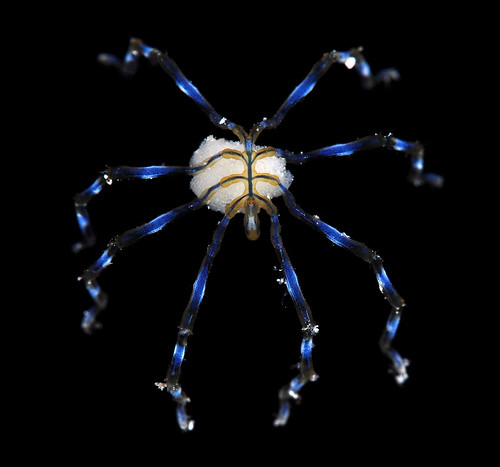
A brief into: Sea spiders are not spiders. They belong to a group known as the Pycnogonids (also called the pantopods) which are mysterious arthropods. Some folks consider them distantly related to the greater group of arachnids whereas others think they are even more unusual...

Most sea spiders are pretty tiny and are less than about an inch (2 cm) across and its not unusual for them to be quite cryptic. So even though they can be present, you really DO have to look for them...
Here a photoessay of tropical, shallow water species by scientist/photographer Arthur Anker displaying some spectactular colors!   Here's a spectacular male carrying eggs..
Male ovigerous sea spider (Pycnogonida)

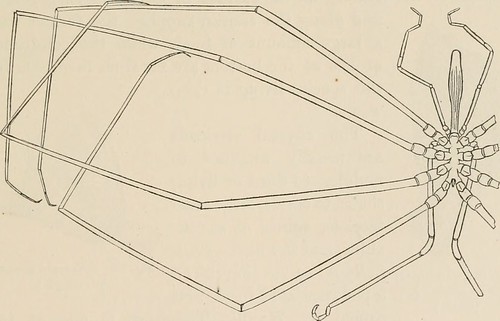
Many live in shallow water but are never seen (hidden and small)... but that's NOT a problem with the deep-sea and Antarctic species!  There's one frequently encountered genus: Colossendeis which is one of the largest known sea spiders reaching a leg-to-leg diameter of over 50 cm! that's almost a FOOT and a HALF!

Most members of Colossendeis live in the proper deep ocean abyss: roughly 1000 to 5000 m and also in Antarctica where the cold-waters allow them to occur in relatively shallow water settings.

Note also the sizeable cigar shaped projection at the top end! That's called the PROBOSCIS! That will be important later! That is presumably what they use to feed.
Image from page 96 of "A contribution to American thalassography; three cruises of the United States Coast and geodetic survey steamer "Blake," in the Gulf of Mexico, in the Caribbean Sea, and along the Atlantic coast of the United States, from 1877 to 18
Unfortunately, there is relatively little information known about sea spiders..... And the deep-sea species? Even less!

So, were the observations something unusual? Has science encountered something like that before??

But much to my delight: YES! There WAS a previous account of sea spiders feeding! and WOO HOO!  It turns out my friends at the Monterey Bay Aquarium Research Institute in Moss Landing, California actually observed something JUST LIKE THIS in 2010!!! Here was their blog post about it! 


The paper, by Caren Braby, Vicky Pearse, Bonnie Bain and Bob Vrijenhoek was published in Invertebrate Biology in 2009, 128(4): 359-363. and it documented "Pycnogonid-cnidarian trophic interaction in the deep Monterey Submarine Canyon"

They observed the same genus, Colossendeis, but at least two species, C. gigas and C. japonica feeding on commonly encountered sea anemones in the deeps of Monterey Canyon.
Braby's paper reveals that only Colossendeis in Antarctica had been observed feeding. These animals fed on limpets and bristle worms and in 1999 sea spiders were observed feeding on sea anemones

Braby et al.'s observations were the first for deep-sea Colossendeis (as opposed to Antarctic) species. Her team's work focused on their feeding on the deep-sea "pom pom anemone" Liponema brevicornis, an unusual sea anemone which literally "rolls" along the bottom of the deep-sea in a manner similar to a tumbleweed!

After the last 2017 Okeanos leg in the Phoenix Islands, I rounded up a BUNCH of the sea spider-feeding observations and decided to share them here as a comparison! Who knows? perhaps it will inspire a further paper!

Remember that NOAA's Okeanos Explorer program has captured these images and made them available for EVERYONE's enjoyment! Please remember that the next time someone talks about government funded science!

Pacific Observations! Over the last few weeks of the Phoenix Island expedition, we saw a BOUNTY of sea spider feeding observations!  

Winslow Reef: This one had its proboscis firmly ensconced into this flytrap anemone and was apparently sucking something out of it! The rather lethargic looking appearance is likely the result of being on the receiving end of whatever is going on here...

And ANOTHER on Winslow Reef! that was QUITE a dive! Here's another flytrap anemone with a sea spider attacking it!   As we saw earlier from Monterey Canyon, sea anemones and other cnidarians seem to be one kind of preferred food!

Baker Island we saw one attacking what was identified as a cup coral...The proboscis seemed to be "drinking" pretty heavily on this one...


Howland Island.....and just for good measure they saw this one crawling over a glass sponge

More Atlantic Feeding? Here we had a sea spider in the Atlantic Nygren Canyon which has been identified as Pallenopsis (thanks to Bonnie Bain), climbing and possibly feeding on this sea pen.

So, unfortunately I'm not really a sea spider taxonomist, so beyond the genus Colossendeis, I'm not sure how many species we are looking at here..but images such as this inspire many questions: Is predation specific to species? Or generalized?  How significant are these events to the ecosystem?
Do sea spiders attack the big colonial corals as well?

Stay tuned for the next exciting episode!

Wednesday, December 4, 2013

Where do those starfishes & Sand dollars on Holiday decorations come from?

Starfish
Wonderful Image by Krystle D
December Greetings! As we get into the holiday and Christmas season, I always get certain questions which pop up around this time of year, asked by the public. One of the common ones I receive around now is (paraphrased) 
"Where do those starfish and sand dollars on holiday decorations come from?" Usually followed by "Are they alive?" and etc... 

So, let me take a trek through several recurring photos of holiday decorations and show you species by species how they compare. 

I have written before on where these decorations come from. A prior overview on starfish here.  A prior account on sea urchins (and sand dollars) here. 

A general rule about echinoderms used in decorations: WHAT YOU SEE ARE NOT SHELLS, THEY ARE MUMMIES (dried endoskeletons). 
Xmas in the 21st century: Death with Santa hat in Leipzig
Image by Werner Wittersheim
A bit of a refresher on basic echinoderm anatomy. All of the distinctive features one sees in echinoderms- spines, tubercles, the various shapes and etc. are covered by epidermis, in other words, SKIN.

So, yes, in order to get one of the starfish dried and made into a wreath? It has to be killed. (that's one of the questions I get about these by the way...)

So unlike say, shells which are secreted outside or independently of the animal's body, echinoderms have an internal support that is analogous to the skeleton in vertebrates. Their tissue is actually infused into this skeleton. 

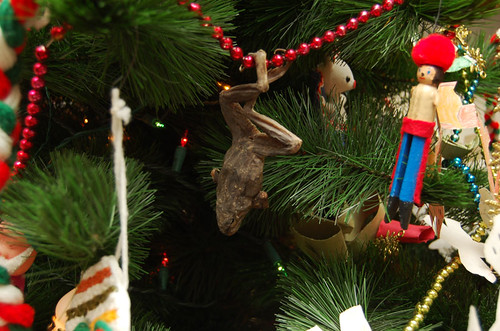
I've said this before many times. Here and here.  I've always found the whole concept of putting echinoderms onto holiday decor as kind of macabre unless you're that guy who puts dead, dried frogs on your Christmas tree, which is perfectly fine....
frog4

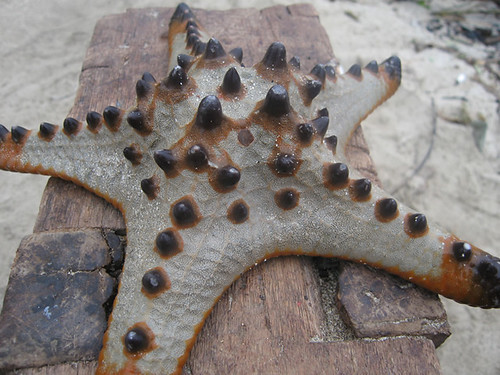
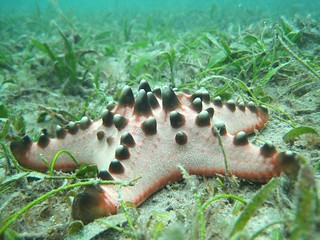
1. "Knobby Starfish" Holiday Wreath
This is one, I've been seeing around is adorned with large, "Knobby Starfish"
These are Protoreaster nodosus, a species which occurs in the Philippines, Singapore, and all throughout the North-Central tropical Pacific.
Knobbly sea star (Protoreaster nodosus)
Image by Ria Tan (Wild Singapore)
Estrella de mar de xocolata: Protoreaster nodosus
Image by Pau Estrada
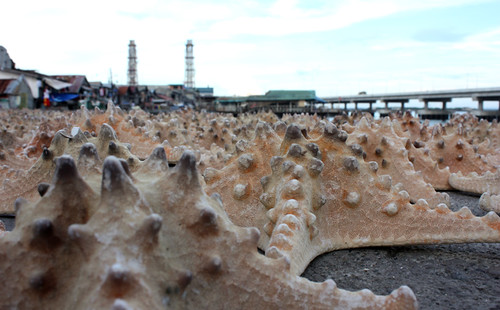
Protoreaster nodosus is an abundant and easily encountered species where it occurs. It is harvested in several places for tourist and gift making decor. A whole industry is oriented around fixing (ie treating with formalin), drying and exporting dried starfishes. I've briefly discussed this here and here

dried starfish
So, there is a fishery of this species, even if people don't eat them. There has been some ongoing work to determine if the species is sustainable (such as this paper by Bos et al.2008).  I'm not sure the results are encouraging. 

2. Pisaster ochraceus & the "Coastal Wreath"(thanks to Gail for the tip!)
Thanks to the wonders of the Internet and directed marketing, I clicked on the link to this item ONCE. And it now shows  up on ALL of my social media and other shopping pages...

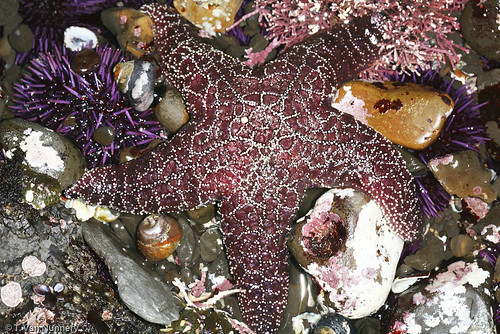
The picture actually shows up on several different gift and other sites, which I'll decline to name. But two species are observered here. the starfish is Pisaster ochraceus aka the Ochre Star from the Pacific NW coast and the sand dollar Mellita (prob. Mellita quinquiesperforata ).

Its not unusual for Pisaster to turn up dressed up as any number of awful, tacky holiday decorations


Here again, is a pic of the animal alive to remind you of the contrast...
Ochre star (Pisaster ochraceus)
Image by TVN
Ochre Seastars (Pisaster ochraceus) Feb 19, 2012. Patrick's Point SP., Humboldt Co., CA (1)
Image by RJAdams55
So, the ochre star, the ecologically important keystone predator, which feeds on mussels and so forth. This species, among several others, is currently under attack from starfish wasting disease
Image from Iamheretokelp
So, perhaps it is NOT the best species to be turning into garish Christmas and holiday ornaments, eh??

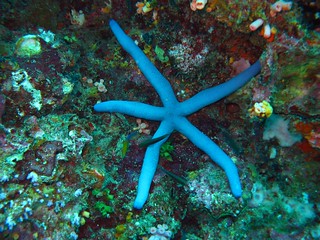
3. "Starfish Wreath" from Linckia laeviagata.

A starfish tree? really?

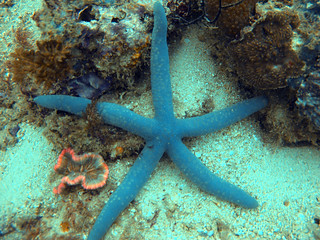
Linckia laevigata aka the "Blue Linckia"(although it does occur in other colors) is one of the most heavily fished sea star species in the tropical Indo-Pacific.


Blue Starfish
This species is "fished" for both holiday trinkets AND the aquarium trade and is probably NOT a good sustainable species for those industries...
Linckia laevigata a, Phi Phi Kho Bida Nok, 100217 (jp)

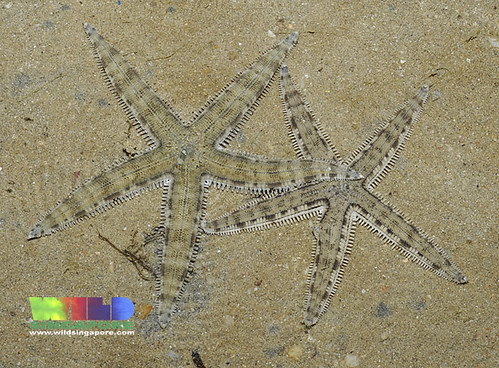
3. Archaster typicus
This treats the two specimens at the top of the "wreath".. these are another species which is widely occuring the tropical Pacific.
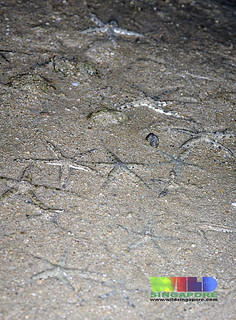
This species is seen frequently in the Philippines and in Singapore. Wild Singapore has a nice summary of its biology here  Images below from Wild Singapore..
Common sea star (Archaster typicus)


Common sea star (Archaster typicus)

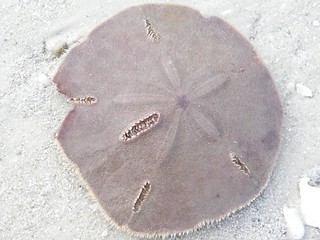
4. Sand Dollars: Mellita spp. 


Mellita spp. are from the tropical Atlantic coast, the Gulf of Mexico, Florida, etc. in shallow water.
Sand dollars are sea urchins! And here's more on that.   Those holes in the body (ie. the skeleton also known as the test) are called lunules  and they are pretty nifty.

Another commonly encountered species in holiday decorations. Sand dollars, especially these species have the most "benefit of the doubt" because its not unusual to encounter their dead skeletons as beach wash.

Although one has to wonder how much collecting one needs to have enough to create a regularly marketable wreath such as the ones I've been seeing marketed on the Internet...

I'm pretty damn amazed at just how WIDESPREAD these get via the tourist industry. I've literally seen these sand dollars shipped across the country and across the WORLD for sale at tourist shops.

Here is what they look like with all the original spination and such...
kbh ca
kbh cz
and we even got video!
                                 

5. Echinometrid? "Sea urchin tree"?


Maybe Echinometra from Australia?  Not sure. Like sea urchins, the tests can be gotten as beachwash.. but not regularly. So, I'm thinking these were likely harvested...

reef4081
Image from NOAA photo library
The websites for "urchin trees" and such were running these items for anywhere between 70 to 150.00.  But cripes! 150 dollars for sea urchin tree???

So to recap:
1. Starfish decorations are mummified remains of living animals, which had to be killed in order to get you a holiday wreath. I wouldn't lick them.
2. Many of the species used in these industries from the tropical Pacific are probably not sustainable fisheries.
3. Personally, I just think decorating starfishes like Santa Claus is tacky. So, please. just stop. Use sea shells or give people candy. People like candy.
4. Sand dollars are okay. Still possible to kill them for use as decorations. But also possible that they were collected beachwash.
5. Good grief. Who pays 150 dollars for holiday decorations made from beachwash??? or mummified starfish remains??? You know what's good for 150 dollars? chocolate.Send to the Echinoblog. Or charity. charity is good.