Sunday, June 29, 2008

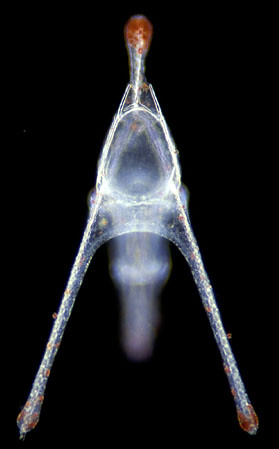
Creature Feature: Ophiacantha bidentata! Deep-Sea Animal Profile by Keyla Pacheco

Today's special Echinoblog was written in part by my intern Keyla Pacheco from the Interamerican University of Puerto Rico!! She is supported by the NMNH Latino Students Initative and is a smart, enthusiastic worker and came up with many interesting bits! I welcome her input! Keyla is co-advised by myself and Martha Nizinski at the NMFS Lab!


When we look at the deep-sea, we often see so many of some critters that they practically take on the landscape!

Today!-one of many articles on the importance of the ubiquitous!!

Today!-we treat a relatively common deep-sea critter that wouldn't normally get the uh..STAR treatment!! (sorry-this is my bit..chris)

Past blogs have focused on critters that have lived or taken advantage of coral as a living substrate. Ophiuroids are among the most frequently encountered of echinoderms that live in this fashion. Among them are the Ophiacanthidae! Where have we heard of these before?

They were all over the news when "Brittlestar City" was found!!

Ophiacanthids are ubiquitous-they are found in nearly all of the world's oceans. But how are they important?

Let's look at a widely occurring species and see:

Ophiacantha bidentata is a widely distributed species found in the shallow waters of the Arctic and in deep sea settings in the North Atlantic and North Pacific.

Dense populations of O. bidentata occur in the hundreds to thousands of individuals occurring among deep water coral habitats. Their abundance and dense aggregations in deep water coral habitats make this animal an important component of deep sea benthic communities.

O. bidentata lives on both soft bottoms but also as an inhabitant on reefs of the deep-sea coral Lophelia. This seems to go in hand with their ability to switch from deposit feeding to suspension feeding depending on food availability.
Because the protection of deep sea corals have become of increasing concern and a “hot topic”, studying species that present an important trophic resource within these communities is of greater interest.

Bigger ones apparently show greater incidence of regeneration..as well as a greater incidence of sublethal predation! This, in turn, seems to suggest that they provide a "renewable trophic resource"..i.e., food among these coral communities!!

So conceivably...fish come for the coral habitat, but stay for the brittle star arms!

Other Curious Facts:

1. Those found in the deep sea waters have shown to be protandric hermaphrodites, which means they start out as male and develop into female. This is apparently an uncommon reproductive strategy among ophiuroids.

2. The same(?!) species found in shallower waters tend to be gonochoric which means there are at least two distinct sexes which do not brood their young.

3. O. bidentata is bioluminescent!

Friday, June 27, 2008

Friday: Starfish Cake!!

So, CAKE is GREAT
+

And I love STARFISH (The introduced Asterias amurensis from Melbourne shown here)

=
STARFISH + CAKE=STARFISH CAKE!!!! (looks like Linckia laevigata and some Asterias rubens...)

MMmmmmm.......

Tuesday, June 24, 2008

Important Things About Life I Have Learned from Echinoderms

So, I was thinking the other day about all of the important lessons of life which echinoderms have imparted upon my day-to-day wisdom and dealings. And I thought "Wow..there's at least SEVEN things!!" So because my brain is riddled by NSF budget numbers, here they are:

1. Why chew and swallow your food, when it can go right into your stomach? 2. Just because you don't have claws and teeth doesn't mean you can't be offensive.

3. You're not slow, you just move at a different rate then uh..most other things.


4. Even if you are, at heart, bilateral, its okay to have a pentameral overlay.


and... Even amongst the pentamerals, its okay to get weird and go bilateral again.

5. You may not have a head, a brain, a face, or eyes facing up, but that doesn't mean you don't know what's going on.

6. Eating dirt and particles is good, but eating protostomes and diploblasts? Even better.

7. Sometimes, its just nice to sit there doing nothing with all of your junk hanging out.
(from "Ridge 2000" Lau expedition, taken with Jason II in 2005 Brisingid sea stars in the Lau Basin / South Pacific vent system

Saturday, June 21, 2008

Echinoderms..So What Good Are They?

A typical conversation I've had with interested parties:

me: ...and THAT is why echinoderms are cool!
other: So?
me: What do you mean?
other: What good are they? Why should I care? How do people use them?

Between this fun little exchange and it bein' the summer grant for writing NSF grants, the whole notion of importance has been a lot on my mind. The answer to the question above, obviously is A LOT.

But for good or bad, echinoderms do not evoke the same need for study that say, various pesty mammals or scavenging, nocturnal insects seem to generate. They do not attack people with rabies nor do echinoderms reside in your sink waiting for your dinner to go bad.
So, aside from their intrinsic interest, what makes echinoderms "worth" studying in the professional world? 

1. Ecology
Far and away the most important reason. A great many near-shore echinoderms have demonstrated critical roles in marine ecosystems. Echinoderms occupy critical roles in those systems, without them those ecosystems would be radically altered. Potentially with very deleterious affects on human systems. Examples:
  • Pisaster ochraceus-keystone species in intertidal ecosystems-feeding on and interacting with mollusks of various types.
  • Asterias amurensis. Introduced from the North Pacific to Southern Australia, where it is currently running amok and apparently wreaking havok with Australian shellfish.
  • Strongylocentrotus and/or Diadema. Purple sea urchins in kelp forests or Black needle urchins in coral reefs. Remove them or increase their numbers and the balance of food is lost.
  • Acanthaster planci. I've written about these earlier. But the short version? They eat coral. A LOT of it.

(from New Scientist)
  • Biomass. Echinoderms are also probably very important in deep-sea and other cold-water ecosystems. But that role remains poorly studied. The presence of deep-sea echinoderms: sea cucumbers, ophiuroids, etc. is substantial and can constitute a majority (up to 90%) of the TOTAL deep-sea biomass. You don't see them, but by the pound, there's a LOT of them spread out on the ocean floor!
  • Plus, they process the benthic biomatter like giant deep-sea earthworms. apparently quite a bit of it.
2. Geology: Index Fossils In geology, echinoderms are important as index fossils. These are fossil members of a particular kind that are used to determine or indicate a specific strata/age of rock. Helicoplacoids, for example occur only in the Cambrian.

 These fossils correlate with occurrence for specific types of organisms in the fossil record and are usually common enough that they can be found readily and make immediate identifiers for the age/layer you are attempting to identify.

 MANY echinoderms find their way towards use in this fashion: sea urchins (including sand dollars, sea biscuits, and "regular" sea urchins), crinoids, blastoids, and even asteroid ossicles can be useful at specific horizons. Fossils can also be used to help reconstruct the paleoecology of a specific area.

Some could only have lived in unconsolidated sandy bottoms. Others only on hard bottoms. Paleozoic fossils can be surprisingly data rich.

3. Food Its always weird for me to think that ANY echinoderms are eaten as food.
But there they are.

Really, only two groups of echinoderms have ANY kind of real market.
To my knowledge, people don't eat crinoids or ophiuroids and only marginally devour asteroids... 

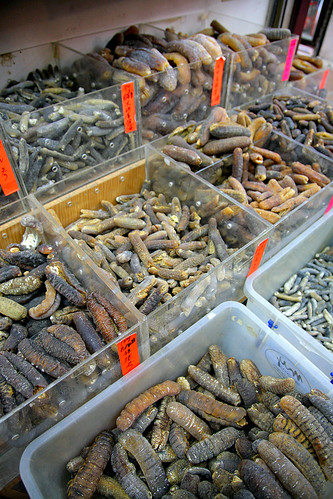
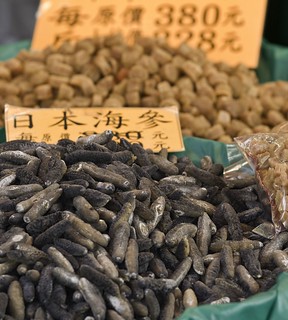
Sea Cucumbers. aka trepang, gamat, or beche-de-mer. Eaten throughout Asia and believed by some to have various medicinal qualities, including tissue repair (some support) and as an aphrodesiac (not well supported).

Holothurians from several different regions, including Alaska, British Columbia, Australia, Madagascar and areas throughout the Indo-Pacific tropics are supported. An update can be found here. Sea cucumber fishery politics can be very contentious. and sustainability of the fishery remains a hot button issue with several species perceived as potentially endangered from overfishing.
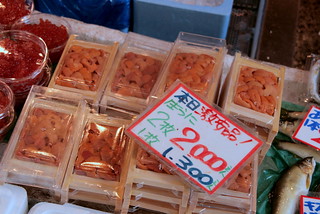
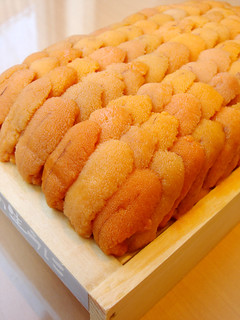
Sea Urchins. Sea urchin gonads are eaten by the Japanese and now throughout the world. Several taxa, including Strongylocentrotus, are sought out for their tasty innards... Sea urchin fisheries appear to have organization. The North Pacific Strongylocentrotus is represented by the Pacific Urchin Harvesters Association. 4. Genetics & Development Recent years have found echinoderms occupying increasingly important roles as experimental animals throughout biology. Although nearly all of the classes have been studied in minor ways , three conspicuous taxa have emerged at the forefront.

The Purple Sea Urchin-Strongylocentrotus purpuratus

By far one of the MOST heavily studied echinoderms in the world. A search on Google Scholar revealed 8,730 hits for "Strongylocentrotus" and "development" with only some 2,740 hits for "Strongylocentrotus" and "genetics". All that plus a recent issue of Science from 2006 which announced the 814 megabase genome of the purple sea urchin (Strongylocentrotus purpuratus). Honestly, how many single echinoderm SPECIES get a whole FRAKKIN' issue of Science devoted to them????? The Asterinidae (Cl. Asteroidea)-particularly Asterina miniata. This odd little group of starfish occurs quite commonly in several nearshore and easily collected habitats. That, plus the keen developmental patterns observed have made several bat star species VERY heavily studied.

When last I checked Google Scholar..some 1850 citations were recorded from JUST "Asterina" (in part a synonym of Patiria) and "development" and some 940 for "Patiria" and "development" with only some 524 for "Asterina" and "genetics". If the "development" hits are combined, that makes some 2790 total.

Asterias spp. (Asteriidae). While not quite in the league of the two groups above. Running "Asterias" and "development" scores an impressive 5, 110 hits but only 979 if run against "genetics" but still....http://www.tolweb.org/tree/ToLimages/Asterias_rubens.jpg

Friday, June 20, 2008

Pycnopodia Friday!!

some videos for your weekend amazement!
Pycnopodia helianthoides (Asteriidae) scares up some sea urchins and ophiuroids en espanol!:


Clam (Clinocardium?) Escaping from Certain Death!


Poking Pycnopodia!!

Tuesday, June 17, 2008

Giant Pink Monsters Among US!!! Enter: Pisaster brevispinus!

Imagine a giant animal that could get to be almost 2 feet across that could sling out tentacles and capture prey a FOOT away from itself!!!

Imagine no further! Enter: Pisaster brevispinus! AKA The Pink Star! The Giant Pink Star! The Short Spined Star! The Giant Short-Spined Pink Star!

One of the three species in the famous genus Pisaster (Family Asteriidae) which occurs on the western coast of North America.
Pisaster brevispinus has two rather famous sister species: P. ochraceus, which everyone learns about when you study keystone species in marine ecosystems and P. giganteus, which is so striking that its hard to miss.

Pisaster brevispinus
occurs between San Diego, CA all the way up to Alaska and can occur in much deeper water than its two shallower sister taxa.

P. brevispinus is a common inhabitant of SANDY BOTTOMS.
The Weirdness

Pisaster brevispinus can HUNT for prey (usually bivalves of various kinds) in the TOP 40 cm of the sand!! That's easily about a FOOT and a HALF!!

HOW does it do that? It has LONG-ASS TUBE FEET!! And dunks them down into the sand! Like this:

(from Sloan & Robinson 1983)

HOW LONG??


P. brevispinus is recorded as being able to extend its tube feet into the sand THE LENGTH OF THE RADIUS OF ITS ARM.

Small to average members of this species can have an arm length of about 6 to 8 inches..but in some GIANT members, P. brevispinus can reach arm lengths of up to TEN TO TWELVE INCHES (that means an overall diameter of almost TWO FEET!!)


That means one of these things with a large radius, can extend its tube feet ALMOST TEN INCHES into the ground!!!

Here we draw on the Echinoblog's extensive computer graphics department to show what this looks like:
(Redrawn from Fig. 6, vanVeldhuizen & Phillips 1978)

Shown here is a diagram of a P. brevispinus specimen with an 11 cm arm diameter showing an almost 8 cm reach!!!!

This species apparently uses its central tube feet in quieter times to hunt for deeply buried bivalves (clams, etc.) and when left to their own devices can get quite big. I've seen these at different aquaria getting almost two to three feet across.

What's even more amazing is that apparently, P.brevispinus can ALSO EXTEND ITS STOMACH LOBES OUTSIDE ITS BODY ALMOST THE SAME DISTANCE.

Velduizen & Philips indicate that it probably doesn't do this easily and only when the food is close to the mouth. But, still...think about it.

Giant Pink Starfish with long tentacular tube feet! What happens when they start getting tired of clams...what happens after that?

What's next??


WHAT HORROR AWAITS US???


Sunday, June 15, 2008

Graduate School: Your Advisor & You

Last week, I got a few more requests to follow up with more grad school advice from the RTP Q&A session. Throughout the summer, I will try to post more information and advice inspired by these discussions on the blog for the benefit of our summer RTP interns and others....
So today I thought I'd write a little about advisors in grad school...

Why is the Advisor important?
When you choose to attend graduate school you essentially need to find a senior scientist who will act as your mentor and/or advocate throughout the time you are enrolled in the program.

The advisor essentially dictates your training itinerary, prioritizes your duties, supports your activities, and works to cultivate your abilities and resources so that you can successfully emerge from the program, whether its as a Doctor of X or a Masters of Z.

The advisor can facilitate your entry into a program, set up your funding, deflect unecessary distractions, and essentially sets the tone and quality of your graduate school experience.
In the most extreme cases, your advisor can literally make you or break you during the time you are a student. That being said, not every student from Dr. Successful becomes the power-house research monster that you would expect them to be and crazy-successful students can result from Dr. Small Quiet School type advisors.

Note, however, that except in some extreme cases, it is nearly always in the advisor's interest to see you succeed. Successful new PhDs and other students demonstrate and further the legacy of those programs and advisors.

What should I look for in an Advisor?
What do you want? Here are some common considerations in no particular order:
  • Will you learn from the advisor (in spite of whatever)??
  • Are they well-funded? Will you need to teach or find money on your own?
  • Does the lab publish extensively? Are there opportunities for you to publish?
  • Does he/she run an active research lab? Or does the advisor train students largely as an educational exercise?
  • What skills will you take away when you are done?
  • If you talk to the other grad students in the lab, do they like the advisor? Hypothetically, the advisor may not be the most pleasant person in the world-but if they are responsible, professional, and do their duty as an advisor, anything more is icing on the cake.
  • If you can talk to lab alumni-did THEY like their advisor?
  • What sort of "vibe" does the advisor have? Micromanager? Responsible? Competitive? Insecure? Elitist? Egalitarian? Creepy? Virtuous? What works for YOU?
  • Does he/she do what you want to be doing? Lots of field work? Lots of lab work?
Some common trade-offs:
  • Busy, crazy-all-the-time, "big-name" advisors with lots of publications, mountains of funding, and a plethora of administrative duties, will seldom if ever have time to see you. You will likely see them regularly but only for relatively brief periods. Post-docs, senior grad students, and other members of your lab will be assigned to watch over you and train you.
  • Advisors with smaller labs and who publish less frequently with overall fewer admin duties might be better mentors but you might have less to help you with in terms of overall prestige and/or obtaining money to support your research.
Support
This is often a responsibility for advisors that occurs on many levels. What's particularly imporant about the support dynamic is that one way or another, students pick up on this as an EXAMPLE of how they will conduct themselves as advisors.

On a pragmatic level, advisors need to support their students through funding. Teaching opportunities. Student grants and fellowships. Travel money. Research Assistantships.

But often, one of the most important consideration of advisors is the simple act of coming through for your advisee and just being there when they need it. This can be as simple prepping the students for scientific meetings presentations and being in the audience. Reading and being prepared for milestone events or regular meetings. Going to "bat" for the student during department competitions or situations requiring an advocate. Being organized in the field. To phrase this a different way, its generally a bad sign if your advisor has come to your thesis defense, hasn't read your manuscript, and has NO idea what you're talking about.

Morale, motivation and a productive/constructive lab tone are also important, but is more difficult to really assess because individual style is so subjective. Some advisors accomplish this by seeding competition within the lab, others do this by creating a family atmosphere, while still others have a friendly but strict, formal production line approach. Some advisors want to be your best friend while others find that a professional mentor-like distance works best.

Advisors & Advice
I often find it good to remind newbie grad students that their advisors provide ADVICE. Your advisor cannot make you do something or say something that you don't want to do. As the grad student, you must take responsibility for your actions and ultimately need to make the call. Bear in mind, that you eventually NEED to make these decisions on your own. Your advisor can help color the factors which weigh into the decisions which may affect your professional development.

Obviously you call upon your advisor because he or she has a lot more experience and insight into potentially delicate or unknown situations and he/she can provide some guidance. To me, its often the advice or wisdom that you can't get out of a book or read someplace which makes your advisor most valuable.

The downside to advice is that it can be colored by the indvidual perspective, conflict of interest, or professional baggage that your advisor has accumulated. Your advisor might be from a different generation or training regime and be unfamiliar with the tone needed to make the decision.

A Good Advisor
In my opinion a good advisor has done his/her job if he/she
  • helped you get a job
  • made you think
  • challenged you and made you more than what you were before
  • is now one of your professional colleagues
  • gave you good research opportunities & taught you how to find more
  • gave you modern, useful research tools & training
  • gave you some wisdom

Back to Echinoderm Goodness by Wed or so...(I hope!!)

Thursday, June 12, 2008

Starro the Conqueror....hiding among us???

Many of you may be familiar with my fascination for the DC supervillain/monster Starro The Conqueror.

Well, much to my delight, I was able to add this wonderful new species to my collection of echinoderm oddities.


Interestingly, Starro has a carinal row on each arm and five primary spines the way many oreasterid starfish do.

And with the arm shape and distinct spine pattern..could Starro the Conqueror be among us? Disguised as....

Poraster superbus???

Tuesday, June 10, 2008

The Helicoplacoidea: Bizarr-O Morphology, Living in Slime & Death by Dirt

In 1963, a bizarre new class of Echinodermata was introduced to the world in the pages of Science by the two legendary invertebrate paleontologists J. Wyatt Durham (shown below), from UC Berkeley and K. E. Caster from the University of Cincinnati.


Weird could not have begun to describe this.... animal. Durham & Caster described one genus, Helicoplacus, which included two species. Other pertinent details include:
  • Round, spindle-shaped body with a spiral coil.
  • From the Lower Cambrian
  • Free-living echinoderm with an expansible test!!! This weird thing could EXPAND like a frakkin' accordion. There are apparently hinges on the lateral plates that strongly suggest that these things would allow the test to expand!! Like a big pulsating heart or tomato!! How's THAT for blowing your mind away.
Helicoplacoids defied the conventional definition of what had been considered an echinoderm.
They were pretty small (about 5 cm-see the penny for scale). Some got bigger but not much more so. (thanks to Dan Blake for some of this information)

They were ASYMMETRICAL and did NOT have your typical echinoderm 5-part body plan. They did seem to clearly have the unique calcium carbonate skeleton (i.e., the stereom) that was unique to most echinoderms. Except that in these beasts, it was arranged into bizarre spiral patterns around the body. Hence the name "helico" meaning spiral or helix and "placoid" meaning plate.

Over time, much more diversity was discovered and today the Helicoplacoidea includes 3 genera: Helicoplacus, Polyplacus and Westgardella which contain 9 species. (Taxonomic review here)

Ecology


Its thought that helicoplacoids were suspension feeders, using several tube foot grooves which formed multiple channels leading up to the inevitable mouth somewhere on the body surface.

You know things are getting weird, when people start debating where the MOUTH is located.

The Cambrian Substrate Revolution

Helicoplacoids lived in the Cambrian. Why was this interesting? See this paper for a good summary.

That's because, during this time, the physical environment of the world was VERY different from what it is today. For example, the substrate (i.e., the dirt, sediment, mud, etc.) that these animals lived in was not very dynamic. Very still. Non-actualistic.

Up until then, there were no little creatures burrowing up and down through the sediment. Nothing creating burrows. Nothing contributing to the dynamic fabric that is the substratum we know today.

PLUS, it was covered in sort of a yogurt or cheese-like film or covering of MICROBES (what kind of microbes is another question).

(there was PLENTY of this. thanks again to Flickr)

Helicoplacoids sat with the spindle-end down, essentially suspended in these bacterial mats like living, suspension-feeding potatoes!

And because we spare NO expense in your education..here is a highly detailed graphic reconstructing how helicoplacoids may have lived. with mouth labelled.

The black lines indicate feeding grooves, which were open to the water around them and were apparently absent on the surfaces of the body which were directed below the outward wurface..

Its thought that when all of this changed i.e., The Cambrian Substrate Revolution, began with the advent of bioturbation and the mixing of sediment by little critters, mixing up different layers of sediment creating little waves of sediment and water, etc.

This began a major ecological shift that ultimately did no favors to the weird things that had become adapted to living there. Did this shift cause or at least greatly affect the Helicoplacoidea? Some believe so.

Phylogeny


Perhaps the most immediate question that arises is: How do you get such a funky looking animal? and how does it fit into the grand scheme of the Echinodermata??

(from Mooi & David, 1998-Helicoplacoids shown in red box)

To be sure, plenty of ideas exist. But one thing seems to be consistent across different phylogenetic ideas. Helicoplacoids occur down at the very base. Early forms that explored morphologies specialized to very specific habitats.

One idea by James Sprinkle and Bryan Wilbur from the University of Texas hypothesizes that helicoplacoids are derived from edrioasteroids but have undergone a striking change in plate geometry and overall shape. Edrioasteroids were a widespread Paleozoic group of echinoderms with a more conventional five part symmetry but which looked like little biscuits. Sprinkle and Wilbur's hypothesis is represented below:

(from Sprinkle & Wilbur 2005)

Sunday, June 8, 2008

Choosing & Understanding Graduate School

So, on Friday, I was a member of a Q&A panel for the Smithsonian's Research Training Program (RTP) in the National Museum of Natural History where, I helped to answer a the questions from some very bright and enthusiastic young people who have interests in pursuing careers as scientists in the "Natural History" field-systematic biology, mineralogy, paleontology, entomology, botany, etc. Basically, if you want to study echinoderms, this is the stop for you!

A lot of regular questions and misconceptions come up ever year I do this, so I thought I would share some of my advice and comments with everyone since I have spent some 8 years or so in grad school!! I went to San Francisco State University for my Masters in Marine Biology and got my PhD in Geology at the University of Illinois at Urbana Champaign in Illinois.

Please bear in mind that this is advice for people interested in the types of sciences indicated above-academic research in the natural sciences. What I know, wouldn't be as helpful for someone seeking to pursue a more distant type of grad program, like say, Humanities, Med school, Business or somesuch thing.

What is Grad School like?


Graduate school is very dissimilar to being in an undergraduate program for a variety of reasons.
  • Your time is largely unstructured. You have some classes but they don't own your time the way that undergraduate classes do. You might take 2 or 3 classes a semester but you'll have sometimes whole days left to your judgement. The program will also have high expectations of your performance. Getting an A or a B is what any instructor will expect of a grad student in their class. All of that unstructured time does NOT mean you won't have anything to do! You'll be teaching, taking care of research, working for your advisor or any number of other independent tasks.
  • Your overall priorities are different. As an undergraduate you are treated like a "customer" in the school program (the school serves you)-but as grad student you become part of the institutional fabric. You are committed to the program. You become, in a sense, indentured to the school. You are a resource. A talent. There are obligations to the department that you must meet as part of your service commitment.
How do Masters and a PhD programs differ? Which one should I get?
  • Time Investment. Most major universities with a well-developed research program will prefer their students to enter into a PhD program (usually about 5-6 years). They often have options for a shorter Masters (about 2 years) program. But for most professors, training a grad student for a 2 year program, which results in one or maybe two publications, is less fruitful then training a student for a 5-6 year program, which results in someone with more publications and overall experience. Many schools will grant a masters to people who don't complete the PhD program.
  • Getting a Masters first can be good preparation. Unsure about how much of a commitment you can make to grad school? It might be a good idea to go to a either a smaller school or a smaller program and take 2-3 years for a Masters to figure out if you like it. For many students, it can be an easier transition to ease into a 2 year program rather then to jump head first into a 6 year commitment with a PhD program. Many undergraduates I've met are often traumatized by the abrupt shift from being an undergrad to a PhD grad. Some are fortunate to have the focus and drive to do the PhD program immediately. Getting a Masters first, can also give you a lot more experience before you actually apply to a PhD. I was much more comfortable with my PhD surroundings than many of the students around me.
How will I pay for graduate school?
  • It is the school's responsibility to fund its grad students.For most science programs, it is typical for that school to provide SOME way to fund its students. Most science departments I have seen in sciences will waive the tuition fee for their grad students. Because of this, most programs limit the number of students based on how much money they can obtain to support the number of students in their program. Some will end up being Teaching Assistants for their lower-division classes. Others will be fortunate enough to have a Research Assistantship, performing research tasks for their advisor. You might even be lucky enough to have a Fellowship or some other grant that will only require your thesis or dissertation research with no outside responsibilities!!
  • Other funding. Aside from teaching, a diversity of methods are available for domestic students. Financial Aid loans. Work study. But these should be secondary sources of funding relative to the above.
How should I select my graduate program??
  • Think about the advisor that you want to work with. A lot of people sort of figure that choosing a grad program is like picking a undergraduate degree program...i.e., "I want to go there because there is a generally good reputation for teaching, etc" But there's usually a SPECIFIC focus for working on something and a SPECIFIC person or persons involved. Unless you have very broad interests it will make your life difficult to just go to a department and hope that there's someone there doing something you will find interesting. When you look into grad school-it's about YOU and YOUR specific interests. You want to work on crinoid ecology? sea urchin paleoecology? deep-sea sea cucumbers? Try and find out who the professional experts are in those fields and go to them. Researchers are almost always receptive to having students so don't be shy about contacting them directly.
  • How is the program? What do you want to accomplish while you're there? Education? Research? Is the department well-funded for research? Mellow but good with teaching? Will you be professionally alone, aside from your advisor? Or will you be in good company. In other words, if you want to study sea urchin paleoecology and your advisor is in a Geology department-does that department have a big Paleontology program? Or is your advisor the only paleobiologist amidst an ocean of geophysicists?? Are there other people you can work with?
  • Having an advisor as contact will work for you when you apply. Most grad programs still require the requisite battery of GRE scores, good grades, and application materials. If you have contacted a person who wants you to work in their lab, they can vouch or maneuver your application through the application process. Your advisor can also give you the heads-up on funding and/or other importants facts of grad school before you apply.
Should I go to the same graduate school as my undergraduate?
  • Probably not. Generally speaking most schools and programs don't look upon it favorably that you got your undergraduate+graduate degrees at the same place. Its interpreted as a sort of academic inbreeding. You don't get to see integrate and learn how other schools and programs differ from the one you began in. This is not to say that it can't be or isn't done-but as a general rule, its considered a good move that you have more academic outcrossing then less.
How do international programs compare with domestic?
  • US programs are longer and often more involved. Schools around the world vary but from what I've seen-PhD programs in Europe, Australia and New Zealand fund you for about 3-4 years to do nothing but your research and then they cut you loose. No teaching commitments or very many of the other travails that you get with a US program. US PhD programs are filled with more distractions, including regular teaching commitments and more involved course work.
There's certainly more which I've missed...and I may follow up with another similar post. But was there another question about grad school? echinoderms? Ask the Starfish man!

Weird Echinoderm stuff to return soon!!

Saturday, June 7, 2008

Starfish on the Brain...and being consumed by your work..

Portrait of echinoderm biologist in the Smithsonian NMNH Gallery (ID available upon request). Readers, this was done by professionals. Do NOT attempt this on your own!

(Starro the Conqueror from Justice League 190 by Brian Bolland fom the Grand Comic Book Database)

That's right..they are SLAVES to those starfish!! Resistance is futile.

(Starro the Conqueror from Justice League Europe 26 by Bart Sears fom the Grand Comic Book Database)