Showing posts with label crown of thorns starfish. Show all posts

Thursday, July 28, 2016

The Crown of Thorns Starfish in Macro! Acanthaster planci? or alien landscape?

Acanthaster plancii détail

Today as I was scrolling through the many years of posts I realized that I have NEVER written about the Crown of Thorns starfish, Acanthaster planci!  If you don't live in the Indo-Pacific you might not realize that this is actually one of the most heavily studied starfish in the world!  There are whole BOOKS written just about the biology and ecology of this single starfish species! 

Why? What makes this species so important?
This starfish is a voracious coral predator!  It just extends its stomach onto the fleshy tissue of a "hard coral" (i.e. scleractinian) and a little while later, only the "cleaned" skeleton of the coral remains! 
If it was a reasonable number of these animals feeding on coral, it would actually be healthy for the ecosystem. Predators control community structure and are important to ecosystem function..

The thing is though that this species, for reasons which have been studied since the 1960s, have undergone sporadic and localized HUGE population explosions! Their incredible abundance results in the wholesale LOSS of complete coral reefs! 
 Crown-of-thorns starfish

They have become especially infamous in the Great Barrier Reef and to many Australians who have become accustomed to physically destroying them on contact. They actually have developed ROBOTS to seek them out and destroy them.. 

So, unlike most starfish, they aren't very popular....

The Beauty of the Beast...


Image from Wikipedia, taken by Jon Hanson, in Thailand: https://en.wikipedia.org/wiki/Crown-of-thorns_starfish#/media/File:Crown_of_Thorns-jonhanson.jpg
Here's the thing though. In spite of all the hate that gets laid on these animals.. I STILL think they are kind of freakin' AMAZING! 

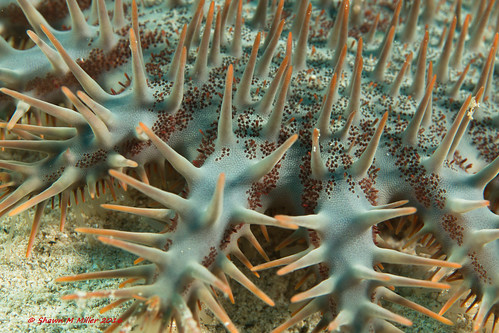
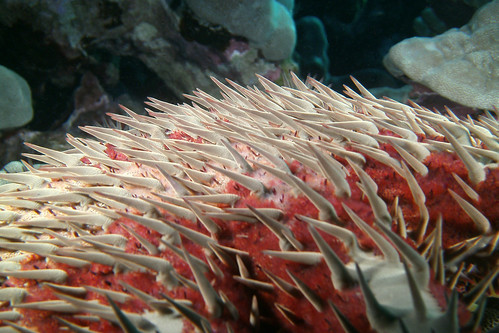
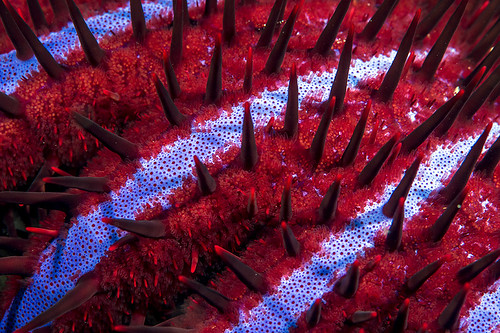
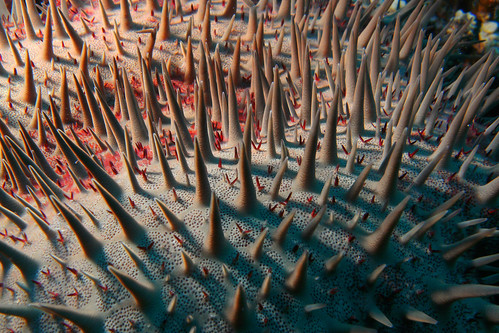
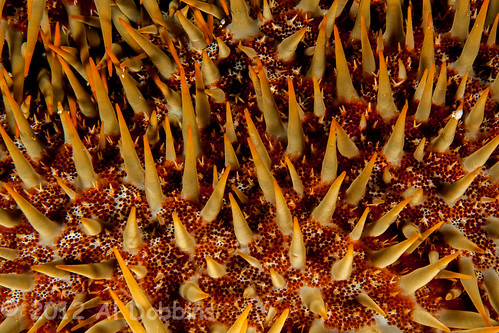
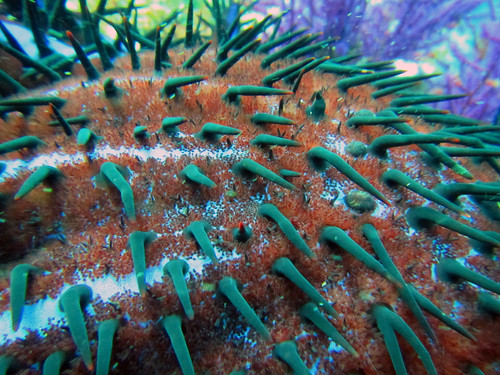
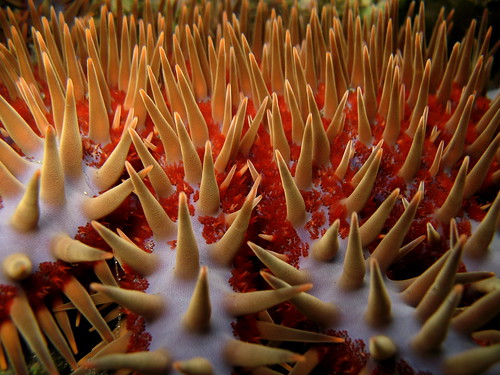
So, today, I thought I would exploit the wonderous world of Flickr and show off some of these spectacular macro shots displaying the surreal surface of these animals...

The crown of thorns occurs across a WIDE range. From Baja California to Hawaii and Japan and then down to the east coast of Africa in the Indian Ocean. The range of colors is similarly vast! Its not entirely clear if these might represent separate species or perhaps represent some other kind of variation based on the environment. Perhaps food? growth? Difficult to say...

But genetics DOES indicate that there are multiple "cryptic species" across this animal's wide range in the Indo-Pacific..

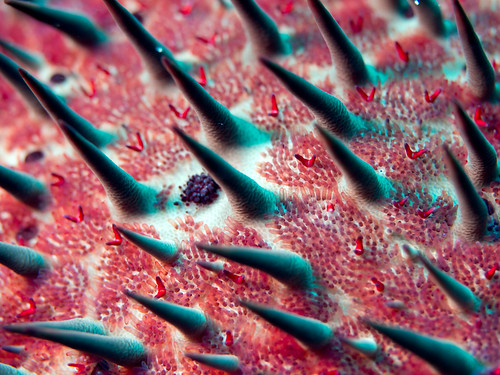
The big thorny bits are of course, the spines.. the dark dots on the surface are the papulae  (or gills) and if you see little white or dark beak like structures, those are called pedicellariae whose function in these animals is not entirely clear... But likely some kind of "in close" defense against parasites or what have you.... 
Crown of Thorns Sea Star

Crown-of-Thorns Sea Star
Crown of thorns closeup - Okinawa
tunguska
Crown-of-Thorns Sea Star (Acanthaster planci) from Aliha Giri.
Close-Up Thorns
crown-of-thorns star: Acanthaster planci
Close up picture of a Crown of Thorns Starfish (Acanthaster planci)

and the ANUS of course! That's the dark spot, probably surrounded by spines...  this shot is nice because it not only shows off the papulae (the gills) but also the pedicellariae (the red tweezer like structures)
Crown of Thorns Sea Star Center Close
Crown-of-Thorns Starfish - Kailua-Kona, Hawaii

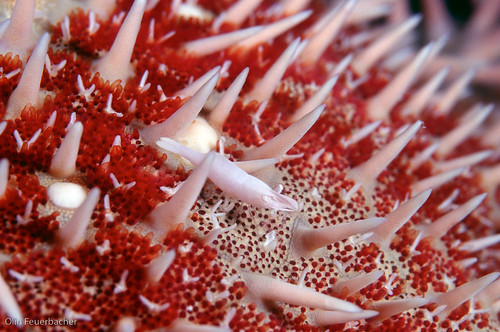
As one finds often time in nature.. you have some big animal with lots of complex surface textures.. so are there animals to take advantage of it! Shrimps often live closely and among the spines on the animals' surface...

here are tiny shrimps.. some in the genus Periclimenes...
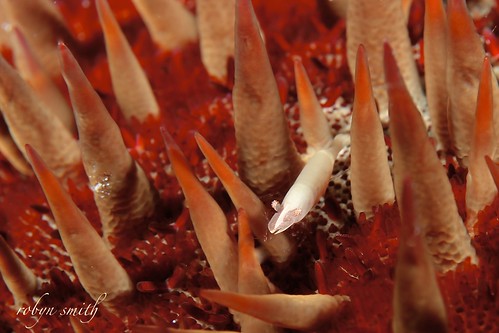
Sea Star Shrimp
Periclimenes soror on Acanthaster ellisii

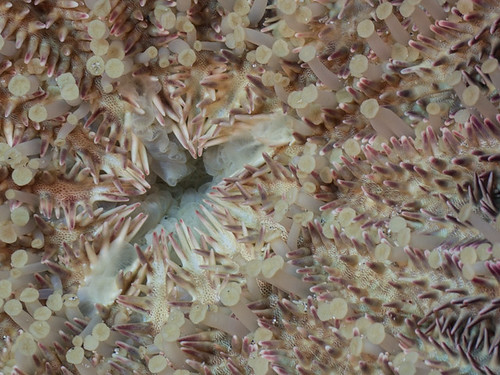
And the ORAL surface!
Strangely enough, the top surface of Acanthaster is remarkably well known but how many people have actually seen the ORAL surface where the mouth is???


In addition to the tube feet all converging at the mouth, you also see the oral spines projecting into the mouth itself! 
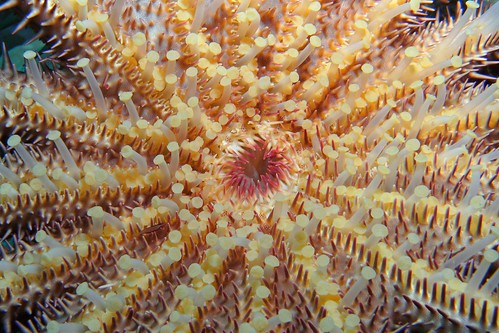
Side B
and in this one, you can actually see some of the cardiac stomach below the purple spines...
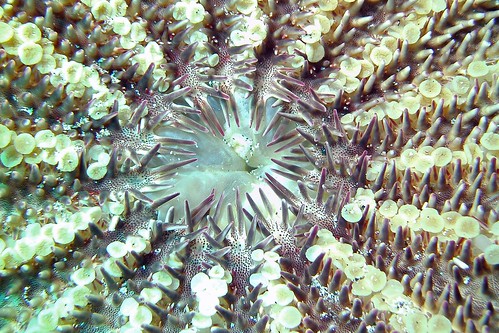
upside-down crown-of-thorns
Crown of Thorns sea star (Acanthaster planci)
Crown Of Thorns Sea Star

And a video to top it all off!


At some point, there will be much, much MORE about the Crown of Thorns! 

Tuesday, May 24, 2011

Worm+Shrimp Versus Crown of Thorns! aka the Importance of the Little Guy!


This week, I am a featured Guest Blogger for the great folks at the Ocean Portal Smithsonian NMNH Website! Click here or on the pic above!

I write about one of the world's most well-known sea star species, the Crown of Thorns aka Acanthaster planci! So, here on the Echinoblog-I thought I would give you a little something extra about this dazzling and spiny beast!!

An epic skirmish between this huge monstrous toxic, spine-covered monster VS. a crazy colored shrimp and a pugnacious polychaete worm!!

First-a little introduction.

They occur on coral reefs throughout the tropical Indian and Pacific Oceans and occur from the west coast of Mexico and central America, north up to Japan, south to New Caledonia and westward to the east coast of Africa.
They are abundant but are also ecologically quite important. Because, not only are they big predators of coral but they are themselves FOOD (and prey!) for other invertebrates in the tropical reef ecosystem!

There are actually a surprising number of animals that feed on the Crown of Thorns Starfish (including giant snails and fish), but today we deal with two tiny but very important predators and the potential impact they may display!

Data for the below comes from work by Peter W. Glynn on populations of Crown of Thorns in Panama (Pacific side) from the Bull. Mar. Sci (1984) and a paper from the Proc. of the 4th International Coral Reef Symposium in Manila in 1981 Vol. 2: 607-6712.

1. The Shrimp! Meet: Hymenocera picta.

H. picta
is known commonly as the Harlequin or Painted Shrimp owing to their very eye-pleasing designs and colors..

But this hides their TRUE murderous nature! This species and several of its relatives are predators on starfish and other echinoderms..Here is a video of one in action feeding on a hapless ophidiasterid... As you can see, they are pretty vicious little crustaceans!
It was estimated by Glynn that the attack frequency on average varied between 3.2% to 7.7% relative to the number of sea stars present. (this could be as low as 0 but as high as 20%!)
(Fig, 2 from Glynn, 1981)

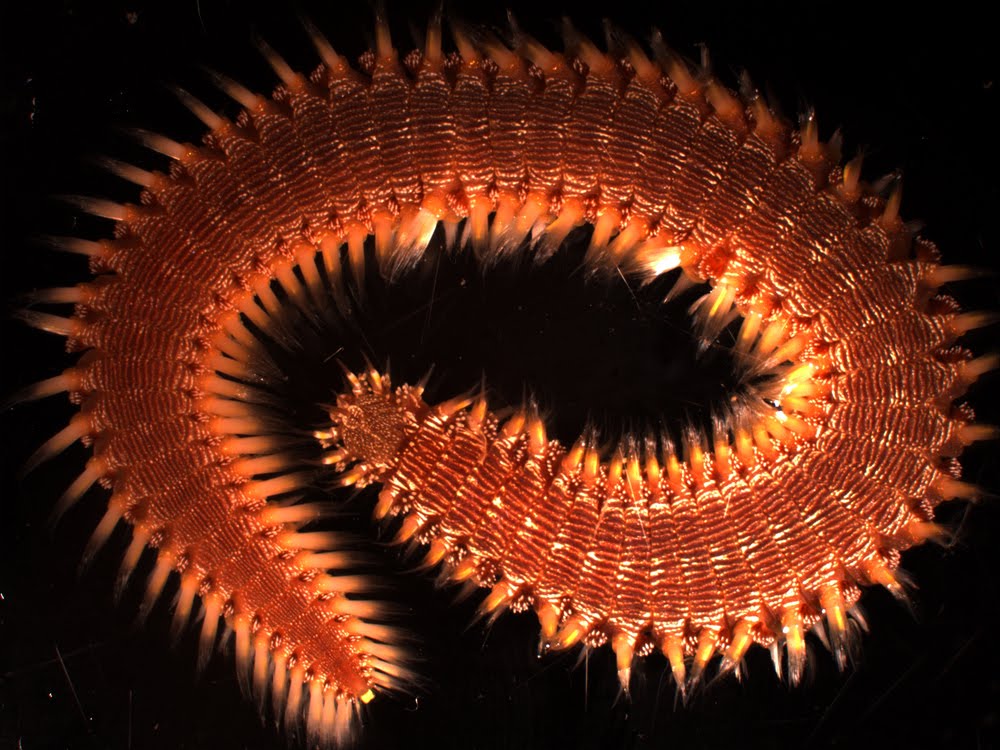
2. The Worm! Meet Pherecardia striata- an amphinomid polychaete worm....with a vicious streak!

Pherecardia striata is an opportunistic omnivore/predator, feeding mostly on algae and detritus-but is also heavily into grabbing and eating crustaceans, mollusks and echinoderms (including other species of starfish) as they become available..

Worms such as these can be quite abundant. Although Glynn did not sample the whole population, sampling recovered many individuals. Based on Glynn's sample, there were from 90 to 380 individuals per square meter of reef!!

(photo by Gustav Paulay, image from CalPhotos)

Similarly, Glynn estimated that the mean attack frequency was about 6.5 % (ranging from 0 up to 25%! of the population studied).
(Fig. 3 from Glynn, 1981)

3. The Action! What happens is this:

FIRST-the shrimp (H. picta) attacks the starfish-tears apart the sea star's surface or dismembering one of the arms. Basically creating some prominent tear in the body wall..

THEN-the worm picks up on the opening and DIVES INTO THE wound/open body wall!!

Pherecardia then proceeds to attack the starfish from the INSIDE!! They enter into the body cavity and begin devouring its various guts! In other words- the pyloric caeca, gonads, water vascular system and so forth..

Sometimes, there can be anywhere from 10 to 18 worms INSIDE a single Crown of Thorns!
4. The Impact!
The relative frequency of COTS that are attacked by both shrimp and worm was pretty low (about 0.6%) but very effective. Based on their observations of wounded Crown of Thorns taken to aquaria, individuals attacked by both shrimp and worms died within a week..

Glynn actually found that the correlation between COTS abundance (i.e., the number of individuals) and shrimp attacks showed an INVERSE relationship (i.e., number of starfish goes down when shrimp attacks are up)!

So, shrimp attacks were MOST frequent when Acanthaster was LEAST abundant.

(there is alternatively the possibility that there was an explanation for the relationship owing to statistical bias of having too few sea stars)

Glynn points out that BOTH Hymenocera and the worm Pherecardia are VERY abundant on the coral reefs in which they live.

So, even if the attacks frequency was not very high-these predators would be very effective and potentially affecting COTS populations (at least in localized regions..)

Glynn goes so far as to imply that populations of East Pacific (i.e., Panama) Acanthaster planci might well be kept "in check" by the constant attacks (and feeding) on the COTS created by being constantly under attack by these tiny but abundant little predators working in tandem!

and if by chance you can only understand tropical Pacific ecology using Star Wars analogs, then you are in luck! Think of it this way...

Millenium Falcon = the Harlequin shrimp Hymenocera picta
X-wings = the worm Pherecardia striata
Death Star= Crown of Thorns Starfish Acanthaster planci

and watch this....

That's the basic message. :-)

Monday, December 29, 2008

2008: The Best Crown of Thorns Video Awards!

Because you demanded it! The Best (and so far..only) Crown of Thorns (aka COTS)- (Acanthaster planci) Videos that I have featured of 2008!!

Let them inspire you as they have me!


COTS On the Move!


A neat close up of the MOUTH and oral surface of a COTS


How many COTS videos come with a soundtrack and a long essay about how beautiful they are?


here's the giant Triton Charonia in a life and death struggle with the COTS!