Showing posts with label cidaroids. Show all posts

Wednesday, October 7, 2015

Some great Macro Shots of shallow-water Tropical Urchins!

So, after all that deep-sea stuff, I thought this week might be a good moment to look at some tropical, shallow-water species....

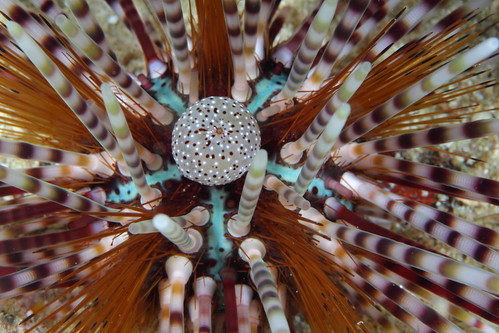
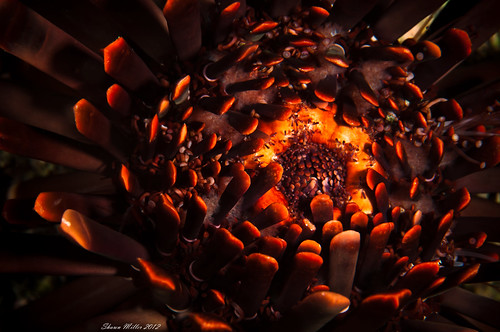
Stunning image of the cidaroid Plococidaris verticellata by Shawn Miller
Plococidaris verticillata, sea urchin

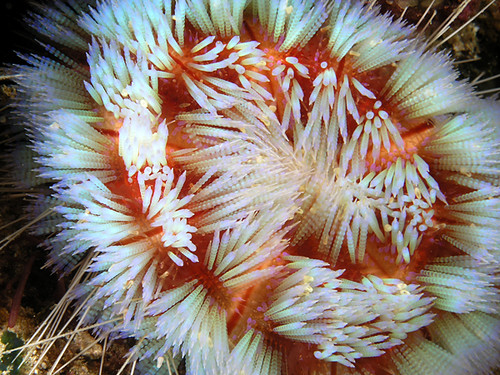
A fire urchin (probably Asthenosoma) from Puerto Galera, Philippines
Puerto Galera - Fire Urchin
More fire urchin love!
fire urchin

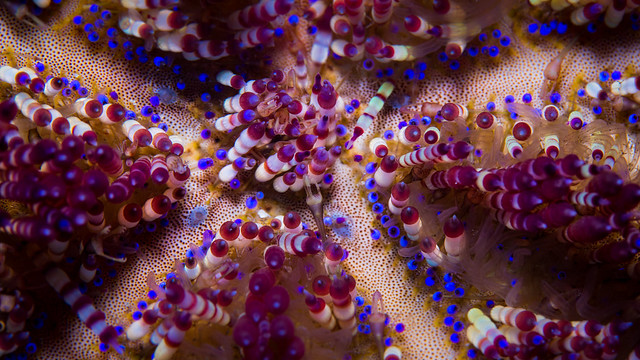
A magnificent anal sac in Astropyga
Seaa Urchin
Another anal sac from a diadematid urchin..
Urchin

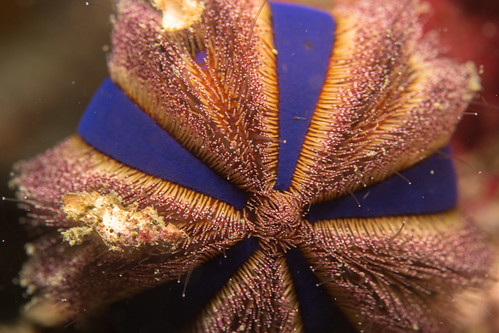
Details on Mespilia globulus!
Reaching Out

The slate pencil urchin Heterocentrotus mammilatus..or swirling maelstrom of the ELDER GODS?
Pencil urchin  - Heterocentrotus mammillatus
What lies beneath? the teeth from Aristotle's Lantern! 
Mouth of a Pencil Urchin

Tuesday, August 27, 2013

The Sea Urchin Skeleton as Art! Natural and Enhanced!

Coelopleurus exquisitus Coppard & Schultz, 2006
There is a natural and wonderful symmetry to many natural objects and echinoderms have always had a certain appeal to folks with artistic natures. Their skeletons are pentameral and often have no shortage of patterns and visually interesting processes. Go here to seem my SEM odyssey of the urchin test!

Sea urchins are no exception to this-and everyone I know who has ever found an intact sea urchin (or sand dollar) test on the beach is always delighted. A "test" is the name of a sea urchin skeleton. They don't have "shells".

Here's a nice example of a cidaroid sea urchin test. The spines attach to the "knobs" (called bosses) that are present on its surface.
Sea Urchin Shell
sea urchin test by Rainy City
Today, I thought I would present some of the many delightful examples that many of these tests have found their way into the creative processes of the wonderful artists on the Internet!  Then compare below with some examples of sea urchin tests with their own innate artful patterns!

Cidaroid Urchins a la Warhol! by Calypso985
Urchins a la Warhol
A stunning underlit cidaroid urchin test by Mark Bolles
Pencil Urchin Shell on White Plexi
A neat repeating Urchin Spiral by Jeff Kreulan 
Urchin Spiral
"Red Tide" part of an art exhibit featuring urchins with a distinctive presentation. Pic by Selene Vomer
red tide
"Algae Bloom"   Image also by Selene Vomer. Chicken skeleton over urchin skeleton. Hm?
algae bloom
"Phosphorflock" Pic by Selene Vomer. I think its supposed to represent some kind of egg?
phosphorflock

Here it is illuminated...
the sea urchin up close
Image by tiboutoo

Illuminating or highlighting urchin tests with lights, lasers, fluorescence is a common theme...

An illuminated urchin by gmenut
Urchin

One lit up with fluorescent lighting... "Voodoo Moon" by Sea Moon
Voodoo Urchin...

"Sea Urchin Laser Fluorescence" by Bob Fosbury
Sea Urchin laser fluorescence


And there's this stop motion classic "Javelin" by Ian McAlpin


Natural Beauty  In contrast, here's some tests in their natural glory...

a cidaroid test by gripspix1
Cidaris 1


Another urchin test. Image by "fontplaydotcom"
shell 6


The test of Coelopleurus exquisitus, a recently discovered New Caledonian sea urchin species, described by my colleague Simon Coppard, who found tests of this species on Ebay a few years ago!

Amazingly, the patterns? ARE NATURALLY OCCURRING. Those are on the test under the spines and all of the other structures and skin on the surface! They don't disappear after the animal has died. They are ingrained in the mineral structure of the test.

Both images below are by Simon Coppard
Coelopleurus exquisitus Coppard & Schultz, 2006


and we didn't even get started on Irregular urchins like Clypeaster and the other Sand Dollars..
Sea urchin


Tuesday, November 20, 2012

Paris! Sea Urchins or Street Urchins?

This week, the Urchins of Paris! 

Wait, what?  Do you mean those delightful scamps that run around making mischief in the streets ??
Not street urchins-but oursins!  Or Sea urchins! (tests-the dried internal skeletons shown here)
This week:  some of the rich and diverse holdings of the Museum national d'Historie naturelle!

Sea Urchins (oursins!) or members of the Echinoidea are of course-the echinoderms that look like a big spiny ball (this includes sand dollars and sea biscuits!).  Sea urchin specimens comprise  an incredibly diverse (and important) collection in Paris with holdings from all over the world-especially from the tropical Indo and South Pacific! Undoubtedly many new species await description! 

So for example here we have the very incredible looking Chondrocidaris gigantea
                                        

Others from the tropics are distinctive and RED but remain sadly, unidentified. Is this a new species awaiting discovery?? 


In addition to the above "regular" urchins, here are some cleaned tests (again-the skeleton of an urchin with all the spines removed) of some "irregular urchins" (distantly related to sand dollars).

A test of Schizaster edwardsi from the Atlantic...
                                              
I believe this one was called Breynia but not sure which species.                                                                        
                                             

But why limit yourself to enjoying only the outside of these skeletons when you can go INSIDE??   No-not x-rays...but old-school careful dissection...

Here's the Atlantic "sea biscut" Clypeaster rosaceus with the "top" completely removed..
 showing the internal struts around the mouth...
 Go ahead and take a walk around inside a sea biscuit!
The long history of the museum permits me to share with you some display mounts from a bygone era...

These are the individual spines of various species mounted on one plate each. These are easily 100 years old and are possibly MUCH older... probably from the 1800s...


Here is a vintage 1894 specimen collected by the sea urchin researcher Gustave Honoré Cotteau (he died in 1894 so this is probably just a note indicating the specimen is part of his collection).
                                     
Here is a brief summary of who he was (in French)  A short summary translation of his bio (some edits for clarity):
Judge, naturalist, geologist.
Gustave Cotteau made ​​a career in the judiciary while devoting himself to paleontological studies. It was a judge in civil court Coulommiers civil court judge in Auxerre (1867), and retired in 1874.
As a scientist, he devoted himself to the research and study of living and fossil echinoids, which he had a collection of over 500 species. With numerous articles in newsletters and journals of learned societies which he belongs, he continued the publication of the collection founded by Alcide d'Orbigny in 1840, Paleontology French. He was curator of the town of Auxerre.
Secretary-General of the Institute of Provinces, responsible for publishing the reports of international conferences of Prehistoric Anthropology and Archaeology and the annual reports on the progress of geology and paleontology in France from 1858 to 1869...
You can check out some of Cotteau's work at the Biodiversity Heritage Library site HERE (for free download). But Cotteau was a prolific author and wrote MANY classic texts on fossil echinoderms.

Okay! Now time to go get some Turkish Delight! More next week!