Showing posts with label evisceration. Show all posts

Tuesday, February 7, 2012

Sea Cucumber Defense Pt.2! Evisceration of Cuvierian Tubules!

Sea Cucumber defence 2
Image from Adam Broadbent on Flickr

Last week I wrote up a general overview of evisceration (and regeneration).

Evisceration is a general term that describes the expulsion of how SOME sea cucumber's "viscera"-intestines, respiratory structures, gonads, etc. (varies with time of year and presumably the species) is EXPELLED through the body wall. Here's a nice video that shows what that looks like..


In many cases-this is interpreted as a defense-but as you read last week, there is some evidence that evisceration can also serve to aid in excretion of waste and to aid in other bodily functions. Some have hypothesized that evisceration serves to expel parasites, such as these lovely pearlfish! That live in the cloacas of sea cucumbers! (Read more on that here and re-live the glory of anal teeth!)

But if we get away from the general phenomena of evisceration-we can focus on the defensive ecology!! Specifically in tropical sea cucumbers in the Aspidochirotida (and I believe only in the Holothuriidae) which have special organs ONLY for eviscerating!

Enter: What are Cuvierian Tubules!
These organs are known as Cuvierian Tubules! Cuvierian Tubules (named for their discoverer-the French zoologist Georges Cuvier)


Cuvierian tubules are branching structures that occur on the respiratory tree (seen above in blue) of sea cucumbers.

They branch off the respiratory tree and are expelled through the body wall at oncoming predators, such as fish, crabs, or predatory echinoderms, such as sea stars. But how effective are they? How do they work? How do these affect the sea cucumber's day to day ecology?

Ecology and Defense
Much of the information used in this section is taken from an excellent paper by Jean-Francois Hamel and Annie Mercier in Marine & Freshwater Behaviour & Physiology 33: 115-139 and this: physiology and regeneration oriented papers by Didier Vandenspiegel, Michel Jangoux and Patrick Flammang in Biological Bulletin (2000). and this: Patrick Flammang, Jerome Ribesse and Michel Jangoux in Integrative and Comparative Biology 42: 1107-1115.
Hamel and Mercier studied the efficiency of Cuvierian tubules in 3 species of tropical sea cucumbers (note that idents were taken on face value from labels-but used for educational purposes)

Bohadschia argus
Sea Cucumber - Bohadschia argus - PC092244
Holothuria leucospilota
Long black sea cucumber (Holothuria leucospilota)
and Holothuria marmorata (also called Bohadschia marmorata)
Bohadschia marmorata

Some ecological dynamics...

  • Cuvierian tubules are "shot" from near the anus and so aim is directed at the threatening stimulus.
  • The oral tentacles or mouth seems to be most sensitive to being threatened. Whenever the mouth was stimulated (i.e., threatened) the animal would retract the tentacles and arch the body to orient the anus towards the "stimulated" area. Water was taken in through the anus followed by expulsion of the Cuvierian tubules with expelled water.
  • Interestingly-the slowest reaction by the animal ended to be if it was stimulated or provoked around the anal region. Maybe the rear regenerated more readily??
  • Cuverian tubule "stickyness" was most effective on slower moving predators such as crabs, snails and sea stars (87-100% targeting success). This was generally not as effective against fish (5-35% targeting success)
  • (Fig. 1 from Flammang et al)
  • Lab trials showed that if a potential predator was touched by Cuvierian tubules-about 96% of those predators avoided the sea cucumber for about 3 days.
  • If the sea cucumber LACKED Cuvierian tubules then those individuals were devoured or bitten to death at a higher rate.
  • Tubules that did not ultimately stick to a a surface can be quickly pulled back in or retracted.
  • Even if Cuvierian tubules have been completely exhausted, the other viscera can STILL be used as a defense.
  • Regeneration of Cuvierian Tubules took 15 to 18 days (so about 2 weeks-with complete regeneration in up to 5 weeks)
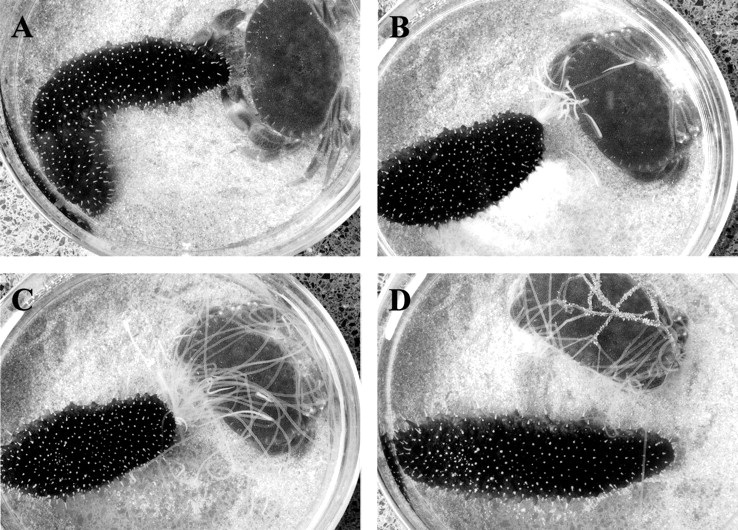
Flammang and his associates found that tubule "tenacity" or the adhesive strength varied with the surface it was in contact with, temperature and salinity of sea water and the time following expulsion from the body.
Sea Cucumber defence 2
Image from Adam Broadbent on Flickr

Regeneration of Cuvierian Tubules

There's a whole blog that is to be written about all of the various dynamics involved in sea cucumber regeneration.

But what it comes down to is that there are many cells which are "undifferentiated" that is-their use in tissue has not yet been determined by the body's needs.

These "proliferate" or become more numerous and as regeneration begins, these undifferentiated cells decreases and the "specialization" or "differentiation" of cells begins to replace the lost tissues (i.e., the Cuverian Tubules).

Vandenspiegel, Jangoux and Flammang summarized the strategy for Cuverian Tubule defense and regeneration very eloquently and so I repeat it here:
Holothuroid Cuvierian tubules thus constitute a very efficient defensive mechanism. Indeed, in addition to their remarkable structural organization, which accounts for their adhesive and mechanical properties, their large number, sparing use, and particular regeneration dynamics also make them an almost inexhaustible line of defense maintained at limited energy cost.

Tuesday, January 31, 2012

Sea Cucumber Evisceration! Defense! Regeneration! Why? GROSS!

(From the Echinoblog Art Department!)
So, you've probably heard of this.

EVISCERATION! Explodoing Guts! One of the things that sea cucumbers (class Holothuroidea) are probably best known for when you learn about them at aquaria and in introductory marine biology classes!

Sea cucumbers are, of course, the "worm-like" echinoderms. They usually eat fine mud or organic goo and are composed of 3 main parts!
First-a mouth (surrounded by tentacles)
Second-some guts!
Third-a second hole for spewing out what doesn't get eaten!
You wouldn't think that something so seemingly basic-would be capable of so many WEIRD ass things. But as we'll see they are.

Information from today's post comes from 2 primary sources: 1 from a review by Jose Arraras and Michael Greenberg and a second paper by Maria Byrne from 1985 on evisceration in the west coast sea cucumber Eupentacta quinquesemita! (abstract here)

What is evisceration?

A sea cucumber behavior wherein they can EXPEL their "guts" THROUGH their body wall.

Yuck. AWESOME. The most awkward super power ever!

Its often associated with defense-but as we'll see, there is always more..

I limited my coverage here strictly to evisceration (the general behavior) but next week..I'll delve into a special sub-section of evisceration...

1. How it Works: Evisceration and REGENERATION!!

So when we refer to "evisceration" the first word that one sees is "viscera" which usually refers to the intestine. Such as what we see in this diagram in purple!


But what is often seen in evisceration is an expulsion of MOST or MANY of the various organs inside as we see here...
That includes gonads (for reproduction), their "respiratory tree" (basically gills for "breathing"), their hemal (i.e. circulatory) system and of course, their intestine!

Different kinds of sea cucumbers evert/expel different organs. These can also vary depending on certain times of the year (as we'll see).

Basically what happens inside the body this:
  1. The various attachment ligament/tissues which connect and anchor all of the various internal organs to the body wall all begin to rapidly soften. Sea cucumbers, like all echinoderms have a unique kind of connective tissue which permits them to toughen or soften their body texture at the animal's whim.
  2. The body wall itself begins to get soft at certain localized spots where the "evisceration" or expulsion will take place.
  3. Muscles in the body wall contract causing a rupture through the softened/weakened body wall and all of the various guts/viscera/what-have-you are SPEWED out through the hole!! Pew! Pew!
(NOTE: actual sea cucumber evisceration does not go BOOM!)

One tropical family of sea cucumbers, have special structures called Cuverian Tubules which are adhesive and used specifically for defense. I'll be blogging about those-hopefully next week..so I will hold off on saying much about those for now.

2. Who Eviscerates?

Interestingly, the extent to which evisceration occurs varies among different groups. Here is a generalized classification for sea cucumbers taken from the Holothuroidea Tree of Life page.
Only two of the major orders shown here have been shown to display evisceration behavior-The Dendrochirota (or Dendrochirotida on the tree) and the Aspidochirota (or Aspidochirotida) on the tree.

Evisceration has apparently not been observed in the others (which are curiously-mostly made up of deep-sea members). Its not clear if some deep-sea sea cucumbers-such as sea pigs eviscerate or not.

Some of these non-eviscerating groups (such as the "Apodida) DO have very potent powers of regeneration!! -which is something we'll discuss below.

A. The "Dendrochirotida" apparently eviscerate primarily through the ANTERIOR end!
Apparently the body wall plus muscles, nerves and the cloaca survive and ALL the "lost" parts are regenerated!

Some experiments dissected two dendrochirotidans-Sclerodactyla and Thyonella into "anterior" and "posterior" regions.

Apparently under lab conditions the anterior sections died. And not ONLY did the posterior regions survive-BUT the segment including the cloaca could REGROW the ENTIRE animal.

Recent experiments have suggested that relatively young animals can regrow a body from either region. So the potential for regeneration may be related to the growth of the animal in question.

B. In contrast-those sea cucumbers in the other major group -the "Aspidochirotida" eviscerate through the POSTERIOR end!
(From the Echinoblog Art Department!)

Apparently this group shows a different array of evisceration and regenerative abilities. The species that have been studied don't instantly die if cut into different regions but apparently several taxa are capable of asexual reproduction-and so its unclear to what degree this group shows any limiting factors to regeneration.

3. Why do sea cucumbers Eviscerate?
Since evisceration was discovered-one of the most apparent ecological interpretations of "why would it do that???" was explained as "for defense."

It often expels those viscera (which are often quite sticky, gross and inundated with toxic body chemicals) towards oncoming predators-which usually include fish and hungry starfish!

But as sea cucumbers were better studied-it turned out that these cases were not quite so clear cut! And defense was sometimes just not an option.

For example, one of the better studied sea cucumbers-Eupentacta quinquesemita
Eupentacta quinquesemita (HMB) (2)
(photo by Dougmason on Flickr)

and sure enough, tests with expelled viscera and a place for the sea cucumbers to hide was effective against one of their most aggressive predators..the sun star.. Solaster stimpsoni
Solaster stimpsoni (Striped Sunstar) (photo by jackson.chu on Flickr)

Interestingly though, Byrne found that these sea cucumbers would eviscerate ON THEIR OWN-and would do so SEASONALLY!

Evisceration would apparently begin in September and continue through November. Of the populations she sampled -76% at one site and 49% at another were eviscerated.

Regeneraton in these individuals can take about 2-4 weeks. Viscera were regrown in time for winter but apparently this "annual evisceration" event could vary from year to year...

Sometimes, parasites (usuallly certain kinds of snails) were associated with the evisceration-but for the most part, the regularity was often observed without parasites present.

Could Evisceration serve as a kind of "back up excretory purge?"
So, here's the thing-sea cucumbers, like most echinoderms directly lack a way to excrete wastes. They are essentially open to seawater the way starfish, sea urchin, and other echinoderms are..

So, the intestines in Eupentacta will often build up metabolic waste and associated "wear and tear" type chemicals. Byrne speculated that a regular evisceration could conveniently and economically "excrete" or purge these chemicals (along with the intestine and other viscera).

AND do it regularly!!

4. And how does Regeneration Fit into all of this?

The part of this process that has the MOST interest from the rest of the scientific community is actually the second, more understated part of the evisceration process.

That is to say, it was not the expulsion of the viscera but the REGROWTH of those guts and organs!! Sometimes in a surprisingly short period of time.

Regeneration time in sea cucumbers apparently varies on which organs were lost and in what species..Regrowth time varied from 7 to 145 days!! Yes, that means that at the shorter end of the range, there were some species for which regeneration of an organ could take as little as a WEEK!

How amazing is sea cucumber regeneration? One study of a sea cucumber called Leptosynapta crassipatina found that a simple disk of tissue containing part of the calcareous oral ring, the nerve ring, and the mouth could regenerate the COMPLETE animal!!

The physiology of regeneration is complicated-but essentially, lost parts form from either the "re-differentiation and remodeling of exisitng tissues" or from having a generalized "a mass of undifferentiated, proliferating cells that forms at the wound site, eventually giving rise to the regenerated structure".

So, basically, this has implications for understanding cell life and death (implications for cancer), regenerating body tissues, and for better understanding of stem cell research.

I've often thought of this as a great example of how something that started out as essentially a neat story in the Natural History of Marine Invertebrates has evolved into research that likely has the broadest implications and with an unforseen but likely important impact!

That said-next week, MORE on SEA CUCUMBER DEFENSE!!