Echinodermata! Starfish! Sea Urchins! Sea Cucumbers! Stone Lillies! Feather Stars! Blastozoans! Sea Daisies!
Marine invertebrates found throughout the world's oceans with a rich and ancient fossil legacy. Their biology and evolution includes a wide range of crazy and wonderful things. Let me share those things with YOU!
Today I thought it would be cool to gather up close ups of various starfish and offer a perspective that most folks don't usually see.
Colorful and beautiful. Yes! But also, functional. A lot of the mouth you see below were photographs of sea stars from the tropical Pacific and Indian Oceans. The tropics are a tough place for some animals with many crabs and fish always willing to take a peck of tissue or a tube foot for dinner.
A great many of the sea stars in these areas come with protection- a LOT of it. Spines and armor adorn the soft, vulnerable areas of these sea stars. Those spines on the tube foot grooves you see below can actually interlace and close up the grooves to protect the vulnerable tube feet from being pecked at by fish, crustaceans or what-have you...
Here's another shot of Halityle from another angle. Plus you can see the tiny shrimp!
Photo by Shaun-in-Munich
From a "cushion star" probably Halityle.. (note the shrimp!)
Photo by Tanaka Juuyoh
This is from the more common "cushion star" (and why common names are so unhelpful) Cucltia novaeguineae
And another...
Both of the above photos by Nick Hobgood
Here's more Culcita goodness!
Photo by Michael Rys
From Fromia sp. Note how all of the spines interlace and protect the tube foot groove
Photo by Adam Broadbent
From an oreasterid (not sure which)-note how all of the large spines completely block the tube foot grooves and mouth
From an oreasterid(?) or something close to it. Note the very prominent white-colored spade-shaped oral plates that project into the mouth. The whitish furrow spines are thought to close over the tube feet groove under adverse conditions.
Another oreasterid that I'm unsure of the species-probably Pentaceraster. A nice perspective. Notice the tiny Periclemenes commensal shrimp!
Photo by Tahiticed
The colorful underside of what looks like the goniasterid Stellaster aequestris..
Here's a tropical goniasterid that lives in the deep-sea Atlantic-A weird animal called Gilbertaster that I worked on a few years ago.. See all of those elongate "lip" like things? Bivalve pedicellariae! See here for some more on pedicellariae.
Could these be for further defense?
BUT notice what happens when we look at some starfish species that live in cooler water settings where the predators are a little different.. We see more soft-bodied taxa and different kinds of mouth armaments...
In contrast-here's a cold-water starfish the sun star Solaster
Photo by Melanogaster
Note that in a cold-temperate water starfish such as Asterias you can see a LOT more tube feet and soft tissue exposed and hanging out than in starfish you see in the tropics..
A video that shows the Arctic asteriid starfish Urasterias linckii just PLOWING into a field of creepy caprellid amphipods! This looks like it might be feeding or possibly the opposite-defending itself?. Are the pedicellariae "batteries" on the side being used? Do these species typically interact? Many mysteries!
As a caveat-this video could have been staged, obivously some time lapse was used, not sure. but it IS pretty cool and is I think the first time I have EVER seen Urasterias alive in a video! So, enjoy!
here's some better pics of the animal itself I found on Flickr
Photo by Alexander Semenov
And a close up of the MANY pedicellariae. They are quite abundant and pretty frakking HUGE!
No term excites a starfish biologist (well, me anyway..) more than trying to figure out what pedicellariae do!
But wait, you've never heard of the word? What are they? I'm glad you asked!
Pedicellariae (singular pedicellaria) is a blanket term that is used to describe a panoply of tiny claw, clamp, wrench or beak shaped structures that are present on the external surface of starfish and sea urchins.
Pedicellariae absent in sea cucumbers, ophiuroids, and crinoids but seem to have developed as very different structures in sea urchins vs. starfish.
As a generality though, they are used by the animal to interact with the environment. They can grab or protect-but the exact use of pedicellariae in some groups seems... mysterious. I'll treat pedicellariae in sea urchins another day but today, let's go through some examples of what some pedicellariae are known to function as.
In some cases function is known and other times not...There are many different kinds of pedicellariae-but here are some of the best known (and easiest to see..)
1. "Forceps-like" (also called forcipulate) Pedicellariae
These are pedicellariae that are composed of three pieces with two really pronounced wrench-shaped "jaws" that usually have teeth or some kind of nasty looking shank on each piece.
In a lot of forcipulate species, such as this Antarctic Labidiaster annulatus (which I wrote about before here) they use the pedicellariae to aid in capturing krill!
But in Labidiaster, these pedicellariae are HUGE! And NASTY lookin'... The ones in this species are quite large. The one in the picture below is easily a whole MILLIMETER or two across! (trust me that's big for pedicellariae!)
Here's a Scanning Electron Micrograph picture to give you a clearer idea of what they look like and with all of the glorious details!
The pic of the pedicellariae above the SEM was taken from the arm below for scale.. Note the whitish fuzzy stuff on the surface of the arm? Those are the pedicellariae.
And here's the specimen the arm is from for reference... (a living example is above)
Forceps-like Pedicellariae are formidible and numerous. Below are some close up pictures of these tiny structures on two well-known species on the North American Pacific coast: the giant sunflower star (Pycnopodia helianthoides) and the ochre star (Pisaster ochraceus).
Pedicellariae are typically present around the spines in retractable rosettes or pompons, numbering in the THOUSANDS! These could be extended or retracted like gun batteries if the animal felt threatened.
Pedicellariae are smaller in other forcipulate asteroids but can be quite effective.
During the days of my halcyon youth when I worked as a docent at touch tidepools at Steinhart Aquarium and Monterey Bay Aquarium, people with hairy arms had to exercise some care not to completely apply the surface of the ochre star (Pisaster) lest you wanted all of the thousands of little claws to tear off all your arm hair!
Here's a nice close up of Pycnopodia helianthoides-note the many, tiny white bits around each large white spine. The finger-like translucent structures are called papulae (aka the gills).
Image by Judt
Here's a pic of the whole animal for comparison. Pycnopodia are soft to the touch but get quite large-reaching up to 2.5 to 3 feet across!
Image by Yawnthensnore
Here's an image of the pedicellariae on Pisaster ochraceus. Pedicellariae are the tiny little beak-shaped structures that are around each spine on the surface of the animal. Those big white things are spines-
Image by Alan Davis Photo
Here's a pic pulled farther back to give you some scale as to where pedicellariae are found..
Image by Alan Davis Photo
There are often several types of pedicellariae on each species. In addition to the ones above Pisaster ochraceus also has these really distinctive ones that look like claws rather than beaks!
Image from Fisher, 1930, Fig. 8a
There are a few species of forcipulate asteroids that display how pedicellariae are used-probably for feeding and maybe defense.
But let's look at a few other weird shaped ones...
2. Bivalve Pedicellariae
Starfish in the Goniasteridae and the related Oreasteridae have a different type of pedicellariae. These are flattened and more "lip-like" and can be VERY abundant on the surface of some species.
This is one tropical oreasterid called Anthenea for example..
Some bivalve pedicellariae are not only large but also a bit taller such that they actually seem like large clamps!
Some awesome pics of Hippasteria phrygiana by Katie Gale!
And here is a closeup showing several tinier bivalve pedicellariae on the surface of a tropical oreasterid fron Singapore: Anthenea aspera. The pedicellariae are the tiny little white clamp-shaped structures..
Image by Wildsingapore!
Very neat looking-but again the question: WHAT DO THEY DO??
Do they use them to protect themselves from small, annoying crustacean predators? Do they aid in feeding? Some weird biophysics thing we've not figured out yet???
3. Cholocariform or "Other"?
And then, every so often you get an especially weird and large pedicellariae such as the one you see in the deep-sea Antarctic Chitonaster felli...
The pedicellariae are these five huge pincer-shaped structures that are present on the surface of each interradius.
Each one seems to be made up of two clamp-like components...
But again the question?? What are they used for? Why so big in this species but so small in its sister species? How would the animal use these as a defense? What other function might they be used for?
Scientists have been observing pedicellariae for literally 100s of years (they were originally described as animals! if you can believe it!) but a good understanding of these structures has been elusive! Its weird stuff like this which makes echinoderms such a joy to study...
Evisceration is a general term that describes the expulsion of how SOME sea cucumber's "viscera"-intestines, respiratory structures, gonads, etc. (varies with time of year and presumably the species) is EXPELLED through the body wall. Here's a nice video that shows what that looks like..
But if we get away from the general phenomena of evisceration-we can focus on the defensive ecology!! Specifically in tropical sea cucumbers in the Aspidochirotida (and I believe only in the Holothuriidae) which have special organs ONLY for eviscerating!
Enter: What are Cuvierian Tubules! These organs are known as Cuvierian Tubules! Cuvierian Tubules (named for their discoverer-the French zoologist Georges Cuvier)
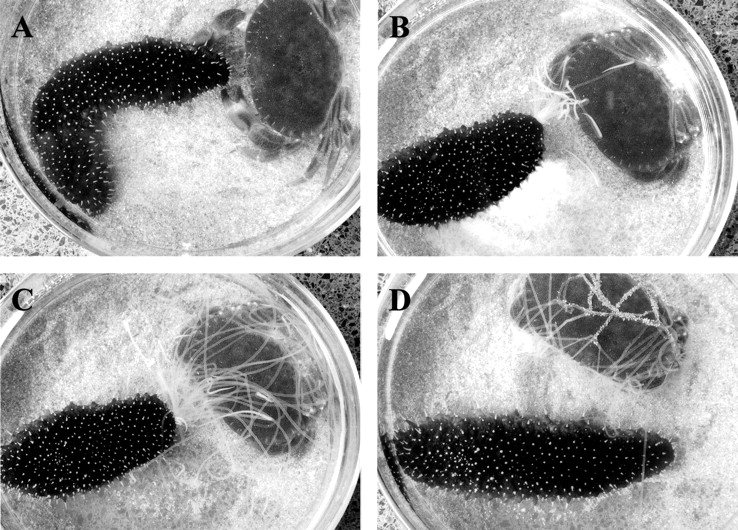
Cuvierian tubules are branching structures that occur on the respiratory tree (seen above in blue) of sea cucumbers.
They branch off the respiratory tree and are expelled through the body wall at oncoming predators, such as fish, crabs, or predatory echinoderms, such as sea stars. But how effective are they? How do they work? How do these affect the sea cucumber's day to day ecology?
Bohadschia argus Holothuria leucospilota
and Holothuria marmorata (also called Bohadschia marmorata) Some ecological dynamics...
Cuvierian tubules are "shot" from near the anus and so aim is directed at the threatening stimulus.
The oral tentacles or mouth seems to be most sensitive to being threatened. Whenever the mouth was stimulated (i.e., threatened) the animal would retract the tentacles and arch the body to orient the anus towards the "stimulated" area. Water was taken in through the anus followed by expulsion of the Cuvierian tubules with expelled water.
Interestingly-the slowest reaction by the animal ended to be if it was stimulated or provoked around the anal region. Maybe the rear regenerated more readily??
Cuverian tubule "stickyness" was most effective on slower moving predators such as crabs, snails and sea stars (87-100% targeting success). This was generally not as effective against fish (5-35% targeting success)
(Fig. 1 from Flammang et al)
Lab trials showed that if a potential predator was touched by Cuvierian tubules-about 96% of those predators avoided the sea cucumber for about 3 days.
If the sea cucumber LACKED Cuvierian tubules then those individuals were devoured or bitten to death at a higher rate.
Tubules that did not ultimately stick to a a surface can be quickly pulled back in or retracted.
Even if Cuvierian tubules have been completely exhausted, the other viscera can STILL be used as a defense.
Regeneration of Cuvierian Tubules took 15 to 18 days (so about 2 weeks-with complete regeneration in up to 5 weeks)
Flammang and his associates found that tubule "tenacity" or the adhesive strength varied with the surface it was in contact with, temperature and salinity of sea water and the time following expulsion from the body.
Image from Adam Broadbent on Flickr
Regeneration of Cuvierian Tubules
There's a whole blog that is to be written about all of the various dynamics involved in sea cucumber regeneration.
But what it comes down to is that there are many cells which are "undifferentiated" that is-their use in tissue has not yet been determined by the body's needs.
These "proliferate" or become more numerous and as regeneration begins, these undifferentiated cells decreases and the "specialization" or "differentiation" of cells begins to replace the lost tissues (i.e., the Cuverian Tubules).
Vandenspiegel, Jangoux and Flammang summarized the strategy for Cuverian Tubule defense and regeneration very eloquently and so I repeat it here:
Holothuroid Cuvierian tubules thus constitute a very efficient defensive mechanism. Indeed, in addition to their remarkable structural organization, which accounts for their adhesive and mechanical properties, their large number, sparing use, and particular regeneration dynamics also make them an almost inexhaustible line of defense maintained at limited energy cost.
What would our lives be without it? Dry, boring and unlubricated.
I thought I would kick off the Fall with one of my favoritest and weirdest of echinoderms.. Pteraster and its kin aka the Slime (or Mucus) Stars!! Who?? Pteraster is one genus in the family Pterasteridae.
This is group of starfishes that includes 8 genera that mostly live in cold-water habitats, but are most diverse in the deep-sea. The genus Pteraster aloneincludes about 45 species that occur worldwide, from the Arctic to the Antarctic and all the deep, dark places in between... Many of them eat sponges. So, on the surface, fairly harmless..
We'll be focusing on one particularly well-studied species, Pteraster tesselatus that occurs on the west coast of North America between California and Alaska.
This is a sort of thick, pudgy looking beast that can have a diversity of color patterns...
What makes Pteraster and all of the Pterasteridae so unusual?
The surface of the animal is actually concealed below a tent-like covering [called a SUPRADORSAL MEMBRANE (SD in the figure below)] that extends OVER the animal's proper surface!!
That proper surface below the supradorsal membrane is where you would find the typical features on a sea star's surface, such as the gills and etc.. Here is a cross-section through the arm. Tube feet on the bottom. Why is this important? Well, its through the supradorsal membrane that the SLIME comes out!!
2. The SLIME Star!!
So, let's cut to the chase-Pteraster tesselatus earns its common name "the Slime Star" owing to its ability to defensively SPEW MUCUS when annoyed by unwanted contact (and who wouldn't want to do that??) !! GOBS and GOBS of it.
Note to you grammar types... MUCUS= noun. MUCOUS=adjective!
Much of the info presented herein was based on studies by James Nance (Texas A& M University) and Lee Braithwaite (Brigham Young University) from some neat papers in 1979 and 1981 in the Journal of Experimental Marine Biology & Ecology. How It works!
Within the supradorsal membrane are a VAST number of mucus producing cells both on the surface and throughout pores present all throughout.
When Pteraster feels threatened, water enters the animal via the bottom tube foot grooves and flows throw the body cavity and up into the cavity between the animals' surface and the supradorsal membrane.
Mucus is produced by cells in the supradorsal membrane. An opening in the supradorsal membrane, called the osculum, which is normally open
....and all of the little pores in the supradorsal membrane OPENS!!
So, water pressure EXPELS the Mucous-Water mixture out of the supradorsal membrane!! So..imagine suddenly stopping up the pipes in your bathroom....and watching it all go somewhere else...
ShABLURRRUUUUUBBBBPTTTHHHHHHHH!!!!!! (noise is simulated-Pteraster does not actually make this noise unless you REALLY want it to. Then, go ahead-knock yourself out!)and you get THIS!
But WHY does it do that? Would could POSSIBLY offend such an innocuous creature? That just wants to sit around eating sponges all day?
On the west coast of North America, starfish ecology usually involves one of these two predatory "bad boys"...
Solaster..usuallySolaster dawsoni,which feeds mostly on other starfish.
Solaster (diameter=24 cm) can apparently take up to FOUR DAYS to devour an undefended Pteraster (about 14 cm across)! And that's basically Pteraster being devoured alive!
OR the fearsome Sunflower Star..Pycnopodia helianthoides which usually just SWALLOWS their prey whole! This takes about 2 days to digest...
(photo by Allison Gong, UCSC)
Tests using mucus applied directly to food being eaten by either of these two species almost instantly resulted in the predator moving away VERY quickly.
Lab tests applying mucus to fish and other invertebrates, such as snails and etc. also results in avoidance or outright fatality following extended exposure.
The mucus probably contains saponins or something similar. I've talked about how 0ther starfish species use saponins as a means of discouraging predators here.. What about other Pterasterids? So, I've mentioned other deep-sea starfish related to Pteraster..such as this Hymenaster from
the deep sea North Pacific, which is practically MADE from clear gelatinous goo! ...and here...(about a foot across) And if you pick them up? You get the mucous love! or to say it another way.. "It slimed me!"
But this simple behavior begs a lot of interesting questions.
If the slime is defensive then WHAT PREYS on the other species around the world in the deep sea?
What about the tropical Pacific Euretaster?
Is the slime more or less toxic where specific predators are around?
How has this affected the long term evolution of the Pterasterids?
All questions for another day. Pteraster is interesting for MANY reasons that I haven't even begun to address...