|
| Image by RJadams55 |
And that in turn gives you insight into past events and other things around you. Cryptic? Yes..but I will explain.
This week's post is from Kurtis Hayne and A. Richard Palmer, University of Alberta in Edmonton
who have written a swell, new paper in the Journal of Experimental Biology 216: 1717-1725 (here)
(my thanks to Kurtis for an offprint of the paper).
It studies the reaction of the classic workhorse starfish Pisaster ochraceus as it reacts to one of the harshest of environmental stresses: the ocean itself! WAVES!! SPLOOSH!
 |
| Image by Lance and Erin Willett |
Hayne and Palmer collected numerous individuals in and around Barkley Sound near the Bamfield Marine Sciences Center on Vancouver Island. Individuals were collected and measured to assess values for drag and lift. Some were tagged and returned to the field for various field transplant experiments (look below).
Specimens were also surveyed in the field and correlated with the power of various wave forces.
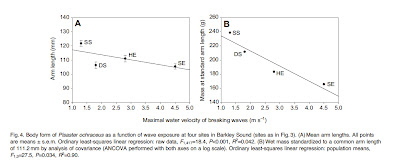
Their findings!
1. Sea stars in wave-exposed sites had narrower arms and were lighter per unit arm length than those from sheltered sites. On average, animals from the most exposed sites were 12% narrower at the base compared to the most sheltered!
2. Body form was tightly correlated with the maximum velocity of breaking waves across four different localities and over time.
3. Sea stars were transplanted between sheltered sites to more wave-exposed sites revealing that they became LIGHTER per unit arm length, developing narrower arms after 3 months! There was a tight correlation between water flow and the body shape which strongly supported the idea that wave force was affecting the body shape.
 and the small box "D" even shows the extent that the abactinal spine/granules show density and a heavier degree of calcification between a sheltered (orange on the left) vs. an exposed (purple on the right) individual.
The exposed form below is overall smaller in size, weigh less, and with a higher aspect ratio (arms narrower, etc.) and with a more dense skeleton.
Dynamics
1. This is thought to aid the individuals in a wave-exposed environment from being washed away. Not as much lift and not as much drag.
2. The heavier granules offer more protection against the crashing forces of the waves.
3. BUT, having a higher aspect ratio comes with some costs:
a. such as being more prone to overheating. Sheltered are much more effective at resisting
overheating and water loss. Although heating may be offset by cooling temperatures from
waves and such..
b. having smaller areas available for gonads. This results in lower overall production of
reproductive material and so on..
Image by jkenning

Image by Shannon Robalino

The protected body form
These make more sense in protected areas away from the harsh, crashing wave-swept regions:
Some dynamics...
1. Larger animals are more likely to be caught and washed out to shore. (greater drag and lift at play)
2. BUT the larger, thicker size involves more water retention and thus better thermoregulation and better cooling.
3. Greater volume for gonads! More potential offspring!
from Scenic Beach State Park in Washington

From Samantha Russell

Bear in mind-that in order to test these interpretations, animals were actually transplanted between protected vs. wave-swept areas. Transplanted animals (from protected to the exposed wave-swept areas) decreased in mass and increased in aspect ratio over time.
Environemntal factors directly affected the body shape of ochre stars!
Biophysics Meets old fashioned Taxonomy!
 Probably the neatest footnote to all of this was that these differences in different forms of Pisaster was observed by several naturalists in California, early in the 20th Century.
The great Stanford starfish biologist and Director of the Hopkins Marine lab, Walter K. Fisher identified several "forma" or distinct morphological variants of Pisaster ochraceus in his giant 3 volume monograph documenting and describing the asteroids of the Pacific Northwest from 1930.(sadly the Asteriidae is not in the volume linked).

 The variant nodiferus is Hayne and Palmer's "exposed coast" morphological form. Fisher's comments about the inconsistency of abactinal spinelet shape/size suggest there remains even more variation and other factors to consider in future studies..
Sometimes, these "forma" turn out to be distinct taxa-perhaps subspecies or species. But sometimes its just some variation in body form in reaction to the environment.
Just as if we took a flabby, couch potato from his comfy TV room with silk bedsheets and put that person into an underground mine to dig minerals for a living. We would perhaps see changes in musculature, bone structure, and maybe even hair/eye color.
So there you have it! A cool convergence between a modern biophysics story with a fun footnote from classical taxonomy/natural history!
Are these considerations we might apply to other intertidal asteroids in similar settings? (Stichaster australis from New Zealand). Image by Jon Mollivan

Want to know more about the Ochre Star: Pisaster ochraceus?
Here's my post about Pisaster ochraceus ecology and role in climate change.
and what explains all the color variation in Ochre Stars?? (here)
Want to see a sea urchin that lives in a high-energy wave swept environment? See Colobocentrotus! The Shingle Urchin.
3. Sea stars were transplanted between sheltered sites to more wave-exposed sites revealing that they became LIGHTER per unit arm length, developing narrower arms after 3 months! There was a tight correlation between water flow and the body shape which strongly supported the idea that wave force was affecting the body shape.
This figure 7 very nicely summarizes their findings. The animal on your left ("A") is an example of an animal from "most sheltered" going right to the one on the lower right from "most wave exposed".
The exposed form below is overall smaller in size, weigh less, and with a higher aspect ratio (arms narrower, etc.) and with a more dense skeleton.
Dynamics
1. This is thought to aid the individuals in a wave-exposed environment from being washed away. Not as much lift and not as much drag.
2. The heavier granules offer more protection against the crashing forces of the waves.
3. BUT, having a higher aspect ratio comes with some costs:
a. such as being more prone to overheating. Sheltered are much more effective at resisting
overheating and water loss. Although heating may be offset by cooling temperatures from
waves and such..
b. having smaller areas available for gonads. This results in lower overall production of
reproductive material and so on..
Image by jkenning
Image by Shannon Robalino
The protected body form
These make more sense in protected areas away from the harsh, crashing wave-swept regions:
Some dynamics...
1. Larger animals are more likely to be caught and washed out to shore. (greater drag and lift at play)
2. BUT the larger, thicker size involves more water retention and thus better thermoregulation and better cooling.
3. Greater volume for gonads! More potential offspring!
from Scenic Beach State Park in Washington
From Samantha Russell
Bear in mind-that in order to test these interpretations, animals were actually transplanted between protected vs. wave-swept areas. Transplanted animals (from protected to the exposed wave-swept areas) decreased in mass and increased in aspect ratio over time.
Environemntal factors directly affected the body shape of ochre stars!
Biophysics Meets old fashioned Taxonomy!

The great Stanford starfish biologist and Director of the Hopkins Marine lab, Walter K. Fisher identified several "forma" or distinct morphological variants of Pisaster ochraceus in his giant 3 volume monograph documenting and describing the asteroids of the Pacific Northwest from 1930.(sadly the Asteriidae is not in the volume linked).

Fisher even observed that the differences in three of these forma seemed to be based on the degree of calcified skeleton, i.e., how built up the spines were...
It is difficult to escape the inference that the characteristic small spinelets of the abactinal area are correlated with queit water, but that this is ot the only factor is evidenced by the presence, along with confertus, of forma ochraceus and nodiferus, the latter found on open coasts and also in deep water (Monterey Bay).

Sometimes, these "forma" turn out to be distinct taxa-perhaps subspecies or species. But sometimes its just some variation in body form in reaction to the environment.
Just as if we took a flabby, couch potato from his comfy TV room with silk bedsheets and put that person into an underground mine to dig minerals for a living. We would perhaps see changes in musculature, bone structure, and maybe even hair/eye color.
So there you have it! A cool convergence between a modern biophysics story with a fun footnote from classical taxonomy/natural history!
Are these considerations we might apply to other intertidal asteroids in similar settings? (Stichaster australis from New Zealand). Image by Jon Mollivan
Want to know more about the Ochre Star: Pisaster ochraceus?
Here's my post about Pisaster ochraceus ecology and role in climate change.
and what explains all the color variation in Ochre Stars?? (here)
Want to see a sea urchin that lives in a high-energy wave swept environment? See Colobocentrotus! The Shingle Urchin.