Showing posts with label taxonomy. Show all posts

Tuesday, September 5, 2017

Pacific Northwest Sea Stars Names: EXPLAINED!!

Sea Stars
So, a bit of bookkeeping- yes. I've been writing the blog less regularly. This has been largely a good problem to have: lots of other projects have been keeping me busy.. So, I'm mainly just writing when a good topic strikes me.. but I tweet a LOT more often than I used to.. so you can keep up with new posts that way...

Today.. some interesting etymology: i.e. the origins of scientific names!!!

I actually used to think that I was going to be writing about the origins of scientific names WAY more often then I ended up doing.. I wrote this post early on back in my first year (2006) here and I've written about some deep-sea starfish names (such as brisingids) with many more little bits about scientific names scattered throughout my long blog history!

The other day, someone asked me about one of the most familiar sea stars that I've worked with.. the Ochre star on the west coast of North America.. and shockingly. I didn't know.

I've also been working on some very old literature associated with the World Asteroidea Database and have been becoming familiar with many of the first descriptive papers used for species that are familiar to many a marine biologist!

So, this week: A short feature on FIVE (ish) names of very common sea stars encountered on the Pacific coast of North America!

What's interesting is that MANY of these species were NOT described by Americans or by American scientists. They were described by scientists in Europe! Many of whom probably regarded North America as exotic as Australia or "the Orient"..

But now, thanks to many, MANY field guides, textbooks, scientific studies and citizen science many of these names are practically a household name! But what do they mean? How does the original Latin/Greek break down..especially in the context of its taxonomic history.. HIDDEN SECRETS of the Pacific NW starfish fauna begin!

1. Pisaster
This species is of course, famous internationally. Pisaster ochraceus is the "poster child" for the keystone species concept among other things..and is well known on mussel beds..and while the other two species aren't as well known-they are still familiar species..
Stars
Who Named Pisaster?: This genus was named by two German biologists in the 1800s, Johannes Müller and Franz Herrmann Troschel, in an important monograph published in 1842, the System der Asteriden which established names for a huge number of the known species at the time.

The name: Descriptions were quite brief at the time and many taxonomists never bothered to include the rationale for the names because scientific names are written in Latin and everyone who was considered educated at the time was already assumed to have KNOWN Latin..

I'll be honest. This one was a bit of a puzzler.  The latter half of the name "Pisaster" has an easy enough translation "aster" for star.. but the former half?  What did the "Pis-" mean???

Some accounts online suggested that the name meant "fish" but that makes NO sense (sorry Merriam Webster!)   As Adam West's Batman would say "NOT SO FAST, old chum...."

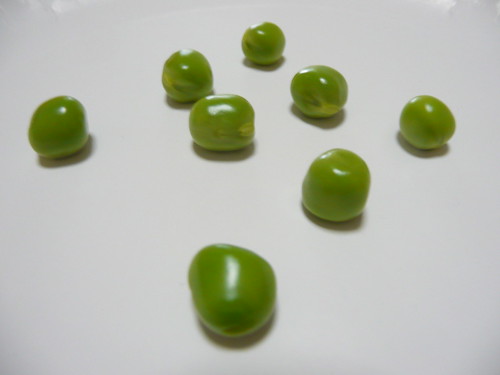
Fortunately my former Masters degree advisor Tom Niesen (formerly of San Francisco State University) came through!  He pointed out that the name ACTUALLY refers to the Latin for "pea" ... PISIUM!
peas
The genus Pisaster makes reference to the small bead like spines present on the surface of the body!
Starfish Macro
and what about the species names?
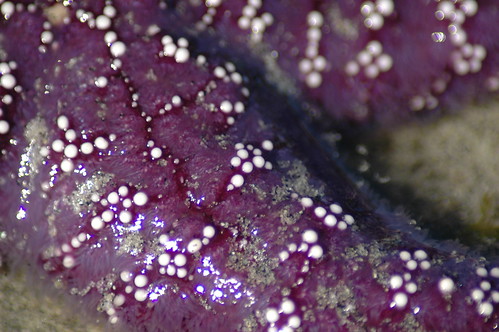
Pisaster brevispinus is the easiest. "brevis" and "spinus" aka "brief or short spined" So, the short spined Pisaster. This makes reference to the short spines present on its body, which differ somewhat from the other Pisaster spp..
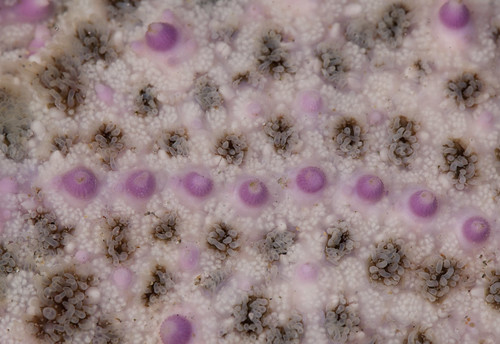
Giant Pink Star Surface Close-up
Pisaster ochraceus: "ochraceus" refers to the color: orange of the species first collected. Again, likely without too much sampling of the other individuals. This species occurs in purple, red and so forth..
      So TECHNICALLY... the common name for this species "Ochre stars" which is usually taken as a translation of the scientific "ochraceus"  name actually means "pale yellow" (possibly orange) stars
Ochre star 1
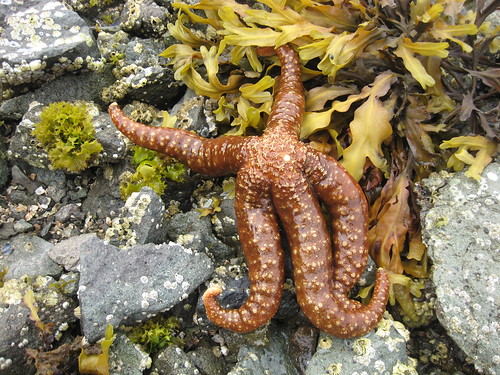
and perhaps one of the biggest mysteries, Pisaster giganteus? This one is a favorite story of mine because it is based entirely on knowing the history of the specimen.
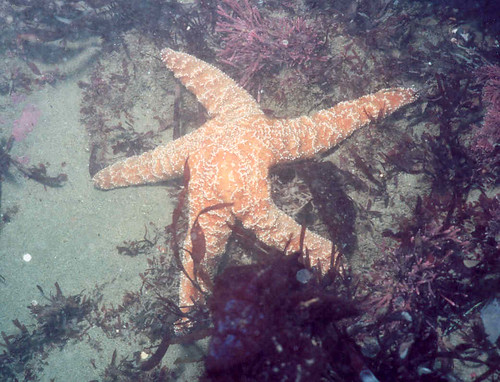
The original holotype of this species was described  in 1857 by William Stimpson. (specimen shown here)

It lives here in the collections of the National Museum of Natural History and it is CRAZY BIG, almost 2 feet across! (sadly, nothing this big will likely ever be encountered in the wild again..)

So, it was quite the monster for its time.

But they clearly had no reference to the greater variation of this species which is in most cases.. nowhere nearly as large as this

This kind of thing is the poster child example for why you need to study variation in a new species..especially if you're going to NAME it based on a characteristic seen only in a single individual!

2. Orthasterias koehleri
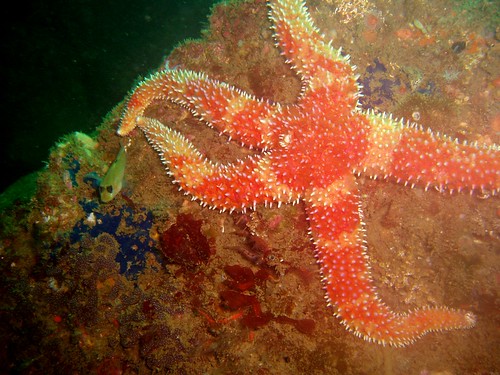
sanc0098
 Who Named Orthasterias?: The genus was named by Addison Emery Verrill in 1914 who was an American naturalist that named pretty much everything in the Americas in late 19th Century and early 20th Century. He was a bit of a whirlwind who named everything from sea stars to cephalopods!

The genus name means: "Straight star" with "ortho" meaning "straight" likely in allusion to the spine series on the body which form regular series and "-asterias" referring to the animal.

Species? Probably what throws people the MOST about this animal is the species name.. "koehleri" and most people always try to find a Latin root for it.. except that its NOT a word that is made out of a Latin adjective!

This species was originally described as Asterias koehleri by a Swiss worker, Perceval de Loriol who mainly worked on fossils in the late 1800s. In 1897 he described this species from Vancouver Island and named it after prominent echinoderm worker, Professor Rene Koehler (photo courtesy of Dr. Dave Pawson, NMNH!) who taught at the University of Lyon  and was a later president of the Société zoologique de France.

Interestingly,  the species was described in 1897 but the genus, Orthasterias was not described until 1914. So, it was SEVENTEEN YEARS until the modern version of this name (Orthasterias koehleri) came to pass..
3. Evasterias troscheli
Mottled Star  (Evasterias troschelli)
Who named it? Another one by Addison Emery Verrill! 
Named for? Evasterias is I believe the root "asterias" with the prefix "ev" meaning "primeval" likely alluding to this species resemblance to other Asterias like species.


The species? This one is another one named by some folks in Europe that might not be obvious to people working with the Pacific fauna.. 

The original name for this was Asterias troscheli and it was named for the aforemntioned German biologist Franz Herrmann Troschel, who worked on fishes and mollusks!  A Wikipedia article is here.


4. Stylasterias forreri
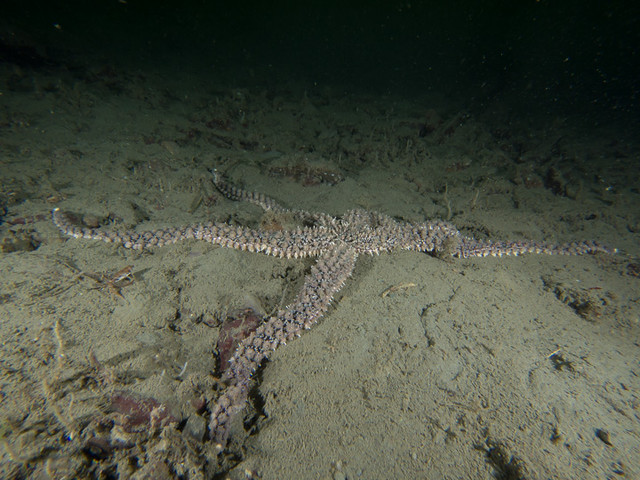
Long ray star (Stylasterias forreri) is long

Who? Another species placed into a genus named by Addison Emery Verrill in 1914!

What does the name mean? The genus "Stylasterias" has the same root as "stylet" or "stilleto" referring to a "sharp stick" or needle. Plus "-asterias" (for sea star).  The "Styl-" prefix alludes to the sharp spines covering the surface.

Who was the species named after? This was another species originally described by a European (in this case, Swiss) worker, Perceval de Loriol in 1887. This was collected and brought to deLoriol's museum by a "M. Forrer" (I'm unsure if "M" is the first initial or shorthand for "Messieur" but that is who the species is named for and was almost certainly described in a vacuum by deLoriol.  Basically.. described purely as an object without much if any ecological information.

Again, this is a species which had a name for 30 years before being assigned its new name Stylasterias in 1914!

5. Leptasterias spp.  
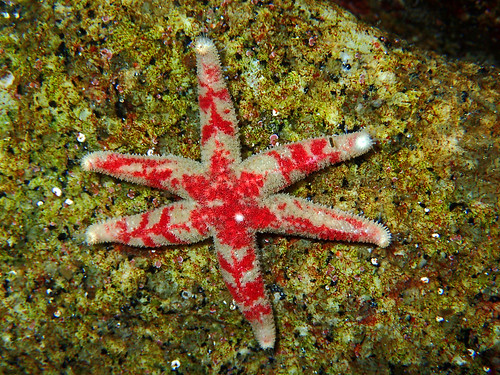
Leptasterias aequalis (Carmel Point)
Who Named it? Another genus named by Addison Emery Verrill!  This time in 1866! 

What does the name mean? This one is actually pretty straight forward. There's of course, "-aster" for star and "Leptos" which is from the Greek for "small" or tiny..sort of like the word Lepton. 
Leptasterias hexactis
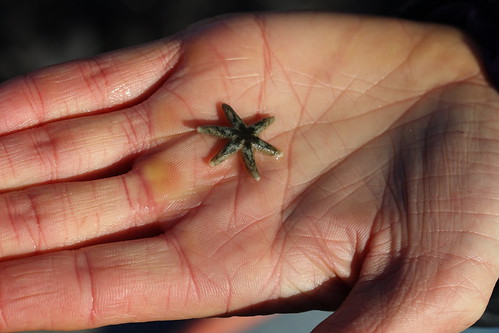
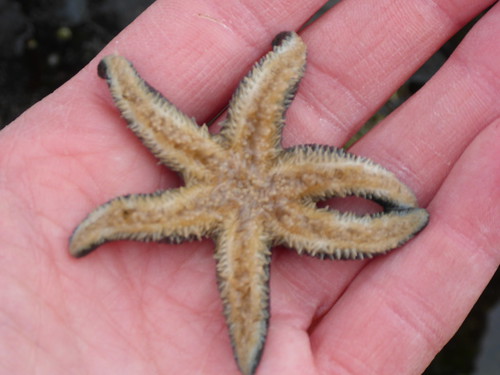
And this is appropriate given how many of the species are pretty tiny (about the diameter of a silver dollar or 50 cent piece.. or 1.00 euro if that's more your speed).. and some up in Washington can get bigger up to the size of maybe a small cookie..
Six armed sea star - Leptasterias hexactis

There are a TON of Leptasterias species of course, both in the Atlantic and the Pacific..but the name was clearly designated BEFORE they realized just how big some of the species got! Leptasterias polaris for example, is easily 1 to 2 feet across!

BONUS. Pycnopodia helianthoides & Rathbunaster californicus
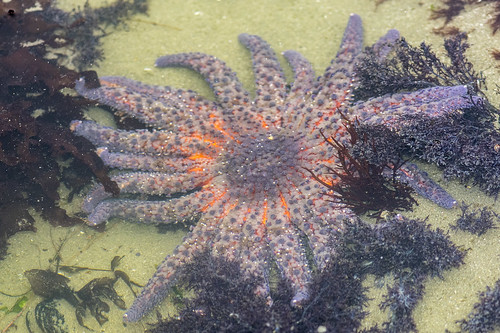
Pycnopodia helianthoides
Pycnopodia is arguably one of the most immediately recognizable species in the world given its size and unique appearance.. and interesting.. it wasn't named all at once!

This species was originally named as Asterias helianthoides and was described by J.F. Brandt, a German naturalist who apparently worked mostly in Russia in 1835 here Asterias was the name they assigned to practically all sea stars back then.. with some species in different families sharing the same genus. and yeah.. if you looked it up the description is basically two short paragraphs long...in Latin. That's why taxonomy gets such a bad rap in the long run..

The species epithet helianthoides is Greek for "like a sunflower" making the common name Sunflower Star one of the best fitting of all of these older species.

On the other hand.. it wasn't until 1862 when a second biologist, an American named William Stimpson (who described the misnamed "Asterias giganteus" (now Pisaster giganteus) rightly thought that this animal belonged in a new and separate taxonomic category..

Stimpson named it Pycnopodia, which in Greek translates to "pycnos" as dense or thick and "podia" referring to its tube feet.. Hence "Dense Tube feet", almost certainly in reference to its very numerous and abundant podia..


Stimpson was actually SO impressed by this animal that in the original description of the genus, Pycnopodia he actually created a new FAMILY to accomodate it: the Pycnopodiidae. This new family hasn't been widely accepted but hasn't quite been disproven either...

Pycnopodia has a SISTER species in deep-water called Rathbunaster californicus.. and I wrote a WHOLE blog about it and its name here. So go check it out! 

Some common trends then...
1. Many of these species were named by Europeans in the 19th Century. Many of them had almost certainly NEVER even been to North America!

2. Many of the genera? Described in the early 20th Century probably in 1914, by Addison Emery Verrill.

3. There were a LOT of names which were based on a bunch of old European guys honoring each other. What you're seeing here doesn't even include ALL of the species that were described.  It was typical of a lot of taxonomists from this era to oversplit.. that is designate a new species based on some highly variable detail. These "oversplit" names were often deemed to be redundatt by later
authors and made obsolete.

4. One important lesson? Try to see some variation in the species before assigning it a name based on that one character!

Wednesday, May 31, 2017

Five Highlights from my NEW paper about the genus Ferdina and its relatives!

GREETINGS! Last week, a new paper I've literally been working on since I finished my PhD has FINALLY been completed! Its easily my largest monograph at the moment and includes a whopping 14 new species, 3 new genera and a new subfamily!

For those who are interested, it was in the latest issue of Zootaxa, published online here (I don't believe the print version is out yet). 

The paper focuses on a group of tropical shallow/deep goniasterid sea stars which include reef setting genera such as Neoferdina but also seldom studied genera such as Ferdina and their relatives. I actually ended up describing 3 additional new genera and MANY new species!

Its always nice when the work is done and the specimens can go back to their home institutions.. many of these specimens were from the echinoderm collections at the Museum national d'Historie naturelle! 

Although the paper is "old school" and was done without molecules, to me it still represents a good example of taxonomy in the 21st Century?  I've written about how taxonomy has been done with new technology and other aspects here..

The whole thing is a lot to unpack.. and so here's some take away lessons that I thought I would share from writing it!

1. Citizen Science & Social Media Made a Significant Contribution! 
I've talked about this before.. the world is flooded with divers, photographers and interested people with cell phones all over the world! 

Thanks to a combination of museum collections and divers I was able to identify and describe several new species and even add color variation to poorly known species in the group I published on! Many times these get misidentified as people try to "shoehorn" them into known species in field guides. 

This new species for example, Neoferdina oni from the Philippines! I actually identified this species based on material collected by the California Academy of Sciences from one of their recent expeditions (such as this one)

The photographer of this specimen, Martha Kiser was incredibly helpful in allowing me to see her photos of this new species. You can see more of her work on Flickr here: https://www.flickr.com/photos/martykiser/sets/with/72157634344493477
Neoferdina glyptodisca sea star ind10 3429
I will likely do a separate post on the etymology of these new species a bit later, but the species epithet of this one "oni" represents a horned demon from Japan which alludes to the two spines on each plate along the side!

Images such as this one gave me more insight into how the colors vary in already established species! and provide leads to possible NEW species...
Sea Star, Neoferdina insolita
Cuming's Sea Star (Neoferdina cumingi)


2. The Mesophotic Zone: New studies and new Species! 
There's a depth region in the ocean that falls just below "coral reef" (~30m) depth but just above the "deep sea" (above 200m).. that's roughly between 100 and 500 feet. More about this area here. and this entire website devoted to this area! 

This area is also known as the "Twilight Zone" aka the "sub Reef area" and contains a fauna that is related and similar but distinctly different from those seen at the surface. 

The California Academy of Sciences's research division as well as their Steinhart Aquarium have both been studying this area in the Philippines. In 2015, they collected this lovely beast, (and here was a news account showing it off) which I had also been observing in the Paris collections from areas throughout the Indo-Pacific!

I initially identified it as a familiar genus, Neoferdina, but eventually realized it was actually a separate and undescribed genus which I named Bathyferdina! 
I've actually been describing Mesophotic Zone starfish for quite a long time. Here was Astrosarkus idipi from many years ago aka the "Great Pumpkin Starfish" and there were several more as well...

One important take away message: Describing new species is PART of understanding the biology of a NEW ecosystem. This was the same thing that happened with understanding all of those predatory coral starfish.. new species led to understanding each "character" of a new ecosystem!

3. Museums & Travel: Where the New Species Roam 
Here's a neat new species from the western Indian Ocean-Madagascar and the east coast of South Africa.. Ferdina mena! Identified by the two distinctive bald patches present in each interradius (i.e. the "armpit") of the starfish.

Thanks to the stunning photos of "Optical Allusion" I was even able to find living images of this species in South Africa!
Starfish, Ferdina sadhensis
I have a strangely long history with this species.. I identified one of these (mistakenly) for the field guide Coral Reef Animals of the Indo-Pacific by Terry Gosliner, Gary Williams, and Dave Behrens- as Ferdina sadhensis which was known only from Oman.

During one of my recent visits to Paris and the Museum national d'HIstorie naturelle in Paris, I discovered that this wasn't just an odd specimen with the twin bald, red spots in each interradius..it was present on ALL of the specimens collected from a collection made from Madagascar!!
Starfish, Ferdina sadhensis
Following this, I was visiting the Iziko Museum in South Africa in 2015 and discovered the SAME species from the east coast of South Africa! Citizen scientists in South Africa also showed me MANY photos of starfishes which confirmed the specimens.

and to return to the citizen science angle.. images on Flickr further showed this species in Mozambique as well as further color and pattern variation of this species from South Africa thanks to photographer Derek Keats and others!
Sea star at Aliwal Shoal, KwaZulu-Natal, South Africa
In both cases, these specimens had been collected and sitting in these museums awaiting discover for YEARS. In Paris-2007 and 2010 and from the Iziko Museum collections-in 1986!!!

So, somewhere in there, this seems to be consistent with the "21 years" which malacologist Dr. Philippe Bouchet has published as the average time it takes for a specimen to get from collection to publication! 

4. Conservation: Aquarium shops & Misidentified starfish
This was an interesting lesson.

For one of the new species I had discovered, Paraferdina plakos, I only had one or two individuals on which to base my new species description. Were they the same? Was it variation? How do different individuals differ from one another? Are the defining characters the same across the species range?

SO, I took advantage of some aspects of the internet which I usually list as pet peeves...

1. Misidentified species made by people who don't want/need to figure out the correct species
2. Pictures of species collected by Internet aquarium and pet shops

I was actually able to make OVER TWENTY OBSERVATIONS of this species misidentified as the common "peppermint star" Fromia monilis!!
This led to ANECDOTAL information about its color and how individuals varied in shape. One or two sites actually were pretty up front about declaring how their specimens had been collected from Sri Lanka, suggesting a further occurrence point for this species.

What does this tell us? Not ONLY are A LOT of new species yet to be discovered but we are ALREADY seeing them sold in the pet trade.. and with no correct identifications by scientists to recognize them, are they endangered? For a species that has just been described we know NOTHING bout its reproductive biology, populations, can they handle the strain of being "fished" for this trade???

5. Mysterious Crystalline Nodules! MicroLenses? or just developing granules? 
On several of the species of starfish I've worked on, close examination of the surface revealed that there were HUNDREDS of these glassy crystalline nodules embedded on the surface of the skeleton!


In this  newly discovered genus and species from New Caledonia, Kanakaster solidus shows these crystalline bodies as a sort of pebbling all over the body surface, which is pretty suggestive of the microlens idea.. but I suppose they could also be incipient or underdeveloped granules which cover the body surface as almost a kind of thick tissue.
from Kankaster solidus, holotype

Whereas, in this species, Kanakaster discus, the crystalline structures are actually arranged in stellate formations rather than simply as granulated pebbling. Much more suggestive of a "lens" type function I would think.. but hard to say without more data.

from Kanakaster discus, holotype

If these ARE lenses? Why do the patterns differ? Some "lenses" are present in shallow-water species whereas others are present in deeper water species! And how are the patterns adaptive? If that's indeed the case? 

Many, MORE questions! and probably at least one more post about these newly discovered animals! 

Thursday, October 13, 2016

New Species of Sea Stars from the North Pacific and BEYOND!


You may recall back in 2009 when I accompanied the Monterey Bay Aquarium Research Institute (MBARI) on a 10 day cruise exploring the North Pacific on the Juan de Fuca and Gorda Mid Ocean Ridges off the Oregon coast. Here was the cruise website.  I blogged about it here.
When we returned from the expedition I was VERY excited because we had collected MANY specimens and several were either new records of rarely seen species or outright NEW species!

I would like to give a big shout out to MBARI because almost EVERY thing they send me turns out to be a NEW species!  Here's a new coral-devouring star I named after MBARI geologist Dave Clague  and here was a poraniid starfish that was observed climbing up a black coral (antipatharian) to devour it

One of my favorite undiscovered starfish was this one, Paulasterias macclaini which I had to describe a whole FAMILY and genus in order to accommodate it!  This species was named for Dr. Craig Macclain, at Deep-Sea News, who had invited me on the cruise.


Well, describing that 6 rayed star took quite a bit of effort but there were many, MANY more species to understand!!!
We also collected many of the more 'non-descript' stars that we encountered as well as several others which turned out to be UNDESCRIBED species!! 

And YES its literally taken me almost 6 YEARS to get all of this done. As I've discussed before (here), it can sometimes take quite awhile for a species to be formally described.


The starfish I reported on in my Zootaxa paper are members of the Goniasteridae, the most diverse family of sea stars, which includes over 260 species in 65 genera!  Most goniasterids live in relatively deep-water (continental shelf and deeper) but historically, there haven't been many of them known from abyssal and lower bathyal (i.e., >1000 meter) depths.

Only recently have we been seeing better collections of these animals from these depths. As I've reported below, some were collected from below 4000 meters!

Sibogaster nieseni! 
The first few specimens of this species were collected by the Monterey Bay Aquarium Research Institute from Taney Seamount (off the coast of San Francisco) from abyssal depths (over 3000 meters!).

It is named for one of my former advisors from San Francisco State University: Professor Tom Niesen (now emeritus)! Author of the Marine Biology Coloring book and noted intertidal naturalist/ecologist along the California coast! 

He gave me my first shot at grad school and happily, his advice and instincts correctly guided me through my early years as a Masters degree student!
photo by J. Sharei
It seemed VERY appropriate to name this species, from off central California, after someone who has done so much to educate others about the significance of the invertebrates of the coast!! 

Interestingly, as I was in the process of writing it up, I suddenly became aware of multiple specimens of similar individuals from OTHER oceans in museums where I was NOT expecting to see them!

This one for example, turned out to be almost identical to the Pacific one I was working on but was from the tropical ATLANTIC! and even one from the deeps of Indonesia... 
Also, unusual is how, such a moderately big animal (about 4 to 5 inches in diameter) could have gone undescribed for so long?  But given how deep it was found (2100 to 4175 meters !) its been well "hidden"! 

This species is likely the deepest member of the Goniasteridae known.


Ceramaster pointsurae! 
This was a tiny little species that I think we collected as part of something else.. perhaps sampling sediment or some other part of the physical environment.

BUT it turns out that it is likely a new and distinct species with some resemblance to the shallow-water species of Ceramaster (aka the cookie stars) in shallow waters..

This species was found during my 2009 trip on the President Jackson Seamont at about 1975 meters! 

This species is named for the Moss Landing Marine Laboratories retired vessel, the Point Sur which was finally retired in 2014. 
I spent many a day sorting deep-sea invertebrates on the deck of the Point Sur and I was saddened to hear about its retirement.

Bathyceramaster careyi! New genus and NEW species! 
Figuring this one out required a bit of detective work, as it turns out...

Several years ago when I was working as a technician for the California Academy of Sciences, I had the pleasure of studying a newly deposited collection of deep-sea starfishes from Oregon State University.

It turned out, that one of the species in the collection was a rarely known species called "Mediaster elegans" collected by oceanographer Drew Carey. To the best of the knowledge of the workers at the time, it was thought that this was a new occurrence, since the original specimens were only known from South America (collected in 1905). 

But as it turns out, after comparing Carey's specimens with the newly collected material by MBARI AND the original type series (i.e., the specimens on which the species was based) it turned out there were actually TWO species present, "Mediaster elegans" (original name) AND this one!  And the one seen by Carey in 1972 was actually undescribed! So, what I'd argue was actually "Mediaster elegans" turns has not actually been seen until now...

and not only that, it had to be placed into a new GENUS in order to be correctly described! 

Boom! NEW genus described! New SPECIES described!
This species was ultimately found to occur throughout the North Pacific between 1700 and 3363 meter depths! 

With this one, named for Dr. Andrew Carey, formerly of Oregon State University! 
The gut contents described by Carey's paper in 1972 suggests that this species feeds on deep-sea sponges.

The paper outlines several goniasterids from the North Pacific at depths below 1000 meters, including several which have not been seen since their description. 

Now that the new genus Bathyceramaster has been described, I can also follow up with a note I made on one of the recent Okeanos dives to Wake Island! 

This white goniasterid we saw at about 2000 m MIGHT be Bathyceramaster, but I'd need to more closely examine the surface to be sure. But if the closeups of the surface texture were correct.. I think maybe??
New discoveries that lead to new questions!! 

What are they eating down there? How do they get so big? Why do some of these species always seem to be alone when you see them? 

My thanks to the Monterey Bay Aquarium Research Institute, the California Academy of Sciences'  Department of Invertebrate Zoology and the Museum national d'Historie naturelle in Paris! 

Wednesday, September 14, 2016

Taxonomy: Lurking behind all the Big Announcements!

GREETINGS! And my apologies for the long silence over the last few weeks: a little bit of time to recharge the batteries and a little bit of frantic insanity as the fall began! So, this week I am back!

There's been a fair amount of news about taxonomy lately, so I thought I would embellish with some "behind the scenes" knowledge that might not have been evident simply from the news reports themselves...

Scientific Names vs. Common or Popular Names: What's Required
Just so that we're all on the same page, here's some general information about the naming of new species.

There are actually a set of internationally recognized CODES (i.e. rules) for describing species and governing their use. These codes are overseen by the International Code of Zoological Nomenclature (here) and although they are not much more than a regulatory organization, they do try to keep everything from going taxonomic kablooey!

Basically, it is these rules that dictate HOW a lot of organisms in the world get scientific names. So, simply SAYING that a new organism is called "A blue Baboo Fish" won't cut it. It actually has to be supported by evidence and published in a PEER-REVIEWED journal and given a proper scientific name in the proper format (in Latin, etc.). ONLY THEN is such a name considered valid.

Common or popular names (e.g., "blue tang" or "cushion star") have their uses but ultimately, scientists depend on the specific context of having a unique identifier associated with a particular organism. Mainly because common names are EXTREMELY variable. I've talked about the insanity of the term "cushion star" here before..

BUT a number of other rules are also at play in order to keep the process of naming new species orderly...

Nomen Nudum aka Why we don't know the name of the President's Fish (yet!)
Have you ever noticed that there's often a significant time lag between the time someone ANNOUNCES that they have DISCOVERED a new species and the time that new species is ACTUALLY described??

That's because the name is not "official" until it is actually published in a scientific journal. If for some reason, the name is actually published before the proper scientific documentation is released to accompany it, the name becomes what is called a nomen nudum which is Latin for "naked name."
So, for example, many probably saw the news that there was a fish species named in honor of President Obama (here), who dramatically expanded the Papahānaumokuākea Marine National Monument.

Note that while some accounts actually went so far as to cite the genus name (Tosanoides) nowhere will you find the FULL name until its published in the literature.  Is it a liberal conspiracy? NOPE. Its Taxonomy!

If they actually announced the full species it would create a nomen nudum, which is kind of like the taxonomic equivalent of a time-space anomaly from Star Trek. That means there's a proper scientific name flying around WITHOUT a proper scientific description.

When written out completely, the full format of valid scientific names display a reference to the original author and date of the paper which described it. Thus, the full name of one of my species
"Circeaster arandae Mah 2006" refers to a paper in 2006 in which I described the species Circeaster arandae.

Getting back to the nomen nudum however, Note  that this does not necessarily invalidate the name. But it does open the name up for other unscrupulous (or unknowing) individuals to inadvertently use the name, thus "taking away" the name from the author's original intent. (or in the worst case, stealing the name from the original author).

Another real example...
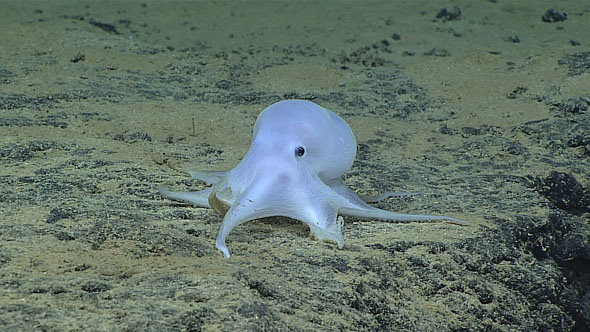
You might have seen this little guy for example. A new species of dumbo octopus that one of my colleagues Stephanie Bush is working on out at MBARI/Monterey Bay Aquarium. 

In an interview she alluded to the fact that the animal is SO cute that she might call it "adorabilis." She called it that informally as part of an interview but the media took the name and pretty much made it stick.

SO many news outlets have now used this name that it has turned up everywhere..but it has NOT been described or published in a scientific journal as of this date (Sept. 2016). This is not strictly a nomen nudum but conceivably, someone might mistakenly cite it in a scientific journal somewhere.

If that happens, then BOOM. It has entered the literature. This still does not mean that Dr. Bush cannot use the name..but it DOES mean that if someone else happens to use the species name "Opisthoteuthis adorabilis" that will "steal" the name away from her because ANOTHER scientist will have justified a species using that name in compliance with the ICZN code..

If by chance the name was published TWICE and in proper compliance by BOTH authors then a new situation arises. In that case the name published first has priority... A great segue into a discussion of SYNONYMY...

Synonymy aka Why you have to be careful if you "bought" a new species
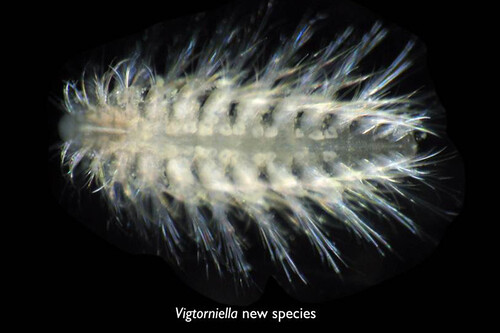
Vigtorniella

Probably one of the most important of the codes in the ICZN is that of "priority" which basically states that the OLDEST (i.e. the FIRST) name established for a species is the correct one. All subsequent names of the SAME species are essentially considered redundant and their use is suppressed once that assessment is made (but there are exceptions on occasion-better explained at another time).

That seems pretty straightforward.  But in truth, it can get pretty unfairly brutal.

There's a LOT of new species that are named in "good faith", sometimes even with very strong data that for whatever reason are ultimately deemed to be "redundant" and are suppressed in the literature.

So that means if someone described a new species with a shoddy (or in some cases, almost NO details)  description-but it was ADEQUATE, followed by a second description that was just an objectively BETTER account, that FIRST author gets credit and the other species get put into the list of "redundant names" aka the synonymy.

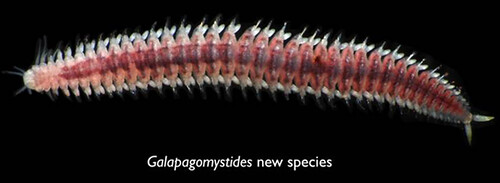
While this consideration is always important, one of the biggest trends this becomes relevant for is the "Buy a new species name" thing that has been done recently to raise funds for further research, or otherwise charitable causes...  Scripps Institute of Oceanography advertised the honor of naming a new species for $5,000 (see worm below as an example) whereas other places have gone over into bidding wars over $7,200!   This ebay auction won the rights to name this new species of moth for $12,600.00
Galapagomystides
So, someone who is NOT a scientist can easily get the rights to name a new species or even name a new species AFTER you as a gift....but its always possible that the name you give it, whether your own or someone else's, could eventually be synonymized by another person in the future because of some unknown specimen or just better understanding of the species in the future. 

Now, granted, there tends to be LESS of a chance of that happening depending on how much work the scientist doing the work has done and depending on what kind of data supported that new species in the first place, especially with molecular data.

But its STILL possible, sometimes even if nothing was done wrong... Science is an ongoing process and although taxonomy has kind of a reputation for being a bit stogy the truth is that it IS quite dynamic and taxonomic changes are common place (much to the annoyance of those who use species names!)

Can you name a new species from a picture?
Okeanos Explorer is a research vessel operated by NOAA that broadcasts LIVE streams of its deep-sea research over the internet. I'm one of the "shoreside talent pool" which answers questions from the scientists on the ship AND from the public. (see #Okeanos on Twitter for some of my live-tweets from the dive).

A question that came up recently from my last Okeanos round, was whether or not a new species could be described ONLY from a picture or video rather than a specimen???

Uh.. No and yes.

For MOST (nearly all) cases, some kind of voucher is necessary. Why? Because we require EVIDENCE to describe a new species. Measurements. Observations of the skeletal (or non-skeletal) structure. Analysis of different features. DNA. Any one of thousands of kinds of data which permit us to carefully contrast the known species of organisms from one another.

At the very least, a specimen must be examined so that we can carefully discern why its gross morphology is different from other similar species. These specimens are conserved. They are saved in museums for future generations to reference and retained for hundreds of years.

HOWEVER. In some RARE instances, there IS an allowance for new species to be described ONLY from a picture. It used to be invoked for exceptional cases-rare and endangered species for example.

But just a FEW months ago Neal Evenhuis at the Bishop Museum in Hawaii made the case that in some cases, a photo ALONE is enough to describe a new species-given PROPER evidence.  (Scientific paper is here)
We live in an era with increasingly high-resolution imagery, sometimes SO good that even the minutest details can be made out without physical examination. Millions of images of a biodiversity survey can be brought back on a drive the size of a large coin.


The octopus seen by Okeanos was identified because it was an "incirrate" octopus (as identified by NOAA researcher Mike Vecchione) which had NEVER been seen at that depth before. Almost certainly a new species

The conservative scientific approach in publications would be to indicate it IS a new species but without a proper name (e.g., Octopus n. sp. 1)

BUT it can't be properly characterized because a LOT of octopus characters are internal and require direct comparison (unlike the South African fly (bee mimic) example above which COULD be identified and characterized).

Also, while unlikely, its POSSIBLE that there is a specimen of this animal somewhere in a museum somewhere in the world which has already been published.  Without reconciliation of all these disparate factors, one risks creating redundant names which are essentially permanent and creating possible confusion.

Thus, identifying a species directly from ONLY a picture would be more direct but not as thorough and does not give us enough data to properly assess it. But yes, there are exceptions.

Identifying species only from pictures also invites the possibility of abuse and reckless taxonomy which could impede and hopelessly confuse the work of legitimate scientists during a time when there is a dire need for workers to be be studying Earth's biodiversity...

Species named after celebrities & pop culture? What's up with that? 
from http://novataxa.blogspot.com/2012/10/2012-yoda-acorn-worm.html
Scientific names as outlined in the Zoological codes are always supposed to be in Latin. A dead language that nobody speaks any longer. This used to be a scholarly language that was widely used among educated people.

This also made scientific names pretty straightforward. I've documented the word origins of MANY starfish species before (such as here)   Some make great stories in and of themselves 

Most scientific names are based on descriptive terminology. So, for example, the name Acanthaster , which is the scientific name of the Crown of Thorns starfish (learn more about this genus here), literally translates into "thorny star" from the Greek acanth- and the Latin -aster meaning star. Many of these names were sort of an open book...
Crown-of-Thorns Starfish
But there has been a LONG tradition of naming species AFTER people, places and things to honor them. Both genera AND species. Some of the oldest and best known genera are named for the "noted scientist of the day", for example Luidia-the starfish is named for Edward Lhuyd who called himself Luidius.

Although you would think that naming a genus would be better than a species (because a genus is higher up in the taxonomic hierarchy), in fact, its not. Higher level names tend to be made into synonymies more frequently than species. Species tend to stick around for quite awhile longer..

It USED to be that many of these names would stick to people known to the scientists: wives, children, close confidants and good colleagues and certainly this continues to be the case. I've named MANY species after close friends and colleagues.

As we have gotten into the 20th and 21st Century however, we NOW see increasingly the role of pop culture influencing taxonomists! There are a number of reasons: Some think it makes taxonomy more relatable, some have found genuine inspiration from popular entertainment, others have many MANY species and have just "run out" of Latin names.. an endless list from a huge pool of scientists.

Sometimes the people/characters as names are directly influential!   As with Yoda above. the genital flaps of that acorn worm (an enteropneust) were VERY reminiscent of Star Wars Jedi Master Yoda! The ICZN is actually surprisingly flexible in allowing for "translating" terms into taxonomic names... And hence its namesake! From a character created in the late 20th Century into an ancient dead language! No problem! (if you know how)

We have flies named after Beyonce, wasps named after Shakira and trilobites named after Mick Jagger! You can see a full list of names here on Wikipedia.

and of course the brittle star named after George RR Martin of Game of Thrones! 

Taxonomists are diverse. No longer done by ONLY classic stodgy, out of touch scientists-but hip, trendy nerds as well! .. it is done by many students and dynamic individuals who follow popular trends.. and we will likely see more and MORE of these pop culture names in the future....

thanks to Monica M. who asked me the question about Obama's fish! that inspired this post.