Showing posts with label Asteriidae. Show all posts

Tuesday, September 5, 2017

Pacific Northwest Sea Stars Names: EXPLAINED!!

Sea Stars
So, a bit of bookkeeping- yes. I've been writing the blog less regularly. This has been largely a good problem to have: lots of other projects have been keeping me busy.. So, I'm mainly just writing when a good topic strikes me.. but I tweet a LOT more often than I used to.. so you can keep up with new posts that way...

Today.. some interesting etymology: i.e. the origins of scientific names!!!

I actually used to think that I was going to be writing about the origins of scientific names WAY more often then I ended up doing.. I wrote this post early on back in my first year (2006) here and I've written about some deep-sea starfish names (such as brisingids) with many more little bits about scientific names scattered throughout my long blog history!

The other day, someone asked me about one of the most familiar sea stars that I've worked with.. the Ochre star on the west coast of North America.. and shockingly. I didn't know.

I've also been working on some very old literature associated with the World Asteroidea Database and have been becoming familiar with many of the first descriptive papers used for species that are familiar to many a marine biologist!

So, this week: A short feature on FIVE (ish) names of very common sea stars encountered on the Pacific coast of North America!

What's interesting is that MANY of these species were NOT described by Americans or by American scientists. They were described by scientists in Europe! Many of whom probably regarded North America as exotic as Australia or "the Orient"..

But now, thanks to many, MANY field guides, textbooks, scientific studies and citizen science many of these names are practically a household name! But what do they mean? How does the original Latin/Greek break down..especially in the context of its taxonomic history.. HIDDEN SECRETS of the Pacific NW starfish fauna begin!

1. Pisaster
This species is of course, famous internationally. Pisaster ochraceus is the "poster child" for the keystone species concept among other things..and is well known on mussel beds..and while the other two species aren't as well known-they are still familiar species..
Stars
Who Named Pisaster?: This genus was named by two German biologists in the 1800s, Johannes Müller and Franz Herrmann Troschel, in an important monograph published in 1842, the System der Asteriden which established names for a huge number of the known species at the time.

The name: Descriptions were quite brief at the time and many taxonomists never bothered to include the rationale for the names because scientific names are written in Latin and everyone who was considered educated at the time was already assumed to have KNOWN Latin..

I'll be honest. This one was a bit of a puzzler.  The latter half of the name "Pisaster" has an easy enough translation "aster" for star.. but the former half?  What did the "Pis-" mean???

Some accounts online suggested that the name meant "fish" but that makes NO sense (sorry Merriam Webster!)   As Adam West's Batman would say "NOT SO FAST, old chum...."

Fortunately my former Masters degree advisor Tom Niesen (formerly of San Francisco State University) came through!  He pointed out that the name ACTUALLY refers to the Latin for "pea" ... PISIUM!
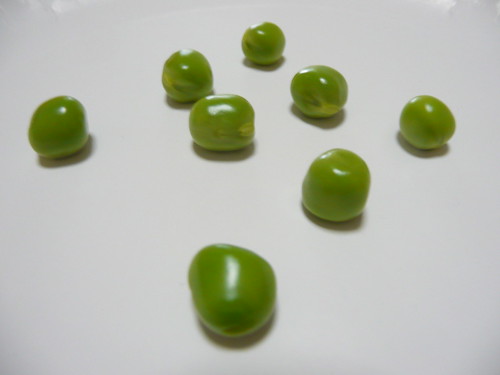
peas
The genus Pisaster makes reference to the small bead like spines present on the surface of the body!
Starfish Macro
and what about the species names?
Pisaster brevispinus is the easiest. "brevis" and "spinus" aka "brief or short spined" So, the short spined Pisaster. This makes reference to the short spines present on its body, which differ somewhat from the other Pisaster spp..
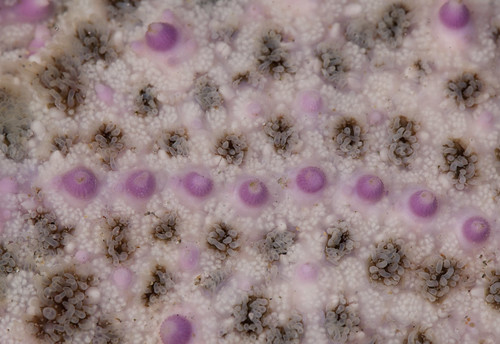
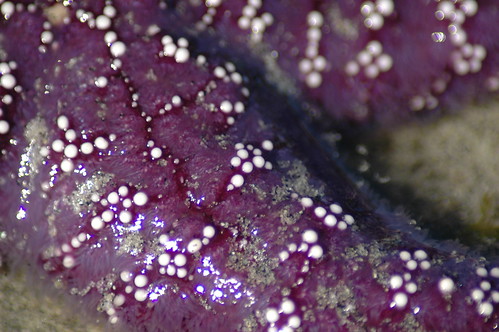
Giant Pink Star Surface Close-up
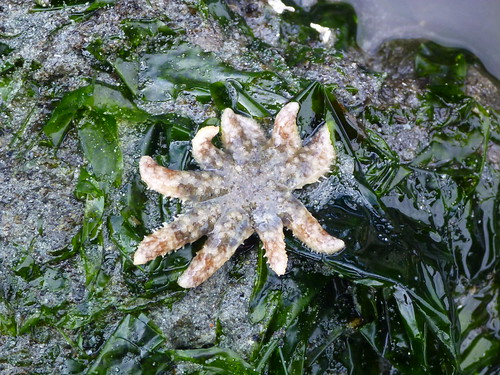
Pisaster ochraceus: "ochraceus" refers to the color: orange of the species first collected. Again, likely without too much sampling of the other individuals. This species occurs in purple, red and so forth..
      So TECHNICALLY... the common name for this species "Ochre stars" which is usually taken as a translation of the scientific "ochraceus"  name actually means "pale yellow" (possibly orange) stars
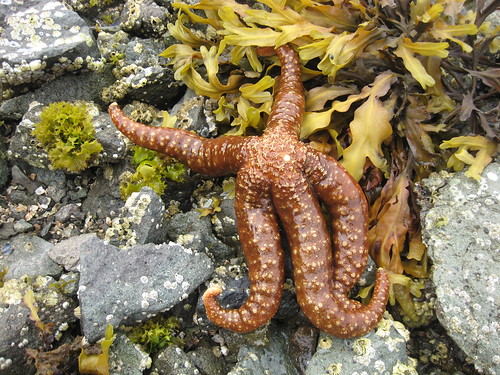
Ochre star 1
and perhaps one of the biggest mysteries, Pisaster giganteus? This one is a favorite story of mine because it is based entirely on knowing the history of the specimen.
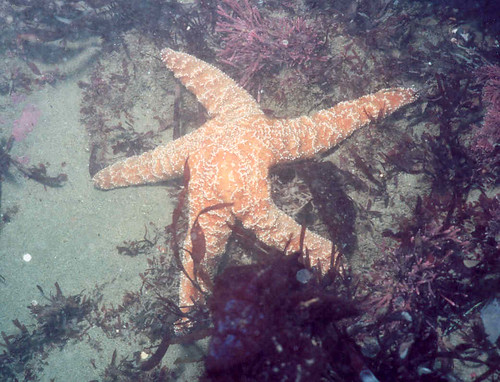
The original holotype of this species was described  in 1857 by William Stimpson. (specimen shown here)

It lives here in the collections of the National Museum of Natural History and it is CRAZY BIG, almost 2 feet across! (sadly, nothing this big will likely ever be encountered in the wild again..)

So, it was quite the monster for its time.

But they clearly had no reference to the greater variation of this species which is in most cases.. nowhere nearly as large as this

This kind of thing is the poster child example for why you need to study variation in a new species..especially if you're going to NAME it based on a characteristic seen only in a single individual!

2. Orthasterias koehleri
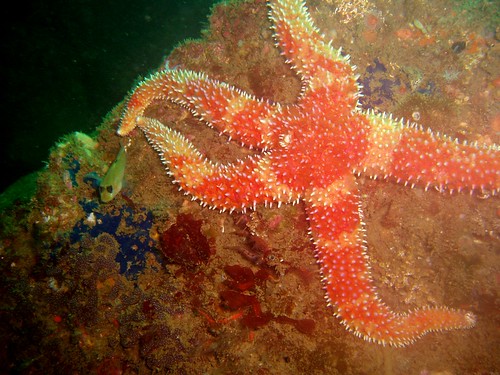
sanc0098
 Who Named Orthasterias?: The genus was named by Addison Emery Verrill in 1914 who was an American naturalist that named pretty much everything in the Americas in late 19th Century and early 20th Century. He was a bit of a whirlwind who named everything from sea stars to cephalopods!

The genus name means: "Straight star" with "ortho" meaning "straight" likely in allusion to the spine series on the body which form regular series and "-asterias" referring to the animal.

Species? Probably what throws people the MOST about this animal is the species name.. "koehleri" and most people always try to find a Latin root for it.. except that its NOT a word that is made out of a Latin adjective!

This species was originally described as Asterias koehleri by a Swiss worker, Perceval de Loriol who mainly worked on fossils in the late 1800s. In 1897 he described this species from Vancouver Island and named it after prominent echinoderm worker, Professor Rene Koehler (photo courtesy of Dr. Dave Pawson, NMNH!) who taught at the University of Lyon  and was a later president of the Société zoologique de France.

Interestingly,  the species was described in 1897 but the genus, Orthasterias was not described until 1914. So, it was SEVENTEEN YEARS until the modern version of this name (Orthasterias koehleri) came to pass..
3. Evasterias troscheli
Mottled Star  (Evasterias troschelli)
Who named it? Another one by Addison Emery Verrill! 
Named for? Evasterias is I believe the root "asterias" with the prefix "ev" meaning "primeval" likely alluding to this species resemblance to other Asterias like species.


The species? This one is another one named by some folks in Europe that might not be obvious to people working with the Pacific fauna.. 

The original name for this was Asterias troscheli and it was named for the aforemntioned German biologist Franz Herrmann Troschel, who worked on fishes and mollusks!  A Wikipedia article is here.


4. Stylasterias forreri
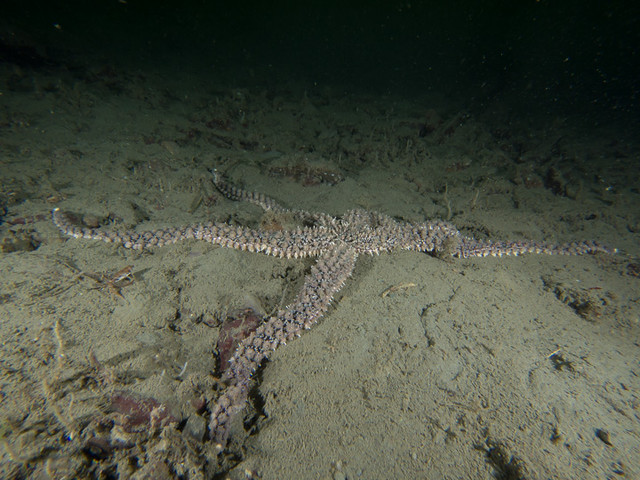
Long ray star (Stylasterias forreri) is long

Who? Another species placed into a genus named by Addison Emery Verrill in 1914!

What does the name mean? The genus "Stylasterias" has the same root as "stylet" or "stilleto" referring to a "sharp stick" or needle. Plus "-asterias" (for sea star).  The "Styl-" prefix alludes to the sharp spines covering the surface.

Who was the species named after? This was another species originally described by a European (in this case, Swiss) worker, Perceval de Loriol in 1887. This was collected and brought to deLoriol's museum by a "M. Forrer" (I'm unsure if "M" is the first initial or shorthand for "Messieur" but that is who the species is named for and was almost certainly described in a vacuum by deLoriol.  Basically.. described purely as an object without much if any ecological information.

Again, this is a species which had a name for 30 years before being assigned its new name Stylasterias in 1914!

5. Leptasterias spp.  
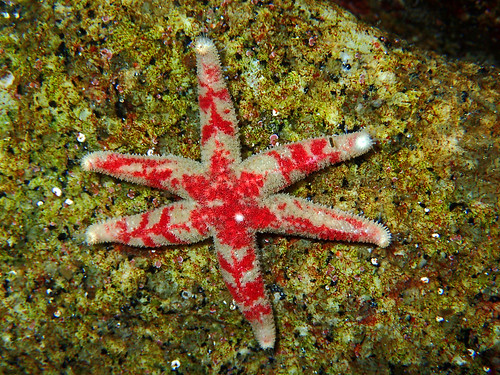
Leptasterias aequalis (Carmel Point)
Who Named it? Another genus named by Addison Emery Verrill!  This time in 1866! 

What does the name mean? This one is actually pretty straight forward. There's of course, "-aster" for star and "Leptos" which is from the Greek for "small" or tiny..sort of like the word Lepton. 
Leptasterias hexactis
And this is appropriate given how many of the species are pretty tiny (about the diameter of a silver dollar or 50 cent piece.. or 1.00 euro if that's more your speed).. and some up in Washington can get bigger up to the size of maybe a small cookie..
Six armed sea star - Leptasterias hexactis

There are a TON of Leptasterias species of course, both in the Atlantic and the Pacific..but the name was clearly designated BEFORE they realized just how big some of the species got! Leptasterias polaris for example, is easily 1 to 2 feet across!

BONUS. Pycnopodia helianthoides & Rathbunaster californicus
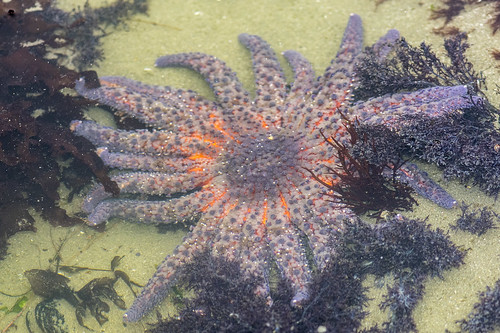
Pycnopodia helianthoides
Pycnopodia is arguably one of the most immediately recognizable species in the world given its size and unique appearance.. and interesting.. it wasn't named all at once!

This species was originally named as Asterias helianthoides and was described by J.F. Brandt, a German naturalist who apparently worked mostly in Russia in 1835 here Asterias was the name they assigned to practically all sea stars back then.. with some species in different families sharing the same genus. and yeah.. if you looked it up the description is basically two short paragraphs long...in Latin. That's why taxonomy gets such a bad rap in the long run..

The species epithet helianthoides is Greek for "like a sunflower" making the common name Sunflower Star one of the best fitting of all of these older species.

On the other hand.. it wasn't until 1862 when a second biologist, an American named William Stimpson (who described the misnamed "Asterias giganteus" (now Pisaster giganteus) rightly thought that this animal belonged in a new and separate taxonomic category..

Stimpson named it Pycnopodia, which in Greek translates to "pycnos" as dense or thick and "podia" referring to its tube feet.. Hence "Dense Tube feet", almost certainly in reference to its very numerous and abundant podia..


Stimpson was actually SO impressed by this animal that in the original description of the genus, Pycnopodia he actually created a new FAMILY to accomodate it: the Pycnopodiidae. This new family hasn't been widely accepted but hasn't quite been disproven either...

Pycnopodia has a SISTER species in deep-water called Rathbunaster californicus.. and I wrote a WHOLE blog about it and its name here. So go check it out! 

Some common trends then...
1. Many of these species were named by Europeans in the 19th Century. Many of them had almost certainly NEVER even been to North America!

2. Many of the genera? Described in the early 20th Century probably in 1914, by Addison Emery Verrill.

3. There were a LOT of names which were based on a bunch of old European guys honoring each other. What you're seeing here doesn't even include ALL of the species that were described.  It was typical of a lot of taxonomists from this era to oversplit.. that is designate a new species based on some highly variable detail. These "oversplit" names were often deemed to be redundatt by later
authors and made obsolete.

4. One important lesson? Try to see some variation in the species before assigning it a name based on that one character!

Friday, July 8, 2016

Pycnopodia Watch! Cautious Optimism about Sunflower Stars!

The Starfish Wasting Disease was first documented on the west coast of North America in 2009 and began to hit really hard in 2013 as I blogged about here and it became suddenly noticeable by MANY scientists on the west coast from Canada to California.  Due to a massive population explosion there followed a catastrophic die off in British Columbia which I documented here, with pictures courtesy of Jonathan Martin. 

In the intervening years, the Starfish Wasting Disease "event" had taken on a HUGE stage. UC Santa Cruz now monitors the health of west coast asteroids on their website (here). 

The first Sea Star Wasting Symposium was held earlier this year in Seattle. A meeting which I attended and reported on here

Perhaps one of the most significant losses following the massive starfish wasting disease epidemic that hit the west coast of North America (and possibly parts of the east coast) was the apocalyptic loss of the iconic sunflower sea star, Pycnopodia helianthoides.
When I was growing up on the west coast, there were sunflower stars that were HUGE!!  Tall tales would  report them reaching two and a half, then THREE feet across! But most were a good dinner plate size.

These animals were voracious predators and for starfish, moved quickly across the intertidal and subtidal...

Sunflower Stars are an ecologically important species. 

Unfortunately, populations of this species were DEVASTATED by the starfish wasting disease epidemic. More so than almost any of the other species, the sunflower stars were more often than not, completely removed from local areas along the coast.

Ecologically this has had VERY significant ramifications. Recent ecological studies, such as this 2016 paper in PeerJ by Schultz et al   have indicated that green sea urchin abundance in British Columbia has increased FOUR FOLD!

This has agreed somewhat with anecdotal observations by naturalists on Twitter observing sea urchin abundance in California...
The exact reason is not clear. Possibly because the sunflower stars are not around? and the animals have just come out of hiding? Or have the stars been controlling the population structure of the urchins?  But it DOES seem to be related to the absence of the once abundant and mighty sunflower stars.

But Sunflower stars are also an ICONIC species..
In addition to be an ecologically important part of the intertidal and subtidal ecosystem, there's a lot to be said for how they really represented the North Pacific. Pycnopodia is an endemic, found nowhere else in the world.. and was often used as an example of the special and diverse fauna on the west coast of North America..

Some of the individuals which had been on display in public aquaria died within days. Some of these individuals had been around for over 20 years. Suddenly? Gone.

Those of us who are most familiar with the West coast fauna.. divers, naturalists, scientists, citizen scientists, beach goers, students, fishermen, anyone with an intertidal or subtidal ID guide was suddenly NOT seeing this species. It was and still is a significant and sad loss.

And so.. observations of THIS species have had a SPECIAL significance..

BUT today, a colleague of mine, Ms. Brenna Green observed THIS. A juvenile Pycnopodia helianthoides in Northern California!! According to her, one of the first she's seen in a good long while!!
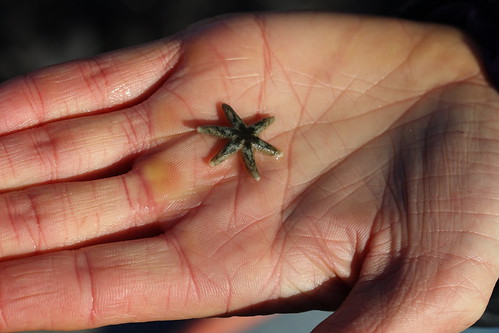
A small individual. Only a few inches across. But still...

I was directed to iNaturalist which has been monitoring observations of ALL asteroids on the west coast.. There were only 60 observations of Pycnopodia since 2014!!- so only about 20 per year that are reported  Note also-some of those observations were from areas that are distant from the primary Sea Star Wasting Disease areas (such as Alaska).

Make no mistake, that's a very low number... but surprising considering that they were considered completely gone from some areas..

But they ARE still out there. And are still popping up..

An anecdotal skim of Flickr and Twitter shows that small sunflower stars have been popping up over the last year or so...
From Titlow, Tacoma, Washington from February 29, 2016
Sunflower Sea Star
Weir's Beach, British Columbia by Laura Verhegge (taken April 21, 2015)
Pycnopodia helianthoides

Recent accounts (such as this one) have documented a resurgence in populations of sea stars hit by starfish wasting disease (based on this paper).

But I would like to think that is SOME good news, even if this doesn't mean a full and immediate recovery..

Another significant issue? SIZE of the observed individuals
Here's one of the most critical parts of these observations: Most are consistently SMALL. Many of the "adult" individuals we were used to encountering were easily dinner plate size or larger have not really been encountered.. or if so, not regularly. 

Are the small sized ones a sign that they simply grow very slowly?  Or more ominously,  do they die as they reach a certain size??

On the upside, I have heard SOME anecdotal observations of adult (~40 cm) sized individuals being seen in Washington and in other localites...

Stay tuned! Research continues. 

In the meantime, for further news check out:


Tuesday, May 14, 2013

Biophysics Meets Old School Taxonomy! Ochre Star Pisaster ochraceus can adapt body shape to wave action!

Ochre Seastar (Pisaster ochraceus) Feb 19, 2012. Patrick's Point SP., Humboldt Co., CA (1 (1)
Image by RJadams55
One of the things I love about biology is when you have an animal which has been studied down to the wire and become so familiar that people take it for granted, and then you discover something completely new about it!!!

And that in turn gives you insight into past events and other things around you. Cryptic? Yes..but I will explain.

This week's post is from Kurtis Hayne and A. Richard Palmer, University of Alberta in Edmonton
who have written a swell, new paper in the Journal of Experimental Biology 216: 1717-1725 (here)
(my thanks to Kurtis for an offprint of the paper).

It studies the reaction of the classic workhorse starfish Pisaster ochraceus as it reacts to one of the harshest of environmental stresses:  the ocean itself! WAVES!!      SPLOOSH!
Hang On!
Image by Lance and Erin Willett
Details....
Hayne and Palmer collected numerous individuals in and around Barkley Sound near the Bamfield Marine Sciences Center on Vancouver Island.  Individuals were collected and measured to assess values for drag and lift. Some were tagged and returned to the field for various field transplant experiments (look below).

Specimens were also surveyed in the field and correlated with the power of various wave forces.

Their findings!
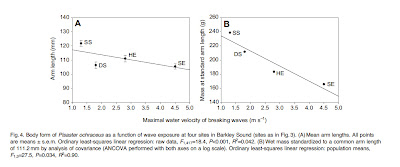
1.  Sea stars in wave-exposed sites had narrower arms and were lighter per unit arm length than those from sheltered sites. On average, animals from the most exposed sites were 12% narrower at the base compared to the most sheltered!

2. Body form was tightly correlated with the maximum velocity of breaking waves across four different localities and over time.

3. Sea stars were transplanted between sheltered sites to more wave-exposed sites revealing that they became LIGHTER per unit arm length, developing narrower arms after 3 months! There was a tight correlation between water flow and the body shape which strongly supported the idea that wave force was affecting the body shape.

This figure 7 very nicely summarizes their findings. The animal on your left ("A") is an example of an animal from "most sheltered" going right to the one on the lower right from "most wave exposed".

 and the small box "D" even shows the extent that the abactinal spine/granules show density and a heavier degree of calcification between a sheltered (orange on the left) vs. an exposed (purple on the right) individual.  

The exposed form below is overall smaller in size, weigh less, and with a higher aspect ratio (arms narrower, etc.) and with a more dense skeleton.   
Dynamics 
1. This is thought to aid the individuals in a wave-exposed environment from being washed away. Not as much lift and not as much drag.
2. The heavier granules offer more protection against the crashing forces of the waves.
3. BUT, having a higher aspect ratio comes with some costs:
          a. such as being more prone to overheating. Sheltered are much more effective at resisting
              overheating and water loss. Although heating may be offset by cooling temperatures from
               waves and such..
          b. having smaller areas available for gonads. This results in lower overall production of
               reproductive material and so on..

Image by jkenning
we saw more starfish on the second day

Image by Shannon Robalino
Pisaster ochraceus


The protected body form
These make more sense in protected areas away from the harsh, crashing wave-swept regions:
Some dynamics...

1. Larger animals are more likely to be caught and washed out to shore. (greater drag and lift at play)
2. BUT the larger, thicker size involves more water retention and thus better thermoregulation and better cooling.
3. Greater volume for gonads! More potential offspring!

from Scenic Beach State Park in Washington
Ochre Sea Star
From Samantha Russell
Pisaster ochraceus

Bear in mind-that in order to test these interpretations, animals were actually transplanted between protected vs. wave-swept areas. Transplanted animals (from protected to the exposed wave-swept areas) decreased in mass and increased in aspect ratio over time. 

Environemntal factors directly affected the body shape of ochre stars!

Biophysics Meets old fashioned Taxonomy!
Probably the neatest footnote to all of this was that these differences in different forms of Pisaster was observed by several naturalists in California, early in the 20th Century.

The great Stanford starfish biologist and Director of the Hopkins Marine lab, Walter K. Fisher identified several "forma" or distinct morphological variants of Pisaster ochraceus in his giant 3 volume monograph documenting and describing the asteroids of the Pacific Northwest from 1930.(sadly the Asteriidae is not in the volume linked).
Fisher even observed that the differences in three of these forma seemed to be based on the degree of calcified skeleton, i.e., how built up the spines were...
It is difficult to escape the inference that the characteristic small spinelets of the abactinal area are correlated with queit water, but that this is ot the only factor is evidenced by the presence, along with confertus, of forma ochraceus and nodiferus, the latter found on open coasts and also in deep water (Monterey Bay).
The variant nodiferus is Hayne and Palmer's "exposed coast" morphological form. Fisher's comments about the inconsistency of abactinal spinelet shape/size suggest there remains even more variation and other factors to consider in future studies..

Sometimes, these "forma" turn out to be distinct taxa-perhaps subspecies or species. But sometimes its just some variation in body form in reaction to the environment.

Just as if we took a flabby, couch potato from his comfy TV room with silk bedsheets and put that person into an underground mine to dig minerals for a living. We would perhaps see changes in musculature, bone structure, and maybe even hair/eye color.

So there you have it! A cool convergence between a modern biophysics story with a fun footnote from classical taxonomy/natural history!
Are these considerations we might apply to other intertidal asteroids in similar settings? (Stichaster australis from New Zealand). Image by Jon Mollivan
JJS_0095

Want to know more about the Ochre Star: Pisaster ochraceus?
 Here's my post about Pisaster ochraceus ecology and role in climate change. 

and what explains all the color variation in Ochre Stars?? (here)

Want to see a sea urchin that lives in a high-energy wave swept environment? See Colobocentrotus! The Shingle Urchin.

Tuesday, May 18, 2010

Battle of the Titans! Starfish Vs. FOOD Videos!!

Agh! Busy this week... But here's some cool videos that demonstrate the diversity of feeding in asteriid starfish!

Marthasterias & that CRUSHING feeling!

Here's the tropical-temperate Atlantic Marthasterias glacialis in the Canary Islands about to devour what I think is Paracentrotus lividus (or some other urchin) using "crushing predation" as described in a recent paper by Gianguzza et al. (2009) in Marine Biology.


Based on their account, this feeding is more then simply using their stomach to devour the soft parts-it uses its body to CRUSH the test (the round "shell" that makes up the body)!! It was previously thought that only fish utilized such a strategy...


Starfish VS. SCALLOP!
Scallops and other shelled mollusks are often prey to asteriid starfish and have VERY strong behavioral responses when they detect them nearby. This has been observed for awhile-for example in this paper by Thomas and Gruffydd (1971).

Here's Marthasterias again..but placed next to the scallop, Pecten maximus. Scallops can SMELL when known predators are nearby..and they can use high pressure jets in their water siphons to escape...like so... But ONLY when specific predatory species are around.


This also looks like Marthasterias...


and here is the North Pacific Sunflower star, Pycnopodia helianthoides doing the same to some Pacific scallop species....


And here is Pycnopodia again! this time harassing what looks like a cockle! Note the extreme escape response as the foot goes into red-alert mode and PUSHES the body away from the oncoming starfish!


More Soon!

Monday, January 11, 2010

...from Hawaii: Something you don't see every day Coscinasterias acutispina!

Today a cool pic of an uncommonly seen starfish from Hawaii! Coscinasterias acutispina!

The animal was found by Pauline Fiene and was photographed by nature photographer Cory Pittman (and should be copyright by him). Both Pauline and Cory oversee the cool Sea Slugs of Hawaii site.

Coscinasterias acutispina is an asteriid-that is, its related to those common intertidal starfish, such as Asterias or Pisaster that feed on mussels and clams on the east and west coasts of North America.
The beast above was observed in Kahului Harbor in Maui. It's about 30 mm in diameter and was found at less than 3 m depth, under rubble. These have been reported from Hawaii in the past, but have been so infrequently encountered that they are actually absent from the excellent Hawaiian Sea Creatures book by John Hoover.

Generally, starfishes in the family Asteriidae occur in cold-water regions like Antarctica or Alaska, but every so often-you get a couple that pop up in temperate to tropical shallow waters. For various reasons, asteriids and other forcipulatacean starfish don't generally live in tropical shallow-waters. So, seeing one outside of temperate water is unusual.


Coscinasterias occurs rather widely though, and you can find other species from New Zealand to the tropical Atlantic...Here's some basic taxonomic info..
This species also occurs in Japan, China, Australia, and other regions throughout the Indo-Pacific. Here is a pic of this species from Japan....
(pic taken from Chiba Museum site)

where it is known by the name yatude hitode, which I believe means "evergreen-palm leaf starfish" (Thanks to Yoicihi K. for the heads up!)

Coscinasterias acutispina is unusual in that it is fissiparous (i.e., it can reproduce asexually-by pulling itself apart), has between 7 to 12 arms and feeds on limpets and other small mollusks.

Ya' wanna know more about unusual Hawaiian Starfish??
Go visit John Hoover's site here.

And thanks to the wonder of Teh Internets! Here is a Youtube Video of this species (but from Japan..I think??) !!

EDIT-Note that there are tiny, little snails on the underside that might be parasitizing the starfish (I don't think they are being fed upon). Thanks to Mudskipper for the call!


Enjoy!

Monday, May 25, 2009

Will Starfish Benefit from Global Warming???

From Mongabay.com....

Based on studies by Rebecca A. Gooding, Christopher D. G. Harley, and Emily Tang at the University of British Columbia in Vancouver in a study to be published in PNAS next week....
(
Rebecca A. Gooding, Christopher D. G. Harley, and Emily Tang. Elevated water temperature and carbon dioxide concentration increase the growth of a keystone echinoderm. PNAS Early Edition May 25, 2009)

To quote directly from their interview on Mongabay:
Climate change is expected to cause widespread disruptions to ecosystems and their resident species. Some creatures will go extinct, others will expand their ranges and thrive.

A new study identifies starfish as one of the possible winners from rising ocean temperatures and carbon dioxide concentrations.

Rearing Pisaster ochraceus , a species of sea star, under varying conditions, Rebecca Gooding, Christopher Harley, and Emily Tang of the University of British Columbia in Vancouver found that increased temperature and acidity will significantly boost the echinoderm's growth rate, more than offsetting the negative effects of reduced availability of calcium carbonate, an important structural building block for many marine invertebrates. The results contrast with other research which has shown a negative correlation between increased ocean acidity and growth rates of calcifying species.

"Our findings demonstrate that increased [CO2] will not have direct negative effects on all marine invertebrates, suggesting that predictions of biotic responses to climate change should consider how different types of organisms will respond to changing climatic variables," the authors write. "Some ecologically important species... may directly benefit from acidification."
Go to Mangabay for the full story....

(Wow....I wonder if this makes my job prospects any better?)

Sunday, March 15, 2009

A Big Deal over a Little Starfish: The Leptasterias Species Complex!!

Ah Spring! As the sun emerges and the tides on the west coast go out, so also the many marine biology students! And so too come the many welcome questions!!
One of the more common questions I've been getting recently has been about this little six-rayed starfish called Leptasterias.....
Its commonly found and is quite a resplendent little animal (in California only about 1-2 cm across).
Leptasterias is quite widespread, extending from the North Atlantic through the Arctic to the cold-temperate North Pacific (Alaska to Southern California). The species in California are nearly always SIX rayed, but the ones in the Arctic and the Atlantic are often five rayed. They are often found to brood eggs and juveniles (but this is a story for another day).

The name "leptos" (in Leptasterias) refers to the Greek for "small, delicate or thin" (with asterias meaning star) alluding to the small, delicate size that many Leptasterias spp. are known for (although some Arctic species can be quite large!)

Leptasterias is a great example of how evolution is both a vexing puzzle and fascinating conundrum for the interested biologist. How can something that is so well known, and play such an important role in our understanding of marine ecology ALSO be so evasive that we don't even know what to call it???

Species in this genus form what is called a species complex. Here is a convenient definition from Wikipedia:
a group of species which satisfy the biological definition of species, that is, they are reproductively isolated from each other, but their morphology is very similar (in some cases virtually identical).
Put another way, this could be interpreted as sort of a "snapshot of evolution" in the works...There is such subtle divergence among closely related species that they we can barely tell them apart!!

Since the late 19th and early 20th Century, scientists, such as pre-eminent starfish biologist Walter K. Fisher at Hopkins Marine Station, have recognized the difficult lines between species along the west coast of North America.
Breaking this down:
  • Leptasterias spp. are found in Southern California up through Oregon, Washington to Canada, Alaska (and the Aleutians) up through the Arctic Circle and down into the North Atlantic.
  • At the far ends of where they are found they differ substantially.. But between any two "species" that are physically close to one another? The external features that are used to tell them apart becomes REALLY close.
  • Several Leptasterias spp. in California for example-L. aequalis, L. pusilla, L. hexactis. All of the names have gone back and forth into synonymy about what is "valid". Walter K. Fisher identified dozens of "forma" and "subspecies" when he formally monographed the species in 1930, making identifications difficult at best.
Figurin' It Out...
In the mid 90s, David Foltz, a population geneticist (and colleague) at Louisiana State University in Baton Rouge and student Jon Flowers got involved with the Leptasterias questions and he applied a variety of allozyme and later molecular tools towards the many species of Leptasterias and its near kin.
Results can be found in a great many of his papers including this one, this one and this one.

They sampled primarily from Alaska to California and discovered several different lineages of Leptasterias...especially in California where they identified 6 apparently distinct cryptic species in Leptasterias "hexactis" and "aequalis"!!!
So, what do you call these?

Right now, this is a pretty tricky question which I typically answer as good news/bad news.

What's the bad news? We are only at the first step. What comes next is the 'synch' up between the molecular /DNA characterisation of the species in Leptasterias AND the taxonomy.
  • More sampling will be needed to further resolve the molecular picture
  • More taxonomy will need to be done to follow once the above gets done.
What's the good news? We have a good idea what's going on and it seems pretty clear about what will need to be done.

So, the issue is NOT that the taxonomy itself is hopelessly confused (altho it IS very complicated) but that it just hasn't caught up with some of the more.... formal nomenclatural "loose ends"...Give it time!

Believe it or not, Leptasterias isn't the "worst" species complex problem/question known out there... (either on the west coast of North America or the world....)!!!

Tuesday, June 17, 2008

Giant Pink Monsters Among US!!! Enter: Pisaster brevispinus!

Imagine a giant animal that could get to be almost 2 feet across that could sling out tentacles and capture prey a FOOT away from itself!!!

Imagine no further! Enter: Pisaster brevispinus! AKA The Pink Star! The Giant Pink Star! The Short Spined Star! The Giant Short-Spined Pink Star!

One of the three species in the famous genus Pisaster (Family Asteriidae) which occurs on the western coast of North America.
Pisaster brevispinus has two rather famous sister species: P. ochraceus, which everyone learns about when you study keystone species in marine ecosystems and P. giganteus, which is so striking that its hard to miss.

Pisaster brevispinus
occurs between San Diego, CA all the way up to Alaska and can occur in much deeper water than its two shallower sister taxa.

P. brevispinus is a common inhabitant of SANDY BOTTOMS.
The Weirdness Pisaster brevispinus can HUNT for prey (usually bivalves of various kinds) in the TOP 40 cm of the sand!! That's easily about a FOOT and a HALF!!

HOW does it do that? It has LONG-ASS TUBE FEET!! And dunks them down into the sand! Like this:


(from Sloan & Robinson 1983)

HOW LONG??

P. brevispinus is recorded as being able to extend its tube feet into the sand THE LENGTH OF ITS ARM (measured from the center of the disk).

Small to average members of this species can have an arm length of about 6 to 8 inches..but in some GIANT members, P. brevispinus can reach arm lengths of up to TEN TO TWELVE INCHES (that means an overall diameter of almost TWO FEET!!)

Yikes.

That means one of these things with a large radius, can extend its tube feet ALMOST TEN INCHES into the ground!!!Here we draw on the Echinoblog's extensive computer graphics department to show what this looks like:

(Redrawn from Fig. 6, vanVeldhuizen & Phillips 1978)

Shown here is a diagram of a P. brevispinus specimen with an 11 cm arm diameter showing an almost 8 cm reach!!!!

This species apparently uses its central tube feet in quieter times to hunt for deeply buried bivalves (clams, etc.) and when left to their own devices can get quite big. I've seen these at different aquaria getting almost two to three feet across.

What's even more amazing is that apparently, P.brevispinus can ALSO EXTEND ITS STOMACH LOBES OUTSIDE ITS BODY ALMOST THE SAME DISTANCE.

Velduizen & Philips indicate that it probably doesn't do this easily and only when the food is close to the mouth. But, still...think about it.

Giant Pink Starfish with long tentacular tube feet! What happens when they start getting tired of clams...what happens after that?

What's next??


WHAT HORROR AWAITS US???