Showing posts with label feeding. Show all posts

Tuesday, April 25, 2017

Okeanos Follow-up: Giant Sea-Spiders EAT! Cnidarians, Anemones, Hydroids & Corals! oh my!

Many of you know that I occasionally "call in" when the NOAA deep-sea research platform Okeanos Explorer goes out to see on its missions. (remember the next leg BEGINS APRIL 27  http://oceanexplorer.noaa.gov/okeanos/media/exstream/exstream.html)

Mostly I call in on starfishes or echinoderm biology..but I do have a broad interest in deep-sea biology. And I just LOVE seeing observations like the one above: a weird animal doing something no one is familiar with!

And the BEST thing about Okeanos Explorer? EVERYONE can enjoy it along with you!! Here's a BUNCH of Sea spider observations from the Atlantic Okeanos Explorer in 2014! 

...BUT of course, our ship and shore-side scientists can't know EVERYTHING. We'll often observe an event, many of us make note of it in case we see it again and often times we'll move on.... forgetting about it until such a time when the observation comes up again.

ONE such observation was one from 2014 on the Atlantic Physalia Seamount wherein we observed a sea spider in the genus Colossendeis sp. with its proboscis (that's the long cigar shaped feeding tube) stuckINTO into this hydroid (an animal similar to a Hydra from freshwater)! Was this feeding? Was it NEW?
Physalia Seamount in the North Atlantic
A brief into: Sea spiders are not spiders. They belong to a group known as the Pycnogonids (also called the pantopods) which are mysterious arthropods. Some folks consider them distantly related to the greater group of arachnids whereas others think they are even more unusual...

Most sea spiders are pretty tiny and are less than about an inch (2 cm) across and its not unusual for them to be quite cryptic. So even though they can be present, you really DO have to look for them...
Here a photoessay of tropical, shallow water species by scientist/photographer Arthur Anker displaying some spectactular colors!   Here's a spectacular male carrying eggs..
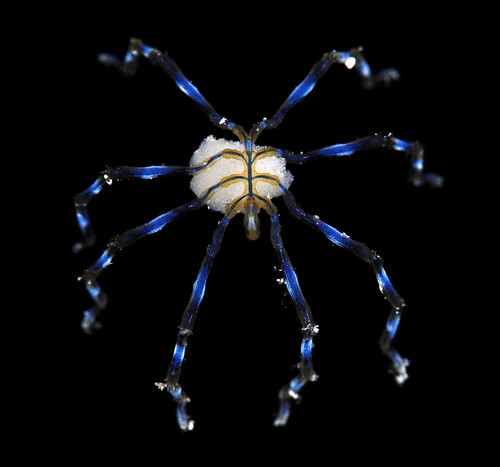
Male ovigerous sea spider (Pycnogonida)

Many live in shallow water but are never seen (hidden and small)... but that's NOT a problem with the deep-sea and Antarctic species!  There's one frequently encountered genus: Colossendeis which is one of the largest known sea spiders reaching a leg-to-leg diameter of over 50 cm! that's almost a FOOT and a HALF!

Most members of Colossendeis live in the proper deep ocean abyss: roughly 1000 to 5000 m and also in Antarctica where the cold-waters allow them to occur in relatively shallow water settings.

Note also the sizeable cigar shaped projection at the top end! That's called the PROBOSCIS! That will be important later! That is presumably what they use to feed.
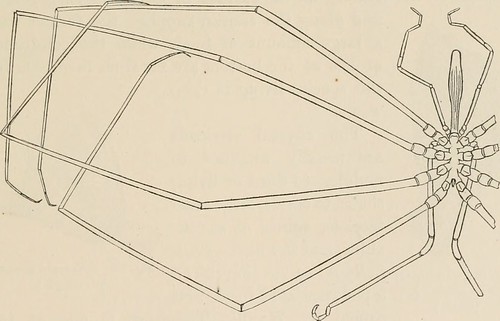
Image from page 96 of "A contribution to American thalassography; three cruises of the United States Coast and geodetic survey steamer "Blake," in the Gulf of Mexico, in the Caribbean Sea, and along the Atlantic coast of the United States, from 1877 to 18
Unfortunately, there is relatively little information known about sea spiders..... And the deep-sea species? Even less!

So, were the observations something unusual? Has science encountered something like that before??

But much to my delight: YES! There WAS a previous account of sea spiders feeding! and WOO HOO!  It turns out my friends at the Monterey Bay Aquarium Research Institute in Moss Landing, California actually observed something JUST LIKE THIS in 2010!!! Here was their blog post about it! 


The paper, by Caren Braby, Vicky Pearse, Bonnie Bain and Bob Vrijenhoek was published in Invertebrate Biology in 2009, 128(4): 359-363. and it documented "Pycnogonid-cnidarian trophic interaction in the deep Monterey Submarine Canyon"

They observed the same genus, Colossendeis, but at least two species, C. gigas and C. japonica feeding on commonly encountered sea anemones in the deeps of Monterey Canyon.
Braby's paper reveals that only Colossendeis in Antarctica had been observed feeding. These animals fed on limpets and bristle worms and in 1999 sea spiders were observed feeding on sea anemones

Braby et al.'s observations were the first for deep-sea Colossendeis (as opposed to Antarctic) species. Her team's work focused on their feeding on the deep-sea "pom pom anemone" Liponema brevicornis, an unusual sea anemone which literally "rolls" along the bottom of the deep-sea in a manner similar to a tumbleweed!

After the last 2017 Okeanos leg in the Phoenix Islands, I rounded up a BUNCH of the sea spider-feeding observations and decided to share them here as a comparison! Who knows? perhaps it will inspire a further paper!

Remember that NOAA's Okeanos Explorer program has captured these images and made them available for EVERYONE's enjoyment! Please remember that the next time someone talks about government funded science!

Pacific Observations! Over the last few weeks of the Phoenix Island expedition, we saw a BOUNTY of sea spider feeding observations!  

Winslow Reef: This one had its proboscis firmly ensconced into this flytrap anemone and was apparently sucking something out of it! The rather lethargic looking appearance is likely the result of being on the receiving end of whatever is going on here...

And ANOTHER on Winslow Reef! that was QUITE a dive! Here's another flytrap anemone with a sea spider attacking it!   As we saw earlier from Monterey Canyon, sea anemones and other cnidarians seem to be one kind of preferred food!

Baker Island we saw one attacking what was identified as a cup coral...The proboscis seemed to be "drinking" pretty heavily on this one...


Howland Island.....and just for good measure they saw this one crawling over a glass sponge

More Atlantic Feeding? Here we had a sea spider in the Atlantic Nygren Canyon which has been identified as Pallenopsis (thanks to Bonnie Bain), climbing and possibly feeding on this sea pen.

So, unfortunately I'm not really a sea spider taxonomist, so beyond the genus Colossendeis, I'm not sure how many species we are looking at here..but images such as this inspire many questions: Is predation specific to species? Or generalized?  How significant are these events to the ecosystem?
Do sea spiders attack the big colonial corals as well?

Stay tuned for the next exciting episode!

Wednesday, February 1, 2017

Brittle Stars that Steal Food From Jellyfish!

Ophiuroids on Jelly in Mozambique. Photo by Andrea Marshall, Daily Mail, http://www.dailymail.co.uk/~/article-3990782/index.html#i-570251ad33a88841
And a HAPPY NEW 2017 to everyone! Yes. Obviously everyone has noticed the Echinoblog has gone to an "irregular" publication schedule. This is one of those "be careful what you wish for" issues- a lot of museum travel = a lot of new discoveries and thus papers and more work!  And so, like a lot of artisan comic books.. I'll be publishing when good topics and/or when the inspiration strikes me.


Their work presents NEW data on the relationship between the "jellyfish hitchiking" brittle star Ophiocnemis marmorata (on the moon jelly Aurelia aurita)! The species occurs widely throughout the Indo-Pacific from Japan to India. I previously wrote about this phenomena back in 2009! here.

1. How many different types of Jellyfish species does Ophiocnemis marmorata occur ON??
The paper reports at least five or six, including at least 3 species of Rhopilema, Cephea cephea (the cauliflower jellyfish), Netrostoma and Aurelia aurita. But other internet records  and social media show further hosts.. such as this hydrozoan, Aequorea from Thailand..
From Chaloklum Diving in Singapore, http://www.chaloklum-diving.com/marine-life-koh-phangan/corals-more-cnidaria/true-jellyfish-scythozoa/scythozoa-other-jellyfish/

And here's a blog that documents this brittle stars on the "hairy" jellyfish. Lobocnema

2. Where/How many are present on a jellyfish host? 
Based on their sample of 92 Aurelia aurita, the authors, found that 79% of them (n=73) hosted brittle stars! quite a large number. Most of them were present under the bell or on the "oral arms" (the lobes hanging down from the bell)
Image by Thomas Peschak, https://www.thomaspeschak.com/
The authors observed that brittle stars ranged widely in size (1.0 to 6.0 mm) but MOST had a disk diameter of greater than 3.0 mm.  Medusae with MORE brittle stars were LARGER than those medusae without brittle stars. 
The largest number of brittle stars recorded (n=14) occurred on a medusae with 155.0 mm bell diameter. 


Its also worth noting that the brittle stars stay on the medusae ONLY within their home range. Many of these jellies, such as Aurelia (i.e. moon jellies) actually go beyond tropical settings and they really aren't seen on jellies in cold to temperate waters.. 

3. So, what are the brittle stars EATING??
The authors used a novel new method which basically breaks down the organic components of specific isotopes (Carbon and Nitrogen) and looks for how much of those isotopes is present in the subjects versus that which is provided by the environment.

Long story short: The data indcates that most of the food sources in Ophiocnemis seems to come from PLANKTONIC SOURCES! (i.e. the mesozooplankton) and NOT from the medusae itself and there were not any observations of Ophiocnemis filter feeding (i.e. arms up in the water).

And so the authors suggest that they are what's called KLEPTOPARASITES (a great word-really!). In other words, they take food directly away from the jellyfish out of the mouth or the oral arms, stealing or scavenging food from the jellyfish which are known as big pelagic predators.. What would be called "indirect food sources"...

There are several reports of other brittle stars that practice "kleptoparasitc" behavior.. i.e. moving down into the feeding arms or near the mouth and stealing food directly from the host. Some of it might not be a big deal to the host.. scraps and etc.. but meaningful to the ophiuroids..
Image by Ron Yeo at Tidechaser, http://tidechaser.blogspot.com/2012/03/brittle-stars-ophiuroidea-of-singapore.html

4. Growth and Settlement..aka Living on a Changing Jellyfish World
Although its not entirely clear HOW these brittle stars get up onto the jellies, one reasonable hypothesis is that they settle there as swimming larvae. Many of the brittle stars observed were tiny (smallest =1.0 mm disk).

Larger medusae seemed to carry a higher "brittle star load" than smaller ones. Its not clear exactly how/WHY certain species are chosen. Whether it is simply the physical dynamic of having a larger  medusae that facilitates more larvae to settle or if perhaps there are other cues??

It also turns out, based on further obsevations by others,  that this species DOES occur on the sea bottom on its own. So, its possible that as they get larger.. the brittle stars fall/jump/ or otherwise "settle" away from their floating substrate.

Or perhaps the jellies themselves die, as we see here on this unfortunate jelly in Singapore! 
Image by Ron Yeo at Tidechaser http://tidechaser.blogspot.com/2012/03/brittle-stars-ophiuroidea-of-singapore.html

5. Why go to all the hassle?? 
Well, one must ask, WHAT does a brittle star get OUT of basically jumping onto a jellyfish as a freshly settled larvae and living on it until it gets too big and falls off??

Obviously, they are getting FOOD. So that's one thing. And to a certain extent they are being PROTECTED..because what better thing to live on that a giant stinging gelatinous mass that eats fish! 

but perhaps the most important benefit is DISPERSAL.. that is the species is carried wide and far.. 
It was suggested that some medusae could carry these brittle stars up to 1000 kilometers from their point of colonization! 
Jellyfish

The apparent range of possible hosts adds further questions about the life mode and just HOW many different types of Ophiocnemis are present? And how do the different jellies affect how the brittle stars diversify and spread?  


Tuesday, February 23, 2016

Zen of the Feeding Sea Cucumber

      
You know what I find relaxing? Sea cucumbers. Specifically watching sea cucumbers just moving along wherever they happen to be and slowly and methodically digesting food from off the bottom of the ocean..

There is a real.. peace from watching them. Slow. Confident. Unworried. Sea pigs and other sea cucumbers... all with their benthic detrital serenity. Its soothing really.
Today: a little gallery showing some nice closeups to ease that tired day today!

Sea cucumbers are versatile creatures. Some species can actually feed with filter feeding apparatus inside their anus  (shown below). If you're not feeding from the front there's always the other end...
Sea Cucumber Anus
Here's the business end: the mouth on some glass, picking tiny detrital food off the surface. Although "scavenger" and "detritivore" doesn't sound very glamorous, it turns out that this serves a vital function to ecosystems in both shallow and deep-sea ecosystems (see the secrets of sea cucumber poop here! )  Sediment is aerated and "turned over" and doesn't just build up anoxic organics... etc.

here is where it all starts!

                 
Some nice video of a Japanese species showing aforementioned feeding tentacles which are used to pick food off the substratum 

Several more species with their feathery feeding arms extended..


Here's a nice one showing one of the feeding arms with food being moved INTO the mouth...

and here...
Power feeder (Pseudocolochirus violaceus)
and let us end with one of the most beautifully shot sea cucumber feeding videos!! Taken by "liquidguru"! 

Lembeh Magnum Sea Cucumber from liquidguru on Vimeo.

Tuesday, August 12, 2014

5 Cool, Weird Brittle Star Behavior Captured on video/pictures!

Ophiuroids (aka serpent stars and brittle stars) do some pretty remarkable things, BUT They are often tiny and cryptic so we don't get to see the cool array of things they do.

Flickr and YouTube have provided us with a HUGE quantity of imagery of interesting aspects of ophiuroid biology. Here is a sampling of the ones I found worth sharing!

1. Swollen Disk! This is the deep-sea serpent star Asteronyx! which live with arms wrapped around deep-sea cnidarians, such as sea pens. But this one has a fully inflated disk! When we study them in the lab, these are deflated and flattened. What do they do with them when inflated?  Why? 

This one is probably a different species, but it gives you an idea of how these live...with their arms wrapped around a cnidarian called a sea pen..


2. Brittle Star Burrowing!?  See those two brittle star arms emerging from the burrow?? That means the disk is buried within the sediment. But WOW! Look at the sediment being dumped out of that burrow in a continuous string! Maybe something else is in there putting that out? or is the brittle star doing that??


One of the rays of an amphiurid. Note the tube feet/spines fully occupied by sediment as it digs its way into the bottom.


That arm is probably part of this critter.. an amphiurid brittle star


3. Brittle Stars Feeding: Tube feet in ACTION!! How often do you get to see a brittle star in full feeding action??


and even MORE ophiuroid feeding action!!!


4. Brooding Brittle Star CT SCAN! Here is an internal CT scan of a BROODING ophiuroid! The ones inside the disk are juveniles!


5. Brittle Star "SWIMS"! This looks like Ophiocnemis, the brittle star which seems to find itself hitching a ride in jellyfishes! I've written about these here! 

Wednesday, July 24, 2013

Who Eats Who? Figuring out Feeding in Deep-Sea Starfish

thanks to MBARI!
People are always fascinated by how animals eat and, I think, the weirder the better. Starfish have one of the most distinctive feeding modes of all animals and I think, that's why people get fixated on how they consume their prey.

The feeding posts on the Echinoblog are among the top ten highest hit and the research literature is full of comprehensive studies detailing the feeding ecology and behavior of a great many starfish species. 

As one might expect, the great majority of feeding studies were initially those of shallow-water species which were easy to observe. Feeding is important to understanding marine ecology in many systems. So, its not just some casual trivia that comes in handy at cocktail parties.

But what about deep-sea species? Understanding the role of predators in these often inaccessible systems is important.  In cases, such as with deep-sea coral, its important to understand what role these animals play, especially given how little we know about the individual animal's importance.

How does one figure out the role..and indeed, the importance of these species in such far away and forboding habitats??


1. The Starfish
Fig. 1 from Gale et al. 2013
Ms. Gale's research focused on seven deep-sea starfish species from the North Atlantic:
A. Ceramaster granularis
B. Ctenodiscus crispatus-aka the mud star (learn more about it here)
C. Hippasteria phrygiana (learn more about it here)
D. Leptychaster arcticus
E. Mediaster bairdi
F. Novodinia americana-a brisingid
G. Zoroaster fulgens (more about Zoroaster here)

but also had some feeding notes on this weird guy.. Tremaster mirabilis! (about which very little is known)

Most of these species occur in a primary range of about 500 to 1500 meters, but some can get relatively shallow. Most are difficult to study and live on the deep-dark sea bottoms...

2. Figuring out feeding
There's generally TWO ways to study feeding:
  • Directly: i.e., you watch a species consuming its prey (or whatever food) and voila! You have a direct feeding observation.
  • Indirectly: You have something which provides inference about what the animal has already consumed. Look at the gut contents or something similar...
In the old, old days, figuring out the feeding ecology of deep-sea species was difficult. Specimens were collected via net-and usually brought up badly damaged. The animals were mostly dead and had often emptied all of their gut and stomach contents. Rarely did you have an opportunity to see the animal interacting with any possible prey items. Any interactions you might have spied could have been caused by the trawl net scooping up any and all of the bottom fauna...

In contrast, I think Ms. Gale et al's paper has acquired some great information using some modern techniques and good ol' fashioned detective work!

Direct Observation  So, the most obvious and direct way to observe feeding is by watching it!  These days, submersible robots aka ROV's (Remotely Operated Vehicles) are one of the main platforms for these types of observations. I've done some similar work in the Pacific (here)
Fig 9A from Gale et al. 2013
This is Hippasteria phrygiana, a widely occurring cold-water/deep-sea coral (and cnidarian) predator, but Gale et al. observed several other species from the deeps, about 500-1100 meter depths,  of the North Atlantic.

Several species were observed as predators for the first time, whereas others were confirmed. For example, Novodinia is a brisingid with a documented suspension-feeding mode and we saw more of that in Gale et al. 2013.

Gale et al. also reported feeding for Tremaster for the first time! Feeding on coral...
Tremaster mirabilis

Laboratory Feeding Experiments
As a complement to the direct observations, Gale also performed several laboratory feeding experiments and was able to observe several direct feeding moments!

Predictably, Hippasteria fed on various cnidarians, including sea pens and other deep-sea cnidarians.
Whereas Ceramaster fed on sponges..

But not all the prey allow the predators to just...eat them. Some, like the sea anemone Hormathia
nodosa 
Image from Natioal Museum of Northern Ireland via EOL
and the deep-sea coral Flabellum alabastrum 
Image from Fisheries & Oceans Canada via marinespecies.org
used their tentacles (which all have stinging cells) as a defense against the oncoming hunger dogs!  And this was effective against the more timid Ceramaster but not against Hippasteria. Flabellum was fed upon by Hippasteria VERY quickly (in 18 minutes)..

Indirect Evidence. This is where some newer techniques shows us some cool ecological stuff!!

Stable Isotopes!!
Here is a video that explains the basics of stable isotopes but basically what it comes down to is this: elements like nitrogen (N) and carbon (C) undergo changes as they pass through different ecological levels in the environment.

In doing so, they become kind of like a "fingerprint" for a particular kind of ecological role. So, for example, species with a stable isotope N (Nitrogen) value of about 16, but w/ Carbon value of about -14 (Hippasteria, Ceramaster and Mediaster) are higher within the overall trophic relationship among these asteroid species.
Fig. 6 from Gale et al. 2013
You've seen Hippasteria, but here's Ceramaster granularis

and Mediaster bairdi
Mediaster bairdi
Image by K. Gale

All the other species, including Novodinia americana, Leptychaster arcticus, Ctenodiscus crispatus and Zoroaster fulgens display lower values which would be consistent with their previously thought of feeding modes as suspension feeder (the brisingid) and deposit feeders/detritivores (mud stars, including Leptychaster and Ctenodiscus) and Zoroaster.

Gut Contents & Prey Items!
One other indirect way of looking at food items?  Gut contents.  What were they eating?

Ms. Gale did a LOT of work looking through the guts of many starfishes.. Much of how they fed is based on detective work.  For example, many animals such as deep sea gorgonians and such, after being digested leave only skeletal bits called sclerites.

Fortunately, these can be used to identify the animals with some accuracy. Curiously Hippasteira also had some crustaceans in its gut..
Figure 3 from Gale et al.
One of the subject animals, Zoroaster fulgens has been one of the more mysterious deep-sea starfish species in my experience is an infaunal predator, that is, a species which eats animals living in bottom mud and sediments.  A related zoroasterid called Doraster is shown here with a snail in its mouth with snail food in the red circle

Gale et al reiterate the importance of the feeding ecology of many of these species...
  • Hippasteria is a widely occuring asteroid which likely affects coral populations
  • Ctenodiscus-the mud stars occur in LARGE numbers, up to ~6000 individuals per hectare and influence the sediment as they move around through it feeding on mud..
Fr. Arcodiv.org
  • Suspension feeding asteroids such as Novodinia capture food from the water column that would ordinarily not be made available to bottom feeders
Brisingid Seastar
not N. americana. Image by NOAA National Ocean service
I've recently discussed some recent observations of a seemingly innocuous species, Porania pulvillus as a predator rather than a passive ciliary feeder. Understanding deep-sea ecosystems is an exciting endeavor, who knows what we'll find!  Simple things like feeding are intriguing and interesting-but poorly known. What will the important impacts of these species be down the line?

But even BASIC knowledge such as this is a complex and time-intensive process. It starts with work like this...

Wednesday, July 25, 2012

What are the FASTEST known Starfish??

Plain sand star (Astropecten sp.)
thanks to WildSingapore for their Astropecten pic!
What is the FASTEST known starfish??
People are always interested in the upper limits of our world. The biggest! The smallest! The most dangerous!

Where echinoderms are concerned, I've tried to answer a few of these. The biggest starfish can be found here.    The largest brittle stars found here. 

But people always seem a little surprised when they see something like a starfish in motion! Most times, starfish move slowly if at all and so if people see one being the lamborginhi of echinoderms, it generally provokes some curiosity...

So, this week a new open access paper by E.M. Montgomery and A.R. Palmer in the Biological Bulletin looks at locomotion in the bat star, Patiria miniata but provides a very handy dandy comparison of movement rates in several well-known sea star species (the paper itself we shall discuss another day....).

Why should we care?? Doesn't this all seem like kind of an...odd thing to know? Indeed. But rate of movement is actually an important bit of information in understanding feeding biology, ecology, and food webs. How fast do the predators go compared to their prey?  How far could an adult travel on its own and disperse its gametes in a discrete amount of time?   So, yeah. Its worthwhile...

It should be noted that most of the rates outlined below are based on a clip motivated by predators. So, its not necessarily clear what their "average cruising speed" would be..

Some general trends..

  1. Sea Star movement rates vary from 0.3 mm/s (milimeters per second) in the "sun star" Crossaster papposus to a breathtaking 50 mm/s!!!
  2. Most of the observed species (which are intertidal-shallow species like Patiria miniata or Leptasterias) seem to run on the slow to moderate side, about 0.3 to 1.3/2.0 mm/s and are medium-sized but relatively few of the smallest or largest species were included.
  3.  Diversity isn't well sampled and we really only know the movement rates of VERY few species (17 out of 1900 species!).
  4. Its thought that larger size does have some relationship to speed and some of the fastest species listed are also among the largest..
Here's a breakdown of speeds in starfish in milimeters per second!

Honorable Mentions:
I should just say that while these seem reasonable-it seems like there are faster species out there. These  just seem to be well-known and as more information becomes available there's likely to be starfishes that put these guys to shame...

Astropecten aranaceus and others.  Speed: 2.5 (error+/-0.8)
Astropecten is the "proper" sand star. They occur on unconsolidated sand/sediments where they sit and wait, buried until prey comes along. They occur in shallow-water, tropical to temperate water habitats all over the world. 

There are many species..many of which are deceptively fast...Here is a nice video of A. aranaceus which is found primarily in European waters..

But here is Astropecten polyacanthus from the tropical Indo-Pacific. Look at that thing go!


Asterias forbesi and Asterias rubens (Asteriidae). Speed: 2.0 mm/s and 3.3 mm/s
These two species are the most commonly encountered in the North Atlantic-so on the east coast of the United States and in Europe. These are the classically known "starfish prey on a bivalve" type of starfish that you see in the intertidal.

Here's video from Massachusetts showing Asterias moving around at a decent but relatively slow clip..

Oreaster reticulatus (Oreasteridae).  Speed: 3.3 mm/s
This species is the well-known "cushion star" found in the tropical Atlantic-Gulf of Mexico, Bahamas, etc. Its primarily an opportunistic omnivore feeding on algae and other organics present on the bottoms.

This was honestly kind of a surprise. On the spectrum of starfish that are known for speed-this one isn't one of them. But the original account observed them in undisturbed, natural settings, so perhaps there is some bias on my part...
Oreaster sea star with the right number of arms

TOP FIVE FASTEST KNOWN Starfish!
Of the known movement rates listed in Montgomery and Palmer's paper these were the 5 highest with embellishment from what I've seen etc.  Bear in mind this is 5 of the best known species, out of nearly 1900 different species-so..there's possibly (probably) faster or at least, comparably fast taxa out there....

5. Protoreaster nodosus (Oreasteridae). Speed: 4.6 mm/s (deviation +/- 1.2) 
This is the well-known "Chocolate Chip Starfish" that occurs in the tropical Indo-Pacific. This species  is often encountered in the aquarium and tropical tourist trade. It is related to the "Cushion star" O. reticulatus above..and similarly, feeds on microalgae and lives on loose, sandy bottoms.

The video doesn't show them at their quickest but its something..

4. Acanthaster planci (Acanthasteridae). Speed: 8.3 mm/s (deviation +/-2.5) 
This is the infamous Crown of Thorns Starfish which occurs throughout the tropical Indo-Pacific from Hawaii and Baja California all the way to the east coast of Africa in the Indian Ocean. Its a large, fast, coral eating predator..

No wonder it moves so quickly...

3. Archaster typicus (Archasteridae). Speed: 12.7 mm/s (deviation +/- 5.4)  Here's one that a lot of people probably don't realize.  This is the "fake Astropecten". I outlined a blog awhile bag about how to distinguish it from "proper" Astropecten here. 

Archaster is parallel/convergent with Astropecten (below) but live in a similar habitat buried or semi-buried in loose sediment/gravel...There's a nice account of biology here by my friends at Wild Singapore..


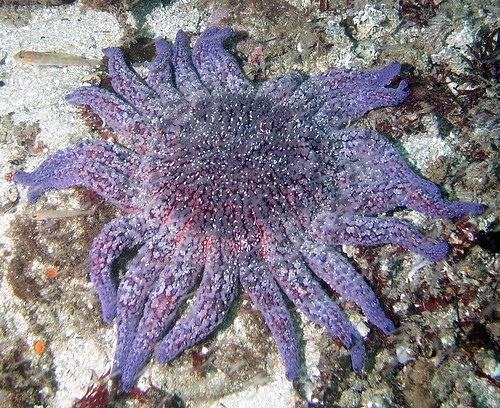
2. Pycnopodia helianthoides (Asteriidae). Speed: 20.4 mm/s
Pycnopodia is found only on the west coast of the United States from Alaska to southern California. Its a big animal-up to about 2-3 feet in diameter.

Its a big animal and boasts 15,000 tube feet on its 20-30 arms. Its a feared and voracious predator on mollusks, sea urchins and other invertebrates, which can actually smell it coming and will move out of the way when they do...

It has THE reputation for being the fastest starfish known.. but as we shall see, this is not the case...
Giant Sunflower Star
here's some footage of this formidable species in motion!


1. Luidia ciliaris and friends (Luidiidae). Speed: 50 mm/s !!
Luidia is a genus of "sand star" that lives in tropical to temperate, usually shallow sandy habitats all over the world. They are predators that feed on mollusks, sea urchins and other invertebrates.

L. ciliaris occurs in the North Atlantic around Europe-the UK and so thereabouts..
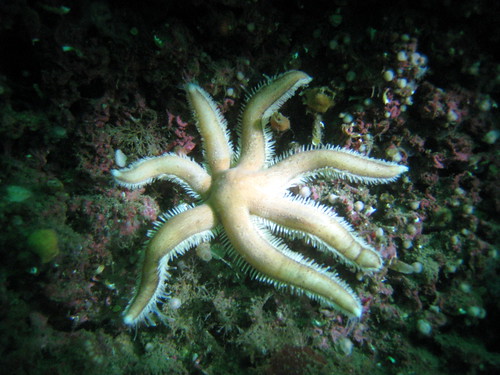
7 Arm Starfish

So, not what you thought! Pycnopodia has gotten the reputation as the "fastest starfish" in the world.
But NOT so! It would seem that Luidia spp. overall seem to be among the fastest of sea stars with a rate of movement just short of twice as fast as Pycnopodia!

Diver and photographer Neil McDaniel (who has contributed to the Echinoblog before) has graciously tested movement rates and found that under duress  Luidia foliolata is about 25% faster than Pycnopodia. Luidia foliolata travels at a rate of about 46 mm/sec vs. about 35 mm/sec in Pycnopodia.

Perhaps something to do with living primarily on sandy sediments??

But why talk when I can show you...
Here's Luidia maculata from Lembeh (Indonesia).  Note however, that this one has some commensal crabs that seem to be in on the action..


Even the 5-armed species are pretty light on their tube feet... Luidia clathrata from Isle of Palms, South Carolina..

Starfish from paul zoeller on Vimeo.

Thanks to Neil McDaniel for his contribution to this account!

Friday, May 4, 2012

Wow! Urasterias Vs. Amphipods! BONUS Echinoblog!

Last night I found this..

A video that shows the Arctic asteriid starfish Urasterias linckii just PLOWING into a field of creepy caprellid amphipods!  This looks like it might be feeding or possibly the opposite-defending itself?. Are the pedicellariae "batteries" on the side being used? Do these species typically interact?  Many mysteries!

As a caveat-this video could have been staged, obivously some time lapse was used, not sure. but it IS pretty cool and is I think the first time I have EVER seen Urasterias alive in a video! So, enjoy!

here's some better pics of the animal itself I found on Flickr
Urasterias linke 1
Photo by Alexander Semenov
And a close up of the MANY pedicellariae. They are quite abundant and pretty frakking HUGE!
Urasterias linke
Photo by Alexander Semenov

If you want to why/how the pedicellariae might be used in feeding click first on this intro post  and then there's this earlier post about asteroids feeding on moving prey! (and on Labidiaster-the king of starfish predators on moving prey!)

Sunday, April 22, 2012

Cockles and the Starfish who like to eat them! A nice gallery of escape responses!

Here's a neat escape response that was captured on Flickr between a Florida cockle and the sand star Astropecten! Images captured by "The LivingSea.com"  Plus some video of Pacific cockles being chased by sunflower stars!


Here, we see Astropecten articulatus in contact with the cockle (Trachycardium egmontianum) A Beaded Sea Star picks up the scent of a mollusc nearby

The cockle is alerted! And it extends its large muscular foot to begin its escape! Florida Prickly Cockle extends its foot to leap away (Trachycardium egmontianum)

 The foot pushes the cockle away!
 Mollusc uses its foot to escape predation

And aWWAAAAYYYY it goes!
 A Florida Prickly Cockle avoid predation (Trachycardium egmontianum)
And away!
Bivalves methods to avoid predation

On the Pacific coast, different species of predatory starfish (in this case the sunflower star Pycnopodia helianthoides) also feed on cockles.. an identical response is observed..


Here's a really nice one


Here's one that literally does a judo like flip on Pycnopodia!


here's a decent one with a wacky sound track..


Here's a variety of responses to both cockles AND scallops!  (the scallops are the one that "jet" away using their excurrent siphons)