Showing posts with label ophiuroidea. Show all posts

Monday, May 8, 2017

Brittle Stars of (squid & fish) Death pt 2! Okeanos Explorer Edition!


This Saturday we were witness to one of the most AMAZING echinoderm related ecology/natural history moments that I've seen in awhile!

Namely watching this brittle star CAPTURE and EAT SWIMMING PREY!.. and this happened all LIVE on Okeanos Explorer's live stream deep-sea research!  http://oceanexplorer.noaa.gov/okeanos/media/exstream/exstream.html

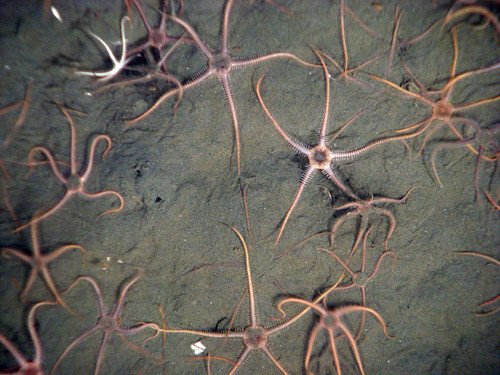
The Okeanos Explorer was surveying Jarvis Island in the central Pacific at a depth of about 400 to 500 m. They were watching a tiny squid swimming through a thicket of deep-sea "bushes" composed of hydroids and worm tubes, covered by many, MANY animals including brittle stars!

Most times we see brittle stars, they have their arms up in the water, presumably filter feeding... Brittle stars are frequently numerous as I've written about here. 

The tiny squid (apparently in the genus Abralia (as identified by Mike Vecchione at NMFS) was moving along its merry way..when suddenly.... (at 0:25 to 0:30) the tiny squid is knocked around and then CAUGHT by the arm of one of the ophiothricid brittle stars!!!

UPDATE: Here's teh Official NOAA Okeanos Explorer Video!

(video captured by 2011ACVVV)
(video captured by Steve Hornik of the Facebook Underwater Screengrab Group)

As indicated by the Biology Co-lead Dr. Scott France "Did that really happen?"

Here it is again blow by blow...

Spines in these brittle stars is sharp and often with jagged edges..so capturing something soft-bodied isn't TOO surprising..

Brittle star eating dead squid! followed by many OTHER brittle stars sharing the prey!
 
The GIF 
WHAT?? Brittle Stars feeding on swimming prey? THAT'S CRAZY! but, its happened before...

Yes! Most of us don't think of sea stars OR brittle stars as capturing fast moving or SWIMMING prey!  Strangely enough, THIS WAS CAUGHT ONCE BEFORE!!

Once, back in 1996 at the San Francisco International Echinoderm Conference Dr. Steve Stancyk and C. Muir at the University of South Carolina and Dr. Toshihiko Fujita of the National Science Museum in Tokyo presented some fascinating data showing the very abundant deep-sea brittle star Ophiura sarsi capturing and then swarming over and DEVOURING fish and shrimp as they got too close to the abundant carpets of brittle stars on the deep-sea bottom!!!  Here was my blog post about back in 2008! 

I remember seeing the presentation of this talk at San Francisco State University. The room was Standing Room ONLY! EVERYONE had to see the famous video of the brittle stars capturing swimming prey!!

BUT ! Dr. Stancyk has graciously NOW permitted his VIDEO of this event to be put up on Youtube making it AVAILABLE FOR THE FIRST TIME!!Basically... at about 4:48, a myctophid fish (and later a squid) gets too close to the "brittle star carpet", gets caught in a loop by the arm, gets DRAGGED down and then overcome by DOZENS of brittle stars!!! 


 Perhaps the most...striking part of this and the Okeanos Explorer video is how.. BRUTAL the brittle stars are when finally tearing apart their prey. Ophiura sarsi was literally rending those fish and squid apart! 

Similarly.. the ophiothricids seen by the Okeanos were carrying off their tiny squid prey..likely to be devoured by many, brittle stars which collaborated in the capture... Ophiuroids have teeth! and presumably DO use them on food! 
What will Okeanos Explorer see next??

Wednesday, February 1, 2017

Brittle Stars that Steal Food From Jellyfish!

Ophiuroids on Jelly in Mozambique. Photo by Andrea Marshall, Daily Mail, http://www.dailymail.co.uk/~/article-3990782/index.html#i-570251ad33a88841
And a HAPPY NEW 2017 to everyone! Yes. Obviously everyone has noticed the Echinoblog has gone to an "irregular" publication schedule. This is one of those "be careful what you wish for" issues- a lot of museum travel = a lot of new discoveries and thus papers and more work!  And so, like a lot of artisan comic books.. I'll be publishing when good topics and/or when the inspiration strikes me.


Their work presents NEW data on the relationship between the "jellyfish hitchiking" brittle star Ophiocnemis marmorata (on the moon jelly Aurelia aurita)! The species occurs widely throughout the Indo-Pacific from Japan to India. I previously wrote about this phenomena back in 2009! here.

1. How many different types of Jellyfish species does Ophiocnemis marmorata occur ON??
The paper reports at least five or six, including at least 3 species of Rhopilema, Cephea cephea (the cauliflower jellyfish), Netrostoma and Aurelia aurita. But other internet records  and social media show further hosts.. such as this hydrozoan, Aequorea from Thailand..
From Chaloklum Diving in Singapore, http://www.chaloklum-diving.com/marine-life-koh-phangan/corals-more-cnidaria/true-jellyfish-scythozoa/scythozoa-other-jellyfish/

And here's a blog that documents this brittle stars on the "hairy" jellyfish. Lobocnema

2. Where/How many are present on a jellyfish host? 
Based on their sample of 92 Aurelia aurita, the authors, found that 79% of them (n=73) hosted brittle stars! quite a large number. Most of them were present under the bell or on the "oral arms" (the lobes hanging down from the bell)
Image by Thomas Peschak, https://www.thomaspeschak.com/
The authors observed that brittle stars ranged widely in size (1.0 to 6.0 mm) but MOST had a disk diameter of greater than 3.0 mm.  Medusae with MORE brittle stars were LARGER than those medusae without brittle stars. 
The largest number of brittle stars recorded (n=14) occurred on a medusae with 155.0 mm bell diameter. 


Its also worth noting that the brittle stars stay on the medusae ONLY within their home range. Many of these jellies, such as Aurelia (i.e. moon jellies) actually go beyond tropical settings and they really aren't seen on jellies in cold to temperate waters.. 

3. So, what are the brittle stars EATING??
The authors used a novel new method which basically breaks down the organic components of specific isotopes (Carbon and Nitrogen) and looks for how much of those isotopes is present in the subjects versus that which is provided by the environment.

Long story short: The data indcates that most of the food sources in Ophiocnemis seems to come from PLANKTONIC SOURCES! (i.e. the mesozooplankton) and NOT from the medusae itself and there were not any observations of Ophiocnemis filter feeding (i.e. arms up in the water).

And so the authors suggest that they are what's called KLEPTOPARASITES (a great word-really!). In other words, they take food directly away from the jellyfish out of the mouth or the oral arms, stealing or scavenging food from the jellyfish which are known as big pelagic predators.. What would be called "indirect food sources"...

There are several reports of other brittle stars that practice "kleptoparasitc" behavior.. i.e. moving down into the feeding arms or near the mouth and stealing food directly from the host. Some of it might not be a big deal to the host.. scraps and etc.. but meaningful to the ophiuroids..
Image by Ron Yeo at Tidechaser, http://tidechaser.blogspot.com/2012/03/brittle-stars-ophiuroidea-of-singapore.html

4. Growth and Settlement..aka Living on a Changing Jellyfish World
Although its not entirely clear HOW these brittle stars get up onto the jellies, one reasonable hypothesis is that they settle there as swimming larvae. Many of the brittle stars observed were tiny (smallest =1.0 mm disk).

Larger medusae seemed to carry a higher "brittle star load" than smaller ones. Its not clear exactly how/WHY certain species are chosen. Whether it is simply the physical dynamic of having a larger  medusae that facilitates more larvae to settle or if perhaps there are other cues??

It also turns out, based on further obsevations by others,  that this species DOES occur on the sea bottom on its own. So, its possible that as they get larger.. the brittle stars fall/jump/ or otherwise "settle" away from their floating substrate.

Or perhaps the jellies themselves die, as we see here on this unfortunate jelly in Singapore! 
Image by Ron Yeo at Tidechaser http://tidechaser.blogspot.com/2012/03/brittle-stars-ophiuroidea-of-singapore.html

5. Why go to all the hassle?? 
Well, one must ask, WHAT does a brittle star get OUT of basically jumping onto a jellyfish as a freshly settled larvae and living on it until it gets too big and falls off??

Obviously, they are getting FOOD. So that's one thing. And to a certain extent they are being PROTECTED..because what better thing to live on that a giant stinging gelatinous mass that eats fish! 

but perhaps the most important benefit is DISPERSAL.. that is the species is carried wide and far.. 
It was suggested that some medusae could carry these brittle stars up to 1000 kilometers from their point of colonization! 
Jellyfish

The apparent range of possible hosts adds further questions about the life mode and just HOW many different types of Ophiocnemis are present? And how do the different jellies affect how the brittle stars diversify and spread?  


Wednesday, June 1, 2016

Echinoderm Research at Museum Victoria! So long and thanks for all the Starfish!

Tropical brittle stars (2)
In the same way that a particular class of echinoderms is made up of diverse members, so are the research labs which study them!  So, in my last installment of #EchinoblogInAustralia I thought I would do a brief profile of researchers doing various kinds of echinoderm research at Museum Victoria in the Marine Zoology Department!

I've done similar profiles for the researchers in Paris at the Museum natioinal d'Histoire naturelle (here)! I think this gives everyone a bit of insight into the many different crew members which staff the various roles in the big research seen in scientific papers. And Dr. Tim O'Hara's lab has had a good week for "big research paper drops" with more to come!!

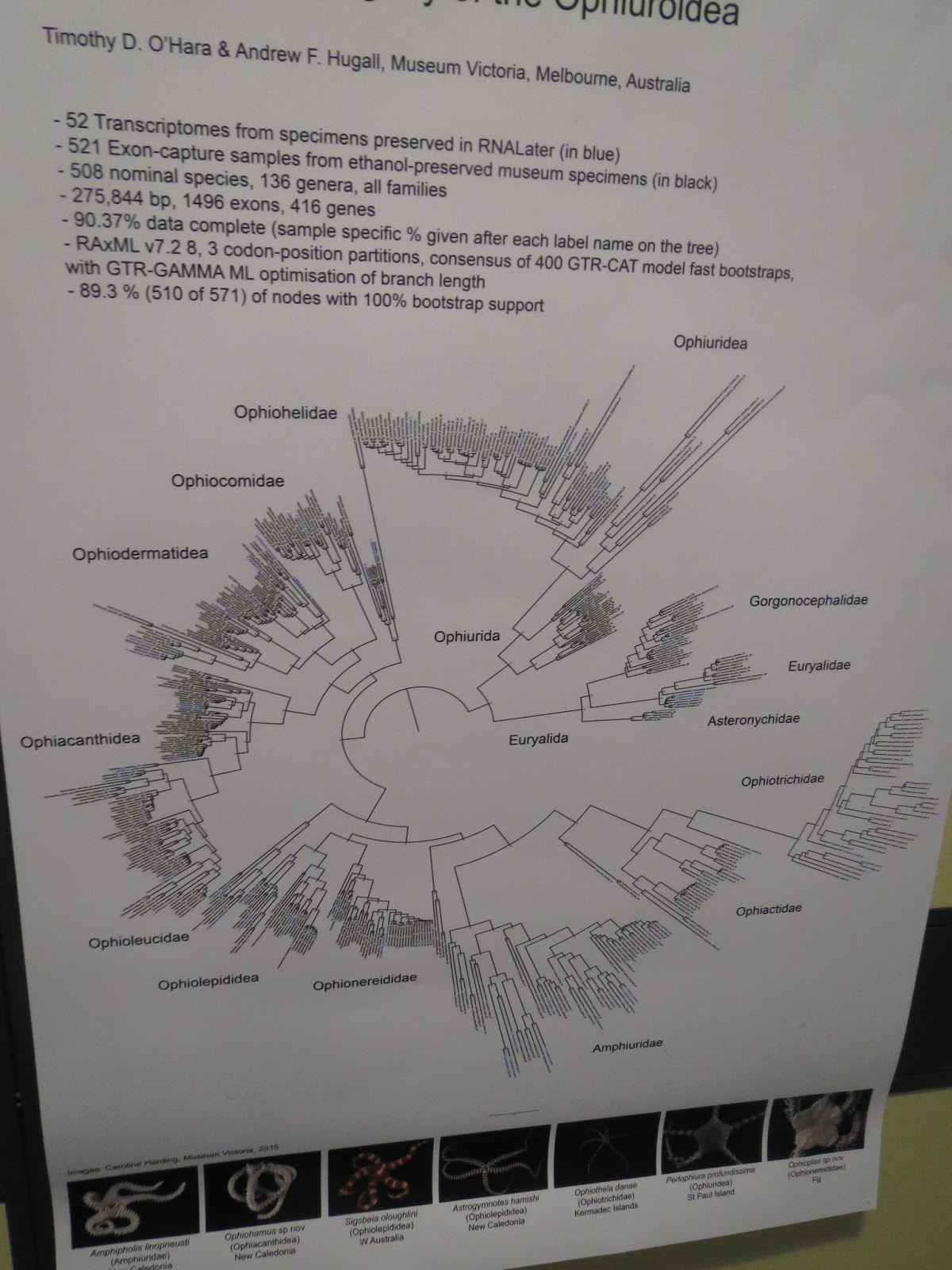
Just as a refresher though.. Here's a pic with the BIG project that Tim O'Hara's lab has been working on for the last several years: the BIG ophiuroid (aka the brittle and basket star) phylogeny! aka the "family tree" of the ophiuroids!

As I've mentioned previously, the new phylogeny is a BIG deal. It involves a group with over 2000 species which has been a taxonomic headache to scientists for over 100 years. Their research has literally turned this whole field on its head! (if brittle stars had a head!)

The tree clarifies which groups show support for being "real" and elaborates on how different brittle star and basket groups are related to one another.  It will almost DOUBLE the number families!!!
The tree itself is HUGE. Here it is below printed out and mounted on the wall for easy reference. You can see that it extends from that lower bookshelf to the that top shelf-so the printout is easily 6 feet tall (or two meters)!!

The tree was made using a phylogenomic data set. This is different from a lot of the molecular trees made in the last 20 years because it includes a whopping 425 genes and over 60 taxa! (other trees generally use only 3 to 10)  You can see the big paper as published in Current Biology here.

The Echinoderm researchers at Museum Victoria includes a diversity of workers!

1. Dr. Andrew Hugall
Where Tim O'Hara provides the "Ophiuroid Taxonomy and context", Dr. Hugall is the phylogenetics and analytical guru part of the "Big Ophiuroid" team. Although he is currently working on marine invertebrates, he worked previously on birds, discovering "Accelerated speciation" in highly colorful birds, a paper which was published in Nature in 2012. You can see that here. 
Dr. Hugall worked on the analytical aspects of the project and, in conjunction with Dr. O'Hara, cleaned up the genetic data in order to make it ready for analysis. He also provides a good complement to the "natural history" side of the lab with a powerful analytical background.

2. Lupita Bribiesca
Lupita is a PhD student at the University of Melbourne and got her undergraduate degree from the Universidad Nacional Autónoma de México. She's not only very proficient in computer coding and analysis but she's already a prolific author in echinoderm systematics! Especially in anchialine cave echinoderms!
In Mexico, Lupita worked on echinoderms which lived in submarine caves fed by the ocean. Some of her work can be found


3. Skipton "Skip" Woolley

Skip is a relatively new name on the echinoderm scene! But started out in grand fashion! His name of course headlines last week's BIG NATURE paper on ophiuroid deep-sea diversity! (here)

He's been doing analytical work looking at "big picture" diversity patterns in ophiuroids. His prior paper looked at biogeographical subdivisions in Western Australia in the journal Diverstiy & Distributions. 

4. Dr. Kate Naughton
I featured Kate Naughton's work on the blog back in 2009 when she and Tim O'Hara discovered a brooding "cryptic" species of the Australian Biscuit Star Tosia using molecular tools to understand the relationships of Tosia australis along the Australian coast. (see this story here)

Since then Kate has received her PhD and continued to do her awesome work combining ecology, taxonomy and molecular phylogenetics at Museum Victoria.
These days she's been working a LOT on feather star (i.e., crinoid) taxonomy and diversity in Australia. It turns out that there's a LOT of these in Australia that remain to be discovered and what's known requires a lot of work. 

As with many of us, she seeks a good job, funding for her research and all of life's finer things!

She HAS however also been working on new species of brittle stars in the genus Ophionereis! 
photo by John Keesing


5. P. Mark O'Loughlin and Deep Sea Sea Cucumbers
One of the most established echinoderm researchers at Museum Victoria was actually Tim O'Hara's original mentor!  

Mark O'Loughlin has been a fixture of the "marine invertebrates" scene in the Melbourne/Victoria area of Australia for decades. He's published a huge volume of work on echinoderms,  including sea stars and sea cucumbers. Here's his profile at ResearchGate! 

here's a sclerite from a new species of "sea pig" (Family Elpidiidae) that Mark is currently working on from the the Great Australian Bight (979 m)
Mark has been working steadfastly into his 80s but has assisted by many student workers (one of which is seen here)

My thanks to the Museum Victoria for my visit! About 1000 specimen lots identified! 
Until NEXT TIME, Melbourne!! 

Thursday, May 26, 2016

BEHOLD: The GAME OF THRONES BRITTLE STAR! & new ophiuroids from New Caledonia!


As many of you picked up on last week, I've been busy working on starfish at Museum Victoria in Melbourne working with my colleague Dr. Tim O'Hara, one of the world's leading authorities on ophiuroids! aka the brittle stars and basket stars!

He's had a BUNCH of big research news drop lately (here's the link to last week)

While talking to Dr. O'Hara he informed me of of some neat, NEW SPECIES he's described from the deep-sea habitats of the South Pacific New Caledonia in late 2015! These were just too neat to pass up a post on!

I've reported in earlier posts (here) about working with Dr. O'Hara on echinoderms in the Paris collections! 

All of these species were published in the Memoirs of the Museum Victoria, vol. 73: 47-57 published in 2015. Co-authored by Caroline Harding, also at Museum Victoria!  This article is OPEN access and can be downloaded HERE. 

1. The Impeller Brittle Star


As Dr. O'Hara tells the story, he was once called upon to aid a ship's engineer during his attempted crossing of the Bass Strait on the yacht Irene. A similar looking impeller failed the yacht's engine thus indelibly impressing its shape onto his mind's eye!
                                                                                                                     
Fast forward many years.. and Dr. O'Hara is describing this new amphiurid brittle star from the deeps of New Caledonia.

The large shields on the disk trigger a memory that reminds him of the impeller's shape! and voila! 
Enter: Ophiodaphne impellera 


2. The Game of Thrones Brittle Star: Ophiohamus georgemartini!!
Probably the most STRIKINGLY amazing brittle star Dr. O'Hara described was this one, a new species in the genus Ophiohamus (family Ophiacanthidae), collected from a depth of 275 meters off New Caledonia!

Here's a nice shot of it holding onto this sponge stalk... Note that its most striking feature? Those big crazy spines that are coming off the disk!

If we take a closer look at those big thorny spines coming off the disk...
and compare them with the sharp thorns coming off the crown depicted on the cover art from Game of Thrones: CLASH OF KINGS!                                                                 This provided the inspiration for the Species name for THIS new species of brittle star!        
BOOM! Tim named this one in honor of the AUTHOR of one of his favorite shows: GAME OF THRONES!! 
Ophiohamus georgemartini!! 

3. Ophionereis sykesi (family Amphiuridae) in honor of his wife who as Tim O' Hara put it "has had to put up with him rummaging around the world's museum collections for years"

An animal with a gorgeous disk plate field which I'm sure is a fitting honor for the Mrs! 

4. And finally, Amphipholis linopneusti, described by Dr. Sabine Stohr in 2001.  

NOT a new species but an interesting one from the New Caledonia region in that its one of the few echinoderms that I know of which is actually sexually dimorphic!  That means there are actually ways of determining males from females using external characters! 

The lowermost basal arm spines of males are enlarged, sometimes flattened and hour-glass-shaped, whereas on the females they are cylindrical with a blunt rounded apex.  Its a subtle difference to be sure but it exists, which is more you can say for a lot of echinoderms! 


Wednesday, May 18, 2016

BIG DATA about SMALL Echinoderms! Ophiuroids & their HUGE impact!

Image by Dr. Julian Finn, Museum Victoria
If you had asked me 10 years ago if the echinoderm group we would be learning the MOST from would be the OPHIUROIDS I would have been skeptical.

Basket stars? Taxonomy was impenetrably difficult. 
non-Basket stars? even worse.

Plus, Brittle stars were tiny, numerous, CRYPTIC animals. Who would study them? 

I'm sure we would see "big picture" stuff from sea urchins, sea stars or maybe even crinoids. But brittle stars? It would take a LOT of work to make them an "ideal" animal to work off of....

This week a BIG NEW PAPER in Deep-Sea Brittle Stars dropped in the pages of NATURE! 

I'm sometimes quite happy to be proven wrong! 


The paper from Tim O'Hara's brittle star lab at Museum Victoria in Melbourne, Australia, written by Skipton "Skip" Woolley et al. comprehensively analyzed 165 THOUSAND distribution records of brittle stars!!  

In other words, Tim identified, requested and/or otherwise retrieved THOUSANDS of records of brittle stars! When you consider how MANY specimens of ophiuroids there are? That is a HUGE effort!! 
Based on this analysis of species records correlated with different habitats, especially across different depths, they were able to determine several broad based and IMPORTANT patterns about WHERE brittle stars occur..
  • Deep-sea species diversity is shaped by energy availability (i.e. thermal energy and nutrients)
  • Continental shelf to upper-slope species richness consistently peaks in tropical Indo-west Pacific and Caribbean (0–30°) latitudes, and is well explained by variations in water temperature. 
          In other words, warmer water (heated by the tropics) promotes greater species richness. 
  • Deep-sea species show maximum richness at higher latitudes (30–50°, i.e. polar regions), where they are concentrated in areas with high carbon export flux and regions close to continental margin (richness drops as you get away from the land).
  • Ophiura sarsi
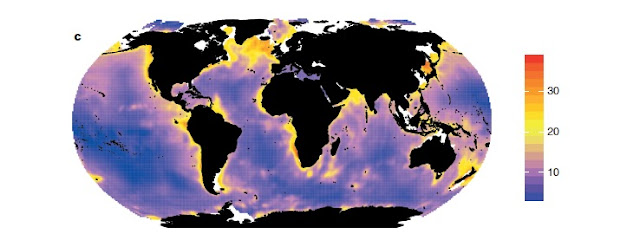
  • Global brittle star richness, in terms of species, peaks in the tropics at "shallow" continental shelf depths (20-200 m) and upper slope depths (200-1200 m). These peaks drop when you get below 2000 m depths. 
           The yellow and red in the diagram indicate species richness. These are warmer areas with                    relatively high nutrients, etc.  As the colors fade to purple and blue we see those numbers    
           decrease on the broad abyss of the ocean floor.

  • Data are consistent with a hypothesis that deep-sea species richness is maintained by species migration from shallower regions. i.e., "high energy areas feed low energy areas"
  • Historically we have looked at tropical areas as the focus of conservation efforts, but if we TRULY want to conserve deep-sea habitats we will need to consider the areas which show DEPENDENCE on the shallower regions for diversity.
If this is the case, then our conservation efforts will need to focus on MORE than simple high species diversity. We'd need to further look at places which are DEPENDENT on diversity!

In some ways, brittle stars are one of the most important "model animals' to observe these trends and interactions. Why?

1. Echinoderms, including brittle stars live ONLY in the oceans. No freshwater, or land relatives.

2. Brittle stars are EVERYWHERE. They are one of the most numerically abundant groups of echinoderms known.
PB230486 Amphipholis squamata 

This paper is the latest "big thing" to come out of Dr. Tim O'Hara's echinoderm lab at the Museum Victoria! 

The Nature paper is sort of the "other shoe" that has dropped with big discoveries. (Remember that
echinoderms have five shoes!)

Dr. O'Hara's other BIG news  in recent years has been the announcement of this: a comprehensive family tree of the ophiuroids! 

The Brittle Star Phylogeny Project
One of the most important and fundamental elements of biology is understanding the evolution and relationships of your study organisms. 
  • How are all the different groups related? (e.g., how are basket stars related to other brittle stars?)
  • How did they diversify? Where? 
  • What kind of habitat did they diversify into? 
  • Which brittle stars form actual, NATURAL biological groups? 
A phylogenetic tree helps to answer all these kinds  of questions! 

In biology, a well-supported tree with a strong data set supporting it is BIG DEAL.  You can literally put ALL the information known about a group, in this case-the brittle stars, into a PROPER evolutionary framework!! Perhaps some lineages share a particular ecological nice mirrored by body form. A tree like this can literally be mined for information for years. 

This starts with such immediate things as classification and rearranging all the families to reflect "natural" groupings. In other words whether taxonomic groups such as families or genera-created by scientists based on external characters are "real" or perhaps the result of misleading external appearance. At some point, there's probably a whole POST about that topic!

This kind of data is a POWERFUL statement.

Genetics is powerful stuff. Work on the "Big Tree" of ophiuroids suggests that there are many, MANY more families and SEVERAL orders of magnitude more SPECIES.

Past accounts have estimated about 2000 species?  In fact there are likely several TIMES MORE than that. But the exact number remains to be seen..

The work from Tim's lab has nearly DOUBLED the number of recognized FAMILIES of Brittle stars! 

He's also turned the classification of these animals on their head! some of the oldest known species turn out to be these interesting deep-sea forms.. Ophiomusium and their relatives! Many surprises!
image from Museum Victoria: http://researchdata.museum.vic.gov.au/brittlestar/www/o_lym.htm
You can sort of see how this ties in with the brittle star distribution paper.. How many of these points on the tree will show relationships between deep-sea and shallow-water species??

These efforts are some of the latest results from Tim O'Hara's "Big Data" ophiuroid work!

Remember that the fundamental basis for ALL of these projects has been Tim's skill in TAXONOMY of brittle stars. Many of these species were difficult to identify and reconcile without skills in how to tell them apart.  Here was an account of Tim's work at the Museum national d'Historie naturelle in Paris! He identified over 1000 specimens while I was there.

Other past efforts from Tim's lab:

Here's
 the time he and his student worked on the mystery of cryptic species in the Australian biscuit star Tosia australis! 


Here's his research on discovering the distribution of brittlestars in lateral bands

We'll be seeing more on Tim's lab NEXT WEEK! As Echinoblog continues on in AUSTRALIA!!