Showing posts with label phylogeny. Show all posts

Wednesday, May 18, 2016

BIG DATA about SMALL Echinoderms! Ophiuroids & their HUGE impact!

Image by Dr. Julian Finn, Museum Victoria
If you had asked me 10 years ago if the echinoderm group we would be learning the MOST from would be the OPHIUROIDS I would have been skeptical.

Basket stars? Taxonomy was impenetrably difficult. 
non-Basket stars? even worse.

Plus, Brittle stars were tiny, numerous, CRYPTIC animals. Who would study them? 

I'm sure we would see "big picture" stuff from sea urchins, sea stars or maybe even crinoids. But brittle stars? It would take a LOT of work to make them an "ideal" animal to work off of....

This week a BIG NEW PAPER in Deep-Sea Brittle Stars dropped in the pages of NATURE! 

I'm sometimes quite happy to be proven wrong! 


The paper from Tim O'Hara's brittle star lab at Museum Victoria in Melbourne, Australia, written by Skipton "Skip" Woolley et al. comprehensively analyzed 165 THOUSAND distribution records of brittle stars!!  

In other words, Tim identified, requested and/or otherwise retrieved THOUSANDS of records of brittle stars! When you consider how MANY specimens of ophiuroids there are? That is a HUGE effort!! 
Based on this analysis of species records correlated with different habitats, especially across different depths, they were able to determine several broad based and IMPORTANT patterns about WHERE brittle stars occur..
  • Deep-sea species diversity is shaped by energy availability (i.e. thermal energy and nutrients)
  • Continental shelf to upper-slope species richness consistently peaks in tropical Indo-west Pacific and Caribbean (0–30°) latitudes, and is well explained by variations in water temperature. 
          In other words, warmer water (heated by the tropics) promotes greater species richness. 
  • Deep-sea species show maximum richness at higher latitudes (30–50°, i.e. polar regions), where they are concentrated in areas with high carbon export flux and regions close to continental margin (richness drops as you get away from the land).
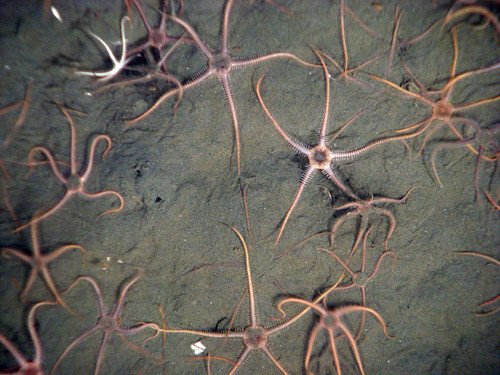
  • Ophiura sarsi
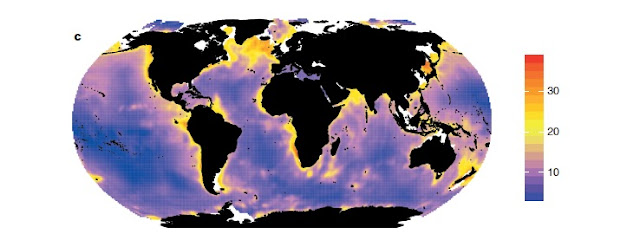
  • Global brittle star richness, in terms of species, peaks in the tropics at "shallow" continental shelf depths (20-200 m) and upper slope depths (200-1200 m). These peaks drop when you get below 2000 m depths. 
           The yellow and red in the diagram indicate species richness. These are warmer areas with                    relatively high nutrients, etc.  As the colors fade to purple and blue we see those numbers    
           decrease on the broad abyss of the ocean floor.
  • Data are consistent with a hypothesis that deep-sea species richness is maintained by species migration from shallower regions. i.e., "high energy areas feed low energy areas"
  • Historically we have looked at tropical areas as the focus of conservation efforts, but if we TRULY want to conserve deep-sea habitats we will need to consider the areas which show DEPENDENCE on the shallower regions for diversity.
If this is the case, then our conservation efforts will need to focus on MORE than simple high species diversity. We'd need to further look at places which are DEPENDENT on diversity!

In some ways, brittle stars are one of the most important "model animals' to observe these trends and interactions. Why?

1. Echinoderms, including brittle stars live ONLY in the oceans. No freshwater, or land relatives.

2. Brittle stars are EVERYWHERE. They are one of the most numerically abundant groups of echinoderms known.
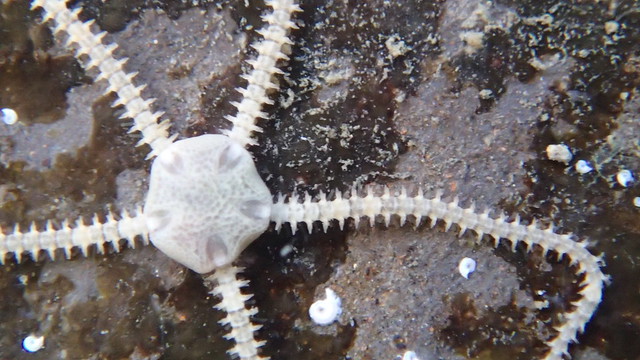
PB230486 Amphipholis squamata 

This paper is the latest "big thing" to come out of Dr. Tim O'Hara's echinoderm lab at the Museum Victoria! 

The Nature paper is sort of the "other shoe" that has dropped with big discoveries. (Remember that
echinoderms have five shoes!)

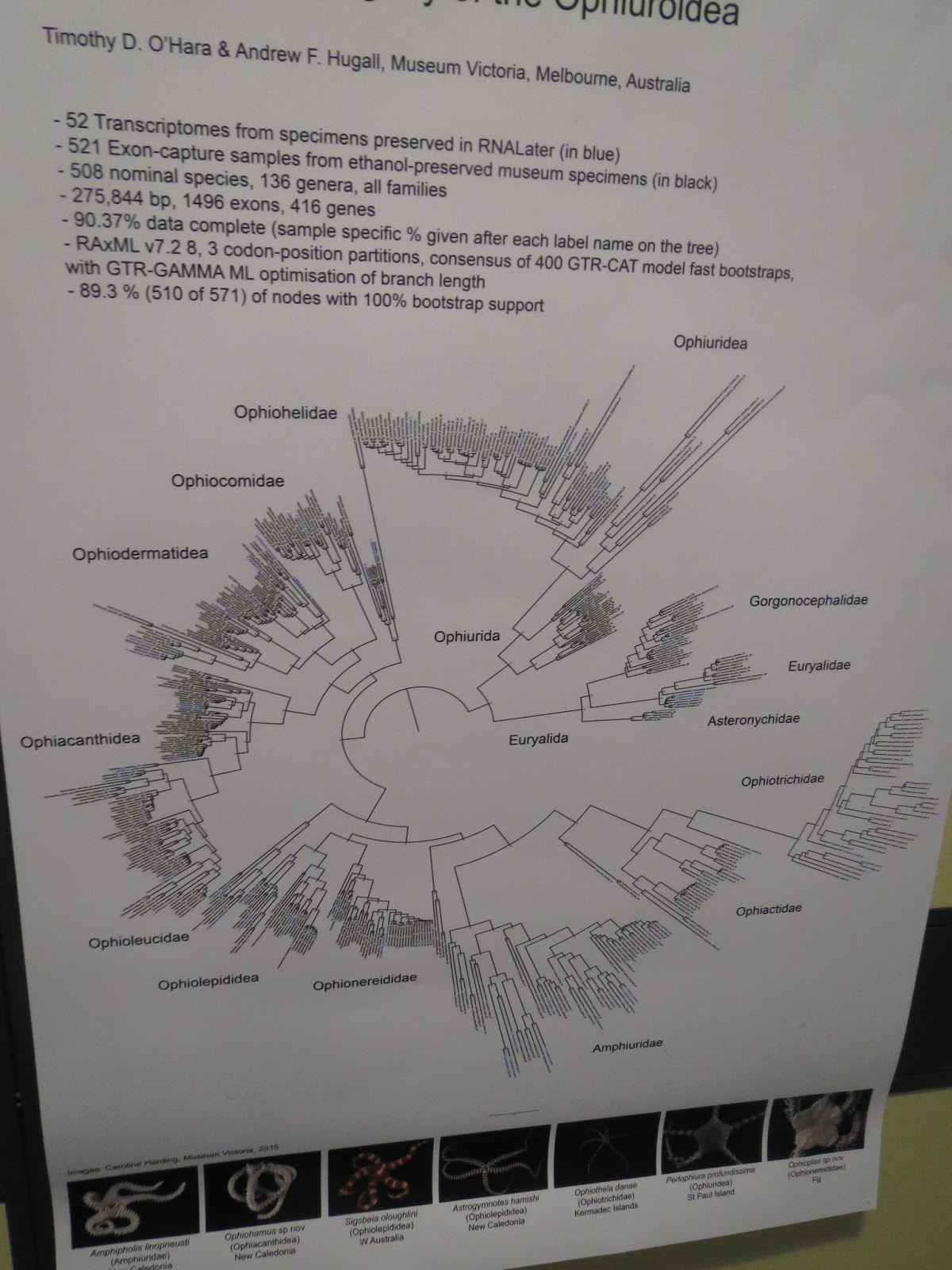
Dr. O'Hara's other BIG news  in recent years has been the announcement of this: a comprehensive family tree of the ophiuroids! 

The Brittle Star Phylogeny Project
One of the most important and fundamental elements of biology is understanding the evolution and relationships of your study organisms. 
  • How are all the different groups related? (e.g., how are basket stars related to other brittle stars?)
  • How did they diversify? Where? 
  • What kind of habitat did they diversify into? 
  • Which brittle stars form actual, NATURAL biological groups? 
A phylogenetic tree helps to answer all these kinds  of questions! 

In biology, a well-supported tree with a strong data set supporting it is BIG DEAL.  You can literally put ALL the information known about a group, in this case-the brittle stars, into a PROPER evolutionary framework!! Perhaps some lineages share a particular ecological nice mirrored by body form. A tree like this can literally be mined for information for years. 

This starts with such immediate things as classification and rearranging all the families to reflect "natural" groupings. In other words whether taxonomic groups such as families or genera-created by scientists based on external characters are "real" or perhaps the result of misleading external appearance. At some point, there's probably a whole POST about that topic!

This kind of data is a POWERFUL statement.

Genetics is powerful stuff. Work on the "Big Tree" of ophiuroids suggests that there are many, MANY more families and SEVERAL orders of magnitude more SPECIES.

Past accounts have estimated about 2000 species?  In fact there are likely several TIMES MORE than that. But the exact number remains to be seen..

The work from Tim's lab has nearly DOUBLED the number of recognized FAMILIES of Brittle stars! 

He's also turned the classification of these animals on their head! some of the oldest known species turn out to be these interesting deep-sea forms.. Ophiomusium and their relatives! Many surprises!
image from Museum Victoria: http://researchdata.museum.vic.gov.au/brittlestar/www/o_lym.htm
You can sort of see how this ties in with the brittle star distribution paper.. How many of these points on the tree will show relationships between deep-sea and shallow-water species??

These efforts are some of the latest results from Tim O'Hara's "Big Data" ophiuroid work!

Remember that the fundamental basis for ALL of these projects has been Tim's skill in TAXONOMY of brittle stars. Many of these species were difficult to identify and reconcile without skills in how to tell them apart.  Here was an account of Tim's work at the Museum national d'Historie naturelle in Paris! He identified over 1000 specimens while I was there.

Other past efforts from Tim's lab:

Here's
 the time he and his student worked on the mystery of cryptic species in the Australian biscuit star Tosia australis! 


Here's his research on discovering the distribution of brittlestars in lateral bands

We'll be seeing more on Tim's lab NEXT WEEK! As Echinoblog continues on in AUSTRALIA!! 

Wednesday, October 15, 2014

Five Points About The Fossil History of Echinoderms! Happy National Fossil Day!

Happy National Fossil Day!
Every few years I'm in a position to share some more love about echinoderms and fossils. I've done this on previous National Fossil Days and tried to shed some light on the often arcane world of fossil echinoderms...

Here's one on paleocology & fossil parasites..

A nice gallery of fossil crinoids..   and this classic piece on giant floating/pelagic crinoids! 

Paleozoic Echinoderms: The Ophiocystioids!  and the Helicoplacoids! 

A LOT of the REALLY weird stuff in echinoderms takes place in the days of the Paleozoic, some 245 to 541 MILLION YEARS Ago... There was a lot of crazy stuff (evolutionarily speaking) happening then. Echinoderms, as a lineage PREDATE Dinosaurs and they've been around since before vertebrates walked on land.

But here's a bunch of interesting facts I've cobbled together to better understand and appreciate fossil echinoderms and their history!!

5. Animal Body Type can bias preservation. This is really a dynamic of fossil preservation which is true for almost ANYTHING. In order for animals or any organism to undergo the fossilization process, it has to "survive" long enough to be buried and then kept together so that it undergoes the process.  MANY factors can affect which animals/organisms/whatever are preserved in the fossil record. The study of how different factors affect fossil preservation is called taphonomy and it affects our perception of the history of life on the planet.

One of those factors is the physical strength of the body itself. Is it delicate? Is it REALLY strong and tough?? Delicate, soft bodies tend NOT to preserve very well (although they can exceptionally) but some bodies with very heavy and strongly calcified bodies are MORE likely to preserve.

So for example, these starfish, in life would have a fairly chalky body. They hold together pretty well when all the tissue is removed.
Here's a whole bunch of crinoid stems preserved in limestone. These are pieces of the "stalk" in stalked crinoids. Hard parts that are pretty structurally solid. You're most likely to find this of all the pieces of a crinoid (aka a "stone lily").

4. Preservation Environment is important. So, here's the thing. The fossilization process requires pretty RAPID burial of the subject organism/animal, whatever for fossilization to eventually take place.  Which brings us to another "bias" of preservation: The environment!!

If the animal lives in an environment in which it is predisposed to be buried ANYWAY, that makes it THAT much MORE likely that it will be preserved. One good example are sand dollars (or really anything which lives buried).

Sand dollars have a pretty solid skeleton but ALSO live buried in sand. Sometimes, they can be killed by burial and pretty much just get preserved there in the sediment as it turns into rock.
                           

and voila! (yes, its not the same species but play along, its not easy finding matching videos and pictures of fossil sand dollars! )

3. There were MORE KINDS of Echinoderms in the Paleozoic!
One of the oldest questions from biologists unfamiliar with the fossil record is, "Why haven't you completely figured out the evolutionary history (i.e. phylogeny) of Echinoderms yet?? There's only FIVE of them!"

Yes. Only five LIVING groups (crinoids, sea stars, brittle stars, sea urchins & sea cucumbers) are around today. BUT when you get into the VERY earliest days of echinoderms in the Paleozoic (245-541 MILLION years ago), you have easily TRIPLE the number of groups! (i.e. classes) and a crazy diversity of body plans NOT seen today!

You got things that look like crinoids. Disc-shaped echinoderms. Accordian-shaped, asymmetrical echinoderms. Weird, crazy tentacle-balls. and all sorts of natural "experiments" in Echinoderm morphology.

A crazy panoply of things! Oh, to go back in a time machine to see when rock was young!
                           
2. The Roots of Recent Echinoderms were there...
Picking up on the crazy, diversity of echinoderms mentioned above its worth mentioning that the ancestors of MODERN echinoderms were seen among them.

Ophiocistioids for example are intermediate between sea urchins and sea cucumbers.

Also in the Paleozoic, we had the early ancestors to brittle stars and sea stars.  Today, the brittle stars and sea stars distinctive looking in appearance that we can easily tell them apart, but looking at those early forms was NOT so easy...

Can you imagine walking around in the Paleozoic seas and seeing something that was NOT quite a starfish but also NOT quite a brittle star!! Something in between....

That's kind of why some paleontologists get so twitchy about what you call a "sea star" versus a "brittle star". They have LITERALLY spent years arguing WHY that is the case..

1. The Permian/Triassic Extinction Changed everything
So, then at the END of the Paleozoic, in the Permian, you have one of the most devastating MASS EXTINCTIONS known to life on Earth at the Permian-Triassic Boundary. That is the end of the Paleozoic and the beginning of the Mesozoic (i..e time of the dinosaurs).

This extinction was huge. 96% of marine species were wiped out. Part of this? All those aforementioned echinoderm classes.. (about 15 of them)? GONE.

Only survivors from FIVE groups survived to live on today.   Here's a cartoon of this from Echinoblog Art Department!
Echinoblog Art Department Lives on!
Any one of these could be a whole blog post but this gives you a short summary of some dynamics involved with the rich fossil history of the Echinoderms! Happy National Fossil Day! 

Tuesday, June 28, 2011

The Surprising Evolutionary Tree of Forcipulate (Asteriid) Starfishes!

Have ya' ever wondered how different things go into the BIG picture?

Well, that's what I do for a living. Try to figure out the BIG starfish picture!
My research looks at placing different species within the broader, larger context of that animal's evolutionary history and discovering new species is part of that overall direction.

But how do they all fit together? how does that work?

One of the main sources of scientific data for trying to determine relationships between organisms has been its morphology. Or in other words its overall body shape and how different structures on the skeleton have changed across different species..


So, different groups of whatever animal or organism that are studied all tend to have various dynamics and levels of difficulty at figuring out these evolutionary relationships (and consequently, the groups or classification that they belong to).

And the "higher up" you go (i.e., beyond the species up to families and orders), so too does the level of difficulty!

One such group that has always vexed scientists has been the Forcipulatacea, also known commonly as the Forcipulate asteroids...

This confusion is kind of ironic since it is this group that includes such familiar species such as Asterias and Pisaster which have been some of the most heavily studied species in marine biology!!
But sometimes, diversity is a big pain in the ass!!

How do you figure out relationships between species that are as different looking as this

to this?
To this?
Believe it or not..all of the species above are actually related (albeit distantly). These all belong to the Forcipulatacea, one of the largest, most diverse groups of asteroids living today. But HOW are they related?

Our starting point began with a big, historical mess. The classification had historically included several groups that were confusing and difficult to define..

This week, a NEW paper written by myself and my colleague Dave Foltz at Louisiana State University was published in the new July Zoological Journal of the Linnean Society takes a new look at the classification and evolutionary relationships within the Forcipulatacea and shows us that not all is as it seems...

What was done...
So, basically we sampled DNA from ALL the major groups within the Forcipulate asteroids with the aim of reconstructing the broad evolutionary history of the group!

Forcipulates are diverse echinoderms. There are some 365 species in 77 genera in 7 or 8 families. We sampled from almost all the families and almost all of the genera.

These included species from all over the world.. Antarctica, South America, Canada, Alaska, Japan, Australia, and New Zealand.. We also got species from shallow-water intertidal (like the familiar Pisaster) and from some species in the deepest of oceans (from several thousand meters). Data was collected and analyzed using various computer programs...

What the Prior Morphology-Based Classifications would have said...


So, before I go into the actual results, I thought I would explain a little bit about how the historical methods work and how DNA provides another way to test and study the relationships between different starfish species!

So, basically in the past, I and many of my colleagues would have used morphological characteristics from the external and internal skeleton. My colleagues who work with fossils are limited pretty much ONLY to morphological data.

A tree from morphology would clump all similar-looking species together.. So, in a VERY superficial sense... the tree of relationships would look like this...
So, for example, something like this Pycnopodia
might be MOST likely to closely clustered with this Australian Coscinasterias because of the multiple arms..
as would this formidible Japanese Plazaster borealis
But SOMETIMES, the external appearance of animals can be deceiving!! There exists a phenomena known as convergence!! Which happens when animals develop a pronounced external appearance in reaction to the life mode in which they live.

So, dolphins, salmon and sharks are all distantly related from one another-but superficially they can all LOOK ALIKE because they all swim through the oceans!

If we're lucky, then the organisms we're studying show this convergence more clearly..but often times its NOT. And as a consequence external appearance can be VERY misleading..

And its for this reason that a LOT of the work on the Forcipulates (and particularly on the largest subgrouping-called the Asteriidae) is so difficult.

One important detail about this tree
The morphology would provide us with evidence to support or cluster starfish with similar appearance together.

THEN we could look at the biogeography or evolutionary relationships of different animals based on where they lived..

So, there would be Australian species separated into different groups based on the extensive morphological features shown above...

THAT is what we would expect to see in a lot of these kinds of evolutionary studies...

.... But what we got was different from what we expected!!

THE RESULTS
There was a lot about the overall final tree that wasn't surprising. A lot of the more fantastic and weird-looking deep-sea stuff , such as this zoroasterid was supported and came out pretty consistently where we predicted..
One bit of setting straight was the family Stichasteridae. Our molecular data separated this group out and re-established a classification/grouping that French scientists had established in the 18th Century!

Interestingly, members of this group (e.g., Stichaster) have what may be a parallel Southern Hemisphere ecological role in South America/Australia/New Zealand relative to the northern Pisaster or Pycnopodia which occur NOWHERE in the Southern Hemisphere!

but the one big subgrouping within the Forcipulatacea called the ASTERIIDAE..the family that includes well-known starfish like Pisaster (aka the Ochre star) was always the most troublesome for past workers trying to work out..
The morphology of the Asteriidae gave us a lot of good leads-but ultimately, it just got to be a big morass. A lot of the various genera either look very different or a LOT alike. And understanding the classification of the group became kind of a slow trudge owing to the scope of the problem.

Fortunately, our results were very encouraging and unexpected!

Groupings within the Asteriidae didn't cluster by external appearance, they clustered based on WHERE THEY WERE FOUND.

Lineages/groups were associated with different discrete regions...

For example, there is a lineage of Asteriidae that occur at high-latitudes, around the Antarctica/Southern Ocean!!

Like this Diplasterias brandti (shown here brooding babies in its mouth)
May superficially resemble Pisaster or Asterias, but actually displays NO immediate relationship! I argue that these and their relatives pretty much diversified when the Southern Ocean became isolated by the Antarctic Counter Current...

Its sister group are a lineage of asteriids that live in the Equatorial Tropics!

This is actually a pretty widespread group that extends from Mexico to Hawaii, Northern Japan and even to the tropical Atlantic in both shallow (e.g., Coscinasterias, Astrostole, Astrometis, etc.) and deep water (e.g., Coronaster)

here's the Australian Coscinasterias
the southern California/Baja California Astrometis sertulifera

and Finally, one of the largest and most diverse groups is the BOREAL Asteriidae!

This was probably the most interesting development for me, as a kid who grew up in California.

ALL of the well-known California asteriids, such as the big Sunflower Star (Pycnopodia)
Pisaster ochraceus!
The very tiny Leptasterias!
And the very large Evasterias echinosoma!
the uniquely temperate Asian taxon Plazaster borealis


are ALL part of the SAME evolutionary lineage that occurs (well mostly ) ONLY in the North Pacific and the North Atlantic!!

So, for those who have ever wondered? Pycnopodia. Pisaster. Evasterias. These are all starfishes that are basically endemic to the west coast of the United States!

They are found nowhere else in the world.

So, even though you have one big multi-armed guy starfish like the Sunflower star, Pycnopodia, it has closer relationship to something "normal looking" like Pisaster than it does to ANOTHER multi-rayed (and simlar looking) starfish species, say in Australia or Antarctica!

So even though, you have many species that SEEM to be more closely related superficially, the genetics tells us that different lineages are separated by the various different geographic regions!!

I think that's pretty nifty. And I didn't even get to talk about some of the OTHER parts of the paper!

Tuesday, March 29, 2011

Starfish Wars! The Great Debate in Sea Star Evolution!


Today: something a bit different. I thought that I would share a little bit about the details of a classic scientific debate among starfish scientists! What do we discuss? What sorts of topics are important?

Probably one of the most long-standing debates among scientists who study sea stars has been to understand the evolutionary relationships between those species living today and those which preceded them.
So, in the early 20th Century-many thoughts about starfish classification were also about evolution.

Which starfish would go at the "bottom" of the classification? (i.e., the oldest at bottom vs. youngest at top) What were the ancestors to those species living in the recent?

In the 1920s, opinions and DEBATE flared up as a heated exchange in the pages of the journal Nature between several of the most prominent workers of the day.

The participants in this discussion? Primarily it was between Professor E.W. MacBride (not shown) from the Royal College of Science in London and Dr. Theodore Mortensen at the Zoological Museum in Copenhagen (below)...
Originally, the discussion focused on the family Astropectinidae, which includes sea stars, such as this Astropecten, that burrow into sand, mud and other unconsolidated sediment like this..

But the discussion was later extended to other related members of the Paxillosida. An example is this related Mud Star (Ctenodiscus) here...

What are they fightin' about?
Astropectinids and their relatives in the larger order Paxillosida have a number of unqiue characteristics that suggested different evolutionary hypotheses to each of the two scientists. Simply put- Basal? or Ancestral? (i.e., "primtive" even though this term is not really accurate))

The Paxillosida is so-called because of the presence of structures called paxillae.
Paxillae provide a kind of surface protection above the papulae (i.e., the gills) which are present on the surface of the animal.

Mud and sand can cover over the paxillae but they don't clog up the papulae so that the animal can breathe...
Living in and around sediment-and SWALLOWING mud is often part of these' animals' repetoire!
Many Paxillosidans are voracious predators. You can see some of their eating habits documented here.

Mortensen (and indeed many of the other scientists of his day) interpreted many of the characters in this group as evidence that the group was more "primitive" (i.e., closer to a fossil ancestor).
(thanks to Echinoblog Art Dept. !)

This was opposite of MacBride who interpreted those characters as more "advanced' (i.e., specialized adaptations to the particular setting or lifestyle of the animals).
Let's see some of these characteristics-and see what the fuss was about!!

1. Absence of a brachiolaria larvae. It is common for many astropectinids (and presumably other paxillosidans-although data for all taxa isn't completely known) to LACK this one larval stage.
Mortensen and those who interpret this as a "primitve" or ancestral character would argue that the absence of this larval stage indicates that it is acquired later on by the OTHER starfish taxa.
And that this larvae was presumably NOT present in the ancestor of modern sea stars.

MacBride on the other hand argued that this was more evolved-i.e., a "lost" character as a result of specific modification. Presumably, an adaptation to the muddy/sandy/ sedimenty places that these starfish like to live.

2. Pointed Tube feet (or absence of suckers). Understanding of tube feet in starfish is actually a big deal with many isues pertaing to adhesion and so forth.. This interest continues to be a fairly active area of study.
Mortensen (and the belief of many) was that it was "primitive" to NOT have suckers on your tube feet in contrast to the -the way that most other starfish have. i.e., having suckers made you the more evolutionary sophisticated versus those without suckers.
MacBride argued that the suckerless tube feet were an acquired evolutionary feature (in other words-a loss or change from suckered tube feet) relative to most sea stars who have suckered tube feet (as above).

A point in MacBride's side has been that It turns out that SEM and subsequent work of tube feet shows that in the paxillosidans-these tube feet are actually pointed and not simply "suckerless".

It also turns out that in some Astropecten, there is a suckered tube foot present but only in juveniles.. So it does seem that the "pointed" tube feet develop and then give way to a the pointed tube feet in adults.

3. And finally... in the astropectinids surveyed-the ANUS was absent! And so the argument came down to the same back and forth: Was it missing because it was never there in the first place? (to be acquired by other sea stars later on?)

Or because it was "lost" over time as an adaptation to the environment?

And so it goes...
The discussion/debates over the Paxillosida began in the 1920s and have been an ongoing part of the study of starfish evolution ever since..

The positions of MacBride and Mortensen have found new advocates and the discussion has itself evolved through the many different generations of biological thought-fossils had always been important-but have become a critical part of the discussion in the 1960s and 70s.
The 1980s and 90s saw the phylogenetic revolution and the application of cladistics to the issue. And the discussion continued.

Many of these are interesting stories in their own right..but for now-I am glossing over them and maybe someday I will be able to detail some of those accounts..

At this point, I had found that many of the cladistic and phylogenetic discussions advocating the Paxillosida as derived or "advanced" rather than primtive to be the one best supported by the evidence.

Enter DNA...
What do I bring to this discussion? A few years ago, myself and my colleague Dr. David Foltz at Louisiana State University at Baton Rouge began to work on this question-collecting from the huge diversity of starfish, extracting DNA from them and producing a "family" or phylogenetic tree of modern sea stars.

Part of this tree was recently published by the Zoological Journal of the Linnean Society.. and our tree shows some interesting results...

Now, keep in mind that for various reasons, we did not actually arrive at a solid answer of "what is the ancestral starfish".

Often times, these trees are heavily influenced by many parameters-how many different kinds of starfish are included, the kinds of genetic data used and how much genetic data were included.

That said-this is also one of the most comprehensive DNA trees for starfish that are currently available..

And what you see is that the basal taxa are in yell0w-the Forcipulatacea and the Velatida whereas lodged up in the higher branches (see red box at bottom) : The Paxillosida!

Also interesting-is that nearly all of the taxa that showed adaptations for burrowing were supported among the Paxillosida...
The tree above has also changed a lot of the underlying assumptions about many of the relationships among sea stars. The Velatida had not previously been thought of as being near the base of the tree. So many new angles have been brought into the discussion!

Now, I know for a fact that a new (non-DNA) paper that challenges this is in the pipe! How will this new data conflict or agree with the tree indicated above?


We shall see...