Showing posts with label fossils. Show all posts

Wednesday, February 10, 2016

Heart Urchins! Burrowing their way into your Valentine's Day!

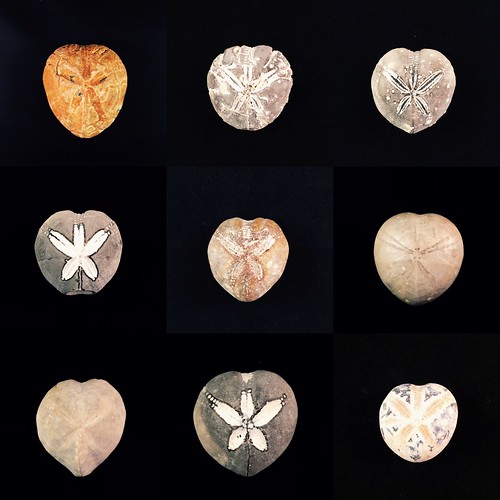
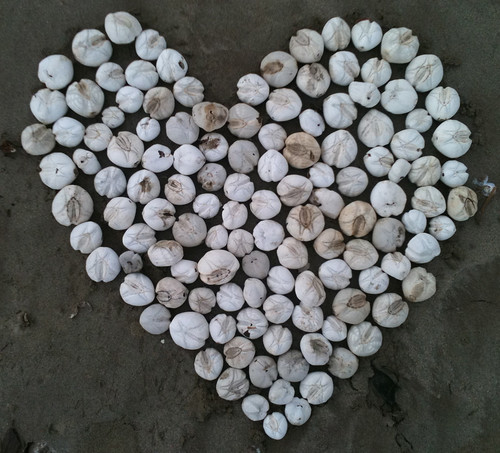
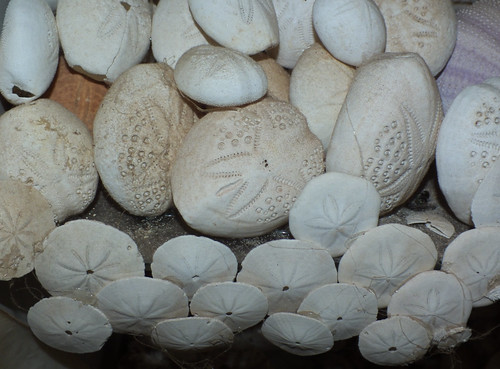
Urchin hearts
So, yes, that most dreaded of days, Valentine's Day is around the corner! What better echinoderm though to celebrate a day about affairs of the heart then HEART urchins!
Yes urchins, that are shaped LIKE hearts and will burrow their way into yours!!

Heart urchins are in fact what's called "irregular urchins", a subgroup known as spatangoids.. These are sea urchins which DIG into sediments. They are closely related to sand dollars (both of them are considered "irregular urchins"). I've discussed this in detail hereSpines and jaws in these animals are specific adaptations for this life mode.
Loveniidae>Breynia desorii Heart Urchin DSCF1788

I've actually written about one of the better known heart urchins, Echinocardium here.  Note the name of that genus, Echinocardium which breaks down into its root words Echino for "spiny" and -cardium for "heart."

As I've discussed elsewhere, heart urchins live primarily in sandy or sediment-type bottoms. They occur widely around the world and although most people don't immediately recognize them, they are pretty diverse, about 18 families with many, MANY living species and even more fossils...

They even go by many, many colorful common names "sea potato", "sea eggs", "sea hedgehogs", etc.


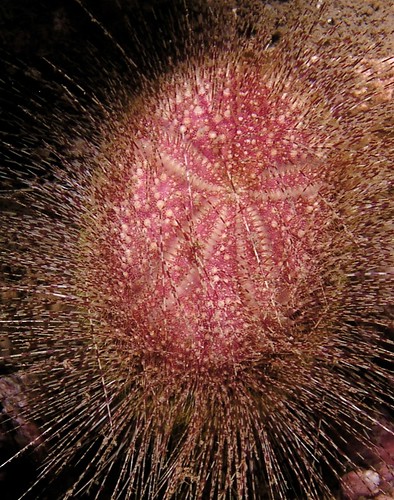
Spiny! 
When people think of sea urchins, they usually think "spiny ball" and heart urchins are no different! BUT they have urchins that are modified as part of their life style to burrowing/digging through sediment..(as we'll see)

SOME species, such as this Lovenia (top) and the Eurypatagus(?) below have very long and pointy spines most of which you'll notice, are all directed backwards. They would otherwise seem rather ungainly for digging..but these live in shallow-water habitats and the spines, sort of akin to those of a porcupine, seem to aid the animal as defenses... 
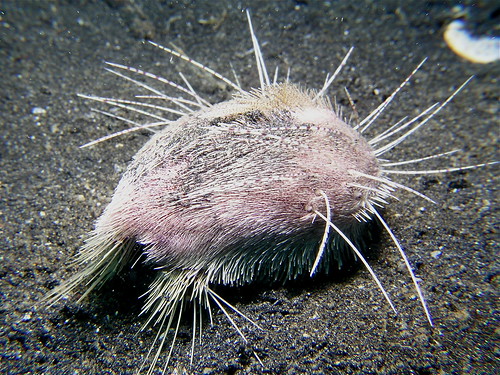
Elongate heart urchin

But the spines can also be used to aid in movement and these urchins move quickly when they want to...
Here's five reasons why, you should LOVE heart urchins!

5. They Dig into and eat sediment!
Let's face it, heart urchins are frakkin' adorable. They look like little underwater moles! Here's a nice cartoon of how they live.. basically they love being buried under the sediment/sand and stick their tube feet up out of the top to respire and so forth..
From Nichols 1959
But why show you a diagram when you can  JUST WATCH IT!!


Check out these cool videos of various heart urchin species from Japan and elsewhere... the one with long spines looks like Lovenia..but there's a couple of species and these are found in all of the world's oceans! Southern (Antarctic), Arctic, Atlantic, Indian Ocean, and the Pacific...

4. Bioturbation is important
You don't often SEE heart urchins that often, but that doesn't mean they are unimportant. They are fairly significant bioturbators! i.e. animals that dig through, aerate and mix up the sediment!

NIWA's Drew Lohrer wrote this really nice summary(2003) of the importance of the heart urchin Echinocardium and their primary impact: bioturbation.

Basically, animals that live in sediment, DIG. And their digging imparts an important biological impact: This distributes nutrients, mixes up the sediment allowing oxygen to be transported around, basically leaving the sediment in a place where OTHER animals would be able to use it. 

Here's is Lohrer's simple but lovely diagram showing how this works...
3. Heart Urchins were around during the time of the dinosaurs! 
As a result of the heart urchin habitat (being buried or mostly so), their skeletons are favorably inclined to be buried and preserved as fossils.
Echinoid

So, heart urchins occur as far back as the JURASSIC with rich faunas in the Cretaceous. So yes, while big reptiles like Tyrannosaurus and etc. were running around on land? Heart urchins and their relatives were digging and moving around on the seafloor during that SAME time period!!

Heart urchin fossils are VERY informative in the fossil record and a useful model animal for understanding extinction, macroevolution and rates of evolution during that time period. 
Micrasters.
1. Environmental Indicators!
So, you want to know how animals with "academic interest" have a practical use??  Well, as it turns out Japanese heart urchins, including Spatangus leutkeni, Brisaster latifrons and Echinocardium cordatum were among three species used as indicator species to detect Cesium in and around Fukushima! 

These were only a few indicator species of course, the others including sea cucumbers and polychaete worms. BUT these are all part of the infauna..that is the animals which live in the sediment and digest the organic materials from the mud and so forth. 

Many infaunal echinoderms were used as part of this, apparently as yet, unpublished study...


Extra! REPRODUCTION! Massive aggregations & spawning video!
And of course, there's SEX. I wrote, wonderingly, about the massive reproductive aggregations of Maretia here. I still don't know much more about it. 


Here's a cool video of a heart urchin from Bonaire. So on that note, Happy Valentine's Day if that's your jazz... 


Wednesday, March 18, 2015

Pyritized Fossils! All that Glitters is not gold...sometimes it's MORE!

this image via Wikipedia
This week, I crack open my geology files and tell you a little about an interesting preservational process known as pyritization! 

This is actually a special type of preservation called permineralization, where an inorganic mineral "replaces" or forms a cast of a particular structure. Mostly hard parts, but soft parts are also replaced, as we'll see.

Pyritization involves the mineral iron sulfide (FeS2), (also known as pyrite or fool's gold)..which will replace the 'hard parts' (shells, skeletons, etc.) present on animals during preservation. 

This mode of preservation actually involves biology!! Bacteria, which are present during the decay of the original organism will produce sulfide. If you've ever seen something dead and buried, that rotten egg smell that accompanies the blackened tissue is the sulfide.

The bacteria in combination with minerals in the sediment/soil can lead to unusual conditions leading to the formation of pyrite which eventually becomes infused with the fossil, sometimes replacing the hard parts and sometimes even the soft parts..

Here are some neat examples...

Pyritized Devonian brachiopod! Paraspifier bownockeri. Image by James St. John


A Devonian goniatite (fossil cephalopod), Tomoceras unlangulare. Image by James St. John

unidentified pyritized ammonite


Some show exceptionally fine details!  Here are sutures on the shell..

And pyritized detail inside the shell

Endoskeletons and soft parts can also be pyritized, resulting in exceptionally preserved specimens!

Here is the Devonian Furcaster paleozoicus..a Paleozoic brittle star from the famous Hunsruck slate in Germany

A nice write up of this area, and the exceptional preservation seen there can be found on this website.                    .
A Pyritizied Devonian crinoid Arthroacantha

But probably one of the most exceptional examples of pyritization is when it captures soft tissues, such as on the trilobite, Triarthus

There were actually soft parts preserved on these trilobites, allowing for some fairly accurate reconstructions of the morphology...

Here's some with a size reference... the soft tissue preservation is remarkable...


and even trace fossils! Here's a worm tube with crystalline pyrite!

Wednesday, January 7, 2015

Pegaster stichos A Cretaceous California starfish example of Paleo History!!

This week, I am in California on my way to Japan! I am visiting the world-renowned Invertebrate Zoology & Geology department at the California Academy of Sciences in San Francisco! 

I used to work here when I was a grad student at San Francisco State University in the 90s and as such I have a long-standing relationship with colleagues at the museum.
While going through the collections, I encountered a specimen of this awesome classic fossil, the Cretaceous Pegaster stichos, a starfish belonging to the family Stichasteridae described by my former PhD advisor, Dan Blake and Dallas Peterson in 1993 in the Journal of Paleontology. Their specimen is below...

                                
The CAS specimen (CASG 68139)  is also from the Cretaceous of California... (my thanks to Dr. Peter Roopnarine @peterroopnarine and Collection Manager Dr. Jean deMouthe for their help!)

If some of you are "old timer" San Franciscans.. you may even recognize that this fossil was originally on display in the old CAS Life Through Time Exhibit!!
                                
These specimens (and others like them) are powerful pieces of evidence for how the distributional ranges of marine animals has changed over time. 

but first.. just a little introduction so we're all on the same page...

The starfish in question belongs to the Stichasteridae, which is a group of forcipulate starfishes. I wrote about the curious pattern of biogeographically arranged lineages in the family tree of these animals awhile back...

Note the purple arrow below. The Stichasterids are down at the base of the tree. Given that the record of this whole group goes back to the Triassic, the fact that they are still around is pretty cool.
BUT most members of the Stichasteridae in MODERN oceans live mostly in the Southern Hemisphere (shown here by Stichaster australis), usually seen in Australia, New Zealand and/or the cold-temperate part of South America

As I've blogged before, shallow water members of this family are often times convergent with sea stars in a different family, the Asteriidae from intertidal habitats in the Northern Hemisphere..

But most members of the Stichasteridae are absent from the Northern Hemisphere EXCEPT in the deep-sea, such as this Neomorphaster we saw in a 2013 Okeanos Expedition, where they can be surprisingly abundant..

The only other EXCEPTION to this occurrence in the northern hemisphere is from FOSSILS!! 

Behold this awesome specimen of the Cretaceous stichasterid, Pegaster stichos!! 
                                 
So, this shows that at ONE TIME, this group of sea stars lived in the Northern Hemisphere and in the Pacific, perhaps even more widely than was previously known. Note also that in this time period, a good chunk of the west coast of North America was underwater...as well as a good parts of Texas and the south..
From NPR: http://media.npr.org/assets/img/2012/10/09/late-cretaceous_wide-e3fc2fd33eac021deb4b6ac5b4d87cb80d50f9f2.jpg?s=6
For most of us, we think of the Cretaceous as the time of the dinosaurs and other big marine reptiles!
from the NPS National fossil DAY page! 
But MANY a starfish and sea urchin was around during those days...

and sea urchins of course!

What happened to them??  Extinction apparently. Or maybe they just moved into more friendly waters?   Why?? Any number of factors including sea level and/or climate change.


Where do modern faunas come from? They were here and there.. and sometimes we can see them back then....

Wednesday, October 22, 2014

Coelopleurus! The most gorgeous urchin you never heard of!

This week, I thought I'd share some gorgeous sea urchin love! Behold Coelopleurus

What's that? You've never HEARD of Coelopleurus??  Well, that's about right, I suppose. Its a distinctive looking enough species but it lives in slightly deeper water than is typical for most casual SCUBA divers or vacationing snorkelers..
Described by Louis Agassiz in 1840, Coelopleurus is a genus in the family Arbaciidae. There are about 14 known species. Eleven living species and four fossils.  

Coelopleurus is a deep-sea urchin, but on the shallow side, about 75 to 500 meters. They occur primarily in the tropics, but across the Atlantic, Pacific and Indian Oceans. 

Biology of these animals is poorly known. 


It is also kind of unusual because it is one of the few sea urchins that displays secondary sex characteristics.. i.e., you can tell the females from the males when the males are spawning. 

You see that structure that the red arrows are pointing to?? 

That is the male "papillae". And in "C" you can see sperm being ejected into the water column. Yow!! This image is from a paper by Dave Pawson and John E. Miller in the Bulletin of Marine Science, 1979. 29(4): 581-586.  
Coelopleurus is unusual because it has these big, long curved spines BUT they are brilliantly colored in red and white!
But even MORE than that?? The tests (i.e., the skeletons) are brightly colored with these very striking patterns that seem to be rather variable..

Here is the test of Coelopleurus floridanus... 
But here's one that is considered the SAME species but a LARGER specimen.... Honestly.. it wasn't clear to me how important the patterns were to identifying each species.

The colors and patterns are embedded in the skeleton. So, if you drop them in a preservative like alcohol, the reds and purples, and etc. don't go away. They remain after death.
Here's another species. This one is from Japan... Coelopleurus undulatus from M. Shigei. 1986. The sea urchins of Sagami Bay. Biological Laboratory, Imperial Household, Maruzen Co. Ltd, Japan.

Gorgeous and amazing. 
Image from the NHM Echinoid database
Here is the most recently described species, Coelopleurus exquisitus which had the distinction of being described, in part from specimens purchased from the online auction house Ebay in 2006. 


Here again, is the very distinctive and unusual color pattern observed in this species... 

But wait! Coelopleurus also occurs in the fossil record!!  Here's Coelopleurus coronaformis from the Cenozoic of Mexico (< 66 million years ago) so pretty recent..

Here's Coelopleurus coronalis from the Eocene of Barcelona, Spain... 

Wednesday, October 15, 2014

Five Points About The Fossil History of Echinoderms! Happy National Fossil Day!

Happy National Fossil Day!
Every few years I'm in a position to share some more love about echinoderms and fossils. I've done this on previous National Fossil Days and tried to shed some light on the often arcane world of fossil echinoderms...

Here's one on paleocology & fossil parasites..

A nice gallery of fossil crinoids..   and this classic piece on giant floating/pelagic crinoids! 

Paleozoic Echinoderms: The Ophiocystioids!  and the Helicoplacoids! 

A LOT of the REALLY weird stuff in echinoderms takes place in the days of the Paleozoic, some 245 to 541 MILLION YEARS Ago... There was a lot of crazy stuff (evolutionarily speaking) happening then. Echinoderms, as a lineage PREDATE Dinosaurs and they've been around since before vertebrates walked on land.

But here's a bunch of interesting facts I've cobbled together to better understand and appreciate fossil echinoderms and their history!!

5. Animal Body Type can bias preservation. This is really a dynamic of fossil preservation which is true for almost ANYTHING. In order for animals or any organism to undergo the fossilization process, it has to "survive" long enough to be buried and then kept together so that it undergoes the process.  MANY factors can affect which animals/organisms/whatever are preserved in the fossil record. The study of how different factors affect fossil preservation is called taphonomy and it affects our perception of the history of life on the planet.

One of those factors is the physical strength of the body itself. Is it delicate? Is it REALLY strong and tough?? Delicate, soft bodies tend NOT to preserve very well (although they can exceptionally) but some bodies with very heavy and strongly calcified bodies are MORE likely to preserve.

So for example, these starfish, in life would have a fairly chalky body. They hold together pretty well when all the tissue is removed.
Here's a whole bunch of crinoid stems preserved in limestone. These are pieces of the "stalk" in stalked crinoids. Hard parts that are pretty structurally solid. You're most likely to find this of all the pieces of a crinoid (aka a "stone lily").

4. Preservation Environment is important. So, here's the thing. The fossilization process requires pretty RAPID burial of the subject organism/animal, whatever for fossilization to eventually take place.  Which brings us to another "bias" of preservation: The environment!!

If the animal lives in an environment in which it is predisposed to be buried ANYWAY, that makes it THAT much MORE likely that it will be preserved. One good example are sand dollars (or really anything which lives buried).

Sand dollars have a pretty solid skeleton but ALSO live buried in sand. Sometimes, they can be killed by burial and pretty much just get preserved there in the sediment as it turns into rock.
                           

and voila! (yes, its not the same species but play along, its not easy finding matching videos and pictures of fossil sand dollars! )

3. There were MORE KINDS of Echinoderms in the Paleozoic!
One of the oldest questions from biologists unfamiliar with the fossil record is, "Why haven't you completely figured out the evolutionary history (i.e. phylogeny) of Echinoderms yet?? There's only FIVE of them!"

Yes. Only five LIVING groups (crinoids, sea stars, brittle stars, sea urchins & sea cucumbers) are around today. BUT when you get into the VERY earliest days of echinoderms in the Paleozoic (245-541 MILLION years ago), you have easily TRIPLE the number of groups! (i.e. classes) and a crazy diversity of body plans NOT seen today!

You got things that look like crinoids. Disc-shaped echinoderms. Accordian-shaped, asymmetrical echinoderms. Weird, crazy tentacle-balls. and all sorts of natural "experiments" in Echinoderm morphology.

A crazy panoply of things! Oh, to go back in a time machine to see when rock was young!
                           
2. The Roots of Recent Echinoderms were there...
Picking up on the crazy, diversity of echinoderms mentioned above its worth mentioning that the ancestors of MODERN echinoderms were seen among them.

Ophiocistioids for example are intermediate between sea urchins and sea cucumbers.

Also in the Paleozoic, we had the early ancestors to brittle stars and sea stars.  Today, the brittle stars and sea stars distinctive looking in appearance that we can easily tell them apart, but looking at those early forms was NOT so easy...

Can you imagine walking around in the Paleozoic seas and seeing something that was NOT quite a starfish but also NOT quite a brittle star!! Something in between....

That's kind of why some paleontologists get so twitchy about what you call a "sea star" versus a "brittle star". They have LITERALLY spent years arguing WHY that is the case..

1. The Permian/Triassic Extinction Changed everything
So, then at the END of the Paleozoic, in the Permian, you have one of the most devastating MASS EXTINCTIONS known to life on Earth at the Permian-Triassic Boundary. That is the end of the Paleozoic and the beginning of the Mesozoic (i..e time of the dinosaurs).

This extinction was huge. 96% of marine species were wiped out. Part of this? All those aforementioned echinoderm classes.. (about 15 of them)? GONE.

Only survivors from FIVE groups survived to live on today.   Here's a cartoon of this from Echinoblog Art Department!
Echinoblog Art Department Lives on!
Any one of these could be a whole blog post but this gives you a short summary of some dynamics involved with the rich fossil history of the Echinoderms! Happy National Fossil Day! 

Tuesday, November 12, 2013

Because Brachiopods-that's why! 5 Things to know about Brachiopods!

Boreadortis recula aequivalvata Öpik
Image by Open Up!
What are Brachiopods?  
Brachiopods are actually a PHYLUM of animals. That's right a whole GROUP of animals that most folks have probably never heard of!
Brachiopod, Mucrospirifer thedfordensis,  Fossil No. F-202
image by Herman Giethoom
Brachiopods are a very old, old group of invertebrates with a relatively rich fossil record.  They have two shells (and are superficially similar to bivalves, e.g; clams and mussels) but are better known in several other ways...

Brachiopods are one of the few groups of marine animals which live ONLY in the Ocean! (Echinoderms being one of the others...)


Some places you learn about some new mammal, but HERE at the Echinoblog? you learn about a whole PHYLUM of animals in five easy steps!

1. What does the name mean? 
Brachiopoda, when you break it down:  "brachio"= arm and "poda"= foot. Wha?  The Arm foot?


The name refers to a structure known as the pedicle. That's the purple stalk bit that is anchoring the animal down to the substrate. This is how the pedicle looks
in the group informally known as the "articulate" brachiopods. Arm refers to the muscular arm-like aspect and "foot" to its use (or disuse) in attatching to the bottoms.

The pedicle manifests in two different ways relative to which of the two major groups of brachiopods you are looking at!

One group has been referred to as the "Articulate" brachiopods. And yes; they are very well spoken thank you. ha ha.you have now caught up with the jokes:

The "articulate" part refers to how the two shells have teeth that articulate with one another.. Here are some hinges on various brachiopod valves.. (images below by Open Up! fr. this awesome photoset fr. the University of Tartu-go take a look at some AWESOME photos! )
Ladogiella imbricata Öpik  Clinambon anomalus praecendens Öpik
Boreadortis crassa Öpik, 1934Ilmarinia sinuata (Pahlen, 1877)

In the "inarticulate" brachiopods the pedicle is this much more developed tail-like feature. the animal is almost kind of a worm. These live in burrows. People eat these! (see below)
亞氏海豆芽 Lingula adamsi Dall
Lingula adamsi Dall by Changhua Coast Conservation Action
2. So these look like clams? What's the diff? 
Relative to the animal inside, brachiopod shells are oriented top-bottom vs. those in bivalves, which are oriented left-right
This image from Kristie Bradford's Historical Geology web page!
Yes. I know the symmetry seems strange and can be oddly difficult to "get" the first time around. Here are some brachiopods...
425,000,000 Years Old Today !
image by mpjones_007

Coptothyris adamsi3a
Image by Alexander Semenov
and here's some clam for comparison (positioned for convenience!)
Two Halves are Better than One
Image by Royston Vasey

3. What/How do they eat?
Brachiopods have a feathery feeding structure called a lophophore! Brachiopods are basicaly suspension feeders. Water flows in and over the lophophore and tiny finger-like bits called cilia pick the food up!

Here's some reality from the very talented Arthur Anker showing the lophophore with the animal's valves open!
Deep-water brachiopod


A further GREAT pic of the lophophore can be found here..

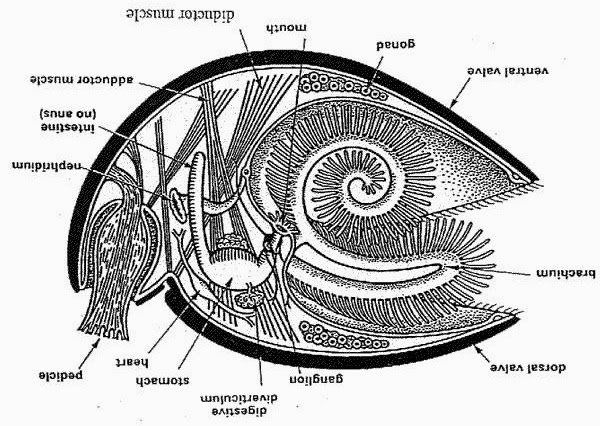
And here is the diagrammatic approach that gives you a general idea of what you're looking at.... The animal below has been turned upside down to show parallel orientation with the pic above...

4. In the Paleozoic (roughly 250-500 million years ago), brachiopods were once THE happening invertebrate! 
Brachiopod Slab
image by David Cartier
Earliest known fossils date back to the Cambrian (600 million years ago-but probably more), but the time of the brachiopod was in the Paleozoic!  (bear in mind how vast a time period 250 million years is.. that's MUCH older than humanity..).  They dominated in diversity and abundance. This was their "time"...   Sadly, most brachiopods underwent a huge extinction at the end of the Paleozoic...

According to the World Brachiopod Database only about 385 species occur today from the ~30,000 described (mostly fossil) ones!!

Many of these species live in out of the way and isolated places...

Here is a gorgeous pic of Coptothyris adamsia from the Sea of Japan
Coptothyris adamsi3a
Image by Alexander Semenov
Here is Laqueus californica from Monterey Bay in some pretty amazingly high densities...


and more from Alexander Semenov: Hemithyris psittacea (Rhynchonella psittacea)
Brachiopod pair


5. Geology! Fossil Brachiopod Shells are sometimes replaced by Pyrite! (aka Fool's Gold)
In the fossil record, the "shells" (called valves) of brachiopods sometimes undergo a process in which they are replaced with pyrite aka fool's gold!

This makes them golden and sparkly!
Pyritized shell pavement, Middle Devonian Silica Shale, Sylvania, Ohio, USA
Image by jsj1771
Fossils and Pyrite 2
Image by E. Sese
Pyritized Paraspirifer bownockeri, Silica Fm, Middle Devonian, Lucas Co, Ohio, USA
Image by JS1771

5a! More Geology Fun! Brachiopod valves are often found in cross sections of rock! 
Geologists know the value of a good cross section! Brachiopods are VERY abundant in Paleozoic rock. And if you cut through the shells of one you get some pretty distinctive impressions in the rock..
Brachiopods Of #4 Kildare St. (With Guinness-Tinted Fingernail For Scale)
Image by Maitri

Sometimes there are minerals such as agate!
Agatized fossil clams (brachiopods) found in some South Dakota decorative rock
Image by Captain Tenneal

Brachiopod shells can be pretty dense and sometimes you see a lot of them! 
Brach-packed...
Sometimes you see some neat rare stuff.. like this soft-part preservation of a lophophore!
Brachiopod fossil with preserved lophophore
Image by Dietmar Down Under

FUN FACT!  People EAT brachiopods!
I wrote about this earlier... but yes, apparently some curry and/or garlic is appropriate....
Lingulids, Thai market
Image by Peter Roopnarine