Showing posts with label ecology. Show all posts

Wednesday, May 18, 2016

BIG DATA about SMALL Echinoderms! Ophiuroids & their HUGE impact!

Image by Dr. Julian Finn, Museum Victoria
If you had asked me 10 years ago if the echinoderm group we would be learning the MOST from would be the OPHIUROIDS I would have been skeptical.

Basket stars? Taxonomy was impenetrably difficult. 
non-Basket stars? even worse.

Plus, Brittle stars were tiny, numerous, CRYPTIC animals. Who would study them? 

I'm sure we would see "big picture" stuff from sea urchins, sea stars or maybe even crinoids. But brittle stars? It would take a LOT of work to make them an "ideal" animal to work off of....

This week a BIG NEW PAPER in Deep-Sea Brittle Stars dropped in the pages of NATURE

I'm sometimes quite happy to be proven wrong! 


The paper from Tim O'Hara's brittle star lab at Museum Victoria in Melbourne, Australia, written by Skipton "Skip" Woolley et al. comprehensively analyzed 165 THOUSAND distribution records of brittle stars!!  

In other words, Tim identified, requested and/or otherwise retrieved THOUSANDS of records of brittle stars! When you consider how MANY specimens of ophiuroids there are? That is a HUGE effort!! 
Based on this analysis of species records correlated with different habitats, especially across different depths, they were able to determine several broad based and IMPORTANT patterns about WHERE brittle stars occur..
  • Deep-sea species diversity is shaped by energy availability (i.e. thermal energy and nutrients)
  • Continental shelf to upper-slope species richness consistently peaks in tropical Indo-west Pacific and Caribbean (0–30°) latitudes, and is well explained by variations in water temperature. 
          In other words, warmer water (heated by the tropics) promotes greater species richness. 
  • Deep-sea species show maximum richness at higher latitudes (30–50°, i.e. polar regions), where they are concentrated in areas with high carbon export flux and regions close to continental margin (richness drops as you get away from the land).
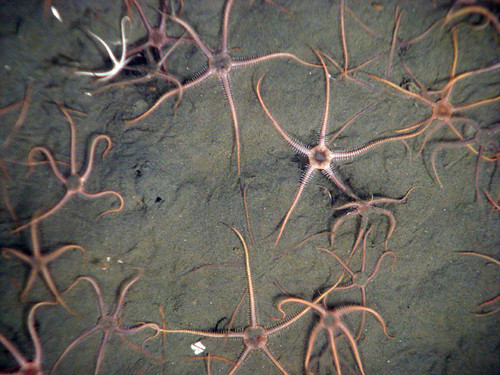
  • Ophiura sarsi
  • Global brittle star richness, in terms of species, peaks in the tropics at "shallow" continental shelf depths (20-200 m) and upper slope depths (200-1200 m). These peaks drop when you get below 2000 m depths. 
           The yellow and red in the diagram indicate species richness. These are warmer areas with                    relatively high nutrients, etc.  As the colors fade to purple and blue we see those numbers    
           decrease on the broad abyss of the ocean floor.
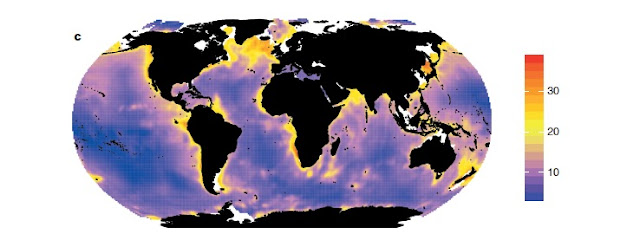
  • Data are consistent with a hypothesis that deep-sea species richness is maintained by species migration from shallower regions. i.e., "high energy areas feed low energy areas"
  • Historically we have looked at tropical areas as the focus of conservation efforts, but if we TRULY want to conserve deep-sea habitats we will need to consider the areas which show DEPENDENCE on the shallower regions for diversity.
If this is the case, then our conservation efforts will need to focus on MORE than simple high species diversity. We'd need to further look at places which are DEPENDENT on diversity!

In some ways, brittle stars are one of the most important "model animals' to observe these trends and interactions. Why?

1. Echinoderms, including brittle stars live ONLY in the oceans. No freshwater, or land relatives.

2. Brittle stars are EVERYWHERE. They are one of the most numerically abundant groups of echinoderms known.
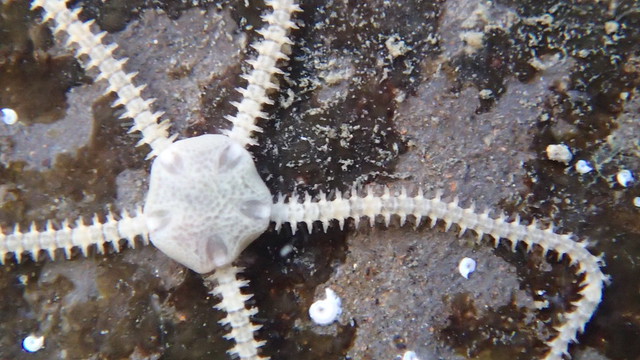
PB230486 Amphipholis squamata 

This paper is the latest "big thing" to come out of Dr. Tim O'Hara's echinoderm lab at the Museum Victoria! 

The Nature paper is sort of the "other shoe" that has dropped with big discoveries. (Remember that
echinoderms have five shoes!)

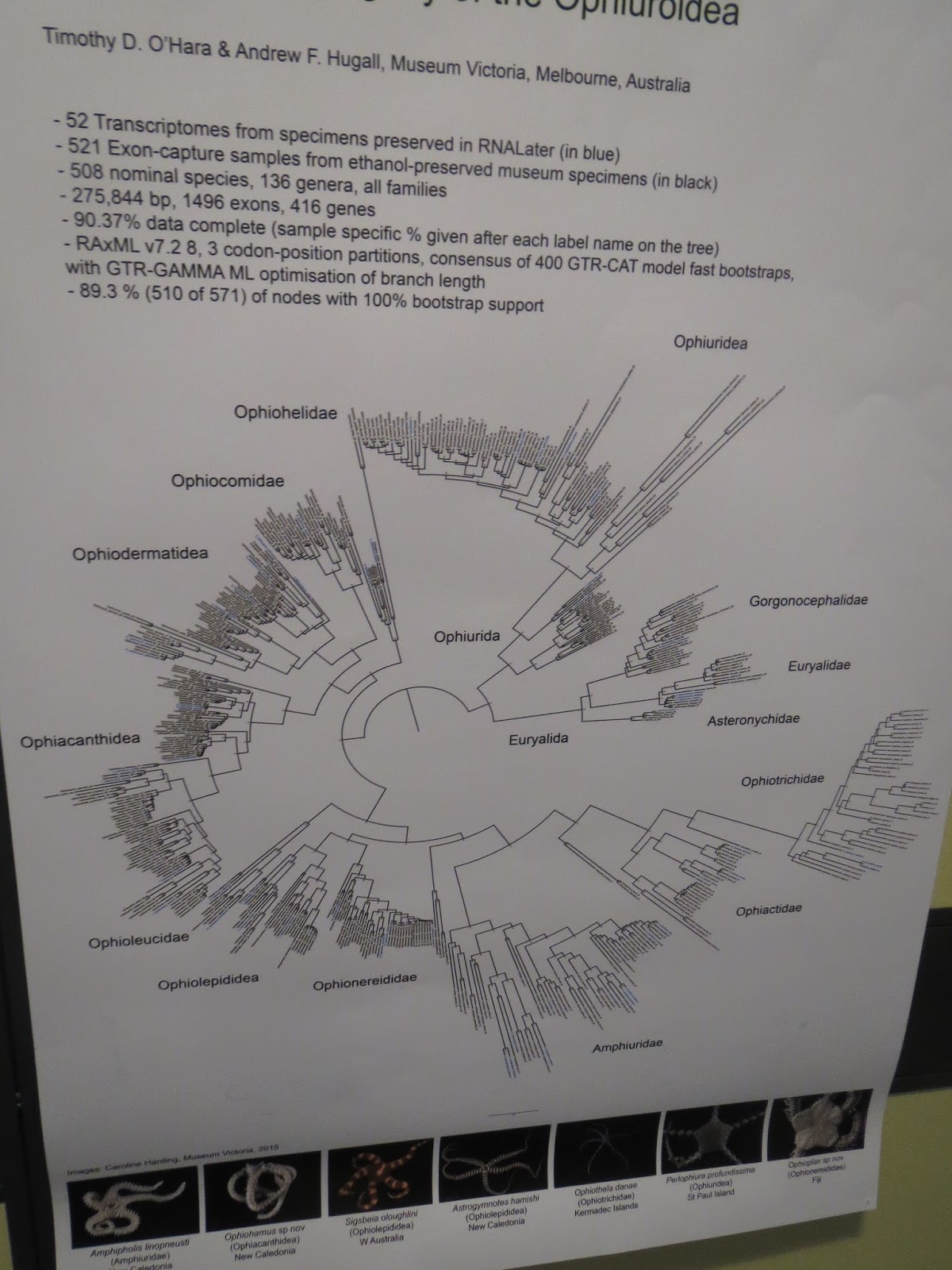
Dr. O'Hara's other BIG news  in recent years has been the announcement of this: a comprehensive family tree of the ophiuroids! 

The Brittle Star Phylogeny Project
One of the most important and fundamental elements of biology is understanding the evolution and relationships of your study organisms. 
  • How are all the different groups related? (e.g., how are basket stars related to other brittle stars?)
  • How did they diversify? Where? 
  • What kind of habitat did they diversify into? 
  • Which brittle stars form actual, NATURAL biological groups? 
A phylogenetic tree helps to answer all these kinds  of questions! 

In biology, a well-supported tree with a strong data set supporting it is BIG DEAL.  You can literally put ALL the information known about a group, in this case-the brittle stars, into a PROPER evolutionary framework!! Perhaps some lineages share a particular ecological nice mirrored by body form. A tree like this can literally be mined for information for years. 

This starts with such immediate things as classification and rearranging all the families to reflect "natural" groupings. In other words whether taxonomic groups such as families or genera-created by scientists based on external characters are "real" or perhaps the result of misleading external appearance. At some point, there's probably a whole POST about that topic!

This kind of data is a POWERFUL statement.

Genetics is powerful stuff. Work on the "Big Tree" of ophiuroids suggests that there are many, MANY more families and SEVERAL orders of magnitude more SPECIES.

Past accounts have estimated about 2000 species?  In fact there are likely several TIMES MORE than that. But the exact number remains to be seen..

The work from Tim's lab has nearly DOUBLED the number of recognized FAMILIES of Brittle stars! 

He's also turned the classification of these animals on their head! some of the oldest known species turn out to be these interesting deep-sea forms.. Ophiomusium and their relatives! Many surprises!
image from Museum Victoria: http://researchdata.museum.vic.gov.au/brittlestar/www/o_lym.htm
You can sort of see how this ties in with the brittle star distribution paper.. How many of these points on the tree will show relationships between deep-sea and shallow-water species??

These efforts are some of the latest results from Tim O'Hara's "Big Data" ophiuroid work!

Remember that the fundamental basis for ALL of these projects has been Tim's skill in TAXONOMY of brittle stars. Many of these species were difficult to identify and reconcile without skills in how to tell them apart.  Here was an account of Tim's work at the Museum national d'Historie naturelle in Paris! He identified over 1000 specimens while I was there.

Other past efforts from Tim's lab:

Here's
 the time he and his student worked on the mystery of cryptic species in the Australian biscuit star Tosia australis


Here's his research on discovering the distribution of brittlestars in lateral bands

We'll be seeing more on Tim's lab NEXT WEEK! As Echinoblog continues on in AUSTRALIA!! 

Wednesday, July 24, 2013

Who Eats Who? Figuring out Feeding in Deep-Sea Starfish

thanks to MBARI!
People are always fascinated by how animals eat and, I think, the weirder the better. Starfish have one of the most distinctive feeding modes of all animals and I think, that's why people get fixated on how they consume their prey.

The feeding posts on the Echinoblog are among the top ten highest hit and the research literature is full of comprehensive studies detailing the feeding ecology and behavior of a great many starfish species. 

As one might expect, the great majority of feeding studies were initially those of shallow-water species which were easy to observe. Feeding is important to understanding marine ecology in many systems. So, its not just some casual trivia that comes in handy at cocktail parties.

But what about deep-sea species? Understanding the role of predators in these often inaccessible systems is important.  In cases, such as with deep-sea coral, its important to understand what role these animals play, especially given how little we know about the individual animal's importance.

How does one figure out the role..and indeed, the importance of these species in such far away and forboding habitats??


1. The Starfish
Fig. 1 from Gale et al. 2013
Ms. Gale's research focused on seven deep-sea starfish species from the North Atlantic:
A. Ceramaster granularis
B. Ctenodiscus crispatus-aka the mud star (learn more about it here)
C. Hippasteria phrygiana (learn more about it here)
D. Leptychaster arcticus
E. Mediaster bairdi
F. Novodinia americana-a brisingid
G. Zoroaster fulgens (more about Zoroaster here)

but also had some feeding notes on this weird guy.. Tremaster mirabilis! (about which very little is known)

Most of these species occur in a primary range of about 500 to 1500 meters, but some can get relatively shallow. Most are difficult to study and live on the deep-dark sea bottoms...

2. Figuring out feeding
There's generally TWO ways to study feeding:
  • Directly: i.e., you watch a species consuming its prey (or whatever food) and voila! You have a direct feeding observation.
  • Indirectly: You have something which provides inference about what the animal has already consumed. Look at the gut contents or something similar...
In the old, old days, figuring out the feeding ecology of deep-sea species was difficult. Specimens were collected via net-and usually brought up badly damaged. The animals were mostly dead and had often emptied all of their gut and stomach contents. Rarely did you have an opportunity to see the animal interacting with any possible prey items. Any interactions you might have spied could have been caused by the trawl net scooping up any and all of the bottom fauna...

In contrast, I think Ms. Gale et al's paper has acquired some great information using some modern techniques and good ol' fashioned detective work!

Direct Observation  So, the most obvious and direct way to observe feeding is by watching it!  These days, submersible robots aka ROV's (Remotely Operated Vehicles) are one of the main platforms for these types of observations. I've done some similar work in the Pacific (here)
Fig 9A from Gale et al. 2013
This is Hippasteria phrygiana, a widely occurring cold-water/deep-sea coral (and cnidarian) predator, but Gale et al. observed several other species from the deeps, about 500-1100 meter depths,  of the North Atlantic.

Several species were observed as predators for the first time, whereas others were confirmed. For example, Novodinia is a brisingid with a documented suspension-feeding mode and we saw more of that in Gale et al. 2013.

Gale et al. also reported feeding for Tremaster for the first time! Feeding on coral...
Tremaster mirabilis

Laboratory Feeding Experiments
As a complement to the direct observations, Gale also performed several laboratory feeding experiments and was able to observe several direct feeding moments!

Predictably, Hippasteria fed on various cnidarians, including sea pens and other deep-sea cnidarians.
Whereas Ceramaster fed on sponges..

But not all the prey allow the predators to just...eat them. Some, like the sea anemone Hormathia
nodosa 
Image from Natioal Museum of Northern Ireland via EOL
and the deep-sea coral Flabellum alabastrum 
Image from Fisheries & Oceans Canada via marinespecies.org
used their tentacles (which all have stinging cells) as a defense against the oncoming hunger dogs!  And this was effective against the more timid Ceramaster but not against Hippasteria. Flabellum was fed upon by Hippasteria VERY quickly (in 18 minutes)..

Indirect Evidence. This is where some newer techniques shows us some cool ecological stuff!!

Stable Isotopes!!
Here is a video that explains the basics of stable isotopes but basically what it comes down to is this: elements like nitrogen (N) and carbon (C) undergo changes as they pass through different ecological levels in the environment.

In doing so, they become kind of like a "fingerprint" for a particular kind of ecological role. So, for example, species with a stable isotope N (Nitrogen) value of about 16, but w/ Carbon value of about -14 (Hippasteria, Ceramaster and Mediaster) are higher within the overall trophic relationship among these asteroid species.
Fig. 6 from Gale et al. 2013
You've seen Hippasteria, but here's Ceramaster granularis

and Mediaster bairdi
Mediaster bairdi
Image by K. Gale

All the other species, including Novodinia americana, Leptychaster arcticus, Ctenodiscus crispatus and Zoroaster fulgens display lower values which would be consistent with their previously thought of feeding modes as suspension feeder (the brisingid) and deposit feeders/detritivores (mud stars, including Leptychaster and Ctenodiscus) and Zoroaster.

Gut Contents & Prey Items!
One other indirect way of looking at food items?  Gut contents.  What were they eating?

Ms. Gale did a LOT of work looking through the guts of many starfishes.. Much of how they fed is based on detective work.  For example, many animals such as deep sea gorgonians and such, after being digested leave only skeletal bits called sclerites.

Fortunately, these can be used to identify the animals with some accuracy. Curiously Hippasteira also had some crustaceans in its gut..
Figure 3 from Gale et al.
One of the subject animals, Zoroaster fulgens has been one of the more mysterious deep-sea starfish species in my experience is an infaunal predator, that is, a species which eats animals living in bottom mud and sediments.  A related zoroasterid called Doraster is shown here with a snail in its mouth with snail food in the red circle

Gale et al reiterate the importance of the feeding ecology of many of these species...
  • Hippasteria is a widely occuring asteroid which likely affects coral populations
  • Ctenodiscus-the mud stars occur in LARGE numbers, up to ~6000 individuals per hectare and influence the sediment as they move around through it feeding on mud..
Fr. Arcodiv.org
  • Suspension feeding asteroids such as Novodinia capture food from the water column that would ordinarily not be made available to bottom feeders
Brisingid Seastar
not N. americana. Image by NOAA National Ocean service
I've recently discussed some recent observations of a seemingly innocuous species, Porania pulvillus as a predator rather than a passive ciliary feeder. Understanding deep-sea ecosystems is an exciting endeavor, who knows what we'll find!  Simple things like feeding are intriguing and interesting-but poorly known. What will the important impacts of these species be down the line?

But even BASIC knowledge such as this is a complex and time-intensive process. It starts with work like this...

Tuesday, July 16, 2013

URCHIN BARRENS! Aka the Trouble with Tribbles (=sea urchins!) Post!

Purple Urchins
Image by Annie Crawley
Sea urchins are among the best known, most heavily published on, and most "important" of echinoderms. People eat them and they are studied in marine ecology pretty heavily. Most marine biologists I know think highly of sea urchins. They're pleasant animals with an unusual appearance

But the truth is, no matter how adorable or fuzzy, useful and/or cute an animal may be, TOO many of them is nothing but trouble! True for Star Trek tribbles and for sea urchins!
(disclaimer: Tribbles are science fiction, sea urchins are not)

*Tribble factoid: Someone has ACTUALLY given tribbles a scientific name: Polygeminus grex! don't believe me? go see Memory Alpha!)

Tribbles are actually a GREAT introduction for today's topic: SEA URCHIN BARRENS!

What are Sea Urchin Barrens??  These are places where a sea urchin species' abundance increases dramatically to the point where the urchin devours EVERYTHING in its path, effectively leaving all else 'barren' except for more hungry sea urchins.
Purple Urchins
Image by Annie Crawley
DSC_001720091004
DSC_003020091004
Images above by AndyOlsson
This is not far removed from the imagined "ecology" of Star Trek's tribbles (A good essay applying real population math about tribble populations can be found here, but this image from the famous ST:TOS episode hopefully gives you the general idea!)
Image from TrekNews.net
The gist of it is simple:  TOO MANY URCHINS and they EAT TOO MUCH. But unlike tribbles (which were eradicated by Klingons-yes I know they're not real), in the case of sea urchins, we can actively study the ecological interactions and conditions which have caused the populations to explode in number.
DSC_001720091004
Image by AndyOlsson
Here is a video showing tons and tons of Red Urchins (S. franciscanus) on a barren in Southern California. Thee bottom is essentially devoid of all but more hungry urchins!


What causes urchin barrens? 
Um. Its complicated but the common thread seems to be that there is an association between barrens and the absence of sea urchin predators.

In many of the papers I've read about Northern Hemisphere species, the loss of a major sea urchin predator seems to be one of the immediate attributed causes of the runaway population growth, but as we've seen with other species such as the Crown of Thorns (Acanthaster planci) the story is often complicated....

Most of the studies involve temperate-cold water urchins in the Strongylocentrotidae, specifically Strongylocentrotus purpuratus (purple urchin), S. franciscanus (red urchin), S. droebachiensis (green urchin) and S. polyacanthus.  Literature was abundant, but this paper by Nathan Stewart & Brenda Konar provided much of (but not all) the info for this post.

In one of the most familiar studies from the Pacific Northwest coast, the main predators were sea otters (in many cases, I assume Enhydra lutris-some papers did not mention species).

The fundamental ideas outline the notion that as sea otter populations decline, predation pressure decreases and with nothing to keep the populations at a controlled level sea urchin populations dramatically increase and began to devour kelp (and really everything else!)  to the extent that they effectively clear the bottom.
Urchin Barren
Image by Santa Monica Bay Restoration Foundation
Purple Urchins
Image by Annie Crawley
In Stewart & Konar's paper, individuals from these population explosion urchins were compared against "healthy" urchins which occurred naturally in kelp forest habitats.  Some dynamics:
  • Urchin densities were SEVEN times greater than those elsewhere
  • Kelp forest (vs. 'barren') urchins were larger and more robust
  • "Barren' urchins were smaller with less tissue
  • "Barren urchins had little to no reproductive tissue compared to kelp forest urchins
Different species of Strongylocentrotus (as well as other urchin species!) live in different places and have different predators!

On the North Atlantic coast, there is a similar population explosion of the Green Urchin, Strongylocentrotus droebachiensis, which from the look of it, is pretty severe

Here's a video that shows just WOW... a lot of them..

I have briefly written about the impact of this many Green Sea Urchins. They all POOP! This actually has a pretty serious ecological impact. 

Some, such as this paper, have proposed that these population increases have been caused by the loss of lobsters (Homarus americanus) which feed on green sea urchins. But in all liklihood, as the system is better understood the more complicated the explanation.
Northern Lobster, Gulf of Maine
Image by AJmart
Other predators, such as wolf eels and starfish, also feed on green sea urchins and well.. it can get messier...

Now, in the Southern Hemisphere we have a similar, parallel situation with a completely different family and species of sea urchin: Centrostephanus rodgersii (Diadematidae).
Sea Life: Long Spined Sea Urchin
Image byEdward Vella
Climate Change Enters the Picture! 
A paper by Ling et al. 2009, in the distinguished Proceedings of the National Academy details  a scenario with some important dynamics
  1. The range of the urchin is dramatically expanded because of increasingly warm waters in/around the eastern Tasmanian region.
  2. The lobster Jasus edwardsii is one of the primary predators of Centrostephanus and has been heavily overfished. The BIG lobsters that would feed on urchins are taken for food leaving the urchins to run amok!
Its important to note how significant the human factor has played into these dynamics. Climate change and overfishing are thought to be the primary agents responsible for urchin "barrens" in these circumstances.

This issue has been conveniently summarized in this video...


The takeaway lesson: Predator loss seems pretty strongly associated with urchin "barrens" aka population explosions. But all sorts of environmental factors, including warmer waters, and multiple predator interactions can be important..

So we have a LOT of sea urchins. Couldn't we uh..just eat them? 

Yes. 

BUT, you can after all, only fish so much. After you've taken the lobsters, the urchins and the kelp what else have you got left? A good answer seems to lie with good sustainable fisheries management..but we shall see how this works out...

Wednesday, July 25, 2012

What are the FASTEST known Starfish??

Plain sand star (Astropecten sp.)
thanks to WildSingapore for their Astropecten pic!
What is the FASTEST known starfish??
People are always interested in the upper limits of our world. The biggest! The smallest! The most dangerous!

Where echinoderms are concerned, I've tried to answer a few of these. The biggest starfish can be found here.    The largest brittle stars found here. 

But people always seem a little surprised when they see something like a starfish in motion! Most times, starfish move slowly if at all and so if people see one being the lamborginhi of echinoderms, it generally provokes some curiosity...

So, this week a new open access paper by E.M. Montgomery and A.R. Palmer in the Biological Bulletin looks at locomotion in the bat star, Patiria miniata but provides a very handy dandy comparison of movement rates in several well-known sea star species (the paper itself we shall discuss another day....).

Why should we care?? Doesn't this all seem like kind of an...odd thing to know? Indeed. But rate of movement is actually an important bit of information in understanding feeding biology, ecology, and food webs. How fast do the predators go compared to their prey?  How far could an adult travel on its own and disperse its gametes in a discrete amount of time?   So, yeah. Its worthwhile...

It should be noted that most of the rates outlined below are based on a clip motivated by predators. So, its not necessarily clear what their "average cruising speed" would be..

Some general trends..

  1. Sea Star movement rates vary from 0.3 mm/s (milimeters per second) in the "sun star" Crossaster papposus to a breathtaking 50 mm/s!!!
  2. Most of the observed species (which are intertidal-shallow species like Patiria miniata or Leptasterias) seem to run on the slow to moderate side, about 0.3 to 1.3/2.0 mm/s and are medium-sized but relatively few of the smallest or largest species were included.
  3.  Diversity isn't well sampled and we really only know the movement rates of VERY few species (17 out of 1900 species!).
  4. Its thought that larger size does have some relationship to speed and some of the fastest species listed are also among the largest..
Here's a breakdown of speeds in starfish in milimeters per second!

Honorable Mentions:
I should just say that while these seem reasonable-it seems like there are faster species out there. These  just seem to be well-known and as more information becomes available there's likely to be starfishes that put these guys to shame...

Astropecten aranaceus and others.  Speed: 2.5 (error+/-0.8)
Astropecten is the "proper" sand star. They occur on unconsolidated sand/sediments where they sit and wait, buried until prey comes along. They occur in shallow-water, tropical to temperate water habitats all over the world. 

There are many species..many of which are deceptively fast...Here is a nice video of A. aranaceus which is found primarily in European waters..

But here is Astropecten polyacanthus from the tropical Indo-Pacific. Look at that thing go!


Asterias forbesi and Asterias rubens (Asteriidae). Speed: 2.0 mm/s and 3.3 mm/s
These two species are the most commonly encountered in the North Atlantic-so on the east coast of the United States and in Europe. These are the classically known "starfish prey on a bivalve" type of starfish that you see in the intertidal.

Here's video from Massachusetts showing Asterias moving around at a decent but relatively slow clip..

Oreaster reticulatus (Oreasteridae).  Speed: 3.3 mm/s
This species is the well-known "cushion star" found in the tropical Atlantic-Gulf of Mexico, Bahamas, etc. Its primarily an opportunistic omnivore feeding on algae and other organics present on the bottoms.

This was honestly kind of a surprise. On the spectrum of starfish that are known for speed-this one isn't one of them. But the original account observed them in undisturbed, natural settings, so perhaps there is some bias on my part...
Oreaster sea star with the right number of arms

TOP FIVE FASTEST KNOWN Starfish!
Of the known movement rates listed in Montgomery and Palmer's paper these were the 5 highest with embellishment from what I've seen etc.  Bear in mind this is 5 of the best known species, out of nearly 1900 different species-so..there's possibly (probably) faster or at least, comparably fast taxa out there....

5. Protoreaster nodosus (Oreasteridae). Speed: 4.6 mm/s (deviation +/- 1.2) 
This is the well-known "Chocolate Chip Starfish" that occurs in the tropical Indo-Pacific. This species  is often encountered in the aquarium and tropical tourist trade. It is related to the "Cushion star" O. reticulatus above..and similarly, feeds on microalgae and lives on loose, sandy bottoms.

The video doesn't show them at their quickest but its something..

4. Acanthaster planci (Acanthasteridae). Speed: 8.3 mm/s (deviation +/-2.5) 
This is the infamous Crown of Thorns Starfish which occurs throughout the tropical Indo-Pacific from Hawaii and Baja California all the way to the east coast of Africa in the Indian Ocean. Its a large, fast, coral eating predator..

No wonder it moves so quickly...

3. Archaster typicus (Archasteridae). Speed: 12.7 mm/s (deviation +/- 5.4)  Here's one that a lot of people probably don't realize.  This is the "fake Astropecten". I outlined a blog awhile bag about how to distinguish it from "proper" Astropecten here. 

Archaster is parallel/convergent with Astropecten (below) but live in a similar habitat buried or semi-buried in loose sediment/gravel...There's a nice account of biology here by my friends at Wild Singapore..


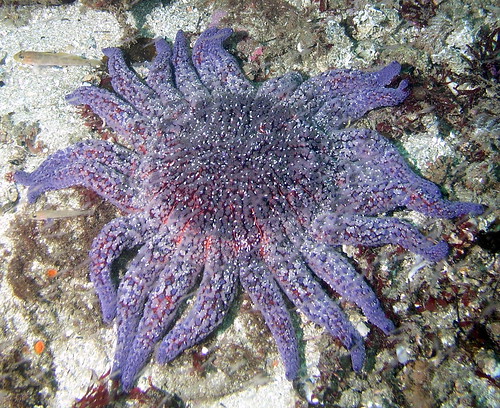
2. Pycnopodia helianthoides (Asteriidae)Speed: 20.4 mm/s
Pycnopodia is found only on the west coast of the United States from Alaska to southern California. Its a big animal-up to about 2-3 feet in diameter.

Its a big animal and boasts 15,000 tube feet on its 20-30 arms. Its a feared and voracious predator on mollusks, sea urchins and other invertebrates, which can actually smell it coming and will move out of the way when they do...

It has THE reputation for being the fastest starfish known.. but as we shall see, this is not the case...
Giant Sunflower Star
here's some footage of this formidable species in motion!


1. Luidia ciliaris and friends (Luidiidae). Speed: 50 mm/s !!
Luidia is a genus of "sand star" that lives in tropical to temperate, usually shallow sandy habitats all over the world. They are predators that feed on mollusks, sea urchins and other invertebrates.

L. ciliaris occurs in the North Atlantic around Europe-the UK and so thereabouts..
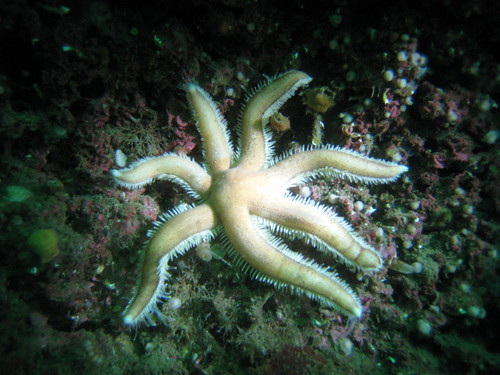
7 Arm Starfish

So, not what you thought! Pycnopodia has gotten the reputation as the "fastest starfish" in the world.
But NOT so! It would seem that Luidia spp. overall seem to be among the fastest of sea stars with a rate of movement just short of twice as fast as Pycnopodia!

Diver and photographer Neil McDaniel (who has contributed to the Echinoblog before) has graciously tested movement rates and found that under duress  Luidia foliolata is about 25% faster than Pycnopodia. Luidia foliolata travels at a rate of about 46 mm/sec vs. about 35 mm/sec in Pycnopodia.

Perhaps something to do with living primarily on sandy sediments??

But why talk when I can show you...
Here's Luidia maculata from Lembeh (Indonesia).  Note however, that this one has some commensal crabs that seem to be in on the action..


Even the 5-armed species are pretty light on their tube feet... Luidia clathrata from Isle of Palms, South Carolina..

Starfish from paul zoeller on Vimeo.

Thanks to Neil McDaniel for his contribution to this account!

Tuesday, March 15, 2011

Putting Tags on Starfish! Where do they go? What do they do? How fast do they do it?


This week-a neat paper from Miles Lamare and team (who are mostly from the University of Otago in Dunedin, New Zealand) about using electronic tagging to study individual movement in the temperate-water New Zealand asteriid starfish Coscinasterias muricata in a 2009 issue of the Journal of Experimental Marine Biology and Ecology (click here).

As much as the idea of tagging echinoderms has come up (and this is actually one of the most common professional inquiries I receive) its not been done very much.

Largely, because its very difficult to stick a pin, tag, flag or any kind of inorganic device into an echinoderm without any number of deleterious effects, including:

-seriously affecting its behavior
-killing it
-causing the arm/spine/limb to be cast off and regenerated and/or variations thereof

.......and so on.

But technology has progressed and the authors introduce the usage of this handy little electronic tag (the DST-milli electronic tag) made by Star-Oddi. The tag is programmed with electronics that record water temperature, and depth every 5 minutes.
The authors attach these tags to the animal with a metal wire to which the tracker tag is attached so that the animal looks like so...
Figure 1 from Lamare et al.

They tested the behavior of the species and essentially, their findings indicated that there were no apparent behavioral changes in feeding and etc.

So, what happened next? They chose 3 individuals with the goal in mind of tracking their movements relative to their feeding behavior and environmental factors. The paper mainly addresses the kinds of data that can be obtained with the tag (as opposed to Coscinasterias behavior) but they did discover a lot...

1. Where they went! and how fast! The Data
So, as it turns out Coscinasterias muricata is fast.

Individuals vary-but on average they seem to be capable of 15.6 meters/day.

This still pales in comparison to the west coast sunflower star (Pycnopodia helianthoides) which is practically a starfish lamborgini at the rate of 3 meters (possibly 2 from other sources) a minute as outlined here-I'll let you do the math)

And that's MUCH faster compared to The Crown-of-Thorns (Acanthaster planci) which can go 2.3 to 4.3 m/day versus the much smaller and slower asterinids (i.e., bat stars) Patiria pectinifera (1.5 to 3.7 meters/day) and Patiriella regularis (5.7 meters per day).

Why is speed important? Read on below...

We see from the data above that different individuals of this species can travel quite a bit and over a pretty broad vertical distance (four to 14 meters). So, what's going on?

2. The Salinity Story
It turns out that C. muricata displays "vertical migration" which is to say that it TRAVELS back and forth from deeper to shallower regions in order to forage for its favorite food, the blue mussel, Mytilus galloprovincialis, which live in the intertidal.
Their direct observations showed that of the ndividuals observed, 92% of these were present in water LESS than 1.0 meter! with fewer and fewer numbers being present throughout deeper adjacent regions.

But based on the tracking info, two of the individuals showed some variation. One occupied deeper water below the mussels and then migrated into shallow water for short periods of less than a day and at intervals of about five days. Another occupied shallow depths for the first week before moving on to deeper depths.
Another important behavior they noticed was how physical factors, such as salinity affected the behavior of the observed individuals. As a species, Coscinasterias muricata is VERY intolerant of low salinity and experiments suggest that individuals WILL die in a relatively short period if salinity is not maintained.

So, if there's freshwater runoff or a storm-it will retreat from shallow water.

Figure 6 below charts the position of each of THREE individuals relative to salinity, temperature, height above the "mussel line" and the amount of rainfall (on the bottom) versus the day during a two week period.


NOTE in the top "blue" box and the bottom box. The depth inhabited by the animals DECREASES when rainfall is highest (i.e., the dilution of salinity is lowest).

Salinity also gets higher as you get deeper...

So, as a physical influence, the salt water layer influences how C. muricata forages for food! An influence that is apparently very significant to the animal's biology..

The authors note something of particular interest... that the animals begin their descent BEFORE the deepening/formation of the low-salinity water layer!! This suggests that there are other physical cues (e.g., changes in wave action) to the animal, so that so that it KNOWS when to move!

This is kind of neat, because these are the KINDS of cues that are not obvious to us. Asteroids have a very different world of perception.
It turns out the aforementioned speed is also an important factor in understanding how the salinity motivates the animal's movement.

The speed of the animal..observed as between 1.78 and 23 meters/hour is faster than the rate at which the low salinity layer deepens during the weather!!

In other words- the starfish can outrace the "low salt" layer as it approaches!


I think most people interpret movement as a function of something observable-like predation. But in this case-maybe not so much?

Undoubtedly, the authors probably have more (or could have more) than this-but the paper's intent was mainly to see what they could learn using these new tags. Foraging behavior for an animal like this is important to marine ecologists. You can't exactly follow a starfish like a panther or a racoon.

And if our recognition of Pisaster (same family as Coscinasterias by the way..) as a keystone species is considered important to ecology-then understanding things like foraging patterns is also potentially significant to what's going on in marine ecosystems.

And just on a pure curiosity level wouldn't YOU like to know the secret lives of starfish?

Tuesday, June 29, 2010

The Ecology of Holothuria scabra! The CUKE-SEA GRASS Connection!

Today- SEA CUCUMBER STUFF! yeah, yeah, cukes get all the good stories!

This is based on a new paper (2010) by Wolkenhauer et al. in the Journal of the Marine Biological Association of the United Kingdom which examines the role the tropical Indo-Pacific species Holothuria scabra and its relationship with tropical seagrass beds!

The subject species, Holothuria scabra is a widespread Indo-Pacific species. It occurs in Asia, Australia and Madagascar in the Indian Ocean in sandy, shallow-water, eel grass beds. Presence below indicated by yellow...
(this map from OBIS-here)

Its a pretty neat beast. It can actually BURY itself into the sandy substrate. Presumably, it is this aspect which earns it, the common name the "SANDFISH".
Yes, if you thought "starfish" was bad.."Sandfish" is even worse and will make your broil in your juices!
But what makes, this beast, such a focus of concern is that H. scabra is a widely fished species which has, in some places has seen complete population destruction from overfishing. (here)

This has motivated MANY studies in sea cucumber ecology and biology. Why?

Because when you remove them, WHAT happens to the habitat they're taken from?? WHAT was their ecological role BEFORE they ended up being sauteed with mushroom sauce??
The STUDY
Wolkenhauer et al., undertook their study in Moreton Bay, in south-east Queensland in Australia in 2003 and 2004.
The authors tested the presence/absence/density of H. scabra relative to its surroundings.

They caged areas off and separated places where cukes were either present/excluded/ Or impeded by the cages.
The authors are careful to note that their study was potentially affected by the time of the year and the number of replicate times they performed the study...but the outcome and its impact remains important.


They also surveyed the sea grass species (Cymodocera serrulata) checking biomass, size, dry weight and several other factors relative to the abundance of the sea cucumbers in the caged areas.

The RESULTS

The short version is: Removing sea cucumbers AFFECTS SEA GRASS systems. In the words of the authors: "seagrass systems may suffer in the absence of holothurians..."

Now, for the sake of space, I'm not going to include EVERY little bit of uncertainty and statistical variation in the data but I will boil it down and say that while there is still DOUBT, there is definitely some signal that suggests exclusion of sea cucumbers from an area will affect seagrass productivity. but here are some choice bits...

Losing Seagrass....
Here is their Figure 3, which shows the two experiments showing average seagrass productivity during the 2003 and 2004 experiments. In this particular experiment examining seagrass biomass there has been a significant decrease over the study period when the cucumbes are REMOVED.
So, what is it about sea cucumbers that makes sea grass beds THAT much more productive when cukes are around??

By ingesting all that sediment and sand and burying itself in the sediment, this kicks up all of the good organic food into the water and can knock loose food and nutrients that would be usable by the seagrass bed and other nearby plants and organisms.

Seagrass beds might also be taking advantage of sea cucumber "ammonium excretions" (which some humans would call "pee" but I would not) into the local ecosystem., thus feeding the surrounding plants and animals.

How much affect would this have??

This paper is one of the foundations of understanding how this "nutrient cycle" could work..

As we've seen before, Sea urchin poop is an important force in kelp ecosystems... (click here to see).

Nutrients and Why tiny Algae is important..
Their Figure 4 shows change in benthic microalgal biomass.

Basically, the amount of organic matter present.. clearly increases when sea cucumbers are excluded (EX below).
To quote Egon Spengler "Peter, that would be BAD"

Why? Well, it turns out that with NO holothurians eatin' their algae, bacteria and detritus, you actually see an INCREASE in the certain organic materials.
There are other studies in subtropical settings which show that algae and bacterial production is REDUCED when sea cucumbers are GRAZING. Up to 10 to 40% of bacterial carbon produced in the summer is apparently taken by sea cucumbers.

This is conceivably a HUGE impact on the productivity of a region!!
With the cukes gone, who eats the bacteria????

The full impact of this hasn't been totally explored but just some hypotheticals you may be familiar with-
What happens in your aquarium tank when you've got too much nutrients and bacteria again???? Your nutrient balance is out of whack. Think of your stomach suddenly producing too much gas. Or a lake with too much algae.
Conclusions: What Do We Take Away from This?

There is a logical chain of events/implication from Wolkenhauer's results.

Sea cucumbers are part of the "natural filtration" function that seagrass beds serve in marine ecosystems.

By burying themselves and freeing up the sediment, they encourage other ecological interactions around them which causes the flow of nutrients and so on.

REMOVAL of sea cucumbers from this system through destructive overfishing, could conceivably harm the seagrass bed/seagrass system
      And why save sea grass?

      Well, for one thing, other commercially fished FISH and many other species live there. But they serve to filter nutrients and chemical inputs to the marine environment among other reasons. which can be found at Sea grass Watch.org. But to boil it down: Seagrass beds are ecologically IMPORTANT.

      Removal of just this ONE species, H. scabra showed an impact on the system.

      Could the lowly sea cucumber could potentially be the ecological lynchpin to the ecological health of seagrass beds??