Showing posts with label tropics. Show all posts

Tuesday, August 28, 2012

Crinoid Close ups!

                White crinoid - Pulau Weh

Crinoids, aka Feather stars are probably the least familiar of echinoderms to many people. They've been around for awhile and you can often see their older Paleozoic ancestors with stalks in fossil beds throughout the world.

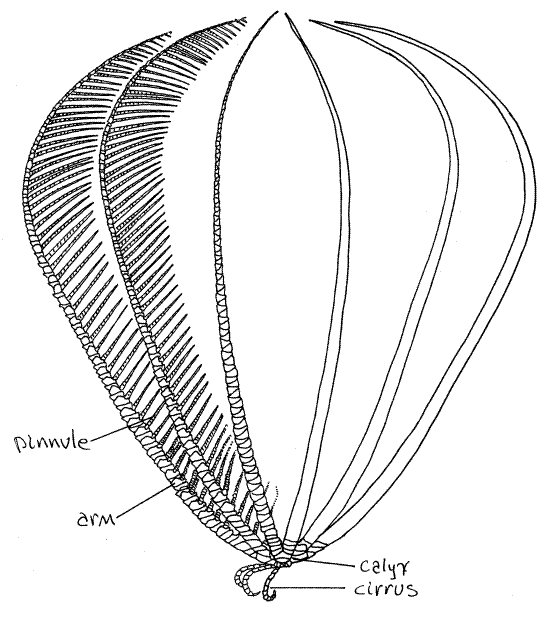
But most modern crinoids almost resemble plants (albeit stunning ones). The picture above shows a typical "feather star" or comatulid crinoid. The arms have feathery appendages called pinnules which are used for capturing food. 

To give you some reference.. here's a generalized diagram. Food goes into the mouth located on the "inside" of the cup where the arms meet.  
Image from lander.edu
I've often tried to make several echinoderms more "visible" to people by sharing some incredible imagery of them-from perspectives that might be unfamiliar. Some of my posts on ophiuroids here and here for example...

Here is a very busy picture of the many structures surrounding the MOUTH (at center covered by more tentacles) (critter from Fiji) (image by Jaw'sDad-Jeff Williams):
Crinoid Patterns

Here's a great picture of the UNDERSIDE of a feather star. See those tentacle-like things wrapped around the whip coral?  Those are called "cirri". Those are the "feet" that adhere the remainder of the animal to its perch.   This image by "sabahsharky"
P1010024

Blue Crinoid Close up.. from Sulawesi, Indonesia.  These are the feeding arms with yellow tipped extensions called pinnules. Image by Richard Merritt, FRPS.
Blue & yellow crinoid (feather star)

A stunning image of Oxycomanthus bennetti from Indonesia by il Cosaro.
Crinoide (Oxycomanthus bennetti)


More close ups!  Neat crinoid close up of the arm. Yellow tips on purple pinnules and arms.

A nice close up of the feeding arms. Three Photos below by Geoff Spiby.
crinoid abstract
crinoid detail copy
crinoid detail 2

Yellow arms by Friscodive
Crinoid abstract 02

A stunning shot of a red-white crinoid by Russel Taylor
Crinoid (featherstar)
Another amazing close up by Russel Taylor
Crinoid (featherstar)
Gorgeous in Green!
Crinoid (Feather Star)

Two photos of crinoids from the Philippines by Courtney Platt
Kirbys Crinoid 7361
Kirbys Crinoid Detail 7363

A neat red/yellow crinoid from the Philippines Image by Jex207
Crinoid

There's a shrimp in this..but mostly I just think the arms are amazing. Photo by MerMate
Bottoms up

One showing nice detail of the segmentation present on each individual arm
Philippines 10_09 Cabilao 1 (19)

And a fossil for comparison. Note that the cup is upside down. Photo by zxgirl
Crinoid Crown

And one of these days I will follow up with the commensals that live on crinoids! The mimicry is stunning...

Tuesday, February 21, 2012

What can the Internet do for Biodiversity? Let's study COMMENSALS!! Some biology can't be studied from samples!

Hostess with the Mostest
(photo by MerMate)
The Internet is amazing!

But often one gets the impression that a lot of people haven't quite realized the potential for discovery.
What can something as simple as humble as a photostream or video channel do for science?

Especially for something like exploring biodiversity? For looking at the many different kinds of animals -some that have yet to be discovered?

What makes the Internet so potentially important is YOU. Everyone out there. A nearly infinite amount of eyes, cameras, videos, talent, and interest.

What does that mean? That means that some people have the good (nay excellent!) graces to take pictures (and/or videos) of moments and/or species in places that many scientists just aren't or can't be. I believe the buzzword is "crowd sourcing".

Sources like Flickr and YouTube thus become great treasure troves of potential discoveries.  Moments and relationships caught of the live animals doing their thing!

So, today I thought I would use some videos and images to demonstrate some commensal relationships between sea stars/starfish) that most people don't often see because they are best seen in the wild when the animals are left to their own devices.

........But then, some incredible individual took a picture or video of it!

And in conjunction with a little bit of narrative (on my part) there is another layer of appreciation of these images as more than just aesthetically pleasing-but a representation of something in nature that everyone can enjoy. GO!

1. Fish Living commensally among the oreasterid Protoreaster nodosus


This video was exciting! I'd never heard of fish living in and around asteroids and have yet to discover prior accounts.

Was this unique or does it happen all the time? Are fish juveniles tied to sea stars? Is this important to their life cycle?

Note also the tiny little brittle stars living on the spines! Probably Ophiactis savignyi-a species of ophiuroid that may literally live everywhere!
Cool star 2 (photo by Mermate)

2. The benthic ctenophore Coeloplana living on the surface of Echinaster luzonicus
Benthic ctenophores on Echniaster  luzonicus (Coeloplana astericola)
(photo by Arne Kuilman)

So, what are these?

Ctenophores are usually found swimming in the water column like this (intro to the group in the video)

But some of the really WEIRD ones live on tropical bottoms and look like this.. (note the feeding tentacles emerging out of the two top "lobes")

But some of these benthic ctenophores are these worm-like forms and they actually live ON sea stars, such as this Echinaster luzonicusBenthic combjelly on Luzon seastar  (Coeloplana astericola)
(photo by Arne Kuilman via Flickr)
I don't know if they are necessarily rare..but people don't see them often. They can be difficult to see and who thinks to look for what is basically a bottom-living jellyfish??

On top of all this- the benthic ctenophores themselves almost never preserve well. So scientists have relativelly little data on them. When I learned about these in Invertebrate Zoology way back when, there was only a footnote about these critters.


If we were lucky-we MIGHT see one in our lifetime. Now-everyone can!
Parasitic flatworms Hostess with the Mostest
(photo by "MerMate" on Flickr)
Here's one close up..

Sea Star (Starfish) Rider
(photo by Mark Atwell via Flickr)

3. This looks like a polychaete and/or a flatworm living on another specimen of what looks like Echinaster luzonicus (Taiwan? or the Philippines?)
2010_0703_100935
(photo by Star Tsai via Flickr)

4. And finally,the shrimp Periclimenes that lives in and around various big tropical sea stars.

They're all called P. soror in the pictures but there seem to be so many-I'm not entirely sure its the same species.. But here's a bunch...

This one living on the ophidiasterid Linckia laevigata in Komodo, IndonesiaSoror Shrimp on Blue Starfish (photo by Fiona Ayerst)
this one on the Crown of Thorns-Acanthaster planci..4113 Commensal shrimp on crown-of- thorns

(photo by Diver Ken)
Periclimenes soror on Acanthaster ellisii
(photo by Olin Feuerbacher)
This one looks like a shrimp living in/around the uncommon oreasterid Halityle regularis
Pin Cushion Star and Periclemenes Shrimp
(photo by Shaun-in-Munich)
On/around the mouth of a "cushion star" so..Culcita?Shrimp On Cushion
(photo by pummkin)
In and around Echinaster luzonicus (oreasterids aren't the only ones with shrimp!)Who's the star?

(photo by MerMate)

If you had collected any of these shrimp without the asteroid (or vice versa) it would have been difficult to make the animal-animal association. What function do the shrimp serve? What do they get out of it? Protection?

These images may seem just like holiday snaps-but to some scientist-they may demonstrate some new species/behavior/relationship!

So, if you're in some exotic part of the world and have some weird, neat picture that you've never seen before let a biologist who knows a thing or two-take a look! You never do know...

And uh... for those with more...mercantile motivation, scientists don't do it for the money (and mostly don't have a lot to give away).

Tuesday, June 29, 2010

The Ecology of Holothuria scabra! The CUKE-SEA GRASS Connection!

Today- SEA CUCUMBER STUFF! yeah, yeah, cukes get all the good stories!

This is based on a new paper (2010) by Wolkenhauer et al. in the Journal of the Marine Biological Association of the United Kingdom which examines the role the tropical Indo-Pacific species Holothuria scabra and its relationship with tropical seagrass beds!

The subject species, Holothuria scabra is a widespread Indo-Pacific species. It occurs in Asia, Australia and Madagascar in the Indian Ocean in sandy, shallow-water, eel grass beds. Presence below indicated by yellow...
(this map from OBIS-here)

Its a pretty neat beast. It can actually BURY itself into the sandy substrate. Presumably, it is this aspect which earns it, the common name the "SANDFISH".
Yes, if you thought "starfish" was bad.."Sandfish" is even worse and will make your broil in your juices!
But what makes, this beast, such a focus of concern is that H. scabra is a widely fished species which has, in some places has seen complete population destruction from overfishing. (here)

This has motivated MANY studies in sea cucumber ecology and biology. Why?

Because when you remove them, WHAT happens to the habitat they're taken from?? WHAT was their ecological role BEFORE they ended up being sauteed with mushroom sauce??
The STUDY
Wolkenhauer et al., undertook their study in Moreton Bay, in south-east Queensland in Australia in 2003 and 2004.
The authors tested the presence/absence/density of H. scabra relative to its surroundings.

They caged areas off and separated places where cukes were either present/excluded/ Or impeded by the cages.
The authors are careful to note that their study was potentially affected by the time of the year and the number of replicate times they performed the study...but the outcome and its impact remains important.


They also surveyed the sea grass species (Cymodocera serrulata) checking biomass, size, dry weight and several other factors relative to the abundance of the sea cucumbers in the caged areas.

The RESULTS

The short version is: Removing sea cucumbers AFFECTS SEA GRASS systems. In the words of the authors: "seagrass systems may suffer in the absence of holothurians..."

Now, for the sake of space, I'm not going to include EVERY little bit of uncertainty and statistical variation in the data but I will boil it down and say that while there is still DOUBT, there is definitely some signal that suggests exclusion of sea cucumbers from an area will affect seagrass productivity. but here are some choice bits...

Losing Seagrass....
Here is their Figure 3, which shows the two experiments showing average seagrass productivity during the 2003 and 2004 experiments. In this particular experiment examining seagrass biomass there has been a significant decrease over the study period when the cucumbes are REMOVED.
So, what is it about sea cucumbers that makes sea grass beds THAT much more productive when cukes are around??

By ingesting all that sediment and sand and burying itself in the sediment, this kicks up all of the good organic food into the water and can knock loose food and nutrients that would be usable by the seagrass bed and other nearby plants and organisms.

Seagrass beds might also be taking advantage of sea cucumber "ammonium excretions" (which some humans would call "pee" but I would not) into the local ecosystem., thus feeding the surrounding plants and animals.

How much affect would this have??

This paper is one of the foundations of understanding how this "nutrient cycle" could work..

As we've seen before, Sea urchin poop is an important force in kelp ecosystems... (click here to see).

Nutrients and Why tiny Algae is important..
Their Figure 4 shows change in benthic microalgal biomass.

Basically, the amount of organic matter present.. clearly increases when sea cucumbers are excluded (EX below).
To quote Egon Spengler "Peter, that would be BAD"

Why? Well, it turns out that with NO holothurians eatin' their algae, bacteria and detritus, you actually see an INCREASE in the certain organic materials.
There are other studies in subtropical settings which show that algae and bacterial production is REDUCED when sea cucumbers are GRAZING. Up to 10 to 40% of bacterial carbon produced in the summer is apparently taken by sea cucumbers.

This is conceivably a HUGE impact on the productivity of a region!!
With the cukes gone, who eats the bacteria????

The full impact of this hasn't been totally explored but just some hypotheticals you may be familiar with-
What happens in your aquarium tank when you've got too much nutrients and bacteria again???? Your nutrient balance is out of whack. Think of your stomach suddenly producing too much gas. Or a lake with too much algae.
Conclusions: What Do We Take Away from This?

There is a logical chain of events/implication from Wolkenhauer's results.

Sea cucumbers are part of the "natural filtration" function that seagrass beds serve in marine ecosystems.

By burying themselves and freeing up the sediment, they encourage other ecological interactions around them which causes the flow of nutrients and so on.

REMOVAL of sea cucumbers from this system through destructive overfishing, could conceivably harm the seagrass bed/seagrass system
      And why save sea grass?
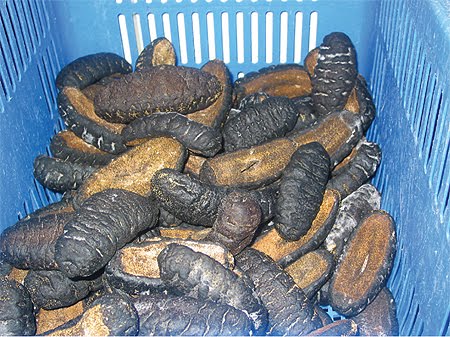
      Well, for one thing, other commercially fished FISH and many other species live there. But they serve to filter nutrients and chemical inputs to the marine environment among other reasons. which can be found at Sea grass Watch.org. But to boil it down: Seagrass beds are ecologically IMPORTANT.

      Removal of just this ONE species, H. scabra showed an impact on the system.

      Could the lowly sea cucumber could potentially be the ecological lynchpin to the ecological health of seagrass beds??