Showing posts with label benthic ctenophore. Show all posts

Monday, March 6, 2017

Highlights from the recent NOAA Okeanos Explorer Samoa Expedition!

So, here is a nice highlight of various wonderful invertebrates observed by NOAA's deep-sea research vessel, the Okeanos Explorer which for all of 2016 and 2017 will be studying the massive marine reserves of American territory in the tropical Pacific!

DON'T FORGET OKEANOS LIVE FEED RESUMES MARCH 7!


But obviously, not everyone can watch EVERY day during the entire dive. So I present some cool highlights (but invertebrates) from the last leg of the research dive.  

My thanks to Santiago Herrera and Matthew Jackson the biology & geology science leads for this last epxpedition!!

If you have missed it and are interested you can always go to Twitter and search for #Okeanos often with #Samoa or other similar terms.


Also a reminder based on recent news about significant budget cuts to NOAA Remember that NOAA operates the Okeanos Explorer program!!  The oceans represent a HUGE unknown quantity and yet, we have no exploration arm to explore the amazing deeps of the Earth. Deep-sea News has made a GREAT argument about why we need an "Ocean NASA"! And right now, the closest thing NOAA gives us the closest thing to that! 

So, if you enjoy these and other images as well as the livestream RESEARCH and DISCOVERY please contact your congressional representative and LET THEM KNOW: DO NOT DEFUND NOAA.

and now.. onto some cool beasts!!


PROTISTS! 
Most of what I'll present here are animals, but in the deep regions of the ocean, single-celled organisms that are basically HUGE amoebas can develop fairly LARGE structures out of sediment. I've written about them here. Some are called xenophyophores but it turns out that there's a fair diversity of them.

Here's at least one structure observed on Utu Seamount at about 3030 meters! 


SPONGES!! Some of the most commonly encountered animals on these Okeanos dives are sponges. Sponges are relatively simple animals that are basically big masses of cells but some of them use specific kinds of materials to create skeletons.  Some use calcium carbonate, some use a fiber called spongin..and one group which is seen commonly in the deep-sea: glass or silicon dioxide.


Here's a large one with a thick stalk and a large opening on the "head"
This is a cool one: this is a cladorhizid sponge. Many cladorhizid sponges are predatory and I think this one is as well..

those spines emerging off the edge makes it a deadly deep-sea umbrella!
Here's another one from a different angel from Rose Atoll, about 2525 meters! 

This is a glass sponge in the Euplectellidae, which is often identifiable by the unusual "cap" on the top of the sponge.. These are known for having 2 commensal male and female mated shrimps which do not escape from the internal cavity.. 
I missed the name/identification on this one..but I like to point out that those brown "roots" are actually GLASS. Glass sponges often seem to be growing "living" fiber optic cable and have been studied for their optical properties! 

WEIRD CNIDARIANS!!
Cnidarians are of course-those animals with stinging cells and radial symmetry. Jellyfish, sea anemones, hydras, hydroids and so on.They account for a huge diversity in deep-sea habitats! 

This "cosmic jellyfish" has been making the rounds. Its been identified as Benthocodon hyalinus by my colleague Allen Collins at NMFS. It was observed on Utu Seamount at about 3006 meters!! 


Its not unusual for us to see a giant hydroid on these dives.. This one identified tentatively as Corymopha
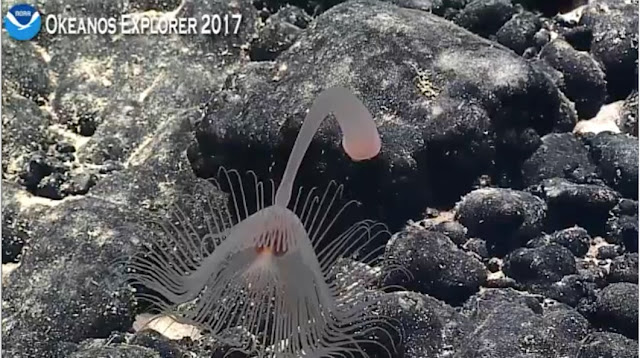

One of the most noteworthy of the cnidarians observed was this Dandelion or benthic siphonophore. Siphonophores are colonial animals which are mostly found swimming though the ocean in long chains which in some instances can be meters long!  Familiar species include the painful Portuguese Man o War. 

BUT the species in this group live attached to the bottom, apparently with a huge array of feeding tentacles extended.. there's a blog about these waiting to be written! hopefully soon...
Similar in lifestyle-check out this tiny bottom living (aka benthic) ctenophore (or comb jelly). I've discussed these at length before here. Again, most comb jellies swim-but then you get these oddballs that have an active bottom life using their long tentacles to capture prey.
A mushroom coral! Rose Atoll, 680 m


Probably the BIG, weird star of this leg was this BIZARRE blobby tree shaped thing! Turns out its a bizarre sea anemone in the family Aliciidae! Its tentacles had been withdrawn...
It turns out we saw one of these during the Marianas expedition LAST year!  Which makes the one above a likely DIFFERENT species from the other one we saw which had yellow buttons rather than white ones..

Dr. Dave Pawson at the National Museum of Natural History was apparently stung by one of these (only 6 inches long) and reported that each of these buttons are batteries of STINGING cells which can cause painful stings that last for several hours!! (click here) 

MOLLUSKS! 
Unsurprisingly, some of the most exciting observations on this last cruise were MOLLUSKS! We don't normally see a lot of snails or clams on these cruises..but we made up for it on this dive! 

Neopilina, MONOPLACOPHORAN! 
Few animals that I know of have what might be considered "holy grail" status. THIS is one of them..

In this case, the mysterious mollusk known as Neopilina! This mysterious mollusk has previously been collected from abyssal and ultrabyssal depths between 4000 and 6000 meters. From both the Atlantic and the Pacific. 

These are rarely collected and in the past were perceived as being VERY important to evolutionary or other ecological studies.  Basically these animals were regarded as ancient AND ancestral mollusks-the "Ur mollusk" if you will. They inspired a LOT of questions about what they were related to and how other mollusks were related to one another.. 

But I think this might be the FIRST time an in situ (in place and ALIVE) observation has been made! I admit that this tiny brown limpet thing does not have the same... presence as say some giant octopus  or squid, but once you know all the history behind it.. well, I say this with no irony-seeing it alive in its habitat was HISTORIC!!


Octopus!  So, of course we are always fond of cephalopods when they turn up! This white translucent octopus species was observed at least twice on the dive at relatively "shallow" depths between 380 and 400 m. This first shot was from Tau seamount.

Note that the webs of skin between the arms were translucent! 
This one was seen at Rose Atoll at about 393 m and it was investigating a series of little holes and caves.. presumably looking for food..


ECHINODERMS!! So, where MY group is concerned I'm always a little biased and have more imagery than of other groups (not as many corals for example). And because I work on starfishes-there's enough pics that I will get to those in another post!

but for now, here's some striking "spiny-skinned" friends that I saw...


This funny beast which I think was in the Deimatidae? Note that as with many deep-sea sea cucumbers, the body wall was translucent and we can see the sediment eaten by the animal THROUGH the body wall! 
The bizarre semi-swimming sea cucumber Psychropotes I blogged about this genus of sea cucumber and the number of species there might in the world oceans! 
This sea cucumber (Paelopatides?) in free swim glide! Moki Seamount about 2083 m WHEEEE!

This interesting fold over backwards behavior of a sea cucumber at Utu Seamount

A sea urchin the family Pedinidae I think? Lovely greenish coloration!
A reddish.. echinothuriid urchin? Aka a "pancake" or "tam o shanter" urchin. I've written about these before  here.  We saw a few different species of these kinds of urchins. But they are difficult to ID from pictures..

MIXED TAXON CRAB + COMBINATION!!
There were at least two interesting cases where we saw crustaceans "team up" with another animal that one does not normally associate.....

1. Decorator crab + cidaroid urchin! This was an odd one. The ROV was observing this cidaroid urchin..and as it changed angles.. it noticed this majiid type "decorator" crab hanging on with its rear legs. We've seen other crabs hanging onto fire urchins in tropical shallow-water habitats as protection-but not seen something like this. Unclear if it is incidental or something that happens regularly...

2. Zoanthid "anemone" PLUS hermit crab! A relationship that has been seen before but no less weird whenever we see it. Basically a sea anemone-like animal called a zoanthid rides and replaces the shell that this hermit crab would normally be wearing..

The crab benefits from the protection and the zoanthid gets driven around by the crab for dispersion, food, etc.. Interesting commensalism!

Here's a nice one seen back in 2015 by Diva Amon!

Sunday, June 26, 2016

Stunning Highlights from Okeanos 3rd leg of the Marianas Expedition!!


This last week has been a busy one-made even more momentous with all of the very AMAZING observations made by this last leg of the Okeanos Explorer as it explores various seamounts and other sites in the Marianas Islands! A whole bunch of information on the geological setting and the various study areas can be found on their website here. 
The entire mission overview can be found on NOAA Okeanos Explorer pages here and of course the LIVE VIDEO is on click away! (when they are broadcasting-usually from about 6pm to midnight Eastern time)

But what are some of the more SPECTACULAR animals they have been seeing?? Here's a highlight of the ones I consider just singularly amazing!

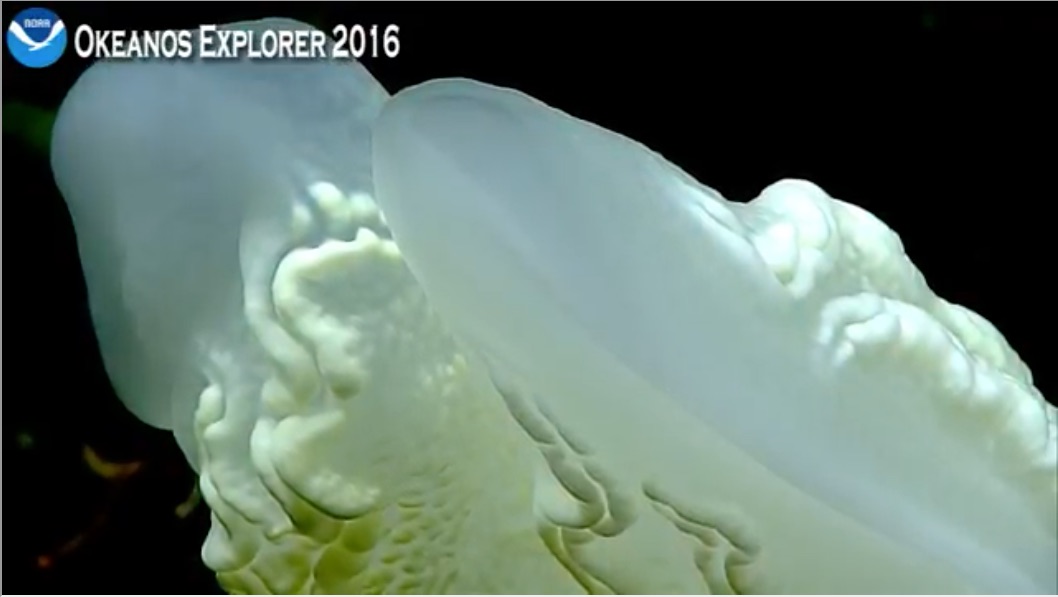
1. Big White Lyrocteis-like Benthic Ctenophore (aka comb jelly)
The last year or two has seen a HUGE awareness of these strange animals. Basically they are the bottom version of swimming comb jellies aka ctenophores. Although gelatinous, they are possibly VERY distinct from proper jellyfish.

We have seen a fair number of these on earlier Okeanos dives (as we see here) and I've written a post (here) about Lyrocteis aka the "Harp comb jelly" which occurs widely in the Pacific.

This newly discovered white animal has a very different surface texture and so far has NOT been observed to extend its feeding tentacles! It has the same "rabbit ears" or "harp" shaped body as Lyrocteis but is it even the same thing??   Interesting!


2. Stunning sea anemone in the family Aliciidae! 
This one was just stunning and weird all at the same time. It kind of looks like a strange gelatinous Christmas Tree! From Ahyi Seamount, 275 meters

Fortunately Dr. Chris Kelley of HURL had seen one of these before. The withdrawn version of a seldom seen sea anemone in the family Aliciidae.

Here's a picture from the HURL database showing it extended. You can see the knobs on the body. Beautiful..but wow. Unusual.


3. The Sea Anemone (from) Liponema! 
ANOTHER bizarre sea anemone. These go by the common name "pom pom anemones" or "tumbleweed" anemones... Why? Because they actually have a very loose connection to the bottoms and can actually ROLL along when they want to move!!

This pic from Pagan Volcano and Supply Reef from about 336 m
Here's a separate species called Liponema brevicornis doing JUST that thing! Rolling along the bottom like a big pink fuzzy snow ball!! 
Image borrowed from Actinaria.com http://actiniaria.com/liponema_brevicornis.php
4. Neat looking sea anemone called Isactinernus! About which it seems there is very little known.... But it has these very distinct tentacled lobes 

Here it is OPEN (seen on Pagan Volcano, 345 m)
and here it is CLOSED (this was seen on Supply Reef)

5. The Ever Majestic swimming sea cucumber Enypniastes! 
This splendid picture taken in the famous Mariana Trench from a dizzying 5, 775 meters!  DEEP!

6. SEA URCHINS GALORE!! 
Here's a stunning urchin with Christmas colors! Caenopedina probably C. pulchella based on what I've been able to find on it.. 


Handsome red cidaroid sea urchin from Moag Crater, 327 meters

An aspidodiadematid urchin, possibly Aspidodiadema from Eifuku Seamount, 420 m. Want to learn more about these urchins with crazy long spines that act as walking legs?? GO HERE.
 7. And some New Species of Snails...
This is what's called a slit shell snail or a member of the family Pleurotamariidae. Long story short: deep-sea snails but with similar shells observed in the fossil record. This gives them "Living Fossil" status and their beauty and color makes them valuable to shell collectors..

The one the Okeanos Explorer has been seeing? Probably a new species according to Chong Cheng at JAMSTEC (@squamiferum on Twitter).
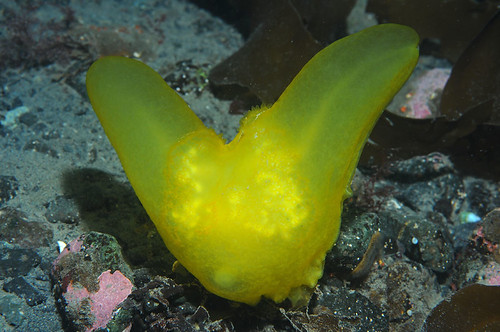
and this STUNNING nudibranch, probably the genus Kaloplocamus, according to Dr. Terry Gosliner at the California Academy of Sciences! 

Those yellow balls on the body extensions? Apparently those are luminescent organs! Not previously seen in this genus..making this a very likely NEW species (thanks to Dr. Gosliner for the determination!)

And anyway.. THERE's MORE to COME! 

Wednesday, January 13, 2016

LyrocteisThe Imperial Harp Shaped Comb Jelly!

Picture by Robert F. Bolland from the Okinawa Slug site
Happy 2016! And a fine one it has been so far! I'm on my annual holiday travel to San Francisco visiting friends, family and my colleagues at the California Academy of Sciences..

During this visit, Curator Bart Shepherd, a colleague of many years from our days at Steinhart Aquarium indulged me in showing off this recent collection from the Academy's scientific expedition to the Philippines: the benthic ctenophore Lyrocteis! Possibly Lyrocteis imperatoris..
These are inspiring animals. They're not only big (about four to 6 inches tall) but they are also WEIRD things that nobody (other than scientists) ever gets to see, but now? thanks to social media and some excellent aquarium science.... these mysterious animals may actually get some time in the sun!  This aquarium in Japan has actually be able to breed them

But WHAT ARE THEY??
I have described and mentioned benthic or "bottom" ctenophores (= comb jellies) before (and recently! see here).

Long story short: Most comb jellies are midwater (=pelagic) swimming gelatinous animals... but SOME of them are unusual in that they have adapted to living on the sea bottom.. Some live on sea stars, while others on coral. 

Today I thought I'd just focus on this one genus: Lyrocteis the only member of the family Lyrocteidae. Lyrocteis includes two species, one from the Antarctic and one from the tropical Pacific.
The name apparently refers to its resemblance to a Lyre. (think of the root word of "lyric" which means "of or for the lyre") Neat, eh?  and "cteis" which refers to the comb rows present in all "comb jellies"
1004182

There's not a lot known about them. They feed (see below) in a manner similar to the swimming species using long tentacles to capture food. When described in 1941 (here), they were labelled as "sessile" but the Antarctic species was described as being able to move 1 to 2 meters per day (here to see)

Here's an individual identified as the Antarctic species: Lyrocteis flavopallidus
                    Ctenóforo
2.... and the other one?
and there's a second species known from throughout the tropical Pacific called Lyrocteis imperatoris, described in 1941 by Professor Taku Komai at Kyoto Imperial University to honor Emperor Showa of Japan. The original specimen was apparently collected from Sagami Bay by the Biological Laboratory of the Imperial Palace. He described it as a "strange marine animal.."

This species is described mainly from the tropical Pacific. Possibly the Indian Ocean I suppose (based on the ones below) but none are known from the Atlantic.  Most of these live in relatively deep-water, at the lower edge of SCUBA depth to significant depths in the deep-sea (>500 m).

Its name in Japanese: 
kotokurage コトクラゲ

Here's the species we saw in the Hawaiian Islands during the Okeanos Explorer cruises in September. In theory.. there are only two species.. the Antarctic one and the tropical Pacific species.
So, this is possibly Lyrocteis imperatoris.. but exact details remain elusive.  A great MANY different color variations have been observed in observed specimens of Lyrocteis.. This makes biologists wonder if they are seeing multiple species??? Or perhaps one species with a lot of color variation??Dr. Komai, the scientist who described this species noted a great variation in color when originally collected.

Its possible (and even likely) that there is more diversity (i.e., more species) but the animals don't make it easy to study them.

Why? Because they aren't seen frequently and when they do, collecting is difficult. The individuals
aren't easy to sample and for whatever reasons, the body of these animals is extremely difficult to preserve..so intact specimens aren't generally available to study...

Here were some spectacular red ones from Okinawa..
Bart Shepherd & the California Academy of Sciences Expedition to the Philippines encountered THREE color forms... the speckled one above and two others: a purple/red one and a yellow one...

and here's a South African species in the Indian Ocean. Another color and puffier..

Feeding! 
One of the nice things about our modern age is that video and image observations have become easy and of high quality

If you have Facebook, here's a feeding video of the Lyrocteis collected by Steinhart Aquarium from the Philippines..

Here's one of the purple south African species observed via video with its feeding tentacles extended...


Here's a nice one of a Japanese species with tentacles extended... from SHINKAYABLOG which translates to "deepsea" blog  This is basically similar to the way that swimming comb jellies feed...
This also explains the kawaii (cartoon mascot) for Lyrocteis imperatoris!   Note the feeding tetnacles catching the fish!!
from @deepsealife https://twitter.com/deepsealife/status/605369053209755648

Amazingly, someone is SO fond of these that they have made tiny magnets out of them!
3. The Story About its original discovery!!?
Dr. Komai, in his 1941 description of this species recounts an interesting story about "when" this species was discovered. Because apparently, although he described it in 1941.. he was NOT the first one to have encountered it!!
What makes the story of the discovery of this remarkable ctenophore more interesting is the fact that another specimen of evidently this form had been obtained previously from the same Sagami Bay and recorded by a Japanese zoologist, but without any idea of its real nature....
...in August, 1896, we find a short note in Japanese by T. N. (obviously Tokichi Nishikawa, the inventor of the famous cultured pearl) entitled " A curious animal" with rather good illustrations, one of which is reproduced in Fig. 3. The accounts and figures clearly show that the 'curious animal' was no other than a specimen of the present platyctenid.
" Nobody who saw it at that time could tell what it was. The real nature of this form thus remained enigmatic only to be made clear forty-five years later."
..and don't worry, I haven't given up echinoderms! But travelling makes you appreciate opportunistic topics!!