
So, here is a nice highlight of various wonderful invertebrates observed by NOAA's deep-sea research vessel, the Okeanos Explorer which for all of 2016 and 2017 will be studying the massive marine reserves of American territory in the tropical Pacific!
DON'T FORGET OKEANOS LIVE FEED RESUMES MARCH 7!
That wraps up #Okeanos American Samoa expedition! Never fear, next expedition to explore Pacific MPAs starts March 7. We'll be back soon! pic.twitter.com/nTlBkF0NRG— NOAA Ocean Explorer (@oceanexplorer) March 1, 2017
From now until April, they have been in American Samoa! You can see an overview of their expedition here. But if you have been following along, then you've been enjoying about 2 weeks of deep-sea research streamed LIVE here: http://oceanexplorer.noaa.gov/okeanos/media/exstream/exstream.html

But obviously, not everyone can watch EVERY day during the entire dive. So I present some cool highlights (but invertebrates) from the last leg of the research dive.
My thanks to Santiago Herrera and Matthew Jackson the biology & geology science leads for this last epxpedition!!
If you have missed it and are interested you can always go to Twitter and search for #Okeanos often with #Samoa or other similar terms.
You can also go look at screengrabs on the Facebook group
Also a reminder based on recent news about significant budget cuts to NOAA Remember that NOAA operates the Okeanos Explorer program!! The oceans represent a HUGE unknown quantity and yet, we have no exploration arm to explore the amazing deeps of the Earth. Deep-sea News has made a GREAT argument about why we need an "Ocean NASA"! And right now, the closest thing NOAA gives us the closest thing to that!
So, if you enjoy these and other images as well as the livestream RESEARCH and DISCOVERY please contact your congressional representative and LET THEM KNOW: DO NOT DEFUND NOAA.
and now.. onto some cool beasts!!
Most of what I'll present here are animals, but in the deep regions of the ocean, single-celled organisms that are basically HUGE amoebas can develop fairly LARGE structures out of sediment. I've written about them here. Some are called xenophyophores but it turns out that there's a fair diversity of them.
Here's at least one structure observed on Utu Seamount at about 3030 meters!

SPONGES!! Some of the most commonly encountered animals on these Okeanos dives are sponges. Sponges are relatively simple animals that are basically big masses of cells but some of them use specific kinds of materials to create skeletons. Some use calcium carbonate, some use a fiber called spongin..and one group which is seen commonly in the deep-sea: glass or silicon dioxide.
I've written posts about glass sponges before, here and a prior Okeanos cruise discovered what is probably the largest glass sponge known here.
Here's a large one with a thick stalk and a large opening on the "head"

those spines emerging off the edge makes it a deadly deep-sea umbrella!

Here's another one from a different angel from Rose Atoll, about 2525 meters!

This is a glass sponge in the Euplectellidae, which is often identifiable by the unusual "cap" on the top of the sponge.. These are known for having 2 commensal male and female mated shrimps which do not escape from the internal cavity..

I missed the name/identification on this one..but I like to point out that those brown "roots" are actually GLASS. Glass sponges often seem to be growing "living" fiber optic cable and have been studied for their optical properties!

WEIRD CNIDARIANS!!
Cnidarians are of course-those animals with stinging cells and radial symmetry. Jellyfish, sea anemones, hydras, hydroids and so on.They account for a huge diversity in deep-sea habitats!
This "cosmic jellyfish" has been making the rounds. Its been identified as Benthocodon hyalinus by my colleague Allen Collins at NMFS. It was observed on Utu Seamount at about 3006 meters!!

Its not unusual for us to see a giant hydroid on these dives.. This one identified tentatively as Corymopha
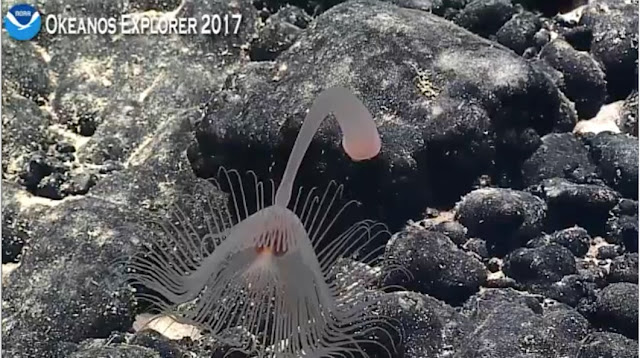
One of the most noteworthy of the cnidarians observed was this Dandelion or benthic siphonophore. Siphonophores are colonial animals which are mostly found swimming though the ocean in long chains which in some instances can be meters long! Familiar species include the painful Portuguese Man o War.
BUT the species in this group live attached to the bottom, apparently with a huge array of feeding tentacles extended.. there's a blog about these waiting to be written! hopefully soon...

Dandelion siphonophore, seen at 2500m depth in Rose Atoll. #Okeanos back at Rose Atoll today, but starting at 700m. ROV on bottom in ~3hrs! pic.twitter.com/CXB4wnl4SQ— NOAA Ocean Explorer (@oceanexplorer) February 25, 2017

Probably the BIG, weird star of this leg was this BIZARRE blobby tree shaped thing! Turns out its a bizarre sea anemone in the family Aliciidae! Its tentacles had been withdrawn...


Dr. Dave Pawson at the National Museum of Natural History was apparently stung by one of these (only 6 inches long) and reported that each of these buttons are batteries of STINGING cells which can cause painful stings that last for several hours!! (click here)

MOLLUSKS!
Unsurprisingly, some of the most exciting observations on this last cruise were MOLLUSKS! We don't normally see a lot of snails or clams on these cruises..but we made up for it on this dive!
Neopilina, MONOPLACOPHORAN!
Few animals that I know of have what might be considered "holy grail" status. THIS is one of them..
In this case, the mysterious mollusk known as Neopilina! This mysterious mollusk has previously been collected from abyssal and ultrabyssal depths between 4000 and 6000 meters. From both the Atlantic and the Pacific.
These are rarely collected and in the past were perceived as being VERY important to evolutionary or other ecological studies. Basically these animals were regarded as ancient AND ancestral mollusks-the "Ur mollusk" if you will. They inspired a LOT of questions about what they were related to and how other mollusks were related to one another..
But I think this might be the FIRST time an in situ (in place and ALIVE) observation has been made! I admit that this tiny brown limpet thing does not have the same... presence as say some giant octopus or squid, but once you know all the history behind it.. well, I say this with no irony-seeing it alive in its habitat was HISTORIC!!

ROV scoop flipped one of these critters over & iIndividual gills (arrows) mean MONOPLACOPHORAN!— Carina M. Gsottbauer (@CarinaDSLR) February 24, 2017
~3800m, Utu Seamount, Samoa #okeanos pic.twitter.com/xKALOOeCtR
Octopus! So, of course we are always fond of cephalopods when they turn up! This white translucent octopus species was observed at least twice on the dive at relatively "shallow" depths between 380 and 400 m. This first shot was from Tau seamount.
Note that the webs of skin between the arms were translucent!

This one was seen at Rose Atoll at about 393 m and it was investigating a series of little holes and caves.. presumably looking for food..

This little octopus didn't like the #Okeanos attention... pic.twitter.com/eGje9dHrAP— Alehkhs (@Alehkhs) February 18, 2017
but for now, here's some striking "spiny-skinned" friends that I saw...
This funny beast which I think was in the Deimatidae? Note that as with many deep-sea sea cucumbers, the body wall was translucent and we can see the sediment eaten by the animal THROUGH the body wall!


Rewatching today's #okeanos dive:— Carina M. Gsottbauer (@CarinaDSLR) February 24, 2017
A sea cucumber singing the song of its people ;)
~3900m, Utu seamount, Samoa pic.twitter.com/EiIkoxCgRD
A sea urchin the family Pedinidae I think? Lovely greenish coloration!

A reddish.. echinothuriid urchin? Aka a "pancake" or "tam o shanter" urchin. I've written about these before here. We saw a few different species of these kinds of urchins. But they are difficult to ID from pictures..


MIXED TAXON CRAB + COMBINATION!!

The crab benefits from the protection and the zoanthid gets driven around by the crab for dispersion, food, etc.. Interesting commensalism!

Here's a nice one seen back in 2015 by Diva Amon!
— Oceanwire (@Oceanwire) September 5, 2015


